Day 4

Saturday, October 19

Another leisurely morning feeling well-rested and ready for the day. Lucy took care of us this morning, with warm, fresh “pain au chocolat” (croissants with chocolate filling), and a pot of tea. Unlike yesterday, the weather is beautiful—clear, crisp, a refreshing 58 degrees. We ventured into downtown Holywood this morning for some shopping.

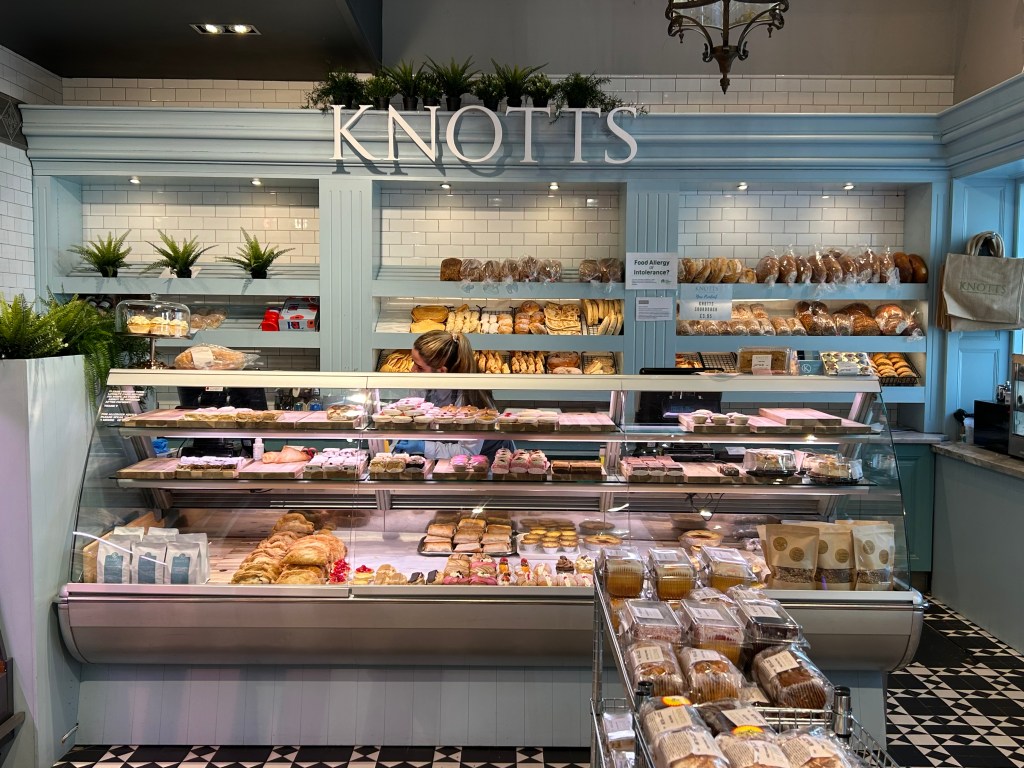
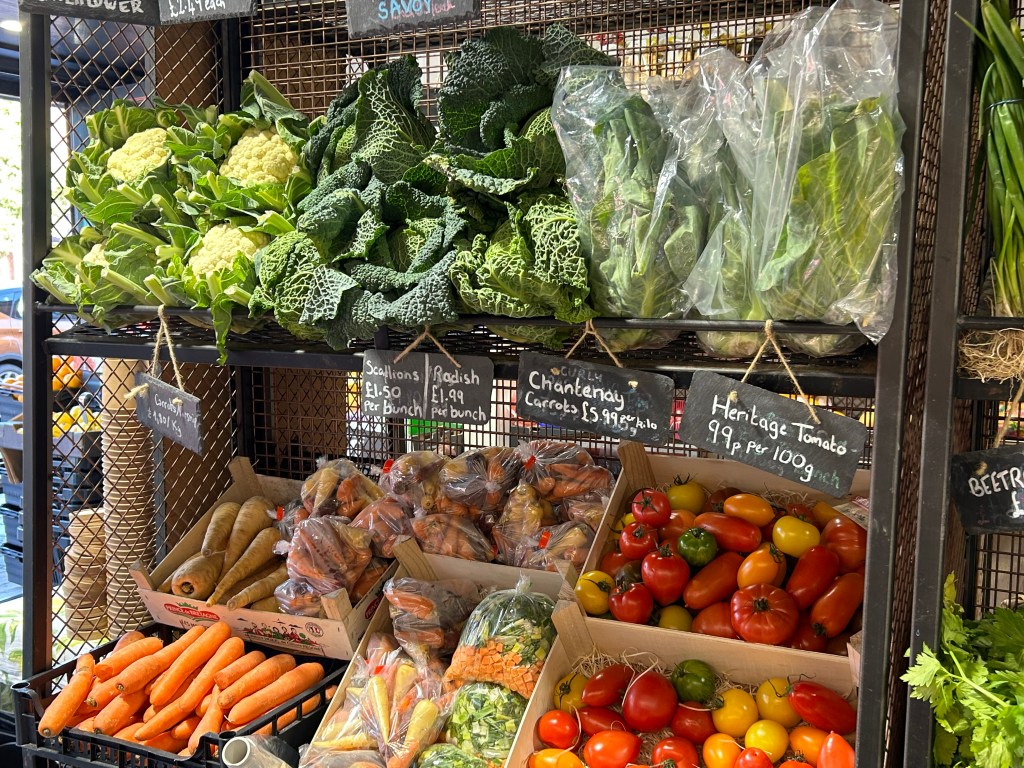
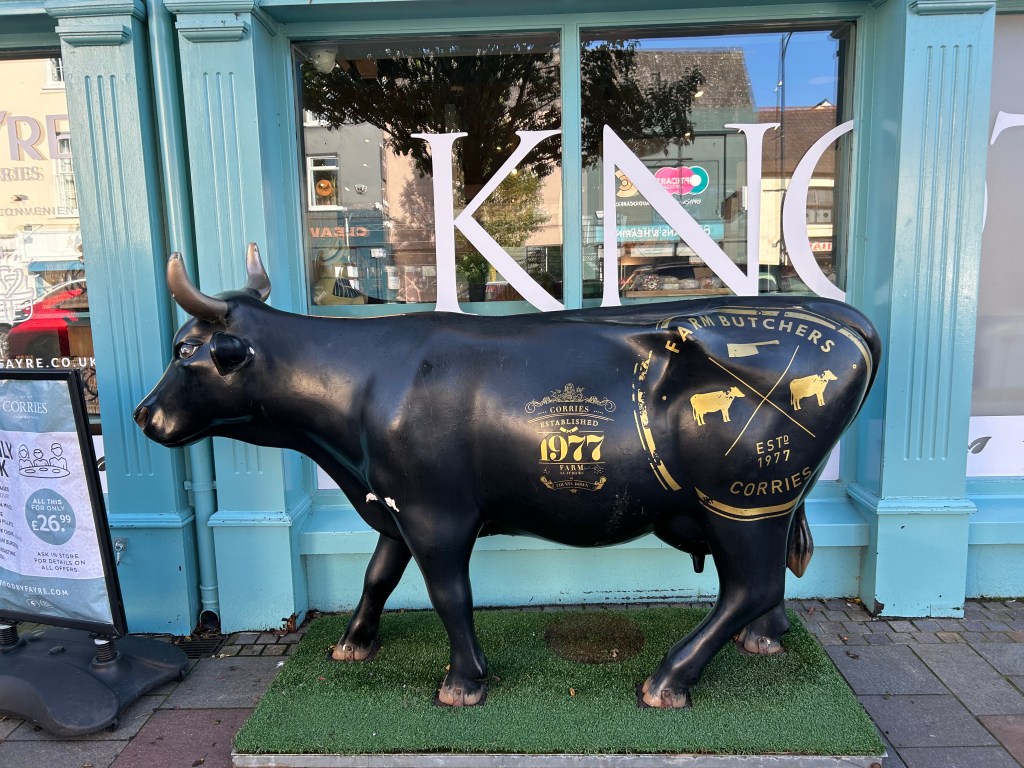
Holywood is a lovely town, really a small city, not too different in size from Auburn but with many more retail shops. The main shopping street slopes downhill to the “lough” (bay). There were green grocers, bakeries, butcher shops, a re-use shop, clothing boutiques, jewelers, and numerous “charity” (thrift) shops. It was interesting to see the food establishments right next to clothing and jewelry stores. Alison was greeted warmly at each establishment, often by name. Since each food shop was specialized, the goods were exquisite—fresh, homemade, natural. We got homemade granola, a loaf of fresh grain bread, croissants, meat, cheese, and more for our trip to Donegal.

Our lunch at home was a spread of fresh bread, ham, and 4 types of cheese just purchased at the cheese shop. Perfect for filling our tummies before our afternoon pub crawl.

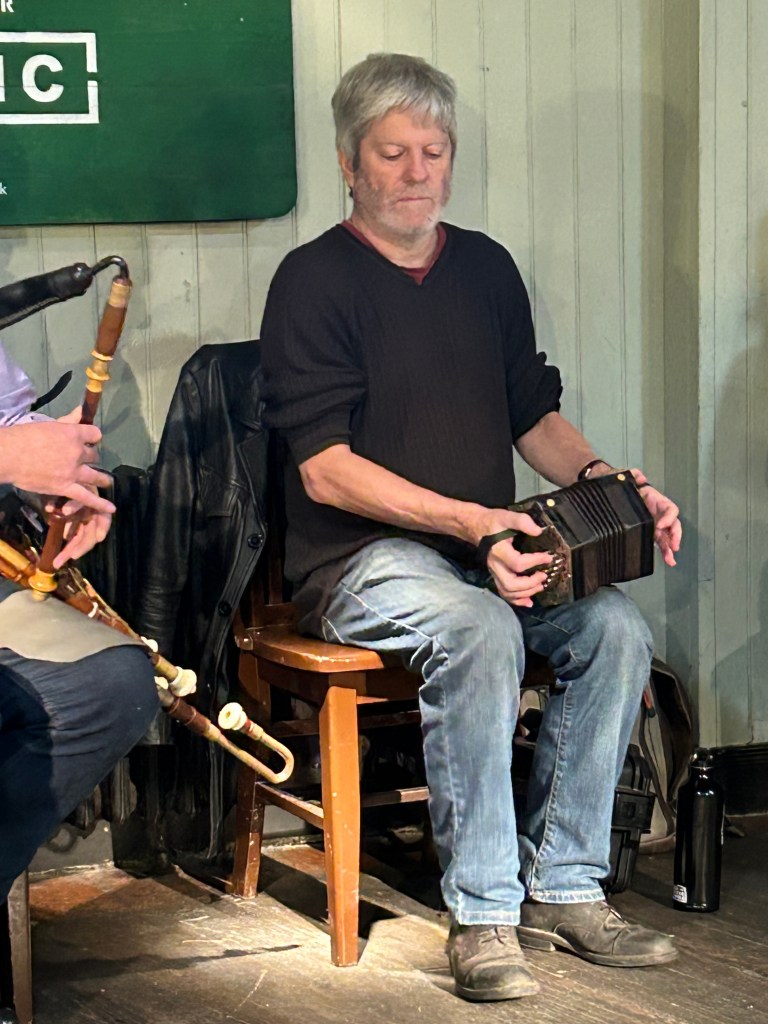
Alison, Santo, and I went to downtown Belfast for a special Irish music pub crawl hosted by two local musicians. We met at one pub, where we enjoyed, along with our Guinnesses, traditional music on the Uilleann pipes and concertina. Between sets, the musicians provided information about the instruments and told us how a typical Irish sessions works. They are not jam sessions, as you would think of for jazz performances. Rather, all Irish musicans have stored over a thousand tunes (jig, reels, and slip-jigs) in their heads! One musician leads the session, and the others follow his lead as to what tune will be played next, cuing each other with a nod of the head or subtle smile. The tunes are played in sets of 3 or 4. We learned about the different rhythms: 4-4 time, the 4 beats counted by the mnemonic “Black & Decker;” 6-8 time with the mnemonic “carrots ‘n cabbages;” and 9-8 time with the mnemonic “carrots ‘n cabbages radishes.” The audience was challenged to guess the rhythms after hearing a few tunes, but the play was so fast that it was surprisingly hard to do.

The Uilleann pipes are one of the most sophisticated instruments in the world, much more so than the more familiar Scottish bagpipes. The bag sits under the players left elbow, and he pumps it by lifting his arm then squeezing with his elbow. There are stops on a large pipe leading from the bag, where there is also a button for turning the drone on and off (something not possible on the Scottish bagpipes). In addition, the piper plays a flute-like instrument with his mouth and fingers, pumping another bag under his other arm. It is incredibly complex and as you listen it seems impossible that all the rich sounds produced are being played by one person.

The concertina was a beautiful instrument with black and silver hand plates and leather bellows with a gold design. It is octagonal in shape, and the musician played it rested on his knee, though he told us this was not the way it was supposed to be played and he was often scolded by other concertina players. The concertina played the melody in long, haunting notes, with accompanying chords humming underneath. This particular instrument was 125 years old and insured for 10,000 pounds.

After about one and a half hours, we did our “crawl” to the next venue, another downtown Belfast pub. Along the way, our guides stopped at several sites important to the musical history of Ireland. We walked through the first floor of the pub on our way to the lower room. The place was hopping, people of all ages, sitting or standing, beers or Guinnesses in hand. In the back room, an actual session was taking place. The downstairs room was reserved for us. Our guides took their seats at the front of the room, where they were joined by a girl in a black ballet top and short skirt over black stockings. Our dancer.

After explaining a bit about how the dancers and musicians worked together, take cues from one another, she demonstrated several dances, arms tight to her sides, feet moving faster than seemed possible, legs kicking fast and high. The she got four volunteers from the audience to join her and taught them a simple dance, which they then performed quite ably.

When our guides announced that we were near the end of the tour, I felt a tinge of disappointment. I relished every moment of their final set. On our way out, we stopped upstairs at the session which included about six musicians, all male, around a long table at the back of the pub. There were violins, Uilleann pipes, guitar, and flute. I loved watching the eye contact among the players and the movements of their fingers as they played, all one with the rapid rhythms of the music.

We arrived home sometime after 6 pm. Alison and Lucy quickly prepared a meal of roasted pork chops, mashed potatoes, and green beans. I don’t know how they do it all in their tiny kitchen. The room is so small, one narrow aisle down the middle, that it is hard to help. On top of that, there are stockpiles of food in preparation for our week-long trip to Donegal filling up the kitchen table. There just isn’t room for any more bodies and no free surface to work.

So once again we are served a magnificent meal, having done nothing to help prepare it. The pork chops are delicious—roasted then topped with applesauce and blue cheese and placed under the grill til the cheese melts. Three votive candles in the middle of the table create the familiar warm atmosphere of our home away from home. We enjoyed our meal, more stories, and laughter.

We ended the night in the living room, first watching a political satire program, Have I Got News for You, on BBC 1, which included some pointed barbs about Trump that really hit the mark, then a few episodes of Father Ted, a 1990s sitcom about 3 priests on a remote Irish island that is so silly and over-the-top that it is surprisingly hysterical.

Another full day of enjoying Ireland, enjoying our dear friends, who are getting dearer every day, and basking in the warmth that surrounds us.

Day 3

Friday, October 18

We started our day with “bacon buns”—bacon and grilled onion on a lovely bun. Slept late again—til 9:30. What is going on with us? The bed is quite comfortable, but still. Are we just totally relaxed? Definitely in vacation mode.

Our agenda for today is a busy one. Belfast Titanic Museum, dinner at the Golf Club across the street from Alison and Maurice’s, and a student musical concert in the local church in the evening.

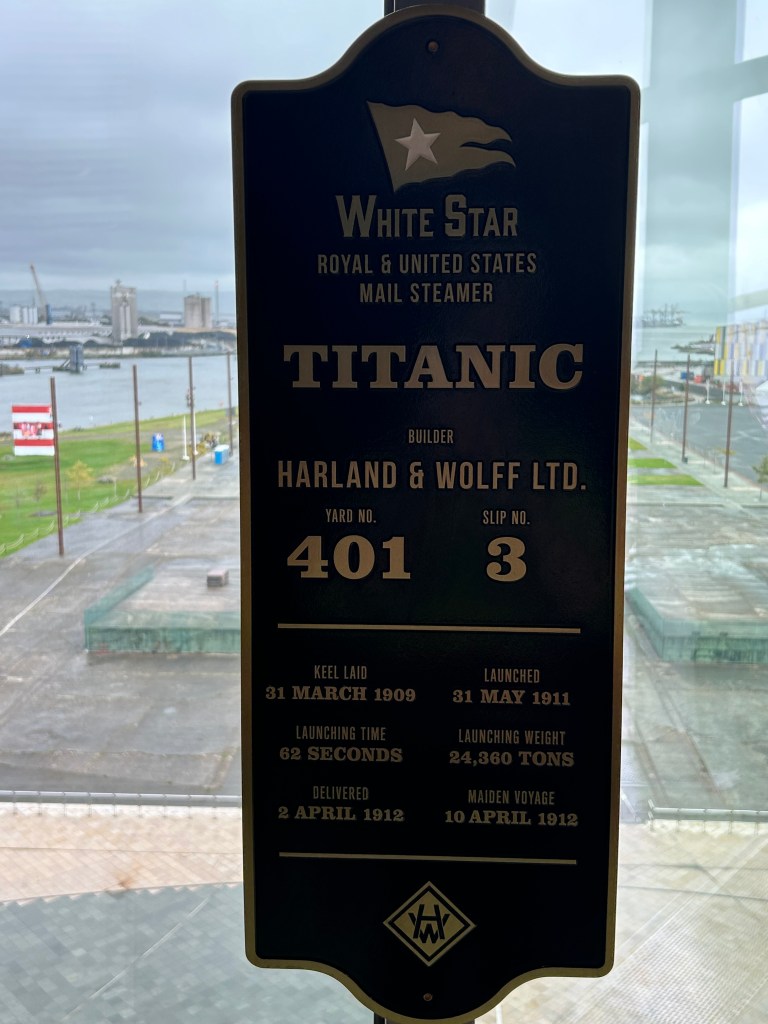
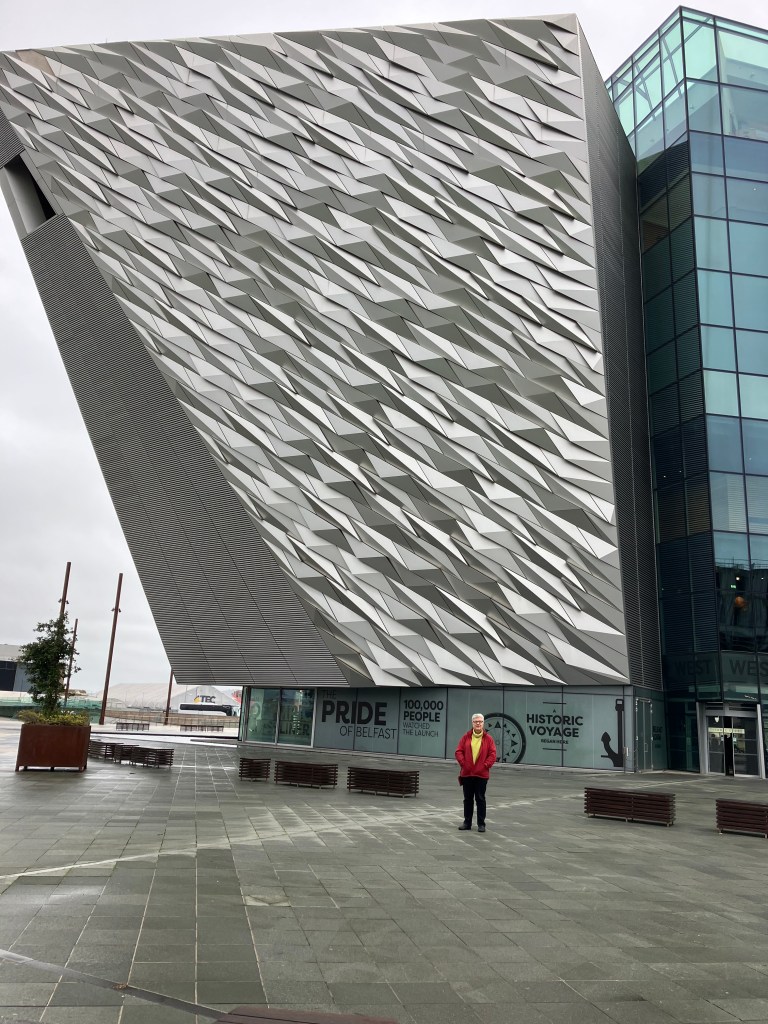
The building that houses the Titanic Museum is the start of the whole museum experience. It is modern, with jagged silver panels forming the shape of the bow of the ship to the exact scale of Titanic. We bought tickets for the Belfast Titanic Experience and headed up the escalator to start our tour.

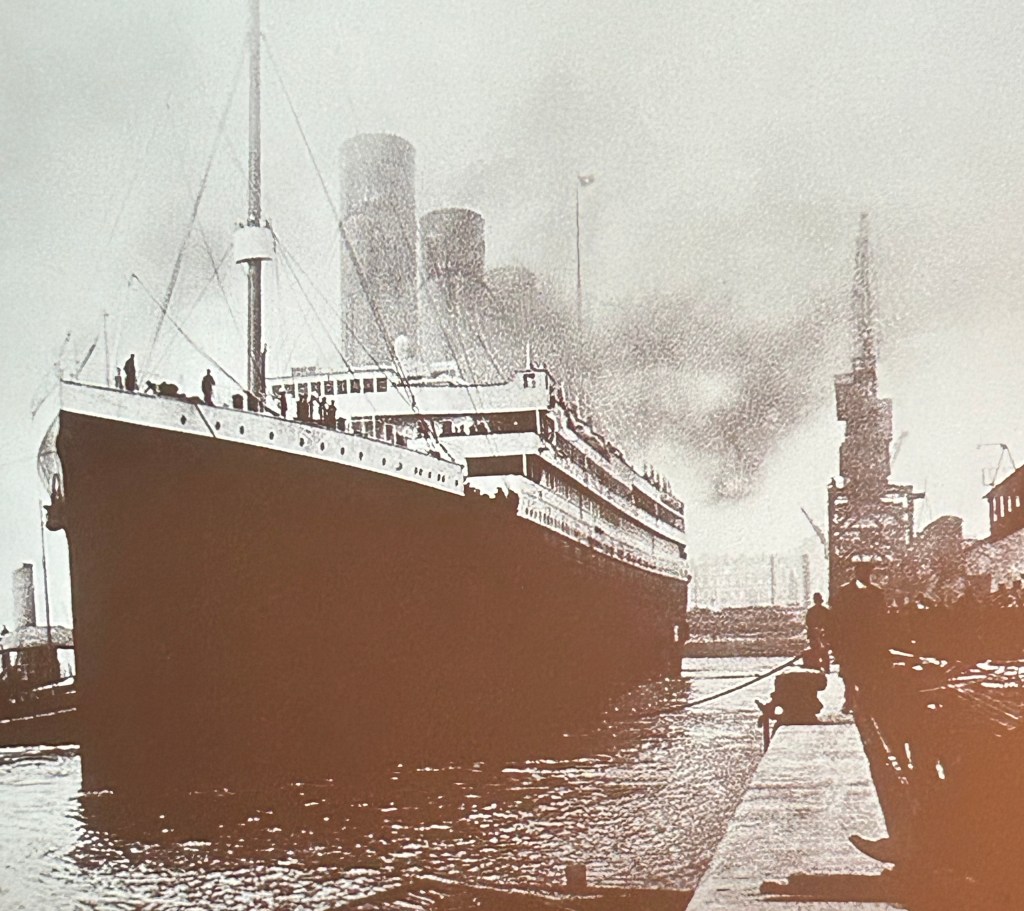
This museum is unique because you learn about Belfast at the time the ship was being built in the Belfast shipyard. It took 26 months to build and tens of thousands of workers. On top of that, other industries in the city provided materials for the construction, so that the project consumed much of the city’s labor force. Belfast was also one of the world’s top producers of linen, employing many of the women whose men were working in the shipyard. All the bedding on the Titanic was linen and because there was no laundry aboard ship, they had to bring all the linens that would be needed for the entire trip. There was also a water aerating company that created tonic water, ginger ale, and other “aerated” drinks.

The most fascinating part of the tour details the construction of this massive vessel. Over 3 million rivets were used in the construction and each required 5 men to hammer each one in–2 on one side and 3 on the other, often using one left-handed and one right-handed hammerer to more effectively pound the rivets through the thick steel.

At one point in the tour, we boarded a moving car, like a Disney World ride, which took us down through life-size displays of the interior of the ship during construction. The scale was massive, almost unimaginable, as much as the museum was trying to help us imagine it.

There were interactive exhibits showing how the engines worked, how the steam moved through pipes to turn the gigantic gears that would turn the propellers, how the keel was laid on a wooden form, and how the rudder was forged and installed to steer the ship. In order to turn the large vessel, the rudder needed to be an equally gargantuan size.

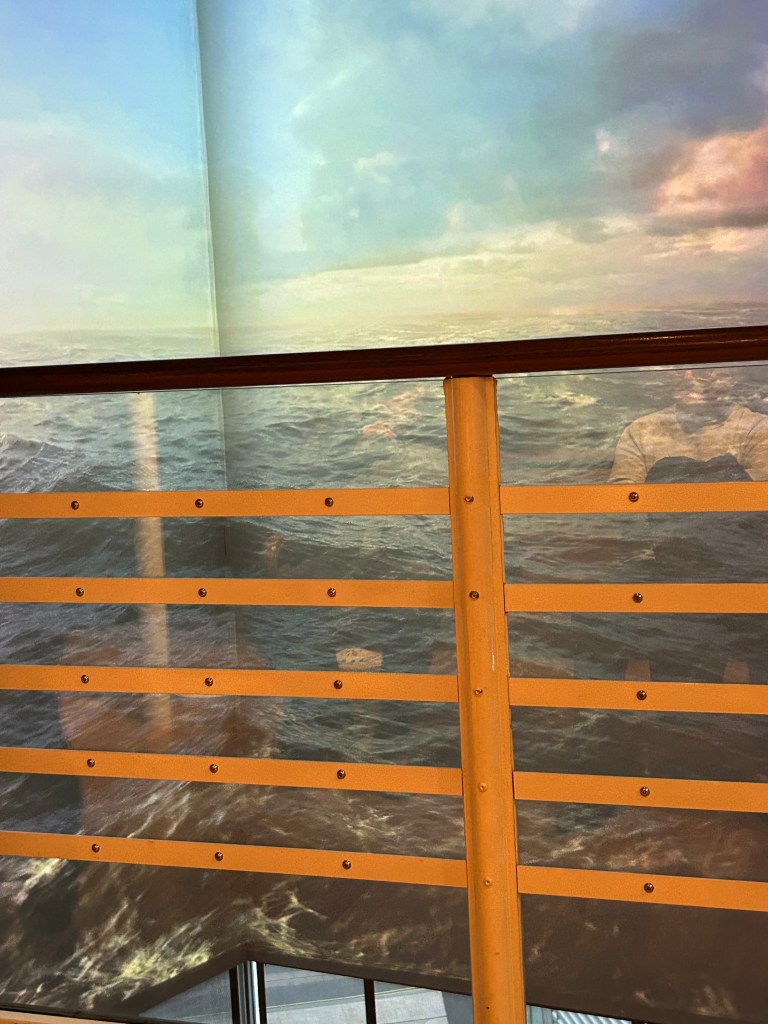
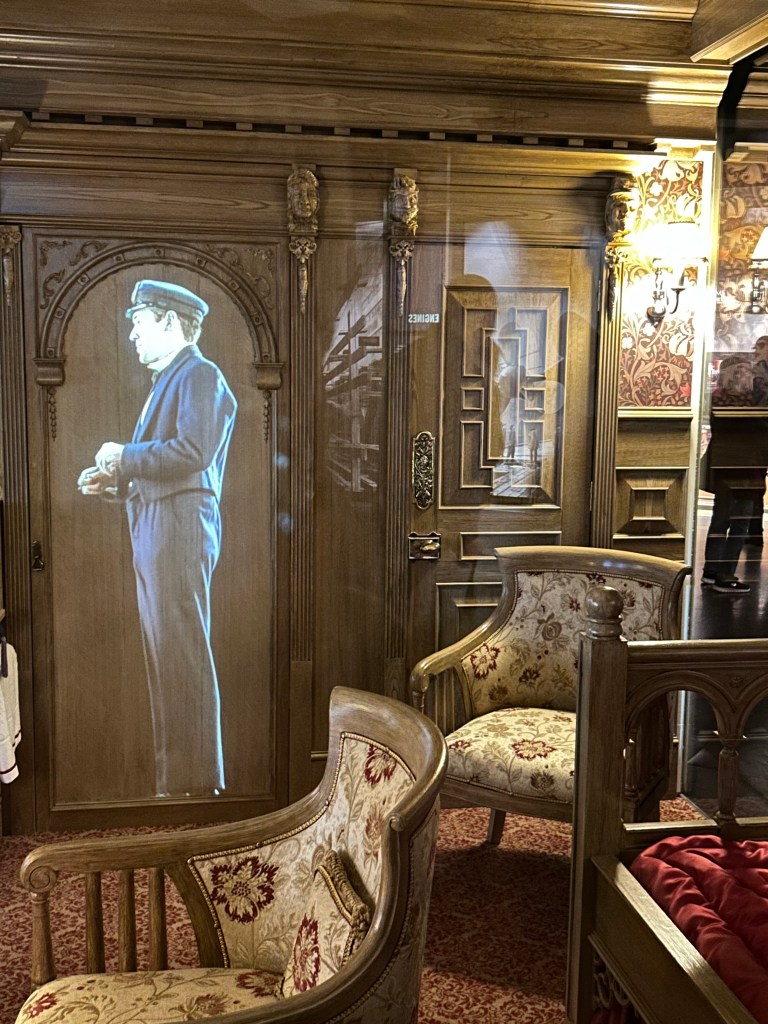
In one area there were projections on two angled screens of rolling ocean waters. You could stand at the rail and imagine you were on the moving ship. Another recreated the launch of the ship in May of 1911, witnessed by 100,000 people in a city of little over 300,000. Once launched, it would take nearly a year to outfit the interior of the ship. Some of the wooden cabinets and chairs were made by Harland & Wolff, the shipbuilders who manufactured the rest of the vessel. The furniture was made to match the style of the wood paneling. Even the pianos were encased in matching wood.

One of my favorite parts was the platform where you stood surrounded by display screens that created the illusion that you were inside the ship and moving through it. This included a walk up the grand staircase and a view from the crow’s nest where two crewman were stationed the day of the crash. Because there were no binoculars, the sighting of the iceberg was too late to save the ship.

The sinking was a perfect storm of factors that came together to propel the Titanic to disaster. A display showed how these factors resulted in a number of new safety standards for ocean-going vessels. The factors and the resulting changes were:

FACTOR: Failure to see iceberg early enough (and excessive speed)
RESULT: Formation of the International Ice Patrol, an agency of the United States Coast Guard that monitors and reports on the location of North Atlantic Ocean icebergs.

FACTOR: No binoculars in crow’s nest. The binoculars were usually stashed in a locker in the crow’s nest but the key to the locker wasn’t on board because a sailor who was reassigned to another ship forgot to leave the key behind when he left.
RESULT: Ships required to have binoculars for each lookout in the crow’s nest at start of voyage.

FACTOR: Radio operator on nearest ship to Titanic was not on duty.
RESULT: Radio communications on passenger ships must be operated 24 hours along with a secondary power supply so as not to miss distress calls.

FACTOR: Not enough lifeboats.
RESULT: All ships must have enough lifeboats for all passengers and crew. Lifeboat drills must take place before ships depart and once during voyage

FACTOR: Height of the bulkheads. Those on Titanic were above the water line but not high enough to prevent water from spilling from one to another.
RESULT: Bulkheads must be high enough to make the compartments fully watertight.

Displays at the end of the tour focused on survivors and lives lost. There are artifacts from the ship along with stories of their owners. On a giant black wall along the stairs leading to the exit are all the names of those who perished on Titanic.

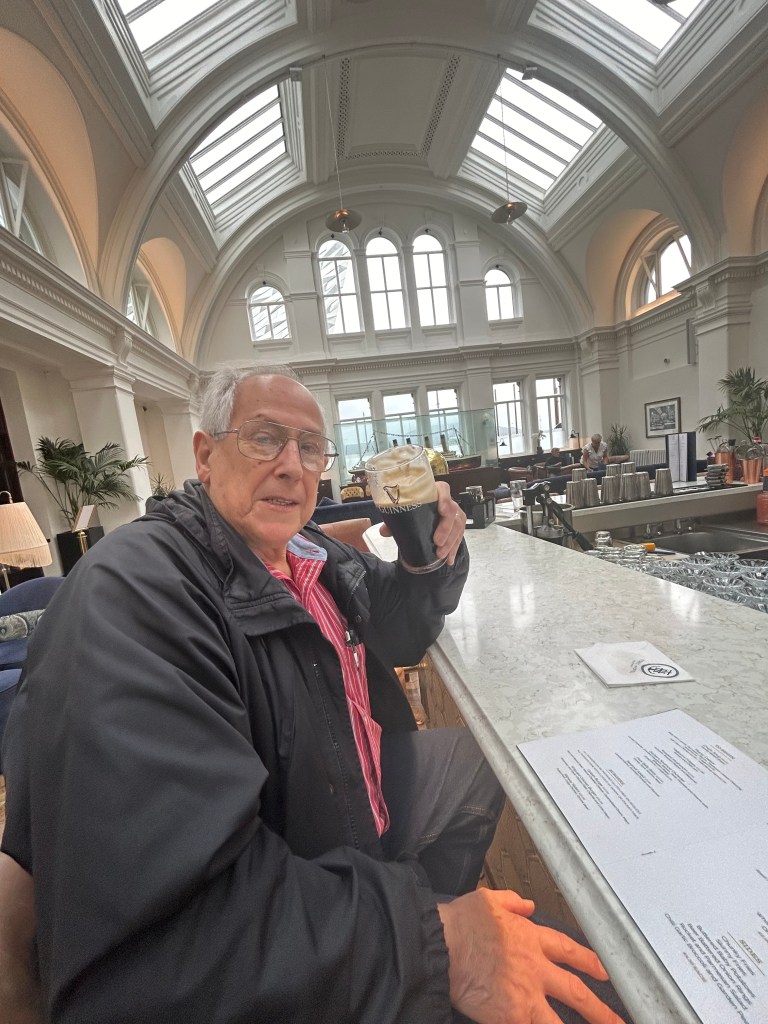
Exhausted emotionally from the tour, Santo and I wandered into the gift shop. There were keychains with rubber Titanics and other tchotchkes with representations of the ship. It just felt wrong. We looked at each other and silently departed the gift shop. We grabbed a quick but delicious bite at the museum café, then headed across the street to the Titanic Hotel housed in the former offices of Harland & Wolff. The hotel is large and elegant. The bar where we had a drink while waiting for Alison to pick us up was the room where the drawings for Titanic, and other ships made by the company, were created. The room had a vaulted ceiling almost completely made of glass that provided natural light for the draftsmen.

We had time for a short rest at home before we dressed for our dinner at the Golf Club. It was raining when we arrived, but over the course of the meal the mist lifted to reveal the lights of Belfast City and the mountain behind. We all enjoyed delicious meals (sea bass with asparagus and leeks for me followed by a white chocolate cheesecake with raspberries).

After dinner we drove to the local Anglican Church for the Holywood Music Festival—performances by local students of classical and traditional music on piano, violin, flute, cello and voice. The final pianist was absolutely remarkable, rivaling the Ukrainian pianist who was featured at Chautauqua this past summer. I was moved to see these young people, some as young as twelve, so devoted to their craft and so accomplished on their chosen instruments.

When we finally got to bed, we had much to savor from this very full day. We are feeling mightily blessed.

Day 1

TuesdayWednesday, October 15-16

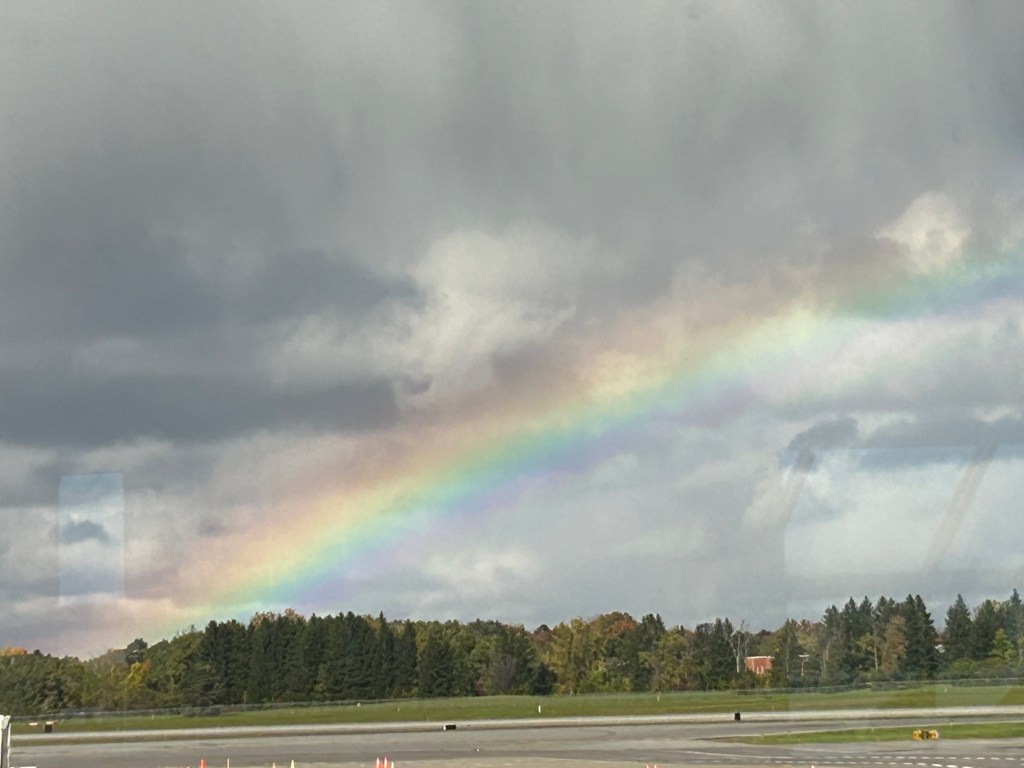
We had an auspicious start to our trip as this vibrant rainbow greeted us as we awaited our first flight at Syracuse’s Hancock Airport. When I shared the photo with Alison in Belfast, Northern Ireland, the friend we were headed off to see, she told me they were waiting at the other end of the rainbow. Santo said to tell her he’d be looking for the pot of gold, which brought to my mind the old ditty “Make new friends, but keep the old, one is silver and the other gold.”

Alison and I met almost exactly 46 years ago, in the fall of 1978, the beginning of my junior year abroad at Trinity College in Dublin. We lived on the same hall in Trinity Hall, a dormitory several miles and a 15-minute bus ride south of the college. The hall had a common kitchen were all us girls hung out, cooked, chatted, laughed, and got to know one another. Alison’s roommate and friend from home was Josie, a Catholic from Belfast. Alison was Protestant and the two met at a camp for youth from both sides of “the Troubles” could come together. They became fast friends. Both were sent south to the Irish Republic to study to keep them away from the Troubles and safe for their college years. Alison returned to Belfast after graduation.

Alison and I have seen each other 4 times in the past 46 years. Every time we meet it is as if no time has passed since those heady days in our cozy kitchen in Trinity Hall.

Alison married her husband Maurice (pronounced here as Morris) in 1992. I married Santo in 1993. Both our husband are somewhat older than us. Both are teachers. Both love grocery shopping and gardening. We both have two children, a boy and a girl, hers just a few years younger than mine.

As we waited, I observed some families with young children and recalled our travels with Viktor and Natalia were young. Natalia had an awful fear of flying, among her other anxieties. She needed to sit right next to me, by which I mean joined tightly from hip to knee. In preparation for take-off, she insisted that I grasp both of her hands in both of mine as she leaned into me, trembling with fear and emitting periodic small, soft screams. It was as if she were trying to create an umbilical cord between us so I could absorb her fear.

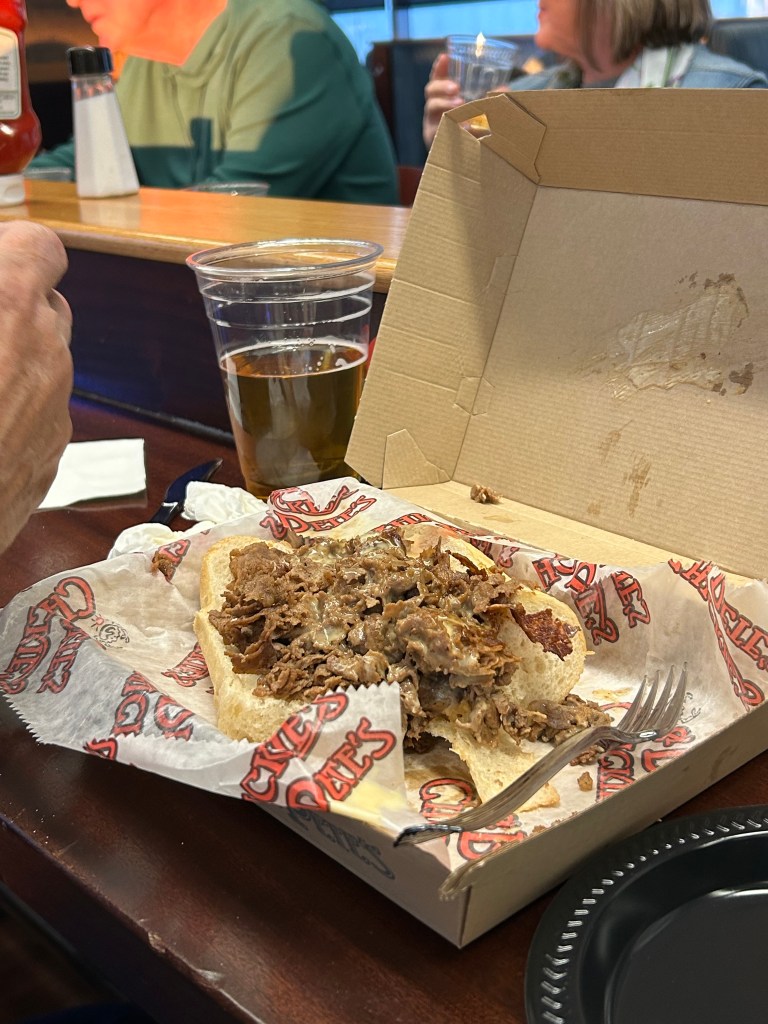
Our first puddle jump was to Philadelphia where we had a 3-hour layover, time enough to enjoy a truly fantastic Philly cheese-steak at a sit-down restaurant at the airport. We sat on high stools at a two-sided bar and got to know some fellow travelers, the couple across from us who were headed to Brussels via Amsterdam, and the woman next to us who was headed to Barcelona for an annual trip to meet up with a group of twenty friends for a week at a “party house” in a rural area about an hour from Barcelona.

On the long flight to London, I watched a film called Ballywalter, set in a small community just outside Belfast. It was wonderful to hear the familiar Northern Irish accent, so uniquely different from a Southern accent. I looked forward to spending two weeks hearing more!

London’s Heathrow was massive, well-organized and exhausting. London’s famous fog was so dense when we landed that even the jet-way from the plane to the terminal was filled with a light, hazy fog. The air was close and warm, not the refreshment we needed after 6 hours on a plane. We walked over a mile just to get to the shuttle that would take us to the British airways terminal for the puddle jump to Belfast. The shuttle was warm and sticky for the ten-minute ride. In Terminal 5, we walked another mile to the gate area where we passed through an automated checkpoint. We placed our passports on a scanner, then faced a camera which scanned us for facial recognition. Once a match was made, the gate opened for us to pass through. After that there was the usual security check, again scanning our passports then loading our hand luggage on a belt and passing through metal detectors. The air was still close and warm as we hiked to our gate area. We did not know our exact gate, so stopped at an electronic board which noted that our gate would be posted at 8:25. It was 8:29. Hmmm. We continued a bit further to the next board. Now it just said that our gate would be in area A. We knew that. We needed a number. Our flight was to depart at 9:15. It was now 8:45 and we still did not know our gate number. Hot, tired, frustrated, we stood staring up at the screen, nervous that we could possibly miss our flight. Finally the number appeared and luckily the gate was just behind us.

The plane brought welcome relief as the air conditioner was on full blast and blowing white mist from vents all along the length of the plane. Ahhhhh. It was now 9 am. We had left our house exactly 16 hours ago and woken up four hours before that. Neither of us slept much on the plane but felt OK when we landed in London. The ordeal at Heathrow brought home how truly tired we both were. It was so nice to know we would be met at the airport by Alison and Maurice!

Belfast airport was small, and after we grabbed our suitcases, we were able to just walk out. No customs, no security check. We had not been checked in London because it was not our final destination. And in Belfast we had only flown from London so were treated as domestic travelers. Already natives on Day One!

Alison and Maurice were waiting just outside the wide swinging doors, quite the welcome sight. We had found our pot of gold!

Day 2

Thursday, October 17

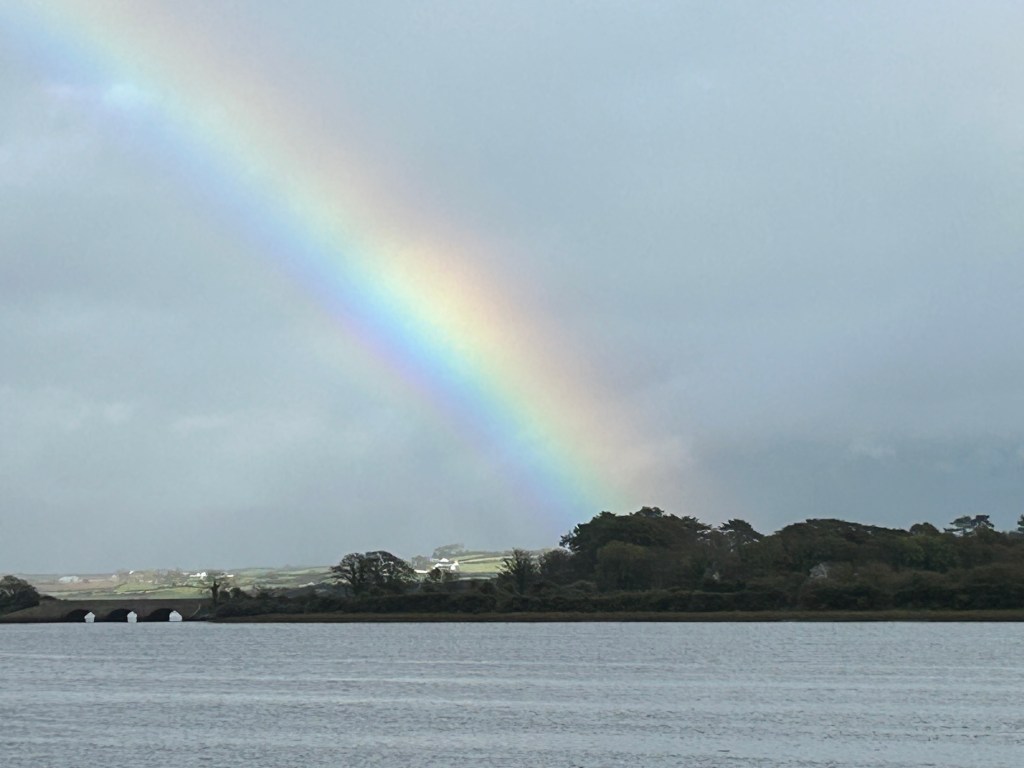
We slept in until 10:30 am, unheard of even for us! After croissants and coffee we headed out for a drive to the Mourne Mountains. The skies were quite changeable, sun and clouds swirling around us the whole day. It was just beautiful. It wasn’t long before we spotted our first rainbow. “There it is,” we cried. “The end of the rainbow that had started at the Syracuse airport.”

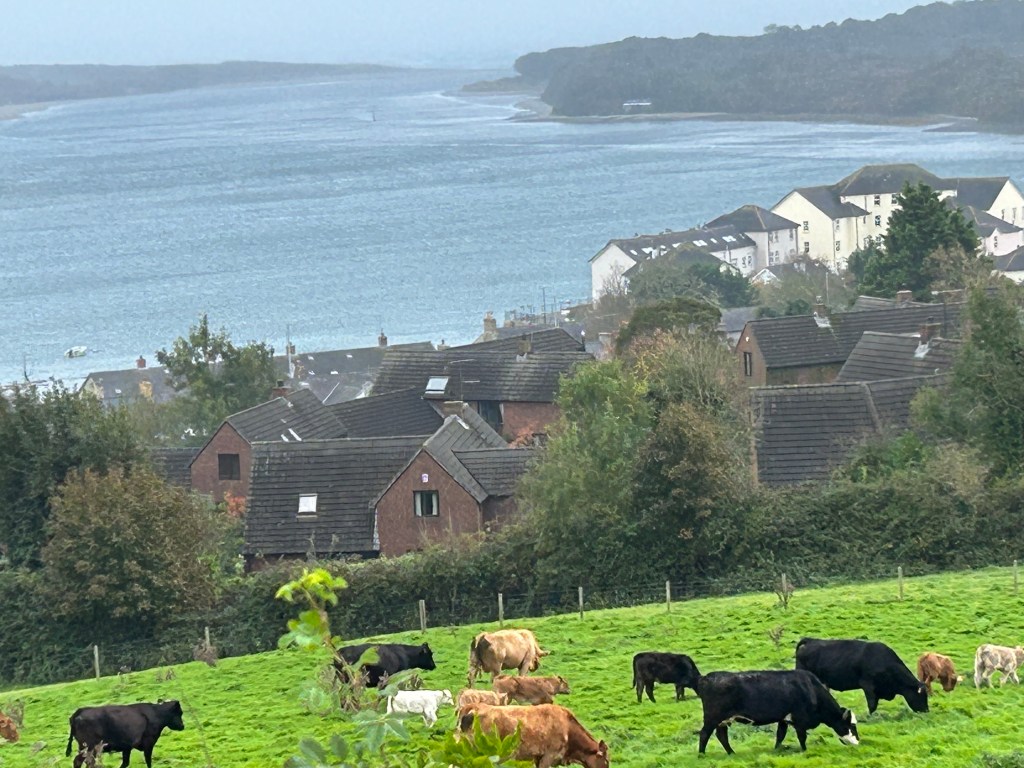
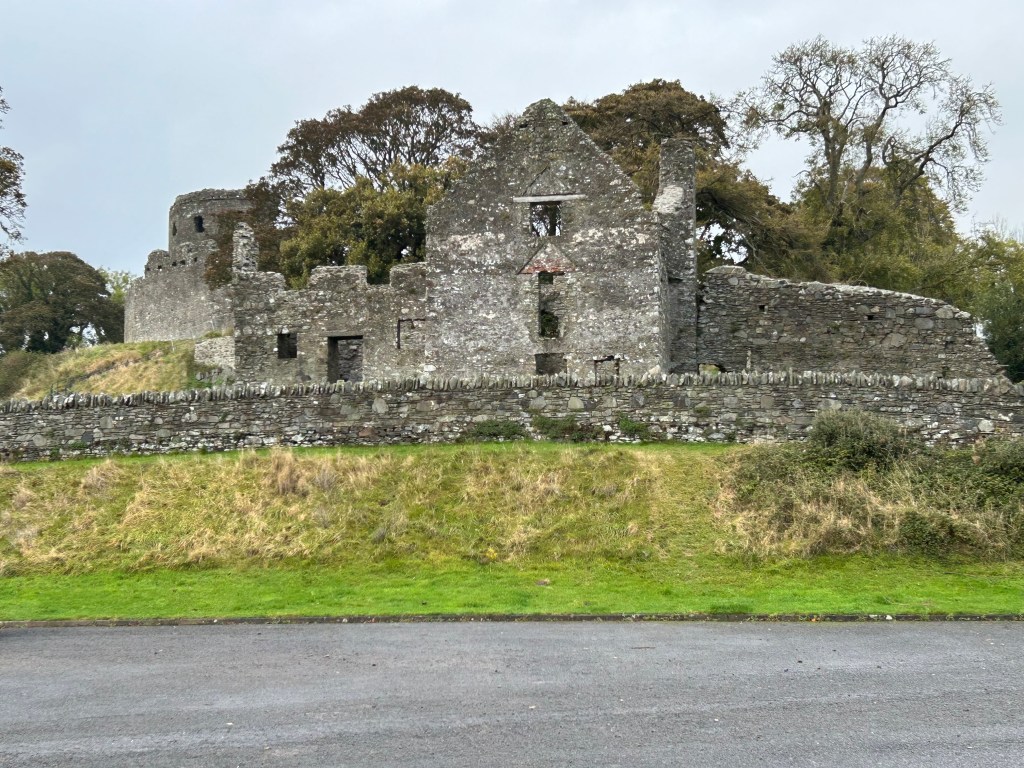
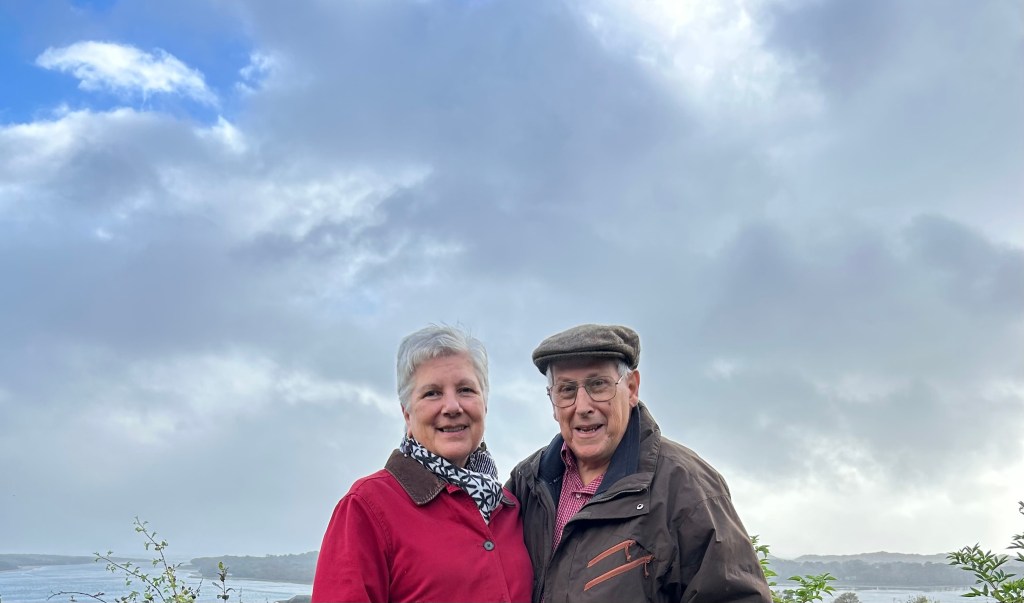
Our first stop was Dundrum Castle, the ruins of a 13th century residence high on a hill overlooking farmland stretching to the bay. In a small hut at the end of the parking lot, the history of the castle was laid out in clever and informative cartoons along three walls, representing scenes and legends from eight centuries. As we took in the view one more time, the sun broke through, illuminating the hay fields to a shade of nearly-white.

Driving closer and closer to the Mournes, the fog and mist that had been covering them lifted, revealing the black mountains behind. They are a range of rounded shapes, resembling the backs of prehistoric beasts. As the skies changed, so did the color of the mountains, becoming mottled in shades of black, brown, and gray. Along the road and crisscrossing the fields were miles of Mourne stone walls. Unlike any stone walls I had seen before, they were constructed from large rounded boulders, tightly packed and, remarkably, level on top. Because of the shape of the stones, holes were inevitable and these allowed the green and gold of the fields beyond to show through.

Our next stop was for a picnic lunch at a park at the base of the mountains. Alison had packed rolls, turkey, mustard and mayo, along with cheddar and relish chips and a cold Pellegrino, and laid everything out on a wee table in the trunk of the van. While Susie sniffed around the field, we ate our sandwiches, talked, and watched the clouds and mist dance around the mountains.

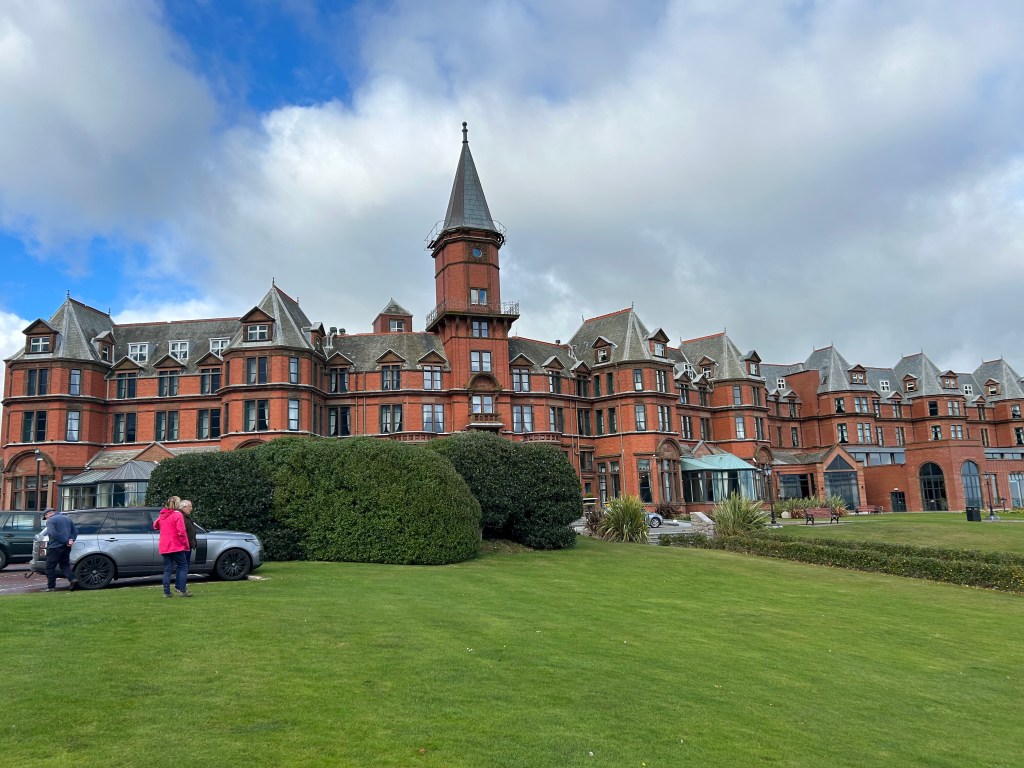
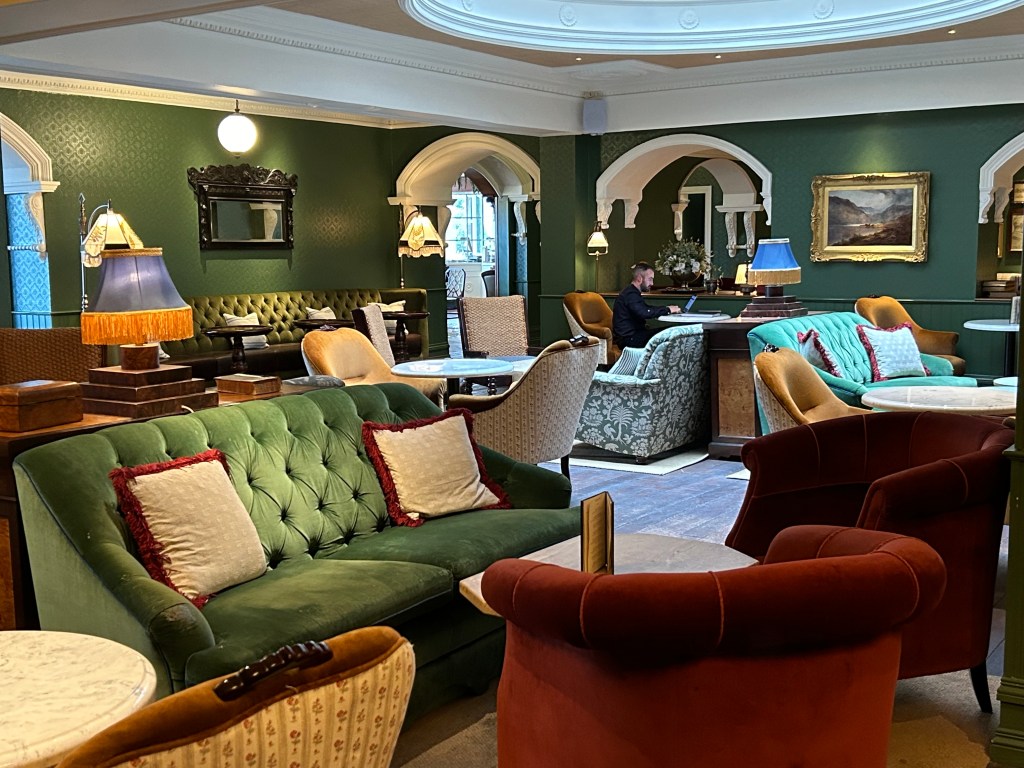
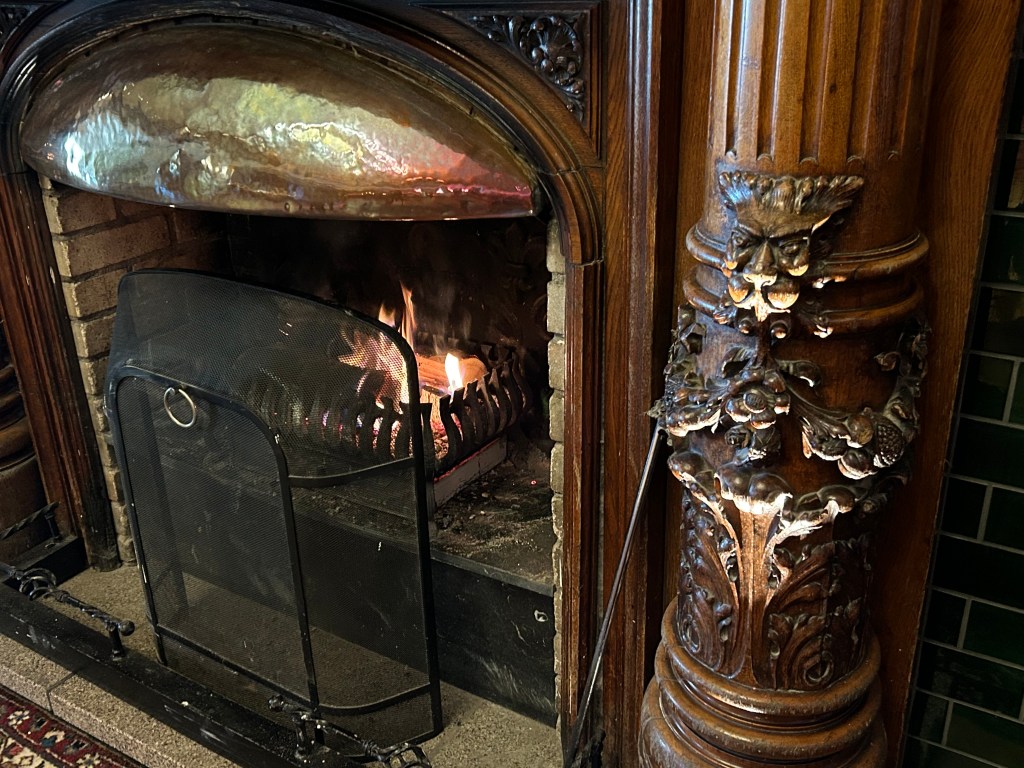
Then it was on to Slieve Donard in Newcastle, a magnificent hotel perched above a long sandy beach, its waves rolling in low and strong. We entered the long brick structure through the main doors and stopped in the rustically elegant lobby, admiring the carved wooden fireplace which roared with a log fire. Almost immediately, a hotel worker in a tweed vest and tie offered to take our picture in front of the fireplace. Then he encouraged us to browse around the hotel at our leisure, even though (maybe because) we were not guests. He even showed us a wall with pictures, menus, and other items from the hotel’s past. We wandered into the dining room, snooker room, card room, and one cozy sitting area arranged below a small domed ceiling.

At one point, I asked the young man how long he had worked there and he said “About a year.”

“Do you like it?” I asked.

“It’s alright,” he said with a smile. “It was supposed to be just a few months, but that was back in January and here I still am.”

“Things happen, right?” I said, and we shared a wee laugh.  

On our way out, he offered each of us a pen with the hotel’s name on it. Our first souvenir.

Arriving back home around 6 pm, Alison and Lucy prepared our dinner of pies (steak or chicken and ham) they had picked up fresh from the local butcher that morning. Along with the pies were chips (French fries) and a bag of frozen peas and corn. There was both vinegar and ketchup for the chips. The pies were hot and delicious. And even though they are not something we usually get a home, they still felt like comfort food. Perhaps it is the air of warmth and hospitality that we breathe in this house that makes everything taste like comfort food.

Once again we lingered at the table, no one in a rush to clear dishes or wash up. More stories were shared, more laughs were had. So relaxing. We are home — over three thousand miles from Auburn.

Reviews are in!

Look what readers are saying about The House of Many Doors.

“A binge read of a memoir! Brillati casts a spell for the reader … The writing and book appealed to my love of falling in love with “characters” and especially those who are awash in history and days gone by.”

“[A] wonderful family story. It was hard to put it down!”

“Loved her way with words. Felt like a nostalgic trip in time.”

“A memoir worth reading. Brillati … is a gifted writer. [The book] invoked memories of my own upbringing and made me yearn for more insight into my past. I felt invested in Brillati’s story and only wished her family consisted of more members to whom I could have been introduced.”

The House of Many Doors: A Memoir of Family

I am pleased to announce that I have published my first book, a memoir about my German and Italian immigrant families and their lives (and mine) in a coal mining region of Northeastern Pennsylvania.

The book was in the works for four years and was published on December 15, 2023. It is available on Amazon in paperback ($20) and Kindle ($9.99) versions.

CLICK HERE TO ORDER

I hope you will check it out!

If you have a book group, or other group you are involved with, that would be interested in the book, I would be happy to do in-person readings and Q&As as long as the location is not too far from Auburn, NY. Use the Contact section to send me a message.

Christmas 2020

I spent the last year
Writing about people who no longer walk this earth:
Living with them, loving them,
Learning from them, laughing with them.

I came to know them in new ways,
My heart and mind open to what is revealed
When we dwell in the spirit of our loved ones.
I found memories buried so deep in my heart
That I had the pleasure of living them again.
And even though some memories inflicted the pain of a fresh wound,
All brought me closer to those I have loved
And love still.

This Christmas, many of us will be separated from those we love most.

After a year spent with so many long-lost loved ones,
Here is what I have come to believe.

I believe, no matter how many miles or years separate us,
We will celebrate with our loved ones.
We will summon memories
That have often been lost in our frantic gatherings of the past.
We will have the time to think about
How much those we are missing mean to us,
And cherish them even more.

I believe that every moment we are apart
Is a gift we give to our loved ones.
The greatest gift of all.
The gift that arrived in a manger,
In a stable far away, in a time long past.
Jesus our Emmanuel–God with us.
The Savior who would sacrifice his very life
So that we might have life and have it abundantly.

Trusting in him, we are united one to another in love
Across all space and time.
We cannot be separated from those we love,
Just as we cannot be separated from the love of God.

“Neither death, nor life, nor angels, nor rulers, nor things present, nor things to come, nor powers, nor height, nor depth, nor anything else in all creation, will be able to separate us from the love of God in Christ Jesus our Lord.” (Romans 8:38-39)

Debra Rose Brillati
December 2020

The Soul of Our Nation

My head and heart are imploding
Crumbling in upon themselves
Crashing with a heavy thud
In the pit of my stomach
Filling me with a hot dust
That burns behind my eyes.

This wreckage is multiplied by the millions
All across our country
As people of faith and goodwill and decency and morality
Witness the planes flying into the towers
Of our common humanity
Seeking to destroy from within
What terrorists from without failed to do.

Who will run towards the fiery rubble
To save us all?
Who will risk life and limb
To stop the madness?
Who will enlist in the army of better angels
To defend and protect the most vulnerable among us?

Even more than we did after 9/11
We the people need to rise up as one
And with courage and perseverance
Oppose the enemies within
Oppose the enemies in Congress
Oppose the enemy in the White House
And save the soul of our nation.

I don’t know how we will do this
I only know we must.

May God help us all.

Debra Rose Brillati
July 2019

Bleeding Heart

The very idea
that someone thinks
calling me a bleeding heart
is an insult
is at the heart
of our inability
to understand one another.

If my heart did not bleed
For the pain of others
If it did not boil
Hot inside my chest
At the sight of a child
Being separated from her mother
If it did not send thick blood
Rushing pulsating throbbing
To fill my head with
A deafening white noise
At the news of shots
Ringing out in a sacred place

Then I would wish my heart
simply
to stop.

Because after all
What is the alternative
To a bleeding heart?

One made of stone?
Or ice?
Or paralyzed
by a hard shell of hatred?

My heart may bleed
But it continues to beat
And as long as it does …

I will bind up my wounds
So I can tend to the wounds of others
I will get close enough to the cold-hearted
So that my heart’s warmth
Might melt their own
I will cushion the landing
As others fall on hard times
So that hearts of stone cannot crush them.

Yes, I am proud of my bleeding heart.

Maybe I’ll even wear it on my sleeve.

Debra Rose Brillati
June 2019

Feral Child

Feral child.
A psychiatrist’s description
Of our daughter in full meltdown.

How can so much rage
Reside inside this petite and delicate form,
Behind the grey-green eyes
So prone to sparkle
Until the demons within extinguish them?

Starting life
Lost, alone, without family or love or support,
An innocent little orphan gone wild.

Our feral child.

How do we reach inside to touch
The lost child
So she knows she is not alone
And never will be?

Why can love not cure
What lack of love has caused?
Are we just impatient?
Or have the long days of care-giving
That never seem to be enough
Fed our own demons,
Leavings us exhausted
from the struggle to wrestle hope
From their clawing grasp?

As her raging subsides,
She seeks my body now.
While at first there was no comfort in my touch,
She has come to endure a prolonged embrace.
Maybe, just maybe,
In these moments
She does truly know that she is not alone,
That she is loved,
That we are not going anywhere.
Just maybe.

I want to strap her lanky seven-year-old body to mine
And carry her through life.
But no,
As much as her heart needs anchor in my love
Her spirit needs to soar.

I pray that each embrace will work some small magic
To quell the dark feral child inside
And bring peace to my bright light
With the sparkling eyes.
Because one day,
She will light up the whole world.

Debra Rose Brillati
March 2004