We arrived in Dublin at about 7:30 am local time, about an hour ahead of our scheduled arrival. A wheelchair was waiting for me on the ramp to the terminal. Our lovely young special assistant with a lilting Dublin accent guided my chair through airport, waiting while we collected our luggage, then got us to the head of the taxi line for a cab to our small hotel in the heart of one of Dubin’s most beautiful neighborhoods.
Kilronan House was set among a row of elegant homes on Adelaide Street, a stone’s throw from St. Stephens Green. Two columns and a black-and-white tile floor graced the entrance where welcoming light drew us in to the cozy interior. Just ahead, the manger sat a desk in the parlor-like lobby. He was a small, handsome man in a starched white shirt. He stood as we entered and greeted us warmly. It felt like being welcomed by family into their home.
Vio, whom I had corresponded with by email, had the accent and features of a Middle Eastern, and his hospitality reminded me of the people I had met in Palestine. No more gracious hosts anywhere. We would find that all of the staff seemed to be of the same nationality and all were blessed with the gift of hospitality.
We arrived at Kilronan House at about 9:30 am after driving straight through Dublin’s inner city traffic for nearly an hour. We had booked our room for the previous night (thanks to Jane Grady for that tip) so we could have a good rest before setting out to sese Dublin. Vio gestured towards the dining room, just through a door off the lobby, and invited us to get settled and then come down for breakfast. He would not let us touch our bags, and carried them himself up the one flight to our room. The room was very bright with a skylight over the bed and in the bathroom. We had a king-sized bed (two beds pushed together in European fashion), window seat, desk and chair (lucky for Santo who loves to sit and write at a desk as he makes notes and records our travels).
The breakfast room was like a dining room in an elegant home: white table cloths, tall ceilings, large mirrors on the walls, stunning wallpaper. The menu offered a two-course breakfast, which came with our room. You could order yogurt, porridge, fruit, etc. as your first course, then follow that with pancakes or various egg dishes, including Santo’s favorite eggs benedict. The coffee was strong and hot, the food delicious and beautifully served. We felt so pampered as we enjoyed our breakfast knowing a much-needed rest awaited us upstairs.
We were able to darken the room with heavy shades on skylights and windows and managed to sleep until about 2 pm. We were ready for Dublin!
We mapped out our first day walk, with Vio’s help, which would take us through St. Stephen’s Green, down Grafton Street, and on to Trinity College, where I had done my junior year abroad and first met Alison.
St. Stephen’s Green is a large city park, noted for the Georgian homes (of the famous door of Dublin) as much as the park itself. We enjoyed the meandering paths leading to a central circle and floral displays that were less manicured, but also less vibrant, than the parks we so love in Paris. We crossed the park diagonally, bringing us to the top of Grafton Street.
During my time in Dublin in 1978-79, Grafton Street was a busy commercial street and the bus we took from our dorm in the suburbs of Dublin drove down the street and dropped us nearly in front of Trinity. Now, Grafton is closed to traffic and the street has been cobbled over to become a lovely pedestrian way. Sadly, though, the small, local Irish stores and restaurants that were there in the 70s had been replaced by large, international, high-end brands like Tommy Hilfiger, Victoria’s Secret, Lego, and Disney. All that remained that was familiar was the posh department store, Marks & Spencer, and my beloved Bewley’s Oriental Cafes Ltd., affectionally known simply as Bewley’s.
As a twenty-year-old at Trinity I had so often gone with my friends to Bewley’s for a cup of tea or coffee and some pastries. The storefronts on either side of the main entrance were framed in gleaming dark wood with beautiful displays of the oriental teas served there. Inside was more gleaming wood, and decorating many of the walls were elaborate art nouveau stained glass windows. Small wooden tables with café chairs dotted the room. We would just go in, seat ourselves at an open table, sometimes moving several together if there was a group of us. When the server came over to take our drink order, she would bring a three-tiered tray filled with gorgeous array of tempting pastries. We just chose what we wanted, and when we were ready to leave, just told the server what we had eaten.
When we reached Bewley’s I wanted to take a closer look, so we stepped inside. It was little changed, except for the addition of a glass counter displaying the pastries and a hostess stand displaying a sign that said, “Please wait to be seated.” We would have sat down for a cup of coffee, but they were just closing. We would find a time in our schedule to come back tomorrow.
We walked through the drizzle that had accompanied us all day on to Trinity. The massive gray stone entrance gate loomed before us. So familiar. And yet not. It’s not that I don’t remember the time I was very young student here, but if feels like that was someone else. It was, really. It was a girl from Dunmore, Pennsylvania, whose only experience outside of Dunmore was two years at Bard College, a very rural college less than an hour from home. There was one visit to NYC on a bus excursion from Scranton with my family. I was about twelve years old and spent the whole time bumping into things because I kept looking up at the tall buildings.
Here I was in a large city, in another country over 3000 miles away, committed to spending one full school year at Trinity College. I was housed in a Trinity College dorm about a 20-minute bus ride from campus. I was amazed at how quickly I made friends in the dorm. The boys were on the first floor, girls on the second in the old mansion that had been converted to a dorm. Ten girls each shared a small kitchen. We would make tea, fix breakfast, and some meals in that kitchen. I remember a red-haired girl names Hazel teaching me how to make croissants from scratch in that kitchen. And fixing a Thanksgiving dinner for friends held in the formal dining room of the mansion. The turkey had to be ordered from some farm and we needed to go to Marks & Spenser’s gourmet department to get canned pumpkin!
My closest friends were roommates Alison, who was a Protestant from a suburb of Belfast, and Josephine, a Catholic from central Belfast. They had asked to room together after meeting at a camp to bring Protestant and Catholic young people together in the midst of “the troubles.” I remember one time when we were on O’Connell Street just over the bridge from Trinity. There was a loud bang that made me jump. “That sounded like a gunshot,” I said. “Oh, no,” came back Josephine, “gunshots are much higher pitched.” Another time on a train ride north to Belfast for a Bank Holiday, Josephine suddenly looked agitated and calmly said to us, “Let’s move to the next car. NOW.” She had seen someone put a backpack on the ground in the space between two cars and feared the worst. Nothing happened, but I was shaken.
I might not have known it at the time, but I think I grew up a lot during that year. I certainly became more independent, though I did have some very good and their families to lean on. On weekends, I travelled alone by train to other parts of Ireland, with no reservations nor any idea of where I would stay once I got there. Walking around these new cities, sometimes villages, with my overnight bag, each time I managed to find a Bed & Breakfast (I think the concept originated in Ireland). Once I met a girl on the train who was going to visit her boyfriend in Cork. When she heard I didn’t have a place to stay, she insisted I stay with them. When her boyfriend picked her up at the train station, she asked if I could stay. He smiled warmly. “Indeed she can.” The girl and I slept at her boyfriend’s sister’s house, and he would bring us back there after each night of laughs and good cheer at one of his favorite pubs. I met some of his friends, and some of them would come to visit my in Dublin later that semester.
One of my weekend excursions was to the remote Aran Islands off the coast of Galway. It was in March and the ferries were not running, but I was determined to get there. I took the train the Galway, then asked someone at the train station how I could get to the Aran Islands. He told me I could take the bus to Rossaveal Pier, and try to hitch a ride on a fishing boat. I made it to the pier, a small strip of cement in the middle of nowhere, and stood there in the cold drizzle alone under the single lamppost and waited. After about 90 minutes, I saw a group of men carrying packages walking towards the pier. They were surprised to find me there and asked, first in Irish then in English when I looked confused, what I wanted. “I want to get to one of the islands. Can you take me?” “Well, we’re going to Inishmore. You’re welcome to come along.” The youngest of the men, Coley Donahue, led me to the small galley on the boat and offered me a cup of tea. As he heated the water on a small cooktop, we chatted. I wish now had a recording of that conversation. I can’t remember and have trouble imagining what was said.
When we got to Inishmore, Coley asked me where I was staying. There were no bed & breakfasts or other accommodations on the island. What had I been thinking? He knew of a woman who sometimes let rooms, and walked me to her thatched cottage not far from the pier. I remember that first night in the small cold room, huddled in the narrow bed with all my clothes, including my coat, and the covers up over my head. The next morning, the old woman made wonderful homemade scones with jam and a very welcome cup of hot tea. It turned out that there was a young German man also staying there. We met over breakfast. He did not speak English, and did not yet know German. Somehow we communicated. He was planning to tour the island by bike and invited me to come with him. So we went to another cottage where a man rented us two bicycles. That evening I visited the only pub on the island ironically called The American Bar. Everyone spoke Irish. Of course Coley was there and sat next to me at the bar. I gradually became better able to understand his halting English. I was smitten, imaging myself in a thatched cottage mending his fishing nets. I drank Guiness because I had had no food since breakfast and had heart that Guiness had some nutritional value. When Coley found out I had not eaten, he insisted on taking me to his house—at 2 am in the morning. By Irish law the pub should have closed at midnight, but as it go later I asked Coley why they were still open. “You see that man over there,” he said, pointing to a man at the end of the bar.. “That the constable.” His own thatched cottage was dark when we got there, so we quietly entered. He told me wait in the small living room. I could hear him in the next room speaking to his sister. The only words I could make out was her saying, “Well who is she anyway?” But she got up and proceeded to cook me dinner—a fried pork chop and boiled potatoes, in the tiny kitchen. At one point, she was asking me something but I couldn’t understand. After asking her to repeat a few times, I finally just said, “Yes.” She proceed to pull a bottle out from under the sink and pour me a glass. Wild Turkey!
The next day, Coley was supposed to pick me up to take me around the island. I waited at the house where I was staying, watching TV on an old black-and-white tv. For hours I waited, occasionally looking out the window. I couldn’t believe he wouldn’t come. He has seemed so eager and sincere. I’m not sure how long I waited before I gave up, but I finally did. After a long walk, I waited for the pub to open so I could get my Guiness dinner. Coley was there. He approached me awkwardly. I don’t know who spoke first, but eventually we discovered that he HAD come by for me at the appointed time and had a waited for a bit. But didn’t think it was proper to come to the door, so he thought I was standing him up! I was leaving the next day, and as he walk me home that night in the pitch black, he begged me to stay another day. I told him I didn’t have the money and he offered to pay for me. Some old adage came to my mind that I shouldn’t take money from a man. So I said no. A decision I regretted for a long time.
Five years later I was able to visit Ireland. This time there was a ferry to Inishmore. I looked for Coley in the pub, but he wasn’t there. At the time, I was brave enough to ask about him. I was told he was in Galway having his boat repaired. So my trip to the island had been a waste. I wanted to just return to the mainland, but the weather had turned since I arrived and no ferries, or fishermen, we running. Eventually I managed to get a small biplane to get me off the island. In Galway, it was pouring rain and both me and my bag were soaked to the bone. I hitched a ride to the boatyard to look for Coley and waked along the boatyard pier asking each fisherman if they knew where Coley Donahue was. I finally found him. We recognized me right away and was truly shocked. He was more difficult to recognize. He looked much older, more ragged, but the worst was that one side of his face had been badly burned and was quite scarred. “You probably wouldn’t know me, would you” he asked sheepishly. His motor had blown up in his face when he was trying to repair it several years ago. Even worse, his sister, who make me pork chops and Wild Turkey, had died of leukemia. I felt unspeakably sad. I met Coley that night at a pub in Galway. We drank. We talked. We even danced. But I could no longer imagine myself mending anyone’s fishing nets. Perhaps I had been cruel to look him up, because it got his hopes up. I still feel guilty about that.
Back at Trinity, Santo and I walked through the gate into the quad. Of course, it was unchanged. The school had been founded in 1592 but most of the current building dates from the 18th century. Outside the quad was a different sorry. There were several modern buiding housing various schools and departments of the college. Santo took my picture. I tried to remember actually walking these cobble stones, running to classes, crossing over to the cafeteria. But I couldn’t. I knew they had happened, but they had happened to that young girl brave enough to hitch a ride on a fishing boat at Rossaveal Pier. Now I panic if I don’t have a confirmed reservation wherever I go.
After Trinity, we were ready for supper and found a nearby pub that had been recommended by ChatGPT, called Donaghues. It was small and dark but lovely and a great escape from the steady drizzle. We had Guiness stew and Guiness. Met a young couple with a baby from St. Louis. The bartender and waitress could not have been friendlier or more accommodating. It was a great find.
I had one more stop I wanted to make on the way back to Kilronan house. I wanted to stop for a drink at the lounge at the Shelbourne Hote, an elegant old hotel right on St. Stephen’s green. That 20-year-old girl had sat with college friends in that lounge feeling very posh and grown-up. After taking a few wrong twists and turns, we found the hotel. The lounge was as sumptuous as I remembered it, in shades of pale yellow and green, with magnificent mirrors and some heavy lacquered Chinese furniture. It was empty so we took the two comfy chairs right in front of the fireplace. I had cappuccino, Santo had a mocha, and I ordered a bread pudding with rum raisin ice cream that was about the best dessert I had ever tasted. What a splurge.
Our day compete, we returned to the comfort of our room, ready for a true night’s sleep.
Our journey began, not with a trip to the airport, but a trip to Boston. We had booked the transatlantic portion of our trip on Aer Lingus from Boston to Dublin. There were good fares on roundtrips between Boston and Dublin, and since our journey would be ending up in Belfast, it seemed to make sense. We are lucky to have old friends Steve and Chris in Massachusetts where we could leave our car and they would drive us to and from the airport.
With our large bags packed and weighed (mine coming it just a little shy of the 50 pound limit), and filling the trunk of the car, it felt like we should be driving to the airport, not to Boston. It would be six hours before we got to Steve and Chris’s, a bit more before we got to the airport approximately 3 hours before our 9:15 pm flight.
The drive was smooth and easy, the day sunny and clear.
At the airport, special services came through for us with a wheelchair at the ready. In addition to saving me from long walk with my neck, one of the best things about getting wheelchair assistance is that it gets you right to the front of every line and the privilege of boarding first. After some glitches with Aer Lingus seat selection process, we managed to get two seats together on the side of the plane, rather than the dreaded middle.
Usually on long flights like this, I would read for a while and hope it got me sleepy enough to try to nod off after a while. Somehow my brain was just too full to leave space the new book I was reading: The Midnight Bookshop. My Kindle never left its baby roo pouch on the seat in front of me. Amazingly, I seemed able to do what I can never do at home: relax. What kept me “grounded,” so to speak, was the gratitude I felt for the trip ahead. Gratitude had always worked for me as a morning and evening prayer, and it served me well on the long flight. I was eventually able to rest my eyes, and I think I nodded off a few times, at least enough to not feel exhausted when we got to Dublin.
Being able to travel like this, to have time alone with Santo, to spend quality time with friends across the ocean, to sail on the magnificent Queen Mary in a style that my immigrant ancestors could never have dreamt of; these blessings flowed like a soothing balm on my usually anxious mind. Isn’t this what vacations are for?
When I first thought of keeping a log for this trip, the title that came to mind was “Traveling with a Broken Neck.” Not broken as in fractured. Broken in the way a toaster I broken. It just doesn’t work.
It is often hard to think of anything but my neck. It is omnipresent, this broken thing. It impacts every moment except those when I am sitting in a comfy chair or lying down. The comfy chair thing is no longer a joke. Walking, I am either staring at the ground or in pain. Standing, it takes all I can do to hold my head up. In conversations with people, I try desperately to maintain eye contact. I want to signal that I am giving them my full attention, because I am. That message just doesn’t get to my neck. Inevitably I need to break the connection as my head, against all my will, collapses into my chest.
The new brace I got several weeks ago can be an enormous help, but even that cannot make my head truly straight. After a while, my chin gets sore. Walking, I still cannot truly see ahead of me, just a bit further ahead on the sidewalk.
How could this thing NOT impact this trip. It is one of the reasons we chose the fjords trip. I knew my neck could not sustain a trip to a beautiful European city: Barcelona, Madrid, Rome, Venice, even my beloved Paris. Those places require too much walking. What good is Paris if only becomes a study of the sidewalks of Paris (the literal sidewalks)? But however bad my neck was, I knew I could still at least see the fjords from the ship.
We added Belfast to the trip to see our dear friends Alison and Maurice. Three years ago we shared a remarkable journey with them across the Atlantic on the Queen Mary 2. Two years ago, we visited them on holiday in Donegal and their home in Belfast. Last summer, they visited us in New York. We have become so close, that more than a year apart felt like too much. I know they see ME, not just my neck. And I don’t care anyway because I just want to spend time with them so much. I know they will be accommodating to my limitations, though I will try desperately not to hold them back from things the others would like to do.
Still, I was truly looking forward to this trip. I love the Queen Mary and looked forward to wonderful meals, relaxing in the lounges, reading, being with Santo away from it all. I was excited to see the fjords and the small towns in Norway we would visit. I’ve even been learning some Norwegian in preparation. “God dag! Jeg heter Debra. Mannen min heter Santo.” And of course, our visit with Alison and Maurice was sure to be filled with laughter, good conversation, shared meals, beautiful sights, and all the joys of friendship.
“Travelling with a Broken Neck” was my way of laughing at myself and my poor-me-ism (see above). It actually felt like a kind of defiance: I would not let this thing get the best of me. It was a way for me to have some control, to laugh at it before it sneered at me.
But then a close friend texted me her good wishes for our trip and described it as “Fjords and Friends.” That was it. She had captured precisely what this trip is about. So much better at capturing my true feelings about this trip: the wonderful things that lie ahead. The people, the places, new friends, God’s wonders, and time to just be, as ourselves and with each other. So, yes, I am a bit worried about my neck, but mostly I am filled with gratitude!
As I crossed the threshold, I had the strange feeling that I was not entering the room. It was entering me. The air smelled dusty, even though there was no sign of dust on the wooden pieces in the room. I was inhaling the molecules of the past. The only things that had changed since the Meccas moved into this house in 1917 were the cracks in the pale blue walls and the colors that had drained from the floral rug.
When Aunt Carmella had asked me if I wanted to sleep in Grandma and Grandpa’s room, it was as if the president had offered me the Lincoln bedroom. My excitement was not because of what was in the room, but because of the momentousness of what had happened here. In this room, in this bed, maybe even on this mattress, Grandma had conceived and given birth to my father and his siblings. It is the room where Grandpa got up at 4:30 am to work in the garden before getting to work at the rail yard by seven. It is where he recovered after his legs were amputated, first one, then the other.
I was single, in my late twenties, and had come home to the family homestead for the holidays. Mom and Dad’s apartment upstairs, where I had grown up, was overflowing with my visiting brother, Tommy, and his new family. Downstairs, Aunt Carmella lived alone. Grandma had died about ten years earlier, and
Grandpa about ten years before that. But Aunt Carmella hadn’t moved into their master bedroom, preferring to stay in the room she had lived in her whole life.
As I stood in the middle of the stark space, a shiver passed through my neck and down my arms, even though steam heat was pouring out of the cast iron radiator in the corner of the room. This space held a certain mystery for me. I had slept in every other bedroom in this house: my own room on the third floor, Tommy’s room across the hall when a storm woke me in the night, my parent’s room on the second floor when I was sick, in a bunk bed in the room that is now our TV room, on a couch in our living room which was once a bedroom, and Aunt Carmella’s room downstairs for much-loved sleepovers. But this room felt untouched and untouchable, much like Grandma herself.
But here I was, about to spend the night in this room, on this
bed.
I dropped my suitcase on the floor. As I sat on the edge of
the bed, the ancient metal springs creaked under my weight, pitching me forward. I had to brace myself with my hands to keep my balance as I looked around the room. Like all the rooms in our house, the doors and trim of Grandma and Grandpa’s room were made of dark wood, varnished many times over. The floor was hardwood. Not the gleaming polished hardwood that realtor’s love to highlight, but dark and worn, almost to the point of splintering. The threadbare rug and faded blue chenille bedspread were the only textiles in the room. The rug was so worn I couldn’t make out what colors it must once have been, and the pattern had blurred into a jumble of muted tones. The walls were bare except for a thin metal cross over the bed.
Across from the foot of the bed were two dressers. Grandpa’s dresser was long and low, covered with an ecru crocheted doily. On top was his pipe collection. The pipes stood
bowl side up in slots surrounding a square box. Inside was a red tin of Prince Albert cherry tobacco.
Grandma’s dresser was tall and narrow. On the top there was a scalloped half oval compartment about two inches deep with a hinged lid. I had never peeked inside; it felt wrong to invade one of the few private places Grandma had. A mirror, brush, and comb were laid out at precise angles on the starched white lace- trimmed doily. This vanity set was not decorated with gold and mother of pearl like the one my parents bought me for my thirteenth birthday, but was carved out of plain wood with no embellishments, just exquisitely smooth beveled edges. I lifted the brush and searched for evidence of Grandma’s hair. By the time she died, her hair was a yellowed gray that matched the brush’s dry bristles. I was not surprised when I didn’t find any. I could not imagine Grandma using this vanity set. She never paid much attention to her appearance. She dressed plainly in cotton dresses and wore only black from the day Grandpa died. She never wore make-up, and her hair was always pinned back in a low bun. Her only adornment was the tiny silver and turquoise earrings she wore. I had wanted these after Grandma died. Those pinpoints of color, her one small nod to vanity, seemed to hold some secret about her that I wanted to discover. But Aunt Carmella insisted on burying them with her.
The room’s two windows were bare except for the cracked
and yellowed plastic shades rolled up almost to the top. Beneath the driveway-side window was a large trunk covered in rugged black leather showing multiple scars. The lid was reinforced with horizontal hardwood slats and metal hardware. The corners were protected by rounded metal fixtures that were cold and smooth to the touch. I lifted the flap of the metal lock on the front of the trunk. It made a funny boinging noise as it fell back and bounced
against the fixed portion of the lock. As I ran my hand over the gentle curve of the domed lid, I felt a long-forgotten pain.
It was Christmas 1965, the first Christmas after Grandpa had died. I was seven years old. Mom and I were downstairs sitting at the kitchen table with Grandma and Aunt Carmella. Suddenly, the three women got up and my mother motioned for me to come with her and Grandma. We went into Grandma and Grandpa’s room, and Grandma and my mother opened the heavy domed lid of the trunk. A moment later, Aunt Carmella appeared at the door with a small tray of miniature glasses. Grandma pulled a bottle out of the trunk, closed the lid, and then poured the golden liquid into the four glasses. My portion barely covered the bottom of the glass. This was Grandpa’s whiskey which he brought out on holidays and special occasions. Only Grandpa touched this bottle. That’s why the women were feeling a bit devilish. Grandma even had a sparkle in her eyes, a glimmer I had never seen before, shiny as the silver of her earrings. The women raised their glasses and toasted “To Grandpa.” Then they brought the glasses to their lips and tipped their heads back to drink. My mother nodded to me, a sign that it was OK for me to do the same. I was amazed by how such a tiny drop could warm my insides from my throat to my belly. The women stood sipping from their glasses, looking out the window.
That’s when I decided it would be fun to climb up on the
trunk where I could get a better view of whatever it was they were looking at. When my mother saw what I was doing, she quickly reached for my hand. I already had my feet on the rounded lid and was pushing up from my knees to stand. As I turned to execute a ta-da move of triumph, my foot slipped on a hardwood slat and I fell, landing hard with my legs splayed on either side of the trunk. I hurt in places I didn’t know I had. A wail and then tears of fear and pain. My mother scooped me up and took me
upstairs to her room and lay me in her bed. There was blood, and pain for a few days. Years later, on the day I got my first period, my mother told me I had broken my hymen that day and, technically, was not a virgin. She was worried about what my husband would think on our wedding night.
“You need to make sure he knows it was an accident,” she pleaded, her voice choking.
“I will, Mom,” I said, comforting her now. “I will. It will be OK.”
A wedding night, sex, or even a boyfriend, seemed light years away. But I knew my mother was feeling a pain she had held for a long time, and I would do whatever I could to make it go away.
Aunt Carmella’s knock on the doorframe brought me back to the present. She came into the room and handed me some towels. They were pink, faded to near white, thin and stiff. “I’m going to bed, Debbie. Do you drink coffee in the morning?”
“Yes, that would be great,” I said, even though I knew the strong coffee she made in her aluminum percolator would be bitter and the last sip would be full of grounds. I gave her a long hug. “Thanks again, Aunt Carmella.”
“Oh, Debbie, you’re such a doll. I’m so happy to have you here.”
After she left, I closed the door and searched in my suitcase for my nightgown and book. To read, I had to keep the overhead light on as there was no bedside lamp. I lay on my back, the chenille bedspread pulled up to my armpits and the book resting unopened on my stomach. I didn’t feel like reading—no characters on paper could rival the ones in this room. I stared at the light fixture at the center of the cracked ceiling. The fixture consisted of a dark metal rod that dropped about a foot from the ceiling. It was fitted with a smaller pipe that curved up to support a tapered nozzle with a brass valve for turning the gas on and off.
Grandpa had wired the pipe for a single bare bulb when they converted to electricity. It was turned on by a pull chain that dangled over the bed. As I lay on the sagging mattress under scratchy floral sheets, I imagined Grandma lying here, focusing on the flame flickering at the tip of the nozzle to stare down her pain as she labored with the birth of my father. My phantom pain returned, merging with her own, though I knew mine was a mere hint of the pangs she felt in childbirth.
I took a deep breath and repeated in a slow cadence as I drifted off to sleep, “Who were you, Grandma?”
✤ ✤ ✤
I want to have warm, fuzzy memories of Grandma, but I can’t say that I do. I lived in the same house with Grandma until she died when I was eighteen. While I saw her as shy and meek, I also saw a mean and bitter side to her. She did not allow Aunt Carmella’s closest friends to enter our house because they were Jewish. She disapproved of my mother because she was German, even though my mother had converted from Lutheran to Catholic to marry my father. She was outraged when my mother’s Black friend visited us.
Whenever Tommy and I were playing in the yard, Grandma sat in her corner of the back porch glider like a vigilant overseer, just waiting for us to do something wrong.
“Get off of that grass. You’re going to ruin it.” “Oh, let them be,” Aunt Carmella scolded her.
“Don’t bounce that ball against the house. It’s too loud.” “But we’re only bouncing it against the wall to the bathroom.
There’s no window and no one inside to hear,” Tommy shot back.
“It’s my house and I said not to bounce that ball there.”
And often we heard, “Don’t you have anything better to do?”
One day my best friend Nancy and I were playing hopscotch on the driveway near the back porch. Nancy lived two blocks away and came over often. Grandma was sitting on the glider watching us, and out of the blue she growled to Nancy, “Why don’t you go to your own house?” Nancy ran home crying and I ran upstairs. When my mother asked me “What’s the matter, Debbie?” I dissolved into tears. I think my mother was as upset as I was, maybe more, but she kept reassuring me, “It will be alright. We’ll figure it out.” I’m guessing she talked to my dad about it when he came home, but I don’t know if he ever said anything to Grandma. I just know that I tried to avoid Grandma for a long time after that.
It seemed to me that Grandma just didn’t want anyone to
have fun. She was miserable and thought everyone else should be miserable as well.
After my stay in Grandma’s room, in Grandma’s bed, something in me shifted. I had put myself, quite literally, in her place. It was the beginning of trying to see her world through her eyes. I started listening more intently when my father, aunts, uncles, and older cousins talked about Grandma, trying to understand who she had been to them. I don’t know why I didn’t just ask them. It wasn’t until I formally interviewed Aunt Carmella when she was 100 years old that I asked her about her mother. I saw Aunt Carmella’s face soften, remembering, “Oh, she was sweet. Gentle and kind.” Then her face changed, “Not like my father. Oh, he was mean.” She shook off the bitterness and softened again, “But my mother, oh, she was sweet.”
✤ ✤ ✤
Grandma was born Anna Sileo in 1890 in Avigliano, a small mountainous village in southern Italy. When she was two years old, her parents, Vito and Maria Sileo, immigrated to America, and settled in Dunmore. Maria gave birth to eight more
children—two boys and six girls, making Anna and her sisters the “seven sisters.”
Anna was sixteen years old when Domenico Mecca brought his family over from Italy. Domenico had known Vito Sileo in Avigliano. While still in Italy, Domenico and Vito pledged their children, two-year-old Antonio Mecca and newborn Anna Sileo, to one another with a handshake. Antonio and Anna’s courtship started sixteen years later in Dunmore. The courtship consisted of Antonio visiting the Sileo house on Sunday afternoons and sitting on the narrow front porch with Anna, and a chaperone, to get acquainted.
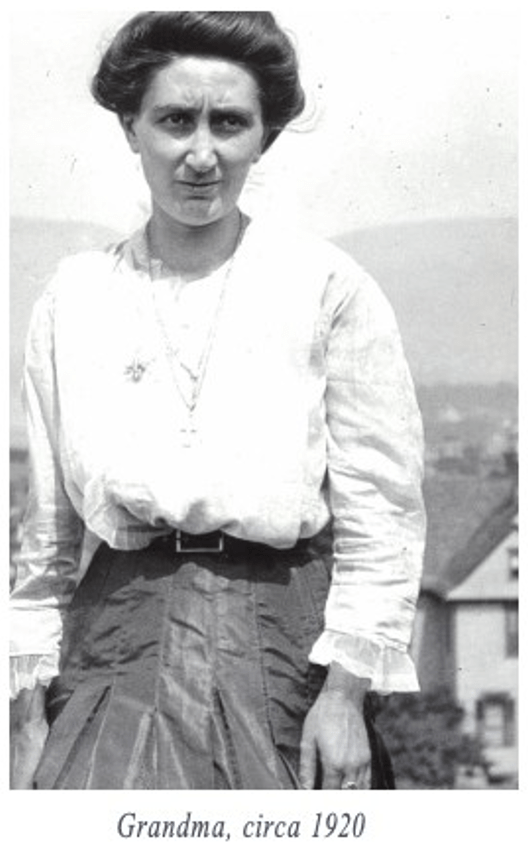
There is a picture of Grandma from about this time. It is a school picture, probably her last year of school. She is standing near the end of a row, the tallest and presumably the oldest student in the picture. Her dress is a dark plaid, her hair pulled back in a tight bun. She looks sad, resigned, her eyes flat, as if they are unable to see beyond the moment when the shutter clicked.
In 1909, Antonio and Anna were married at St. Anthony of Padua Italian Catholic church which stood at the top of Dunmore’s highest hill. Anna’s first child, named Caterina after her mother-in-law, was born on August, 10, 1910. She died the same day. Her death certificate lists her age as five hours. Anna gave birth to four more children in the next few years: Domenic in 1912, Charles in 1914, Catherine (“Katy”) in 1915, and Vito in 1917. While Antonio, along with his father and brothers, worked long hours at the Erie Railroad Shops, Anna cared for her four young children in a two-bedroom apartment in Dunmore’s Hill Section.
Dunmore was made up largely of European immigrants. I
have jokingly said that it was one third Italian, one third Polish, one third Irish, and the rest Anglo. That was how it felt to me growing up there. The groups lived in different parts of town—
the Italians in the Hill Section, the Irish in the Patch, the Polish in an area on the north end of town, the Anglos and some Irish in the area surrounding Dunmore Corners, and the very wealthy Anglos in what was called the Hollywood Section because of the size and elegance of the homes. The three immigrant groups were all Catholic, and each had their own church: St. Anthony of Padua for the Italians, St. Mary’s for the Irish, and All Saints for the Polish. The Anglos went to the towering limestone Episcopal Church in the Hollywood Section or the simple white wooden Presbyterian Church near the Corners where my Girl Scout troop met.
Anna’s father-in-law, Domenico Mecca, was determined to bring his family together in one large homestead, including Anna, Antonio and their children. Unable to find a property in the Hill Section large enough for the house he envisioned, Domenico put down our family’s Italian roots in the Anglo/Irish neighborhood near Dunmore Corners. The property was located at the intersection of Drinker Street, the town’s main thoroughfare, and Reilly Street, a one-block-long street that sloped uphill to All Saints, the Polish Catholic Church, and the beginning of the Polish section. We lived at Dunmore’s ethnic epicenter. I’ve been told that it was a scandal when my great-grandfather built the house there. Other Italians warned him that he would face backlash from his new neighbors by moving to that area. Despite the warnings, Domenico, together with his four sons, built the house at 401 East Drinker Street.
Anna was twenty-seven when she moved into 401 with her husband, mother- and father-in-law, four children, and Antonio’s three brothers and two sisters. Even though she was probably happy to move from the cramped apartment, it must have been daunting to suddenly be surrounded by a hoard of in-laws. During their second year in the house, both Anna and her mother-in-law,
Catarina, fell ill with the Spanish Flu, a worldwide pandemic that killed 50 million people worldwide and 675,000 in the United States. Anna was pregnant when she contracted the flu. Despite her delicate frame and the ravages of the flu, she was able to survive the exertions of labor and gave birth on October 14, 1918, to a baby girl whom she named Maria, after her own mother. Her previous child, Vito, had been named after her father. Perhaps she was hoping to keep herself from disappearing into her husband’s clan in the one small way she could.
Five days later, little Maria died. Her death certificate states the cause of death as “influenza contracted in utero.” She was buried the same day. It is unlikely that Anna was well enough to attend the burial. I imagine her feverish and alone in the big house after the family left to put her baby girl in the ground. As the swaddled body of the infant was lowered into the dirt, perhaps Anna cradled her own still-swollen stomach, imagining Maria safe in her womb. Maybe she felt herself melting into the emptiness of the house—in her fever dreams, the emptiness came inside her and stole her child, leaving her hollow. She probably wanted to stay in bed until the house consumed her as well, but as the fever and aches of the flu subsided, she knew she had to rouse herself to care for her young children.
Eight days after the baby’s death, Anna’s mother-in-law, Catarina Mecca, older and weaker than Anna, succumbed to the flu. Upon her death, the primary responsibility for caring for the household, and the entire Mecca clan, fell to Anna. It was a responsibility she shouldered grudgingly for decades to come.
Over the next six years, Anna would bear and bury more children. In September 1919, a year after Maria’s death, Aunt Carmella was born. In March 1920, three-year-old Vito died. His death certificate states the primary cause of death as meningitis and the secondary cause of death as “La Grippe,” another name
for the Spanish Flu. In October 1921, my father, Thomas, was born. Three years later, in 1924, Anna gave birth to her last child. He was named Vito, like his brother before him. It was common for Italian families to give children the same name as a deceased sibling. Anna again had a child who bore her father’s name. The second Vito was known as “Little Willie.” He was born with Erb’s palsy, a condition which causes paralysis, loss of sensation, and atrophy in the arms. It is often caused when an infant’s neck is stretched to the side during a difficult delivery. Little Willie died in 1927 of meningitis, like his brother and namesake before him, at the age of two-and-and-half.
So much life and so much death. I think of the grim face of the schoolgirl in the photo. Maybe she was staring into her own future, a future that had been sealed the moment she was born. Maybe she knew that the joys would be fleeting. That there would be so little she could control. Not whom she would marry. Not how many children would grow in her womb, not how many would die.
While Antonio went out into the world to work and spent countless hours in his cellar workshop or outside in the yard, Anna spent most of her time in the kitchen. The kitchen was the central room on the first floor and all the other rooms spoked out from there: bathroom, pantry, living room, cellar, master bedroom, and a second bedroom. Each room had a dark paneled wooden door set into a dark wood frame. Every inch was coated with layer upon layer of varnish. Bead board wainscoting of the same dark wood extended halfway up the walls. I wonder if the vertical stripes of the bead board felt like prison bars to young Anna.
Even with all the dark wood, the kitchen seemed spacious. Black-and-white asphalt tiles in a checkerboard pattern on the floor accentuated the open space, which was furnished only with
an icebox, a wooden table and chairs, and a coal stove. Storage and workspace for the kitchen were in a narrow pantry. One wall was lined with painted wood cabinets above a long counter. Under the counter were bins for flour, sugar, pasta, potatoes, and other staples. On the opposite wall was a double porcelain sink surrounded by more cabinets.
There was one other item in the kitchen: a low chair with wooden legs and arms, its seat and back cushions covered in maroon vinyl trying to look like leather. The chair was tucked into the small space between the bathroom door and the outside wall, pushed up against the low radiator under the window. Antonio had topped the radiator with a wide wood plank to make a shelf. I remember seeing Grandma many times sitting in that chair, her elbow resting on the wooden shelf as she stared out the window. This was also the chair where Grandma said her rosary. She would clutch the string of black beads with both hands, leaving one bead exposed between her thumbs. Her lips moved, but no sound came out. At regular intervals, one thumb reached for the center bead and deftly shifted the string to the right. At the beginning and end of her prayers, she used both hands to raise the cross to her lips. Tommy and I knew not to disturb Grandma when she was saying the rosary. We could talk with Aunt Carmella, maybe even play Steal the Deck, but there was no singing or dancing, two of the things we most enjoyed doing with Aunt Carmella, during this time. I didn’t want to stare, but I liked to watch Grandma when she was saying the rosary. Her face was relaxed, even serene, with no trace of the scowl she often wore. It was like she pulled a curtain around herself and disappeared into a world of her own. She seemed happier when she escaped
the here-and-now of her life.
I wonder how many times, when the children were young and she bore on her shoulders the responsibility for the care of
her husband’s large family, Anna had been able to sit, even for a moment, in the chair by the window. I wonder if she ever had time to say the rosary in peace, if she was ever able to escape the life she had never chosen for herself. After Grandma died, Aunt Carmella, who was widowed young and had no children, took up this same post, her dime store romance novels, books of crossword puzzles, and an array of pens arranged neatly on the worn shelf. She did not need a string of beads for her escape.
Anna’s chores were many. She had to stoke the stove with coal, cook breakfast and dinner, and pack lunches for the men before they left for the Erie Shops. She washed clothes and linens by hand, swept floors with a straw broom, and periodically dragged the carpets out to the clothesline and beat them with a paddle. Antonio’s sisters, who were ten and fifteen when the family moved into 401, helped with some of the chores after school. Later, Anna’s daughter, Katy, helped out as well. Katy loved to clean and rejected her baby sister Carmella’s help because she clearly had no interest in housework and didn’t do it right. Anna probably had no interest in housework either, but she had no choice.
Several of Anna’s chores had to be done in the cellar. In a back corner of the low-ceilinged cellar, she filled the black soapstone utility sink with hot water and used a wooden washboard to scrub the family’s dirty clothes and linens. She scraped a rough rectangle of whitish soap back and forth against the fabric to create a lather, then with both hands rubbed each piece against the ridges of galvanized steel as she leaned her full body into the sink. It is no wonder so many sheets and towels in Grandma’s house were worn and threadbare.
Later, in the 1940s, Antonio was able to purchase a Maytag automatic ringer washer. The gleaming white cylinder that held the wash tub stood several inches off the ground on metal legs.
The round lid looked like a garbage can lid, but it too was gleaming white. Grandma was still using this washer thirty years later. I loved to help Grandma and Aunt Carmella with their laundry because the equipment was so much more interesting than the automatic washer and dryer my mother used. When the washer in the cellar was in operation Grandma and Aunt Carmella never let me to get too close. They seemed a bit afraid of the loud noises and rhythmic vibrations created by the machine, and I got the sense that they feared this porcelain monster could attack us at any time. At the top, along the back of the tub, was the wringer: two brown rubber rollers encased in a porcelain frame.
Once the machine stopped agitating and the lid was removed, Grandma pulled out one article of clothing at a time and carefully held them up to the rollers while Aunt Carmella pushed the red button that jolted the wringer into action. The spinning rollers seized the cloth in their grip, squeezing out the excess water and spitting out a flatter, dryer version into Aunt Carmella’s waiting hands. When I got a bit older, Aunt Carmella let me do the catching, though she grabbed the first tail of cloth to come through so I would not get my fingers anywhere near the rollers. The flattened garments always reminded me of poor Wylie
E. Coyote after he had been run over by the Road Runner.
When the oval wicker laundry basket was filled with pancaked clothing, Aunt Carmella hauled the basket over to the clothes lines which hung between the furnace and the coal bin. A cloth pouch full of wooden clothes pins hung from the line and Aunt Carmella put a few in her mouth before grabbing the first piece to hang. My job was to keep feeding her the clothes pins as she worked her way along the line, prodding the basket in front of her with her foot. When the sun was shining, the basket was carried outside, and the laundry hung on the clothes lines Grandpa had strung between two sturdy poles. Many days in the
winter, we had to pull frozen towels and sheets, stiff as boards, off the line and fold them until they cracked to get them into the basket.
My favorite story about Grandma begins at the cellar clothesline. It is known in the family as “The Rag Story.” When Carmella and Katy were young teens in the 1930s, they and their mother used layers of absorbent cloth to create “rags” thick enough to absorb their monthly menstrual flow. This is where the phrase “on the rag” comes from. They used pins to attach the rags to their undergarments. After each use, they had to wash the rags so they could be used again. These were hung on the cellar clothes lines to dry, even in good weather. Antonio’s younger brother Andrew, a bachelor, was one of the extended Mecca family members living in the house at the time. He was known to be mean, selfish, and ungrateful. One day, having just about had it with Andrew, Anna warned him to leave the rags drying in the cellar alone, knowing that he would, out of pure spite, do just the opposite. When Andrew came prancing back upstairs to the kitchen, smothering his face defiantly in a stiff rag, Anna and her daughters doubled over with laughter. Anna had had her revenge. It was small but sweet.
Unlike many Italians at the time, the Meccas did not have
their kitchen in the basement. But at the end of Grandpa’s workbench, next to the anvil, was an old gas stove. It was a beautiful object, its white surface decorated with painted roses and green leaves, chrome trim on the oven door and the long curvy handles of the burner controls, and a back panel with a scalloped shelf edged in red for keeping things warm.
Anna used this stove for canning the vegetables and fruits Antonio grew in his garden. Domenico had purchased two lots when he bought the property; one entire lot was used for gardening. This meant bushels of tomatoes, peppers, onions,
eggplant, peaches, apples, and more. The food was stored in a narrow space along the front of the house we called “the little cellar.” The air inside the little cellar was cool and the dirt floor gave off a smell of wet soil. Along the walls on either side of a narrow walk space were wooden bins of various sizes. The bins were stocked with dirt-covered potatoes, garlic bulbs, and a variety of onions. Above the bins were shelves lined with green- tinted Ball jars filled the tomatoes, peaches, applesauce, jelly, peppers, eggplant, and pickles that Anna had peeled, sliced, cooked, and canned.
It was also on the cellar stove that Anna made sauce from the canned tomatoes. The family could not afford to eat meat very often, but pasta was daily fare, sometimes augmented with beans for added protein. This dish, called pasta fagioli, remained one of my father’s favorites his whole life. Bread was another staple and Anna made several loaves every day.
The work never stopped, not even when Anna’s belly swelled with one baby after another. She did what she had to do to feed the extended family living at 401, usually numbering ten or more. Often she worked alone.
Grandpa never came up behind Grandma while she was at the stove to give her a hug, as I had seen my dad do many times to my mother. He never took her to a restaurant. He never surprised her with flowers or gifts. He didn’t lavish praise on her cooking or notice the small changes she made in the house. Not that she would have expected these things. Their worlds and lives were separate as she knew they would be. She had no girlhood dreams of romance. She may have hoped for tenderness from her husband, but in her brief courtship with Antonio, this hope probably faded. He was a good man, she knew, but he seemed as hard and gruff as his stocky body, rough hands, and the harsh
stubble on his face. Whatever softness Anna once had eroded over their years together.
There is a picture of Grandma and Grandpa from their fiftieth wedding anniversary taken at the party the family held in Uncle Dom and Aunt Florence’s painted basement. They stand stiffly next to one another, not touching. Neither are smiling. The Italian version of “American Gothic.”
By the time I knew her, Grandma seemed to hate everything, especially cooking. She was the only Italian grandmother I knew who didn’t cook. Her sisters were the typical Italian grandmothers, their kitchens always steamy with pots of simmering sauce. I don’t remember ever having a large family meal in Grandma and Grandpa’s kitchen. My mother learned how to cook Italian food from Grandma’s youngest sister, Aunt Ang, and our own kitchen upstairs often swelled with relatives for holiday meals.
When it was just Grandma and Aunt Carmella living downstairs, they sometimes invited me to stay for dinner after an afternoon playing with Aunt Carmella. My mother made me politely decline two times before I was allowed to accept on the third offer. The meals were simple, with barely enough food for the two of them. The first time they served me spaghetti, I was shocked when Grandma opened a jar of Ragu, something neither my mother nor any of our Italian relatives would be caught dead doing. I imagine that when her family and the garden shrank, Grandma was only too happy to retire the cellar stove and buy sauce and peaches in jars at the grocery store. She had done enough canning and cooking for a lifetime.
Though I rarely appreciated it while she was alive, I think
there was an oft-hidden essence in Grandma, a sweetness, a tenderness, even a sassiness, that may have dissipated over the years but did not disappear. I see it in the Rag Story, in the beauty
of the turquoise earrings, in the glint in her eye when she poured Grandpa’s whiskey, and especially in the joy she found in the Seven Sisters.
I first learned about the Seven Sisters on a summer day when Tommy was pushing me on the wooden chair swing Grandpa had built in the side yard. Grandma suddenly appeared with an empty bushel basket in one hand and garden shears in the other. Grandma rarely ventured any further outside the house than the back porch glider, so I jumped off the swing to see what she was doing. Grandma dropped the basket in front of the wall of roses at the edge of the yard. Grandpa had forged a makeshift trellis out of plumbing pipe and planted the roses years before. As the vines grew, the trellis disappeared behind the meandering branches and spreading leaves. I stood quietly at Grandma’s elbow as she began clipping away at the branches. She would scan a section of vines, then remove those that were bare and withered and drop them into the basket.
“What are you doing, Grandma?” I finally dared to ask. I was
a little afraid of Grandma. She turned quickly, startled.
“Oh, Debbie,” she said sweetly, smiling. “I didn’t know you were there.” I rarely saw Grandma smile. “I’m taking care of my roses. These are the Seven Sisters,” she said proudly. “Just like me and my sisters. The Seven Sisters.” She reached out to put her arm around my shoulder and pull me closer. “Look!” she said, bending a branch with a cluster of delicate pink flowers towards us. Then pointing one by one at the tiny buds, she counted, “One, two, three, four, five, six, seven. “See!” she proclaimed triumphantly, “Seven!”
After that, I paid more attention to the rose wall, often counting the clusters to confirm that, indeed, they each had seven roses. I watched whenever Grandma lovingly pruned the bushes back to healthy branches. Sometimes she let me help her look for
the places that needed pruning or pick out the most beautiful clusters to cut for a bouquet. I loved how Grandma loved those roses.
I wonder now if Grandpa chose the Seven Sisters roses to please Grandma. Perhaps this was his small way to show he cared for her. Was Grandma surprised the first year they bloomed? What memories of her childhood and her younger sisters overcame her as she nursed the roses year after year?
✤ ✤ ✤
I picture Grandma as I knew her – her yellow-gray hair pulled back in a bun, wearing a black cotton dress, heavy cotton stockings, and black lace-up old lady shoes, gazing out the window from her maroon chair by the radiator, sipping black coffee with plenty of sugar, the only color the two dots of turquoise on her ears. But now, superimposed on that image, is one of a young woman thrust into the middle of her husband’s large family and into a role she neither desired nor felt prepared for. My heart aches for the young wife drowning in household chores and the young mother burying child after child, for the oldest rose of the seven sisters.
I remember that first night in her bed, and realize that once I listened, Grandma tried to tell me who she was.
You hold my body hostage It is no longer mine I cannot do with it what I will Only what you allow
You let me sleep But waking hours You are my constant companion Sometimes loud, sometimes silent.
Sometimes I think you have left me Then I turn a corner And you grab me from behind Catch me unawares
I try to find the strength to fight you To hold you off, at least for a while Sometimes I make progress Until you remind me that I am no match for you.
I try to imagine a future without you I long to know a freedom So long absent I can barely remember what it feels like
Hope fades as quickly as it comes.
So I cancel a dinner party A trip A card game with my husband. You will not let me enjoy any of these.
I savor the moments When you hold yourself at bay When I feel almost normal And try to stretch them into a life
Perhaps I must accept That you will never leave me That all you have taken from me Is lost.
But for all that you control I will not let you have my heart I will know love and beauty and joy I will learn and laugh and give back.
Pain
You may be powerful But I will not let you have it all.
And if this is as good as it gets I will make it enough.
There are two worn leather chairs, just inside the entrance, around the corner on the left. I prefer the one by the window, but either will do. The backs are just the right angle for sitting comfortably with my legs crossed and the arms are just the right height for holding my elbows while I work on my laptop. When I need to stare off into space, as I often do when I get stuck with something I’m working on, I just need to gaze to my left out the window, beyond the Chipotle parking lot. There is a ridge line to the North, not unlike those that edge the neighboring Finger Lakes. From the its hilltop perch, the floor to ceiling window mostly reveals a vast skyscape. The scenes are often dramatic. I can watch storms rolling in from the North, swaths of gray that coalesce into a black mass. Sometimes they pour down rain, blurring the window. Other times they roll right past, the blue rising up from the horizon like paint spilling upside-down from the hilltops. On hot summer days, I can bask in the burning sun while keeping cool inside, though I keep a sweater in my car for days when the A/C turns into an Arctic blast from the fans above my chair. In winter, I can watch the flakes pile up on Grant Avenue at the base of the hill. That’s usually when my husband calls, urging me to come home. But the swirling skyful of white is just too beautiful and mesmerizing. I’ll get another cup of coffee and take my chances later.
2. A bottomless coffee cup.
I have signed up for Panera’s monthly plan which gives me unlimited beverages 365 days a year. I’m afraid Panera is not making much on me, though I do order breakfast or lunch occasionally.
3. Real food.
As advertised, Panera’s food is fresh and clean. My breakfast choice is either the steel-ground oatmeal with strawberries (I skip the pecans to eliminate some calories) or the multi-grain bagel flat, sliced, with chive and onion cream cheese. It’s about half the calories of a regular bagel and toasts to a lovely crunch. For lunch, I skip the sandwiches (most over 1000 calories) and opt for soup or salad with an apple for my side. I only splurge on the usual baguette side for the French onion soup so I can dip the bread in the broth.
4. The drive.
Since we moved to Auburn from the Boston area, we have been amazed at how scenic every drive is. We turn out our driveway and are in picture-perfect rolling farmland. But then there is “The Arterial” and Grant Ave. The quickest route to Panera is on these busy, commercials streets, but I recently discovered a back way to Panera that makes the drive a little longer but oh-so-much more pleasant. It even include a quirky farm with a big red barn and fake animals!
5. Getting work done.
Whether I’m working on my writing, paying the bills, or researching something on the internet, I am able to concentrate here in a way that is impossible at home, even if I am alone in a quiet room. I am somehow able to tune out the background music, noisy customers, and beeping alarms and tune in to the work at hand. I can’t get distracted from it because there is nothing else I can do here. Except of course for . . .
6. People-watching.
The variety of customers is astonishing. From octogenarians to infants on their first outing to a restaurant, the parade in and out is colorful and diverse. And I have the perfect vantage point from my corner by the window. Only a few tables hidden behind the fake-stone wall with the fireplace curiously set at eye level mar my view of the entire dining room. The large table right in front of me hosts a regular breakfast group of Baby-boomers. Sometimes I overhear bits of conversation, but I don’t really tune in, even though one male voice is so deep and resonant that it is hard to ignore. I wonder how they met, what their connection is, what common past compels them to stay closely connected. The large table further back often hosts meetings of various sorts, usually more women than men. Are they working on a candidate’s campaign? Planning the next fundraiser for their church? Gathering information to present at the next City Council meeting? Tables of two host managers interviewing candidates, tutors working with students, women catching up on one another’s lives, couples taking a break from their phones to share some time together, and sponsors meeting with men and women in recovery. There are times in my life when I have been half of each of these pairs. I’ve also seen many families, mostly moms with kids, probably because I am here during the day. Toddlers often love the smile of a stranger, but they make me feel guilty when I need to drop out of the endless smile volley. The groups often include three generations, sometimes four, with the youngest member the focus of all the attention. It’s fun to guess who looks like who and to wonder whether any are adopted, as my own children are.
7. The staff.
Relentlessly friendly, most of the staff know me by name and I know some of theirs. We all know that we, the regulars and the staff, are part of the same family.
8. The regulars.
Margaret: Margaret is here every day. She picks the same small two-seater table. Regulars always choose the same spots, unless they are not available. Don’t even get me started on what happens when one of my chairs is not available. (OK, I’ve started already).
Digression: My reaction to my seats being taken depends on my mood. On a bad day, when I am really needing some Panera time, this situation causes a physical sensation of panic. Often I leave immediately and try to hold back tears until I get in the car. Of course, a large part of me wants to stare down whoever is in my seat, willing them to leave, but luckily I have resisted this temptation. (Except maybe for a quick petulant look that might move a very emotionally intelligent person. This rarely works). Sitting at a regular table is simply not an option for me on a bad day. It’s comfy chair or nothing. Recently, I realized the Starbucks down the street also has comfy chairs. Sometimes I will turn on my heel and head there, but it is just not the same. The new Roast and Toast also has comfy chairs, but it’s too big a risk—they are usually taken. On a good day, turning the corner to see my chairs taken still pulls me up short. The disappointment is profound, but I am not completely disabled by it. I am able to take a deep breath and consider my options. I actually have a list, including hours of operation, of “comfy chair cafe’s” from Geneva to Syracuse. They’re a fine alternative occasionally, but a longer drive and none has all of the advantages of Panera. Some days I can even sit at a regular table, but it must, of course, be one that faces my chairs!
Now back to Margaret . . . She always has a book to read. I’ve never gotten close enough to actually read the title, but they appear to be works of popular fiction. Sometimes we chat, sometimes it’s just a quick hello. One year my husband and I ran into her and her husband at the New York State Fair. Dick comes in occasionally to join her and always says hello. Margaret has speaking relationships with more regulars than I do. There are a lot of regulars I know by face but not name. We greet one another with a nod and a smile, sometimes a “How are you?” but somehow we are past the point where we can ask one another’s names.
Name Unknown. One of these nodding acquaintances became a speaking friend when he one day answered my “How are you?” honestly. He had just had a cancer treatment. I could tell he was feeling low and he seemed to want to talk. As he told me a bit about his recurring brain cancer, his mood seem to lift. He was genuinely appreciative of my interest and concern. As he raised a hand in goodbye, he said, “Well, whatcha gonna do?” and left with a shrug and smile. Whenever I see him now, I ask him how he is in a tone that lets him know I am truly interested.
Jim. I call Jim “my Panera husband” though I think he may be uncomfortable with that moniker. He’s also a comfy chair sitter, so when he is here we share the comfy chair corner. Over time, we have talked more and more and found much we have in common. We talk politics and shows we’ve been streaming. I have often shared info I discovered while researching my book, including showing him pictures of my family. He’s shared with me about his family, including kids and grandkids. His wife Mary also comes in, usually separately, and I have gotten to know her a bit as well. A few years ago, when Jim had not been in for a while, our family of regulars found out that his daughter had died. We were all shocked and saddened. We had a feeling of helplessness, being only “Panera friends.” I reached out with a sympathy card, and when he started coming in again, we were able to talk about his loss. I see him and Mary at events around town (we seem drawn to the same sorts of events) and they both came to my book reading at the library. Are we really only “Panera friends”?
Paul and Steve. Paul and Steve are both tall, with sturdy builds, square jaws, and winning smiles. They are probably in their early fifties. Handsome. I often find them occupying the two comfy chairs. The first few times, I didn’t hide my disappointment and took a seat facing them, waiting for them to leave (unless it was a bad day when I turned on my heel to cry in the car). One day, they offered to give up the seats. “Do you want to sit here?” they asked, moving to get up. “OH, no, please. It’s fine. I do love those chairs, but I’ll be fine.” This was not what I wanted to do, but how could I be anything but kind in response to their kindness? “I’m Steve,” one of them offered, “and this is Paul.” I tried to register their names in my brain as I introduced myself. Gradually our conversations grew longer as we repeatedly intersected at the chairs. I wondered about their friendship and the regularity of their meetings. Sponsor and sponsee? They both laughed easily and our “war” over the seats became a private joke between us. Somehow I no longer felt so bad when they got to the chairs first. How could I? We were friends now.
Kurt. As soon as he walked in and joined me in the second chair, I knew Kurt was an artist, or at least a creative person of some sort. He wore a rakish beret and the vest over his loose white shirt was colorful. Maybe an African print? As he asked if he could join me, his smiling face was open, even inviting. He just seemed like someone I could talk to, someone I would have something in common with, though I didn’t yet know what it was. I run into Kurt every six weeks or so, and each time we learn more about one another. Musician and psychotherapist are among the hats he wears. He owns a barn a bit south of here that he and his partner have turned into an arts center where artists of all kinds can go to work on their projects. I told him I would go there to continue work on my book if only it had a comfy chair (it doesn’t). I still plan to stop there some day. Kurt’s partner teachers at the University of Nebraska Omaha, the same school where I got my MFA in Creative Writing a few years ago. One day I was attending a meeting about a new community initiative to address the homeless problem in Auburn, and there was Kurt! So many points of intersection.
Linda and Mike. Linda has chin length hair a delicate shade of red that she wears curled softly under. She is slight of build, but seems strong. She comes in often with Mike, a tall, dignified man with blond-gray hair who seems to favor nautical attire. We had a nodding acquaintance for a while until one day on her way in Linda asks me what I am working on and we talk about the book. We introduce ourselves, then I ask what her husband’s name is while he is parking the car. “That’s not my husband,” Linda shoots back, “that’s my son.” I had them both down for late sixties, early seventies so this didn’t make sense. “I’m ninety-nine,” she tells me with a smile, clearly proud of her longevity. Now we greet one another whenever they come is and usually have a short conversation. Linda loves to tell me what she’s been doing or planning to do: cooking a lamb dinner, weeding the garden, walking in Hoopes Park, cleaning the floors, taking their beagle Trixie, who they adopted a few years ago, to the vet. Right after they adopted her, Linda shared photos of the oddly cute pup. For holidays, Linda and Mike go to an elegant colonial restaurant one town over. It seems to be just the two of them. Linda’s husband is dead, and Mike is an only “child.” I’ve been tempted many times to invite them to join us, but haven’t yet. They live in a stately white house with black shutters right near the park. Every year, Mike takes his vacation on Nantucket (hence the nautical style). Linda is now 101.
9. Seeing friends.
Everyone knows where I sit and friends who occasionally stop in always look for me here. I feel like Lucy behind her “Psychiatric Help 5 cents” sign—people are checking to see if the doctor is in! I even call it my office and that’s partly why I work so well here. When I leave home for the office, I am headed to work, so that’s what I do when I’m here. I even imagine an invisible glass door and feel like I’m inviting people into my office when they come up to chat or just to say hello.
10. The stranger.
One day a stranger came in and sat in the other chair, to my right. He was an older gentleman, someone who could have been a professor of some sort, with a worn tweed jacket and a brown wool scarf around his neck against the autumn chill. We nodded and smiled, acknowledging one another. As he sipped his coffee, I could see out of the corner of my eye that he was periodically looking over towards me. I got the sense he wanted to talk, so I pulled myself away from my work of the day to meet his gaze. As soon as I did, he immediately spoke, “Do you remember where you were on nine-eleven.” I only then realized that the day was indeed September 11. A bit odd to ask a stranger, but an apt question for the day. I explained to him how I had been home alone, how I had to pick up my kids, ages nine and five, from school and keep them from the news until my husband could get home and we could tell them together. He listened patiently. “How about you?” I asked. “How do you remember it?” “My son worked in the second tower,” he answered. At first I thought his son had died that day, but he continued to tell me how his son had not gone into his company’s new office at the World Trade Center but had stayed back in the old office that day. His life had been spared. Except the gentleman and his wife did not know this until much later in the morning. For several hours, they thought their son had died. Clearly, this memory was as fresh today as it was every September 11. The fear, the anxiety, the relief—all came flooding back. And he needed to share it with someone. I was so glad I gone into the office that day so I could offer an empathetic ear to the man’s story. I was glad he had stepped through the invisible door to my office. I’m glad he saw the “Psychiatric Help 5 cents” sign. And I’m glad I flipped over the sign to say “The Doctor is IN.”
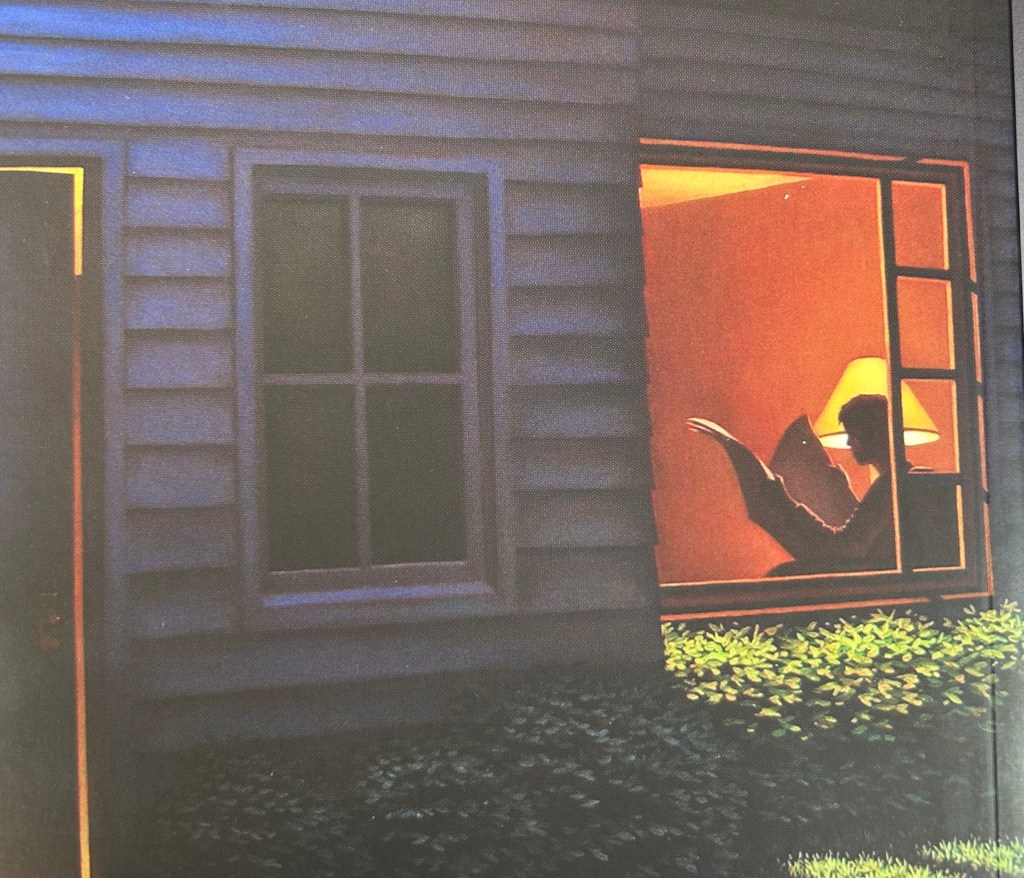
A twilight drive through a strange town. Houses stand in shadowed moonlight, Dark and getting darker. Windows glow an amber shade Or bluish light flickers across the walls As the houses become homes.
There is life inside. Dinnertime, early evening, The time when families gather, Couples hold hands in twin recliners, Men and women busy themselves with chores Or sit alone, reading a book or newspaper. It is the time that homeless people miss the most.
I rarely see a body through the window But I imagine cozy scenes in every house. I want to transport myself Into the glowing light emanating from curtained windows. There is belonging in that gentle light, Comfort.
Longing pulls at my heart. Perhaps I want to know these strangers basking in lamp light. Perhaps I want to share a meal and listen to their laughter.
But no. What I really long for Is my own home Somewhere beyond the headlights Drawing ever closer. As we drive through this strange town.
She started with the paring knife Held it tightly in her right hand The knuckle of her index finger Pressed tightly against the base of the blade. Deftly, she pulled the knife towards her piercing the tight red skin of the McIntosh apple. One. Long. Pull. As she slowly spun the apple in her left hand.
Sitting in my father’s captain’s chair across from her My eyes were level with her hands As she stood at the kitchen table. At her right elbow, a metal colander of rinsed apples Was perched atop a Pyrex pie plate. In front of her, the largest bowl of her colored set, The deep-blue-sky one, stood ready to receive the skins before they were discarded.
How did her large hands perform this delicate task, I wondered. Would my small hands ever be able To match her quick, elegant movements As she shaved thin strips of skin from the white meat of the apples.
Next the apples needed to be sliced very thin A task performed with the same paring knife. With my chin in my hands, I watched as the slices fell like a waterfall Into the bowl, one after the other. My excitement started to build. My part was coming up.
After all the apples were sliced, My mother measured a cup of sugar, a teaspoon of cinnamon, Breadcrumbs, raisins, and a small pan of melted butter Into the bowl.
With the tip of her baby finger, she tested the butter, making sure it was cool enough, Before she slid the bowl across the table to me.“Go ahead,” she said as she wiped her forehead with the back of her hand. “You know what to do.”
After pushing my shirtsleeves up above my elbow, And repositioning myself to kneel on the captain’s chair, I reached both hands into the bowl. The grains of sugar felt rough, while the warm butter oozed between my fingers. I kept reaching, down below the cool apples, Scooping handfuls of the mixture And depositing them on the top of the heap. Over and over I tossed the strudel filling Until the apples were coated evenly.
“I’m done!” I pronounced proudly to my mother, Offering the bowl for her inspection. “It looks just right,” she said, As she wiped my hands with a moist paper towel.
I could only watch as my mother prepared the dough, Mixing flour and egg, stirring with a fork, Then forming a ball that would sit under a warm bowl for ten minutes. Everything had to be just right for the next part: The stretching of the dough.
Mom shook her special strudel cloth, A brown, yellow and white plaid linen tablecloth Used only for this purpose, And pressed it smooth on the table with her hands. Then came the flour before the dough was set down In the center of the cloth.With her wooden rolling pin with the red handles, Mom pushed firmly in every direction Until the dough was about the size of a pie crust.
Now came the magic. With hands greased with melted butter Mom laid the circle of dough on top of her fisted hands. Gently and slowing she pulled the dough apart Stretching it further and further. Then she threw the dough into the air with a spinning motion, Like a pizza maker, Always catching it on the backs of her hands. The dough grew larger and larger And thinner and thinner. Eventually it was too large to spin So she spread it on her arms up to her elbows And continued stretching. She needed to move quickly or her hands would break through the dough And she would need to start all over again.
“It should be thin enough that you can read a newspaper through it,” She told me, laughing. After she laid it gently on the cloth, I stood up to look. Sure enough, I could see the plaid pattern of the tablecloth Clearly through the strudel dough! “How do you do that?” I asked, amazed, making her smile.
Mom let me dump the apple mixture onto the dough, Then she spread it with her hands And ever so gently rolled it up from one end to the other. Then she formed it into a crescent shape And lay it carefully on the baking sheet.
Everyone raved about Mom’s apple strudel. Since my mother is German, People thought it was from some old family recipe, But it was actually from the Betty Crocker cookbook She got when she got married.
When someone asked her for the recipe, Mom gave it, offering to demonstrate The delicate process for making the dough.
Nothing in the world tastes better Than Mom’s apple strudel.
After my mother died, I carried on the tradition of her strudel, Usually for holidays or special occasions. Sometimes my hands break through the dough And I have to start over. Sometimes I forget the breadcrumbs And the filling is runny. Strudel making requires patience And love.
For me, the best part will always be Reaching spread fingers into the apple mixture And turning it over and over. Just like Mom taught me.
We are falling, Swept up into the vortex of a tornado By the forces of evil, No, by people of evil Who watch gleefully As the world they have set on edge Twists out of our control.
We are falling, Spinning madly, Familiar objects fly by Everything out of place, Swirling, tumbling Us, too.
We are falling, No ground beneath our feet Yet knowing that at some point We must land. Gravity demands it. Where we will find ourselves When the twister spins itself out As surely it must?
We are falling Into a new world not of our making. (or is it?) Will we recognize anything? Ourselves? Our country? Will we be able to find among the rubble The pieces we need to rebuild? Will our grandchildren Even know what it is possible to build, Having no model for what democracy looks like?
We are falling Because we had a republic But did not keep it.
Even though we had intended to get up around 7:30 or 8 am to get packed and help Alison and Maurice with the household packing, we didn’t actually get up until closer to 9 am. We are sleeping better and longer than ever before. Wonder what will happen when we get home.
After our own packing was done, we were able to help tidy the cottage by “hoovering” the floors, doing dishes, wiping down the counters, and carrying bags and boxes to the cars. Alison is an amazingly efficient packer and loads more into her car than seems possible … with room to spare. We were on the road before 10:30 am.
We would be taking a long way home along Northern Ireland’s Antrim coast. The scenery all along the way was beautiful, reminding me of the colors around Glenveagh—burnt oranges, dull yellows, and browns covering headlands that loomed over us before plunging into the sea.
We stopped at Downhill House, a mansion built in the late 18th century for Frederick, 4th Earl of Bristol and Lord Bishop of Derry. Much of the building was destroyed by fire in 1851 before being rebuilt in the 1870s. It fell into disrepair after the Second World War leaving an eerie shell of what must once have been a magnificent house (castle). Mussenden Temple, a small circular building located on the cliff next to the mansion, sits high above the Atlantic Ocean. It is said to have housed the bishop’s extensive library. Stone walls surround the entire property, which includes a walled garden, an ice house, and a dovecote.
The grassy path up to the temple led us along a field of cows lazily grazing on a steep hill that eventually plunges to a pristine beach below. Another sloped walkway leads to the mansion, where you can walk through the abandoned remains, with signs identifying the rooms. The views through the windows were like framed paintings of the exquisite scenery beyond. We then walked down the steep hill to Al’s Coffee, a wooden hut surrounded by benches and picnic tables, where we purchased coffees to warm us before getting back into the cars for our ride home to Holywood.
Before we unpacked the car, Alison insisted we sit for a cup of tea and a “wee bite.” While we were enjoying our hot tea as the heat came up in the living room, Maurice secretly unloaded the cars! There was nothing for us to do but head upstairs for a nap before our second dinner at the Golf Club across the street. We are once more settled into our home-away-from-home!
Dinner at the Golf Club was a delight. The staff are all so friendly and welcoming, and of course know Alison and Maurice well. Once again we had drinks in the lounge, where we ordered our dinner, then were brought to our table when our meals were nearly ready. It’s a nice system. I opted for steak with onions rings and sauteed mushrooms followed by a dessert of carrot cake trifle with orange custard and cream. Yum! Hey, I’m on vacation.
I enjoyed our dinner conversation, having quite a laugh about the differences in our “languages”—British/Irish English and American English. Bin lorry vs. garbage truck. Rubbish vs. garbage. French fries vs. chips. Grand vs. great. Lovely vs. nice or beautiful. Etc. We especially love, and are beginning to use “wee” ourselves. It is used for everything here. “Let’s stop in for a wee pint.” “Can you hand me that wee book?” “Do you see that wee man over there?” Etc. I feel our speech is so much less melodic than theirs. But Alison said she liked the cadence of American speech.
As we enjoyed our time together, I was cognizant of how soon it will come to an end. It’s hard to imagine easier people to be with. I only hope they feel the same way, especially as we have rather foisted ourselves upon them for two weeks!