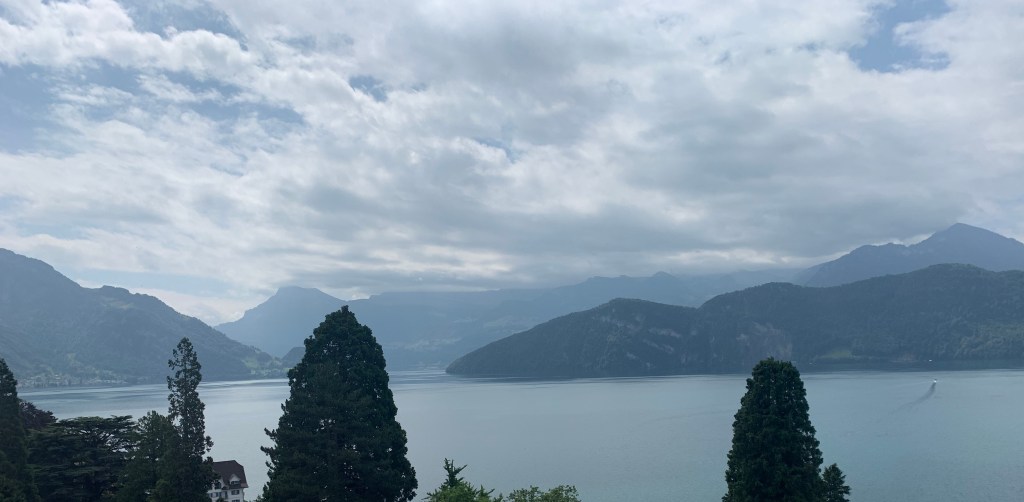
Day 17 – Wednesday, July 12

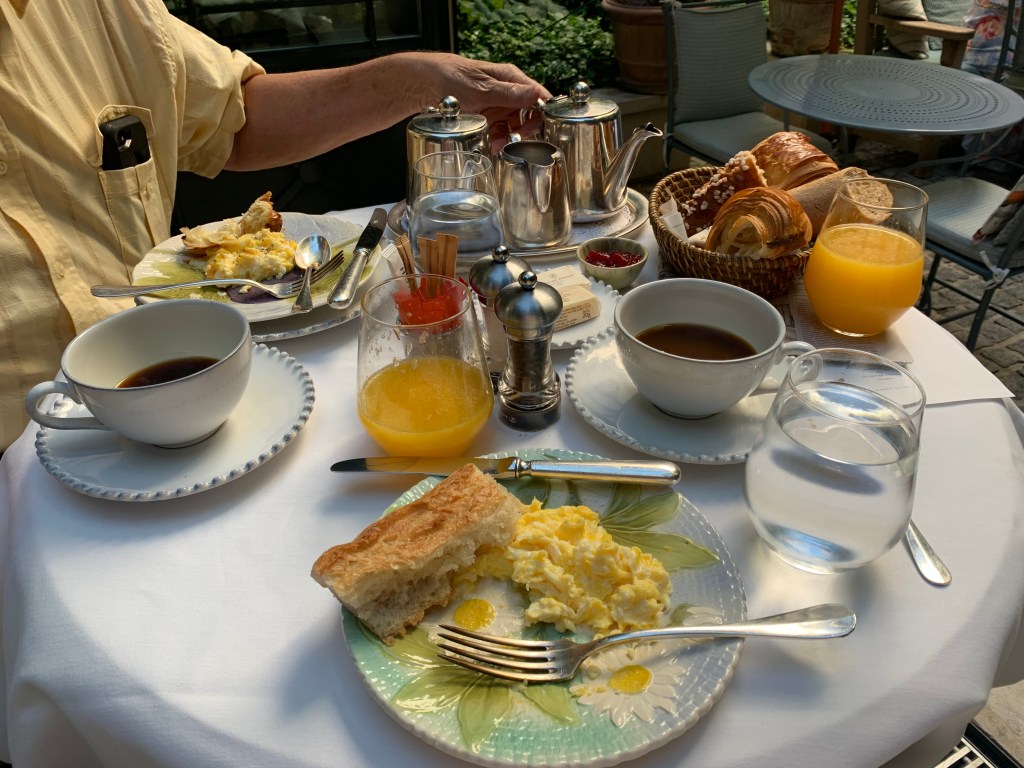
Our late afternoon flight to Manchester gifted us with a leisurely morning. We enjoyed a late breakfast of croissants and scrambled eggs in our oh-so-very-Parisienne courtyard. We didn’t need to go anywhere to feel we were completely immersed in Paris.

After breakfast, we reorganized our luggage in preparation for our flight to England. The goal was to get our largest suitcase below the 50-pound limit so we wouldn’t incur an extra charge. We also wanted to have our overnight bags ready for our two-day stay in Grassington in the Yorkshire Dales. We enjoyed a few restful moments outside in the street-side courtyard before packing everything in the cab and heading to Charles de Gaulle.

At baggage weigh-in, we found our bag was about 2 pounds overweight. Instead of paying an extra 75 Euros, we decided to re-allocate our stuff. The Air France staff directed us to a scale set up just for this purpose. We could put the bag right on the scale, open it, and take out stuff until it got below the limit. Voila!

De Gaulle airport was very organized and efficient, and the people were all very helpful, but it was somehow still exhausting. We ate some packaged sandwiches while waiting at the gate. A lovely woman across from us offered us a piece of homemade lemon cake. “I just can’t eat any more. You enjoy!” We did. People started lining up to board our flight before anything was happening. We weren’t sure why, but figured we should probably get in line, too. We waited and waited with nothing happening. Then finally they started boarding. We checked in with our boarding passes, then followed the line of people on the gangway. And waited and waited and waited some more. There had been no announcement of any delay. No one was saying anything. We all just stood there, baffled and frustrated. I was probably already in a grumpy mood, but this situation really pushed my buttons. Why weren’t they telling us anything? What was happening? Usual travel stuff, but I think I was at the end of my travel tether and really was not happy.

Finally we boarded, and blessedly it was a quick and easy flight to Manchester. We hopped on the shuttle to the Car Rental Village, which was about ten minutes from the airport, and picked up our Ford Focus hybrid. Much smaller than our Peugot SUV, we weren’t sure we could get all our luggage in, but by folding down the back seats, we managed.

We had decided that I would drive first in the U.K. I was nervous yet somehow excited to drive on the other side of the road. We set the GPS to our hotel in Grassington and were off. I told Santo to keep reminding me to get to the left, but I did pretty well with this. The roundabouts were a bit tricky (clockwise rather than counterclockwise) and it was not always clear when we were actually IN the roundabout so we could start counting the exits. The GPS instruction were always to “Enter the roundabout and take the Xth exit.” Amazingly, I only messed it up once.

Judging the width of the car and where I was in the lane was probably the hardest for me. Santo kept yelling, “You’re too close, you’re too close!” but I had cars coming at me on the right and figured it was better to graze up against some grasses and bushes rather than hit another car head-on.

Even expecting narrow roads, we had never imagined them this narrow—and with cars parked on the sides, it was quite dicey at times. I was also tired from the day of travel, and still recovering, so was counting down the minutes until we arrived.

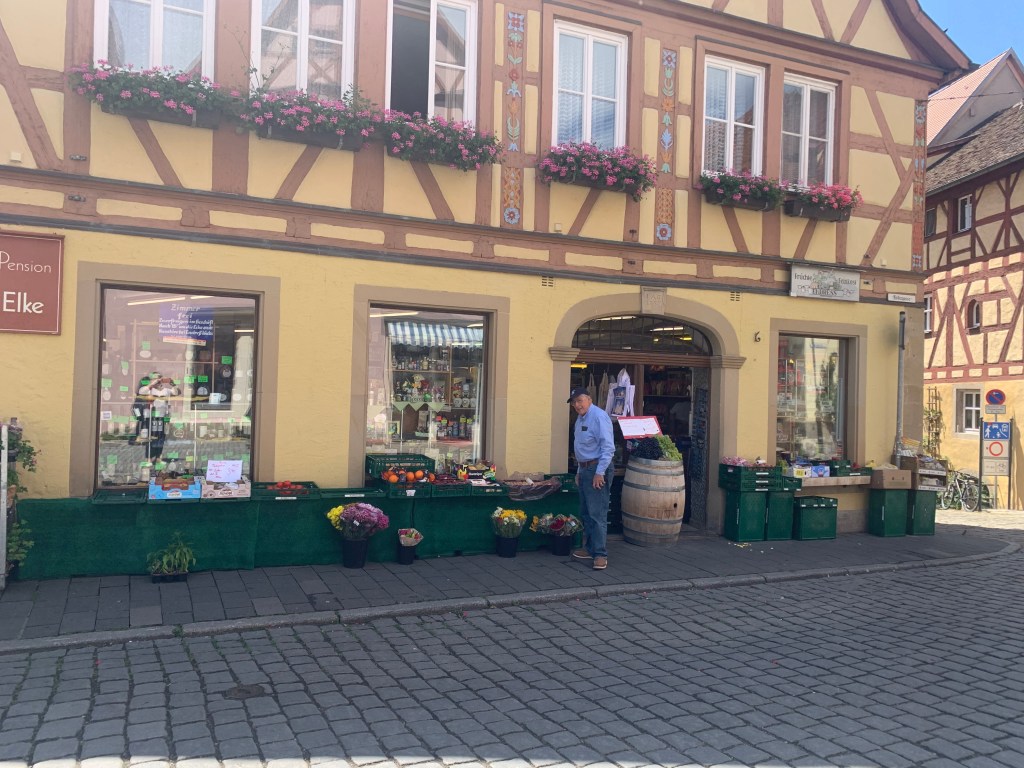
I had set the GPS to the actual hotel, even though we knew we would have to park in the parking lot behind the Yorkshire Dales National Park Information Center. We hoped maybe we could just drop the bags off first. The Devonshire was right on the triangular cobbled square. This is the village that serves as Darrowby in “All Creatures Great and Small.” And The Devonshire is the pub, The Drovers Arms, in the series. There was nowhere to park, even for a moment, near the hotel or in the square, so we drove the quarter mile down the road to the car park. It had started to rain and it was so much cooler (Hallelujah). Luckily the rain had slowed down to a light drizzle by the time we left the car and walked to the hotel.

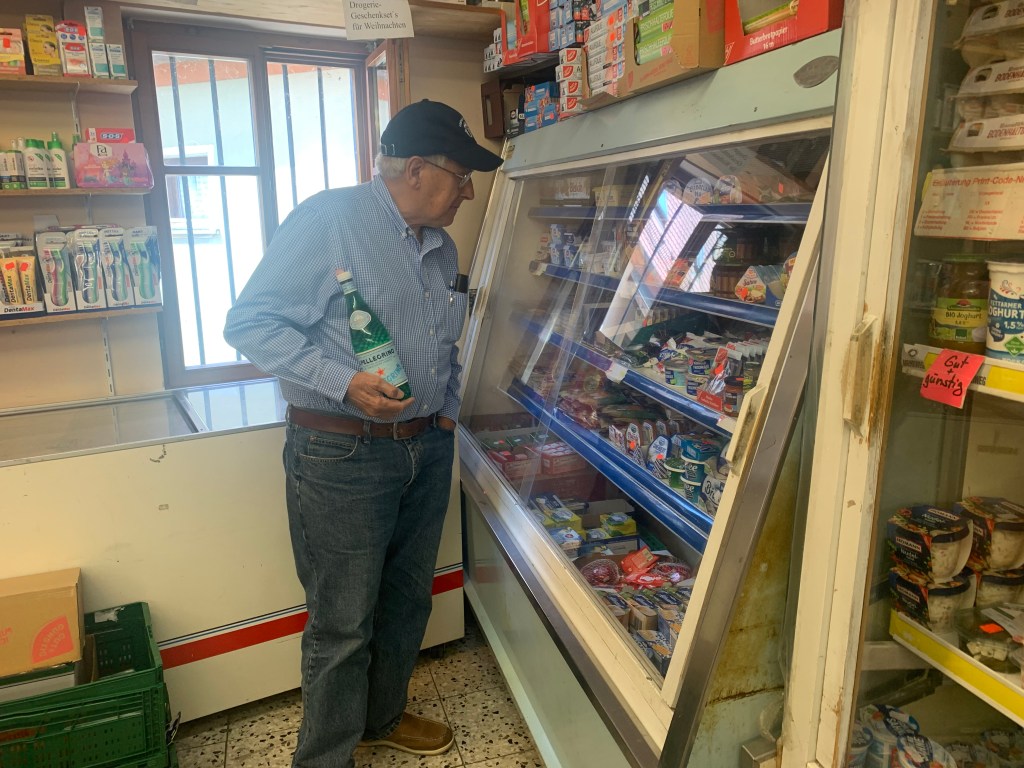
On the way, Santo stopped in a small market in the square to pick up a bottle of water for me (I needed to be constantly drinking water or my mouth turned to cotton). He asked the woman in the shop about where to eat, and she said The Devonshire, “but you better hurry, the kitchen closes at 9 pm.” It was 8:45 pm.

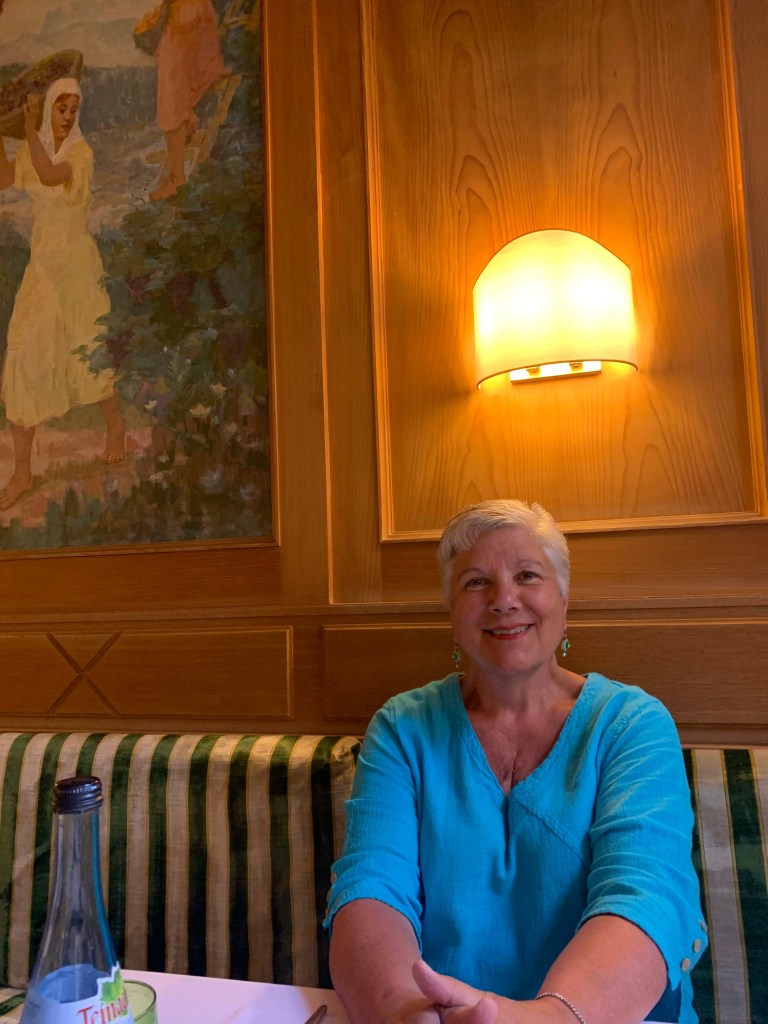
We entered the pub. It was like coming home to a cozy house on a dreary day. The dining room was on the left, the pub on the right, all in warm hues of brown, the old wood lit with the glow of lamplight. The clatter of dishes and friendly voices made it feel welcoming and comfortable.

We asked the bustling waitress where to check in for the hotel, and she said, “With the bartender.” OK, well that’s different, I thought. Santo asked if we were too late to have dinner. She hesitated at first, but we could tell she really wanted to accommodate us. “Yeah, sure, we’ll get it sorted,” she said. A few minutes later, we were at a table in the dining room with our luggage on the chairs next to us. No time to get to the room before dinner.

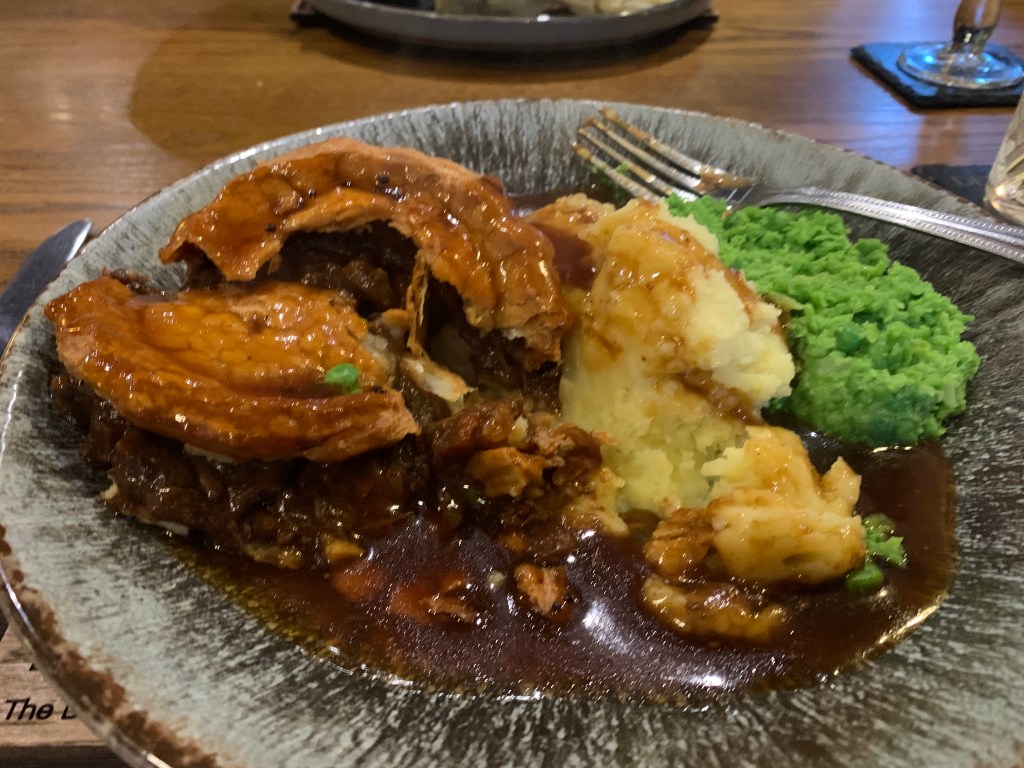
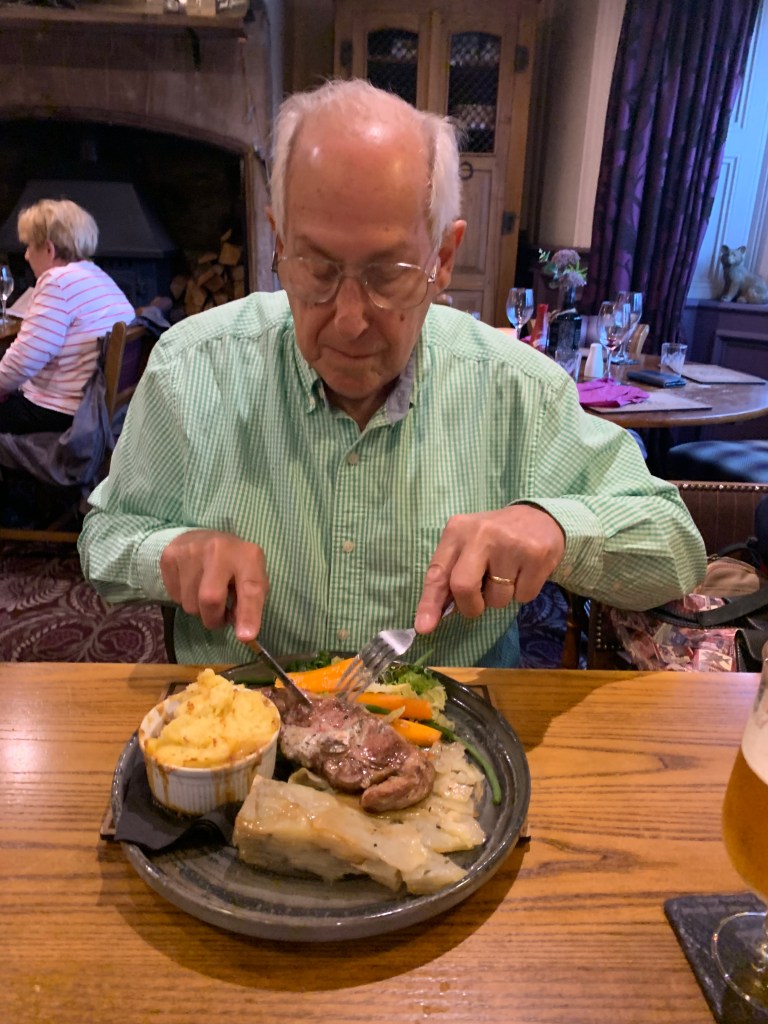
Santo ordered the “duo lamb” dish with lamb chops and a lamb shepherd’s pie. I had the pie of the day: steak and ale. The pie was the size of a large ramekin, crusted top, bottom, and all around with a beautifully browned, flaky crust. When I attacked it with my fork, the tender pieces of steak oozed out in a dark gravy. So delicious. Served with smashed peas: fresh green peas roughly mashed to the consistency of mashed potatoes.
After dinner, we double-checked with the waitress, “So we should see the bartender to check in?” He seemed awfully busy in the full and bustling pub. “Ach, I’ll take you up,” she answered and started grabbing our bags to carry them up for us. She double-checked the room number with the bartender, then led us up the stairs just behind a door at the back of the bar.

Upstairs, the hallway rambled left and right, up and down low steps. All of the rooms were named after characters in “All Creatures Great and Small”: Mrs. Hall, Helen Alderson, Siegried Farnon, the Herriot Suite, even Tricki Woo! Our room was the Skeldale Suite. It was a lovely large room overlooking the square. King bed, small sofa, desk, armoir, and a large bathroom two steps up from the room.

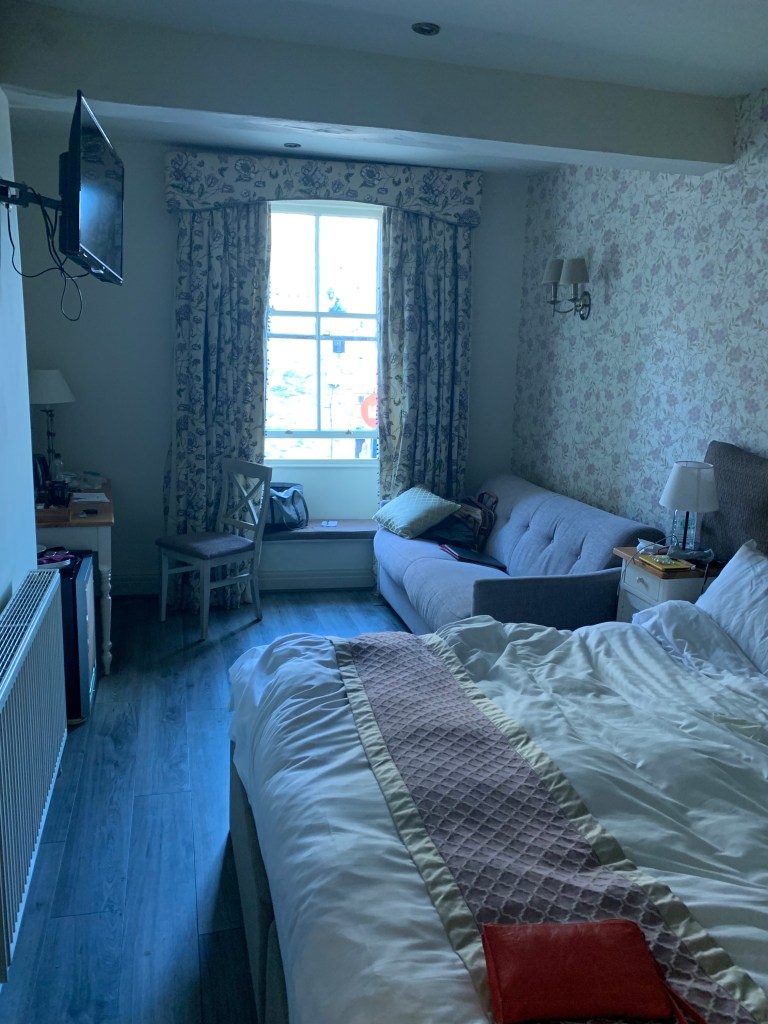
I wasted no time getting ready for bed and crawling in between he crisp white sheets. Santo sat at the desk for a while. For the first (and so far the last) time on our trip, I turned the television on. I found a show featuring female British comics and watched for a bit. Then I turned it off, preferring the stillness. Even with our window open to the square, the only sound we could hear was the low rumble of friendly voices from the pub below. It reminded me of lying in my bed as a child and hearing my parents in another room, their distant voices somehow comforting.
Day 16 – Tuesday, July 16

I woke up feeling the best I had in a long time. Symptoms were still there, but I was cool, at least somewhat rested, and I knew I would just keep getting better as the meds kicked in.

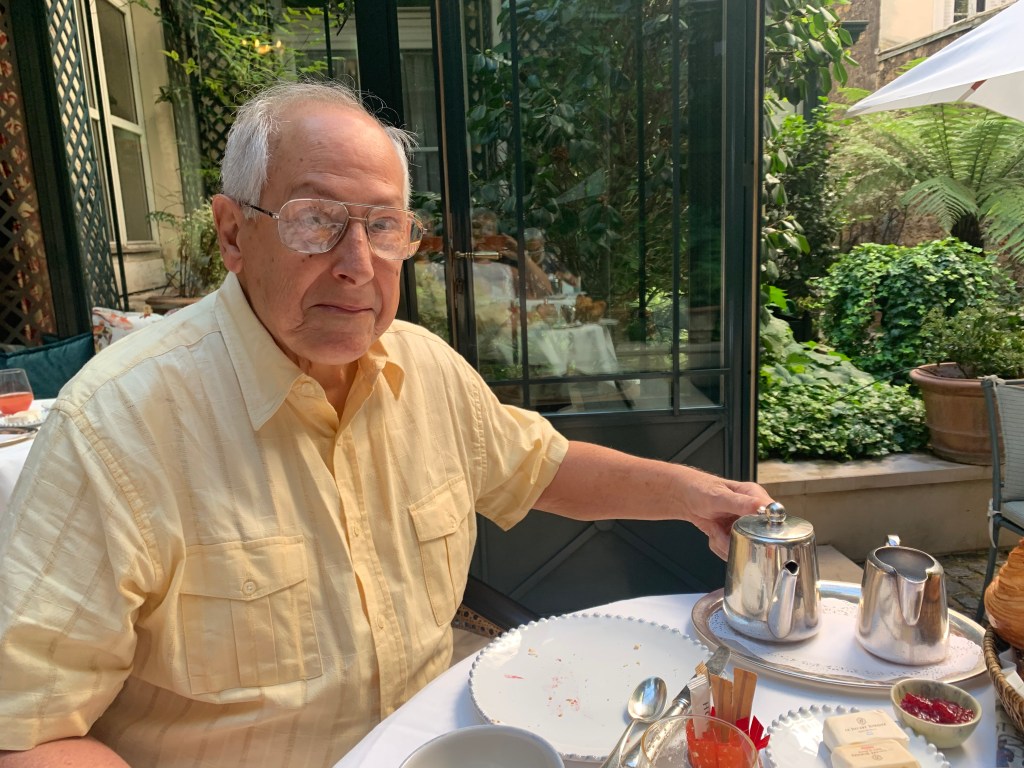
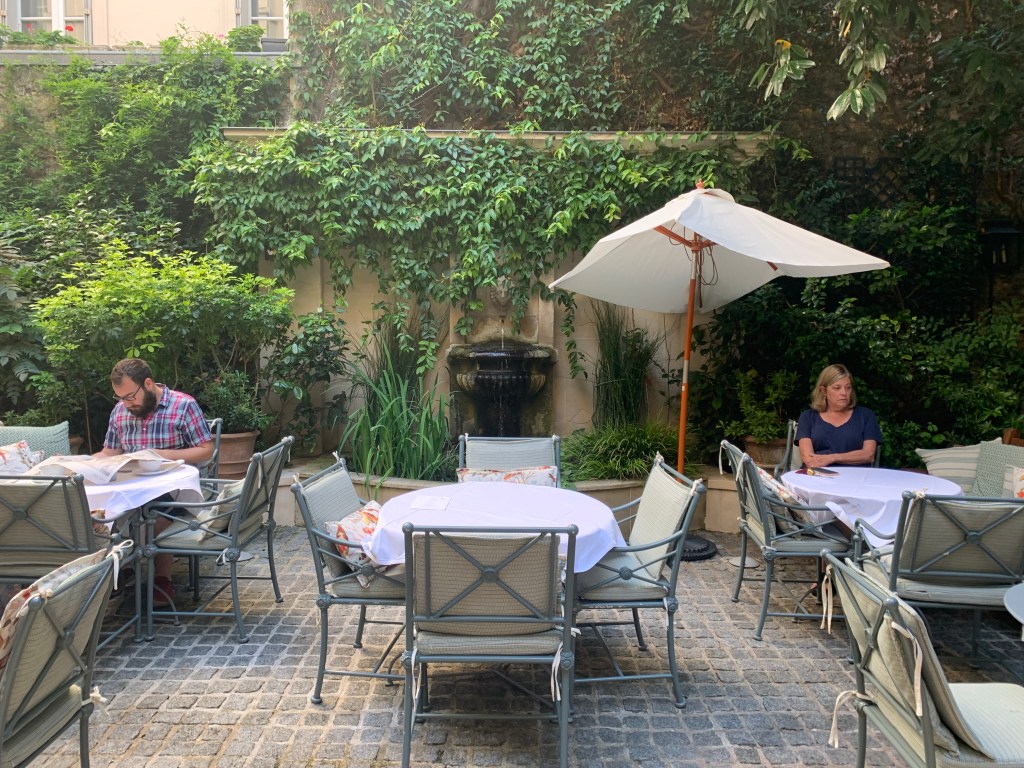
We enjoyed our courtyard croissant breakfast, then ventured out for a day in Paris.

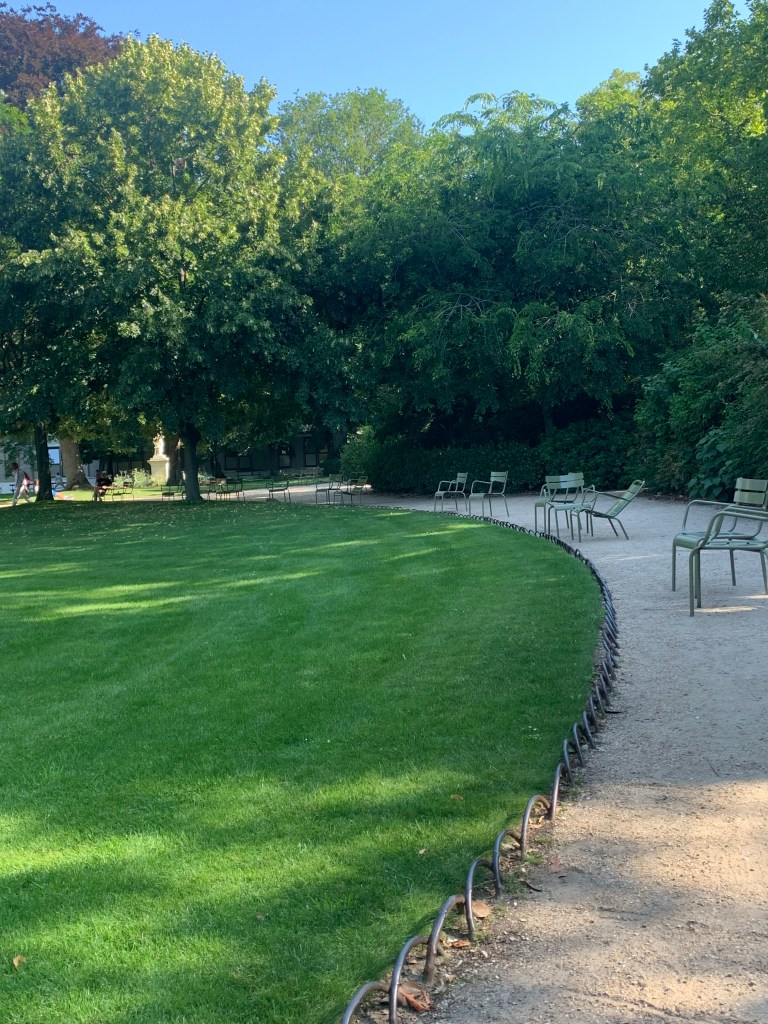
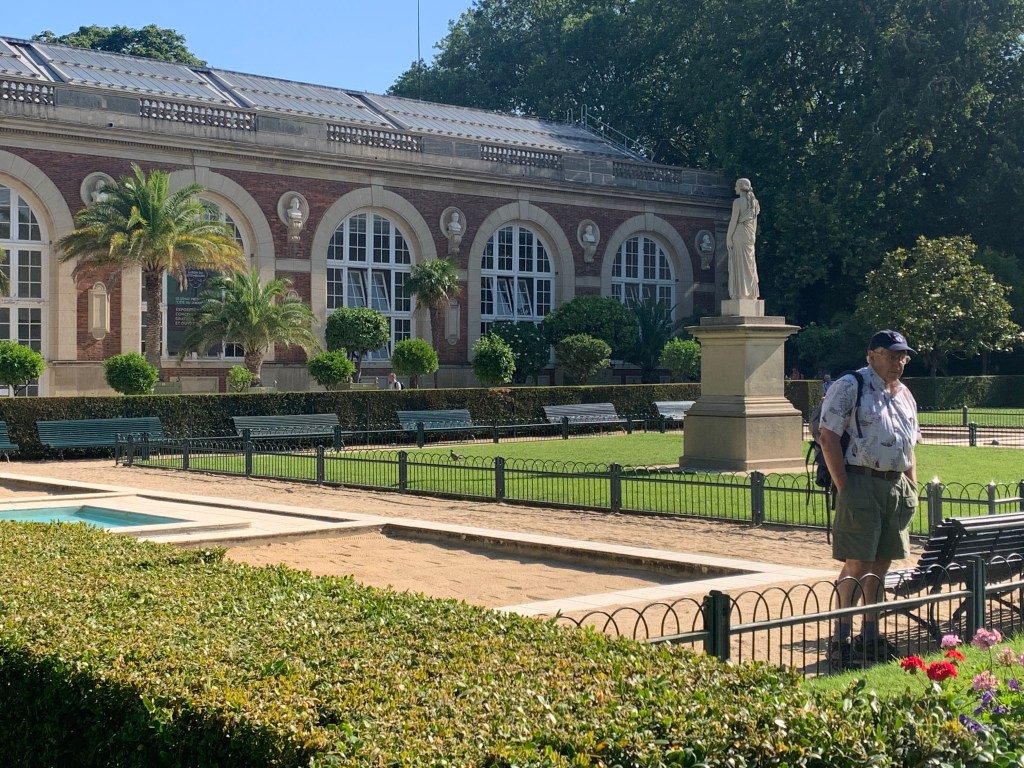
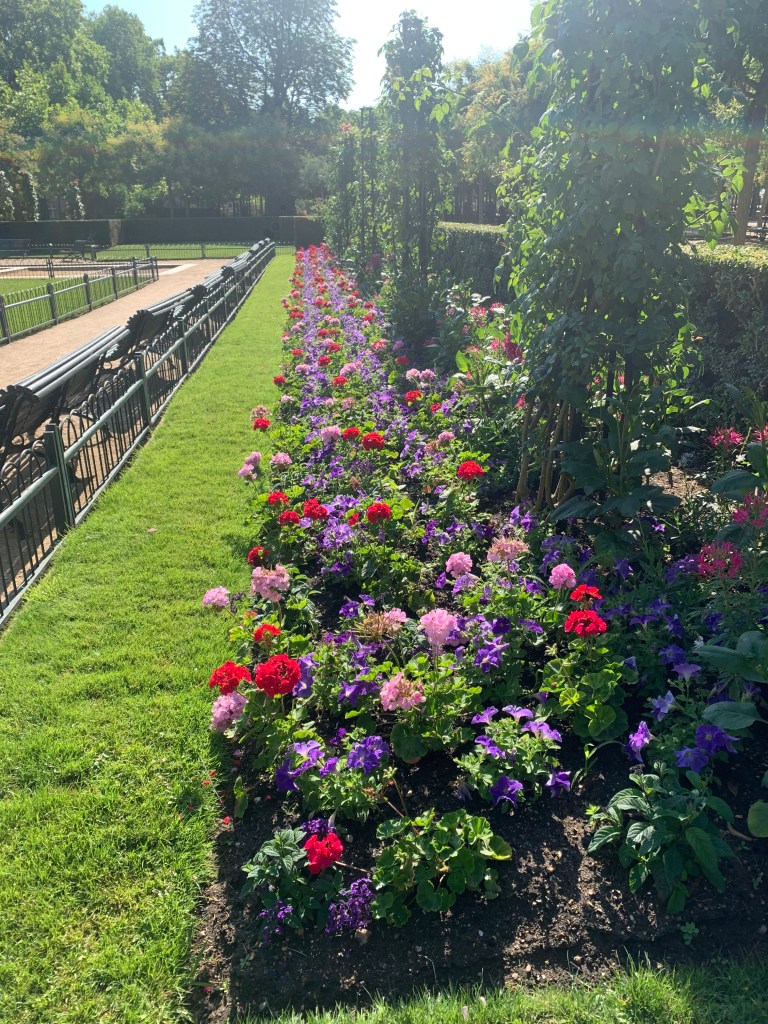
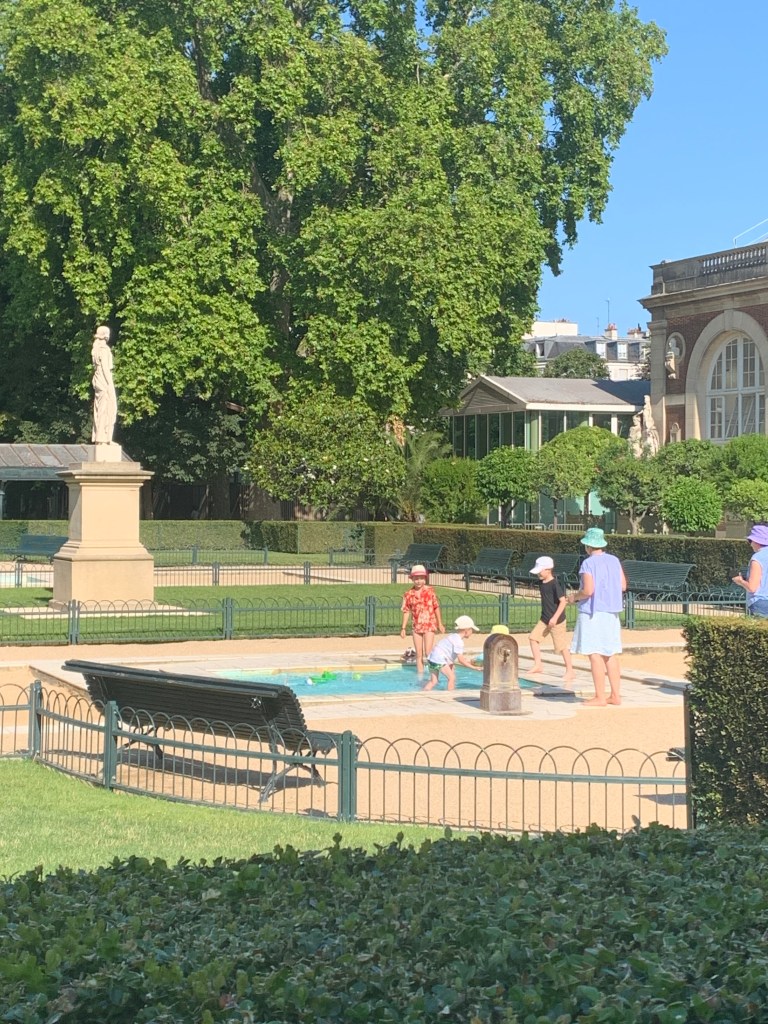
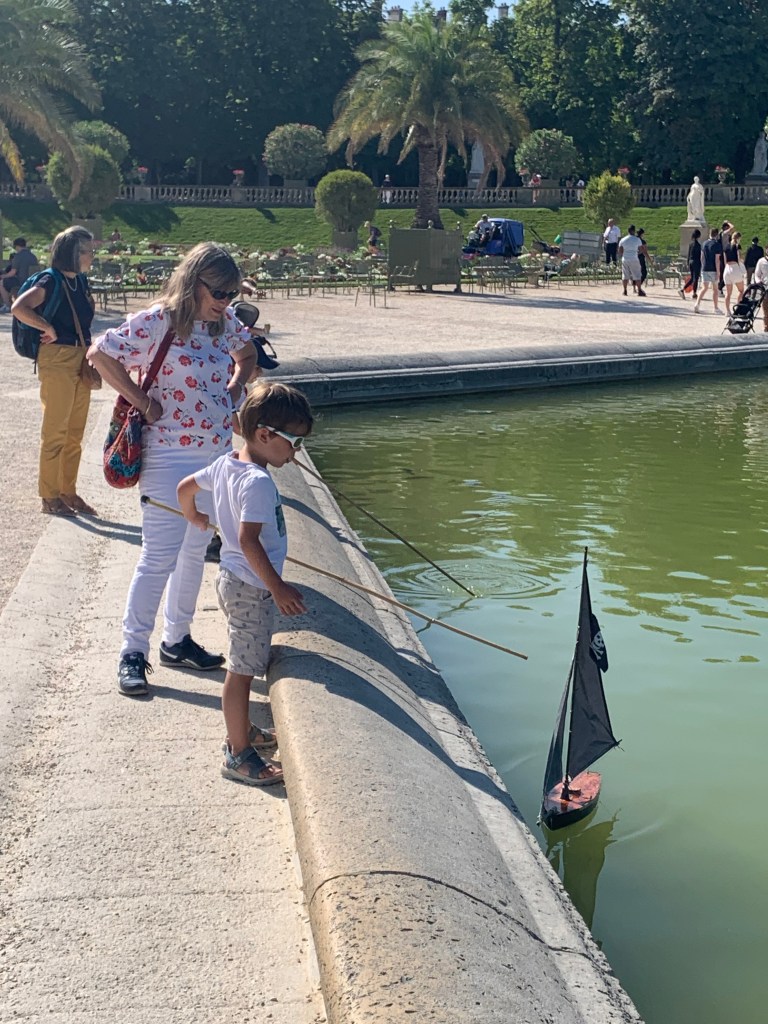
Our first stop would be the Luxembourg Gardens, just a ten-minute walk from the hotel. It was a lovely, clear, crisp morning with the Parisienne rooftops etching a graceful line against a deep blue sky. Tall iron gates at the corner of two streets gave us entrée into the gardens. They just seemed to go on and on. Wide sand-colored gravels pathways, shady wooded areas scattered with green metal chairs and benches, palaces, ponds, flower beds of every description, a wading pool and sandbox for the kiddies, and a round lake where two French boys about eight years old were sailing their homemade sailboats, prodding them long with sticks to set them in motion. We looked, we stopped, we sat, we meandered. One shady area was used by several different individuals and groups doing Tai Chi. Their exquisitely slow, graceful movements seemed to perfectly match the tranquility of the place.

We made our way across the park and exited on the other side onto the Boulevard St. Michel. Luckily, Santo has an insane sense of direction and an excellent memory from when we were in Paris five years ago. He led us across the Seine to Île de la Cité, past the front of Notre Dame, then along its northern side. From the front, the two towers were intact, but massive enclosed scaffolding encased much of the building. From the side, the damage from the 2019 fire was evident. Much of the roof beyond the towers had burned or collapsed. Reconstruction of the buttresses and vaulted ceiling was underway, but the enormity of the task was evident.

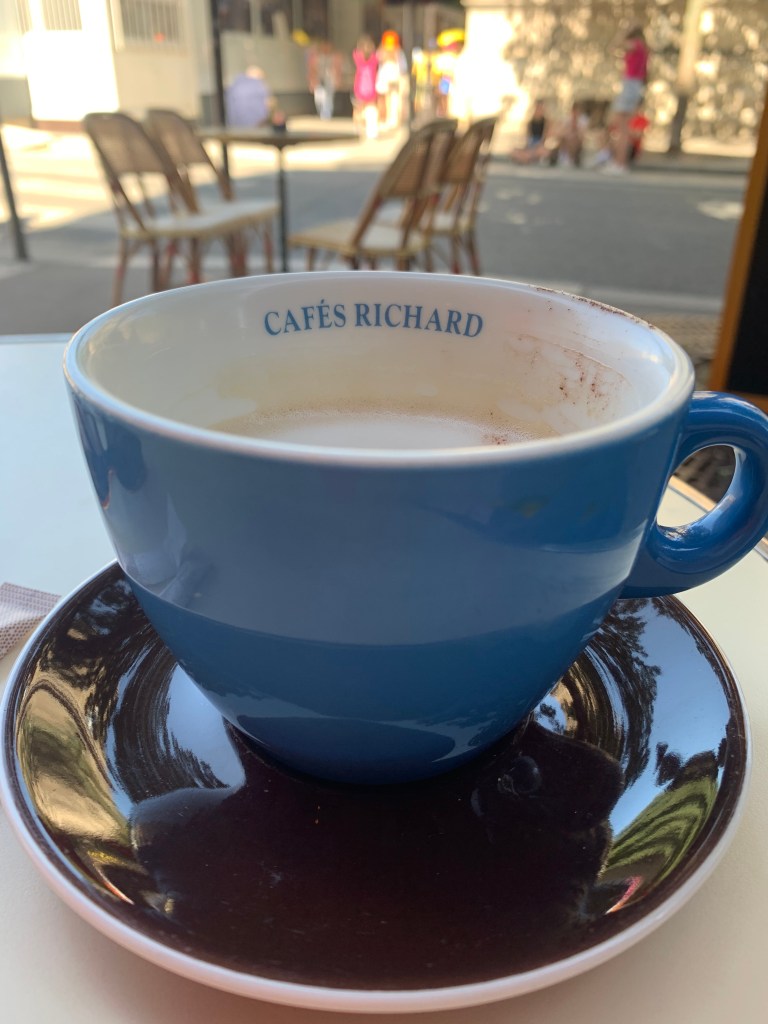
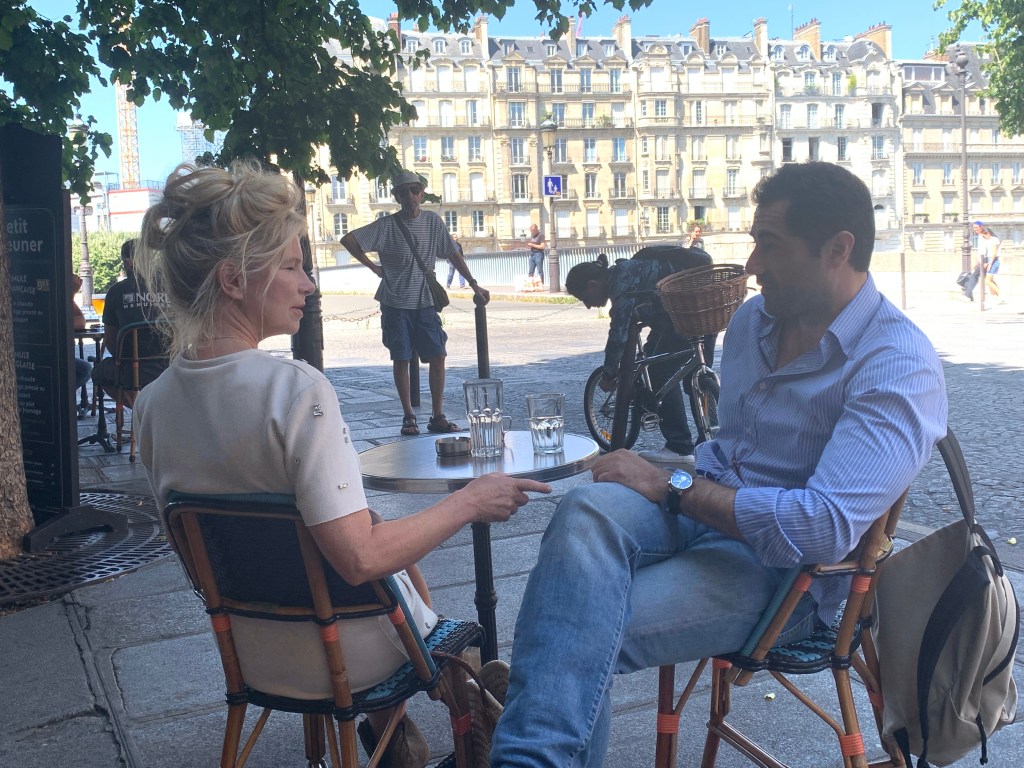
At the far corner of the cathedral was an inviting sidewalk café. The day had begun to warm up, so we decided to take a pause for some seats in the shade and welcome refreshment. I had a large cappuccino, Santo a lemonade, cold and refreshing in a tall glass. It’s what you do in Paris, right?

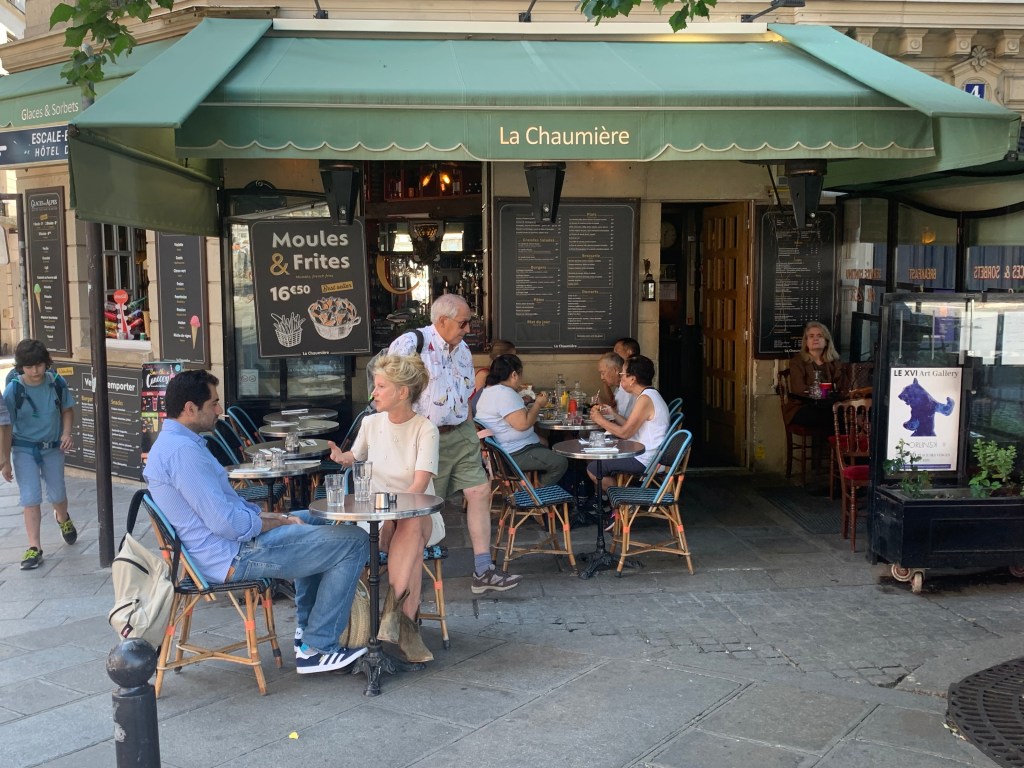
We continued from there in search of the café where Santo had enjoyed a most memorable meal of Moules Frites (mussels and French fries) the last time we were in Paris. It was on a day when I was sick and he had gone out on his own (what is it about me and Paris?). He had always wanted to bring me back there, so we planned to go for lunch. His nose led us directly there, just as he remembered, at a corner on the Ile Ste. Louis. We ordered the Moules Frites special and a side salad to share, as well as drinks. It’s amazing what they fit onto those tiny café tables! The Moules came in a large blue enamel pot, full to the brim, along with bread. My salad was large and delicious. It was more than enough for us both.

At the next table was a lovely family from England on a five week holiday through Europe. The oldest daughter had just graduated and was headed for uni in Manchester in the fall. The younger daughter was still in school. They had all planned the trip together and were crisscrossing Europe by rail to get to their desired destinations, including Verona, Berlin, Amsterdam, and more. The last time Santo had been here, he had met a couple from Australia. Travelling need never be lonely!

After lunch, we hoped to catch a cab back to the hotel so I wouldn’t overdo it on my first day out. We were not having any luck, so I said I thought I could walk it. But along the way, to my relief, we were able to hail a cab. The heat of the day and the exertions of walking several miles were taking a toll on my still recovering body.

Back at the hotel, since our room had not been made up yet, I set myself up in one of the lobby living rooms, on a luxurious red sofa facing a black marble fireplace. A waiter brought me a glass of ice water, and I was able to get some writing done there. From my vantage point I could see, just beyond the archway to the next room, a wall-sized painting of a woman lying in bed, floating in sea of pale, soft bedclothes. Her hand lay atop her brow, her head on the pillow turned to the left where an older gentleman stood over her with a look of concern. It was not hard to project myself into that scene!

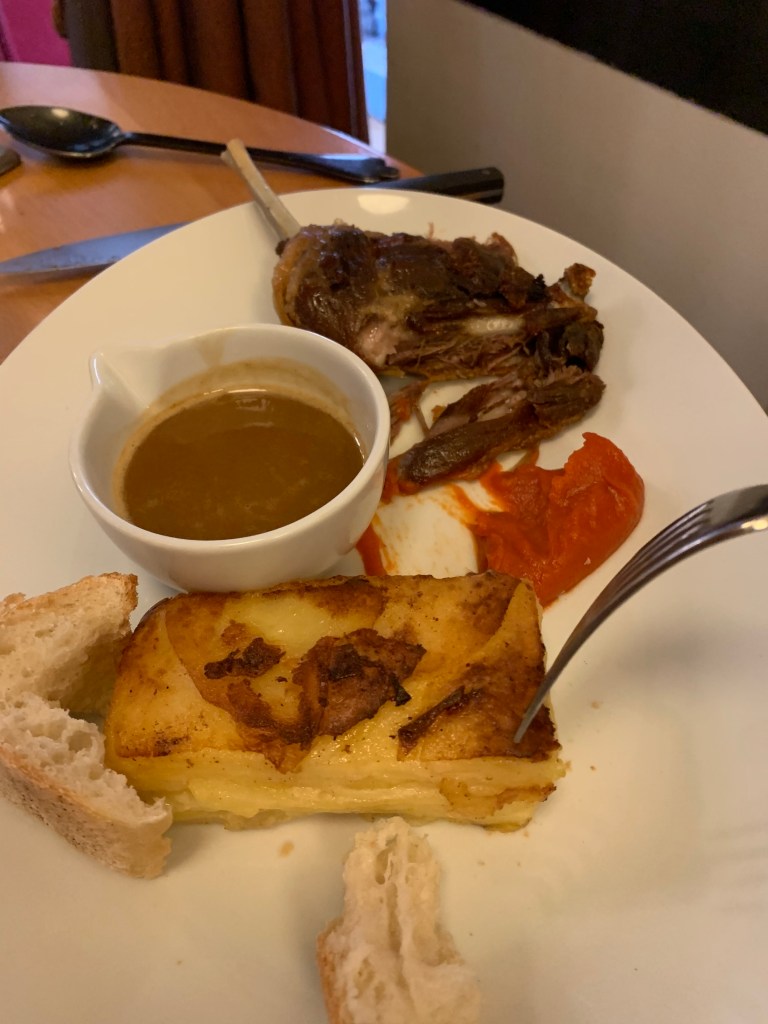
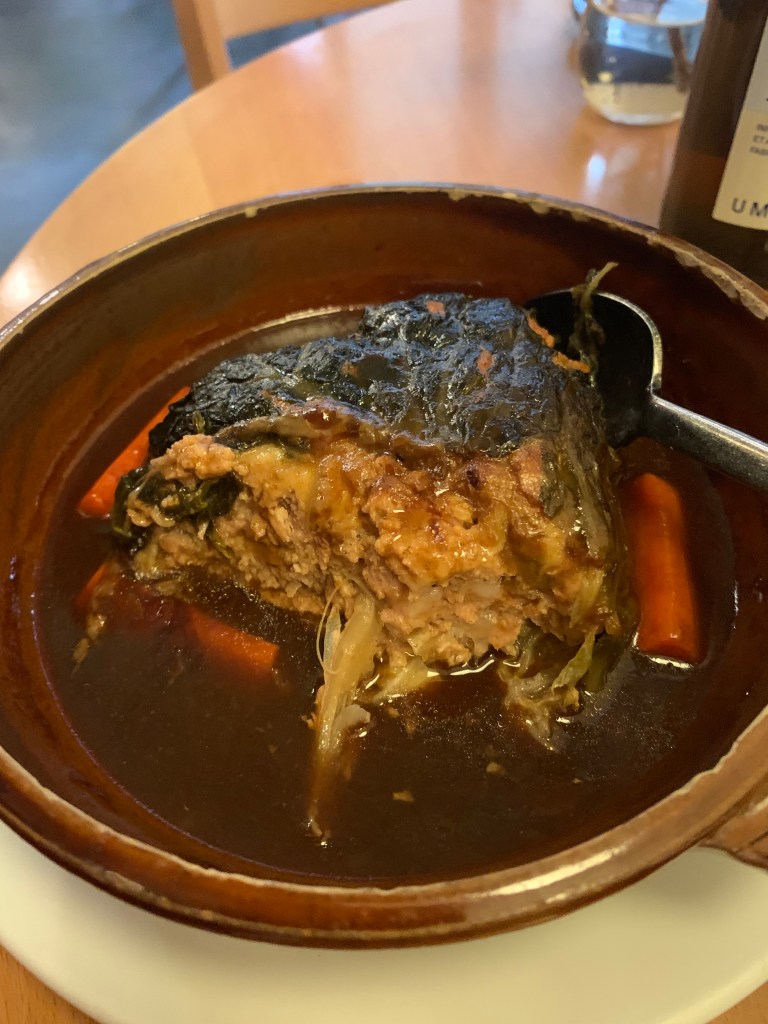
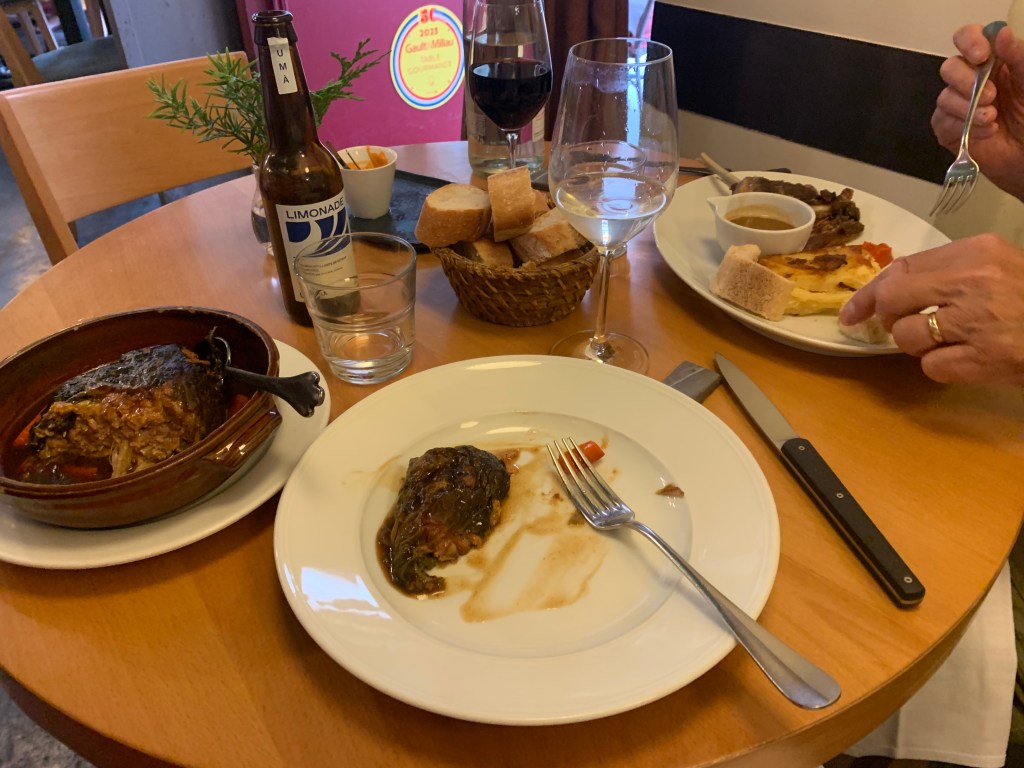
Once our room was ready, I went back for a nap so I would be refreshed for our evening: dinner at a restaurant not too far from the Eiffel Tower, than the much-awaited night cruise on the Seine. We took a cab to the restaurant, which I had found online, and it was excellent. It seemed like a place where locals went. The owner apologized that he did not have a table outside (there were only a few tables inside and out), but seated us at a lovely round table just inside the door where we were able to catch the evening breeze. I ordered the stuffed cabbage, listed on the menu as being from the chef’s grandmother’s recipe. Santo had the classic French duck confit.

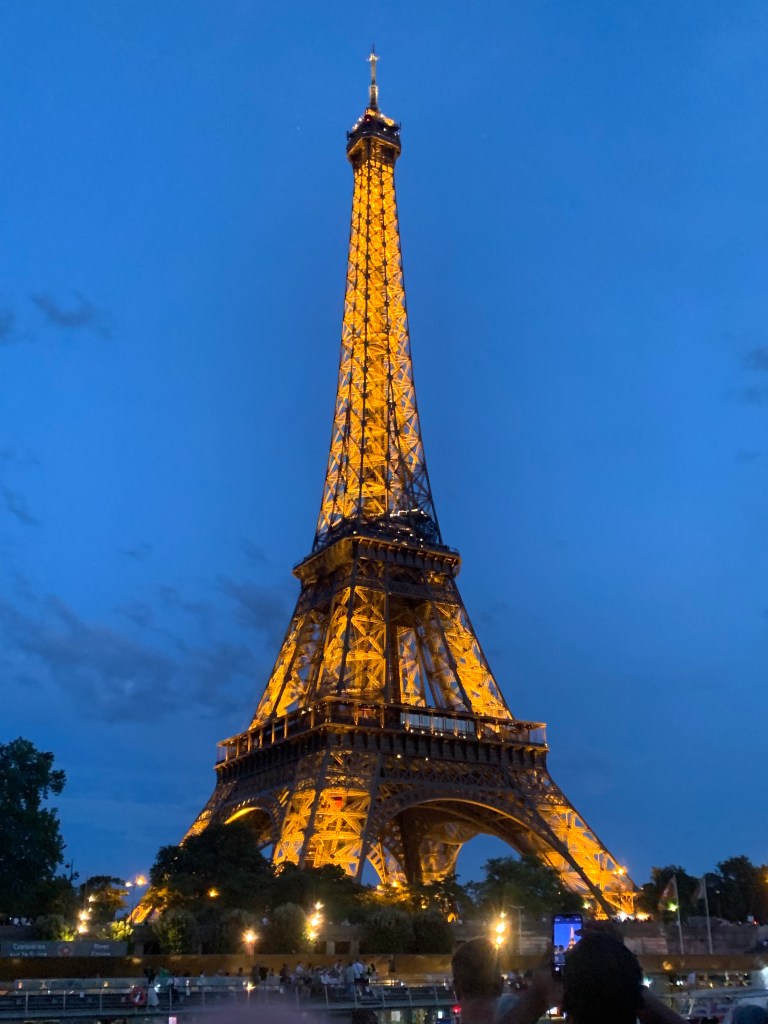
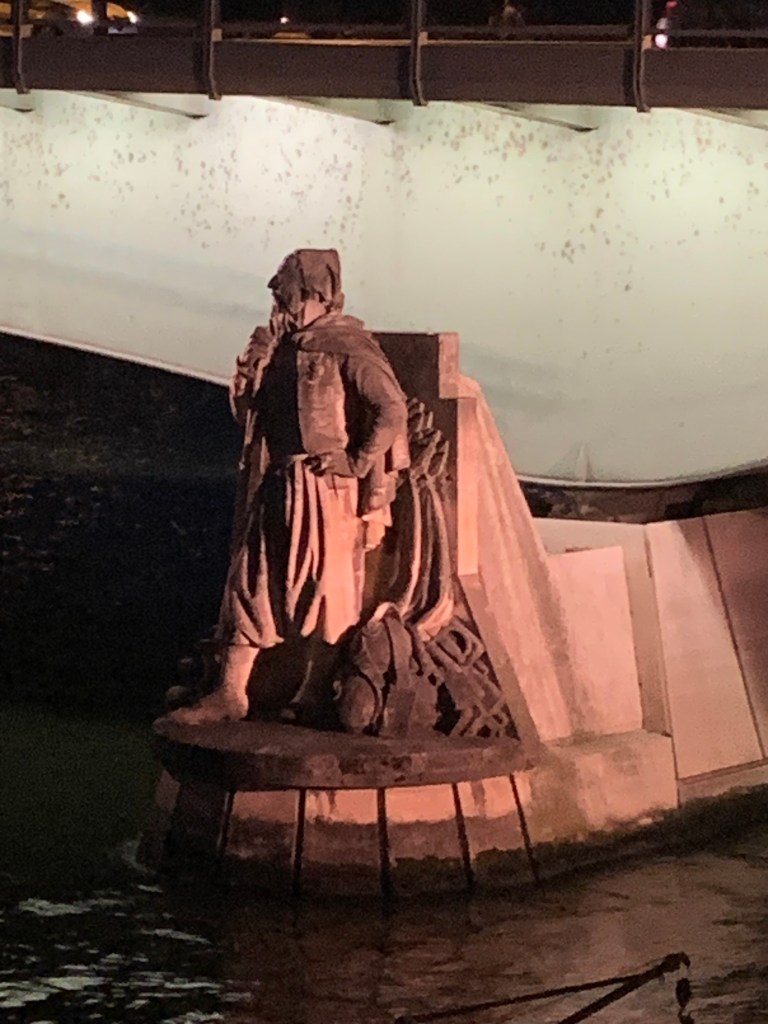
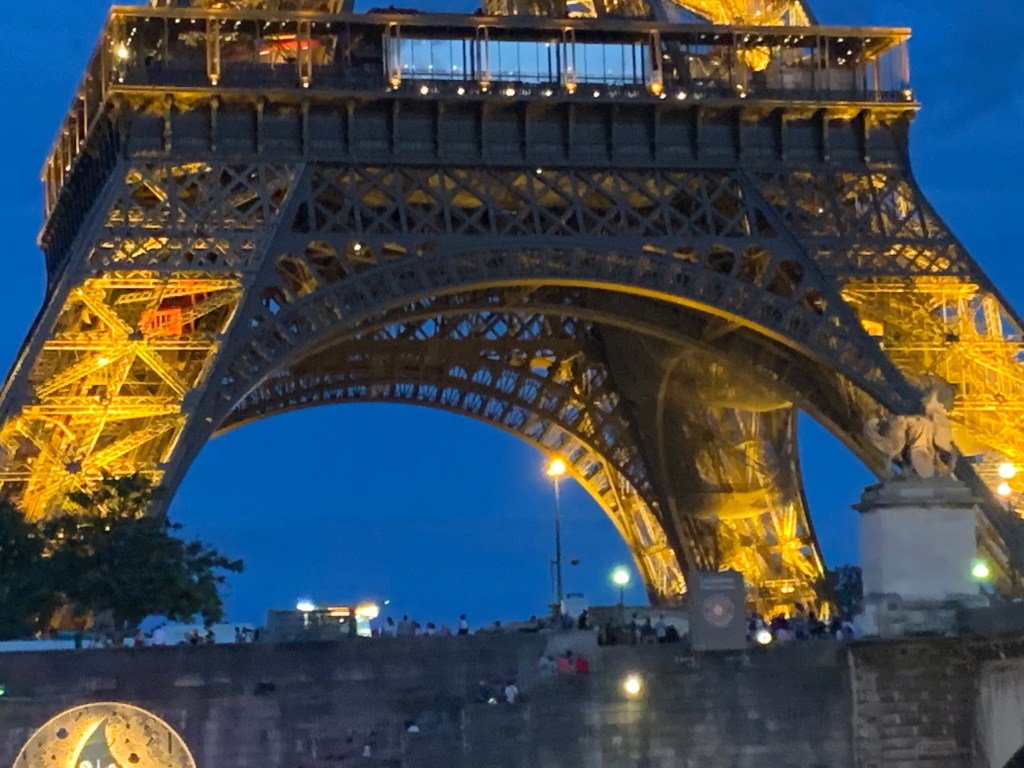
After dinner, we walked along the Champ du Mars, a greenway extending about one kilometer from the Ecole Militaire to the Eiffel Tower. The quay where we would get our cruise boat was another kilometer or more away on the other side of the river. The air was still warm, but there was a lovely breeze. We made it to the ship for a 9:30 departure, a perfect time with sunset coming at 9:54. We sat on the top deck, taking in all that we loved about this city as we made our way back down towards Notre Dame, around the island, and back up the Seine towards the Eiffel Tower just as the lights were coming on. It never ceases to be magical.

After some initial frustration, we were able to get a cab back to the hotel. We had gotten, together, at least one day in Paris. It was lovely. And it was enough. I went to bed grateful, but still wishing I felt a bit better. Maybe tomorrow.

Day 15 – Monday, July 10

When dawn came (I can’t say “when I woke up,” because I didn’t sleep), I couldn’t wait to get out and find someone in Paris who could help me.

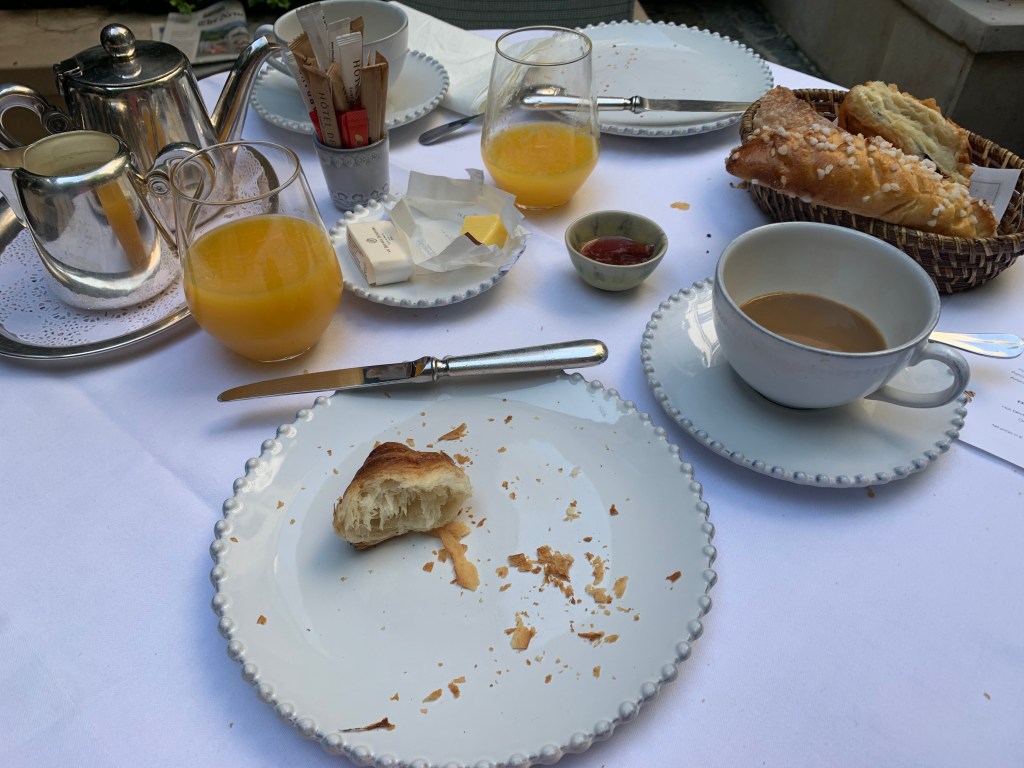
Our breakfast in the courtyard was lovely: croissants and fresh rolls, coffee with warmed milk, orange juice, yogurt, fruit, and granola. I enjoyed it as best I could.

We stopped at the desk to ask about a pharmacy or urgent care center. They suggested trying the pharmacy first (pharmacists in France can diagnose and even prescribe for some things). If the pharmacist couldn’t help, they could refer us to a medical facility.

It was short walk through our lovely St. Germain neighborhood on a crystal clear blue sky morning to the pharmacy. The lovely, young Asian pharmacist asked me many questions, trying to get a clear picture of what was wrong. First she suggested some medication, but when she found out I had been sick for eight days, she thought I should see a doctor. We got directions to a place that had urgent care and set out. It was a hot day, I was tired, feverish, and coughing, but I felt I was finally going to get some relief. Unfortunately, we turned the wrong way out the door of the pharmacy and had gone about 20 minutes before we realized we had to go back to where we had started, then 10 minutes in the other direction. Hope propelled me along.

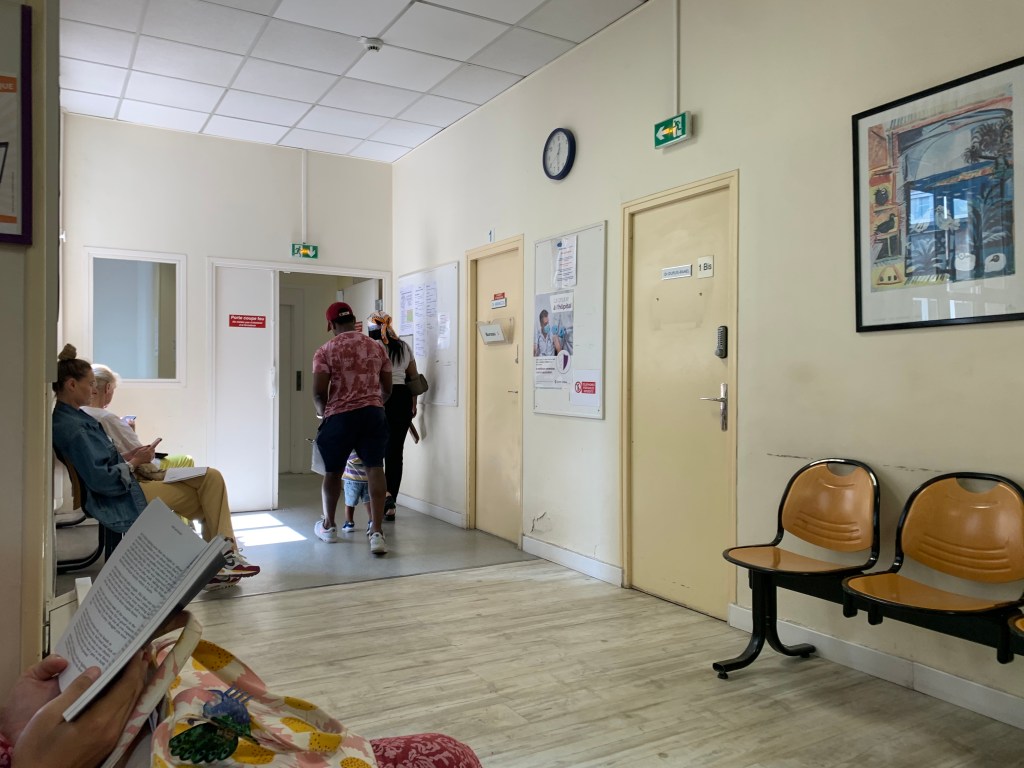
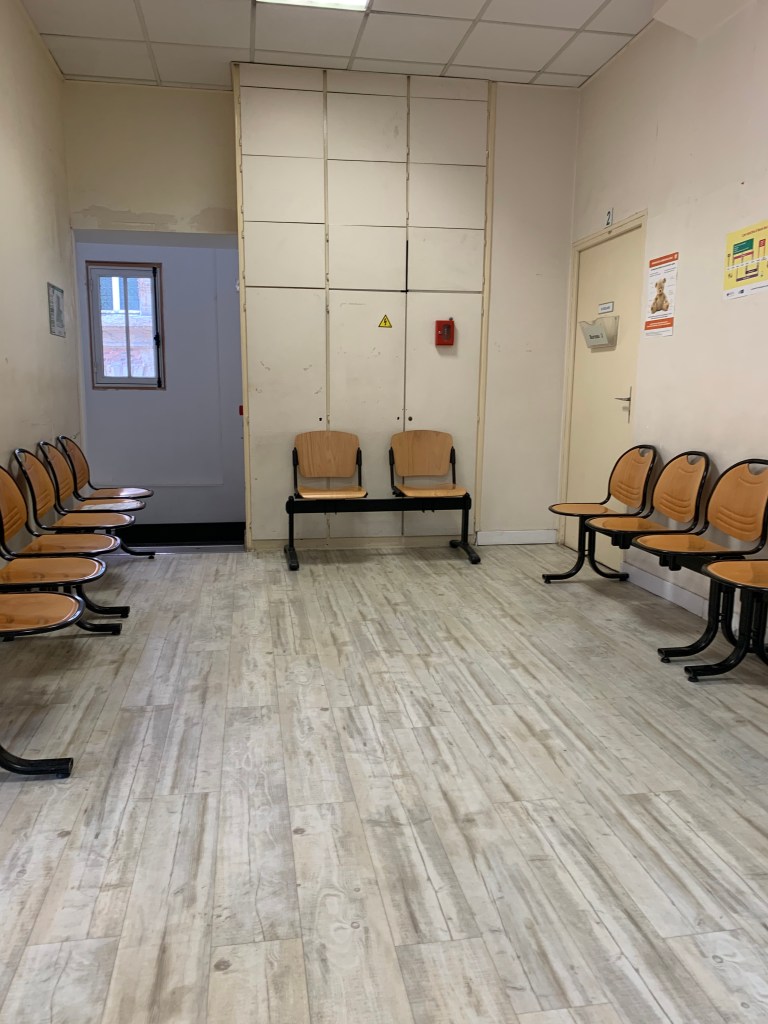
The clinic was located in an old building that took up an entire block. The main entrance led into a courtyard, and we followed signs to the clinic entrance on the ground floor. I explained my situation to the woman at the desk and she directed us to the elevator. “My colleague on the 1st floor can help you.” When we got out of the elevator, the stark and somewhat grungy room was lined with worn plastic chairs. An L-shaped counter had four numbered windows. There was a machine, like the ones at the DMV, where you select what you are there for, then take a ticket and wait to be called to a window. Since I didn’t know which ticket to take, I didn’t know where to go. Santo said to just ask one of the women.

I waited for one of the windows to be free, then asked the woman there if she spoke English. “A little,” she said. “Do you have an appointment?” I explained my situation again.

“So you would like to see a doctor?”

“Oui,” I said. “Is that possible?”

“We only have two general doctors. You will have to wait.”

“How long is the wait?”

“At least two hours.”

That’s when I broke down. I know now that two hours really is not at all an unreasonable amount of time to get emergency medical care, but hearing this released the tears that had been held back by the last shred of hope I had been clinging to. If the waiting area had been air-conditioned and comfortable, I knew I could do it. But sitting in this steamy room for two hours, at that moment, seemed unimaginable. I sat in a chair against the wall, Santo next to me, defeated.

The woman I had spoken with got up after a few minutes and went to one of the doctor’s offices. When she came back, she called me up and asked me for my passport. After taking my information, and a 25 Euro payment, she said that the doctor behind door number one (was this Let’s Make a Deal?) would be able to see me and I should wait for her to call me. I didn’t know if she had pleaded my case and I would be seen sooner, or if I would be waiting for hours, but waiting seemed the only thing to do in any case.

Less than twenty minutes later, a lovely middle-aged doctor in a white coat called me into her office (behind Door Number 1!), which was also the examining room.

“You need English, yes?” she asked.

“I do,” I answered. “I’m so sorry I don’t speak French. I am so grateful.”

Her English was halting, but competent. She listened to my lungs, but did no further examination, just questions about my symptoms, how long, etc. “We will take care of this,” she assured me. “I will give you everything you need.” She had smiling eyes, and was very sympathetic and patient. My angel of the day!

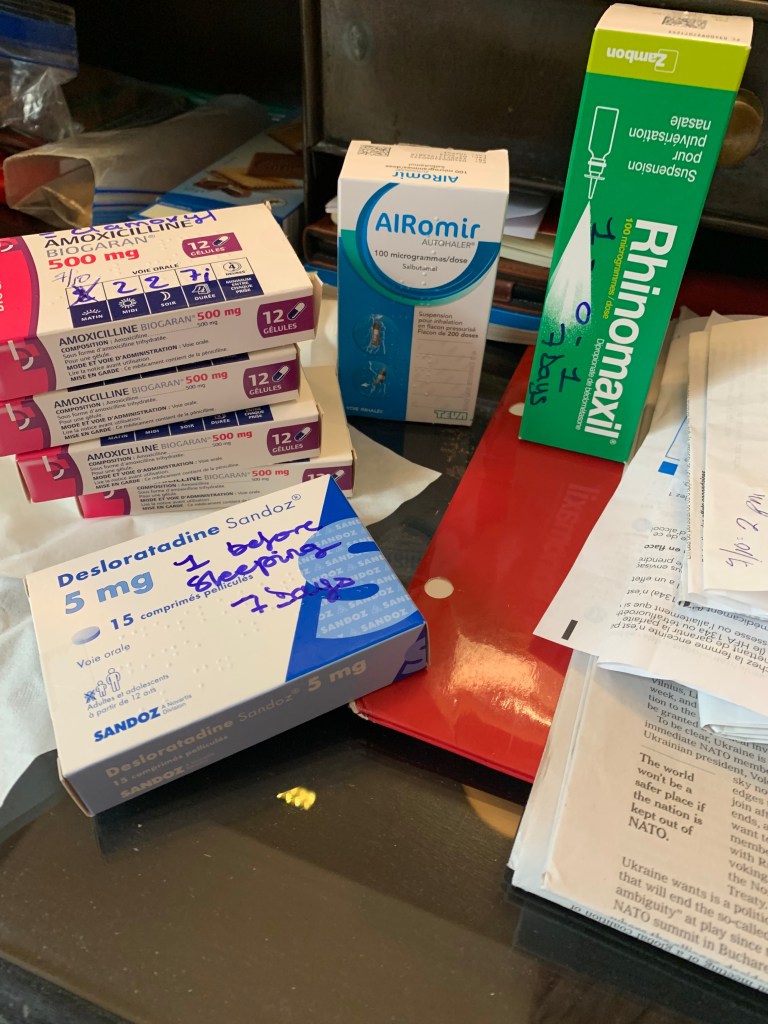
She prescribed an antibiotic (laughing out loud when I told her how we pronounce the word), an inhaler, nasal spray, and decongestant. “In two days,” she said, holding up two fingers, “you will begin to feel better.” I thanked her profusely, prescriptions in hand. We made the short walk to the pharmacy where the pharmacist filled the prescriptions on the spot, making sure I understood the dosing instructions.

Back in the hotel room, I took my medicine, changed into my nightgown, and crawled into the  cool sheets, hopeful that I might actually be able to sleep. I felt bad for Santo though. He loves Paris and was so looking forward to our time here. “I think I just need to rest for a while,” I said. “Later we can go out to dinner and do the night cruise on the Seine.”

“If we do, we do,” he said, “If we don’t, that’s OK, too. The important thing is for you to get better.”

“But I feel bad,” I said, breaking into tears again.

“There is no need to feel bad. I feel bad that you’re sick.”

“You go and enjoy the day,” I told him. “Get yourself some lunch, visit a museum, whatever you want.”

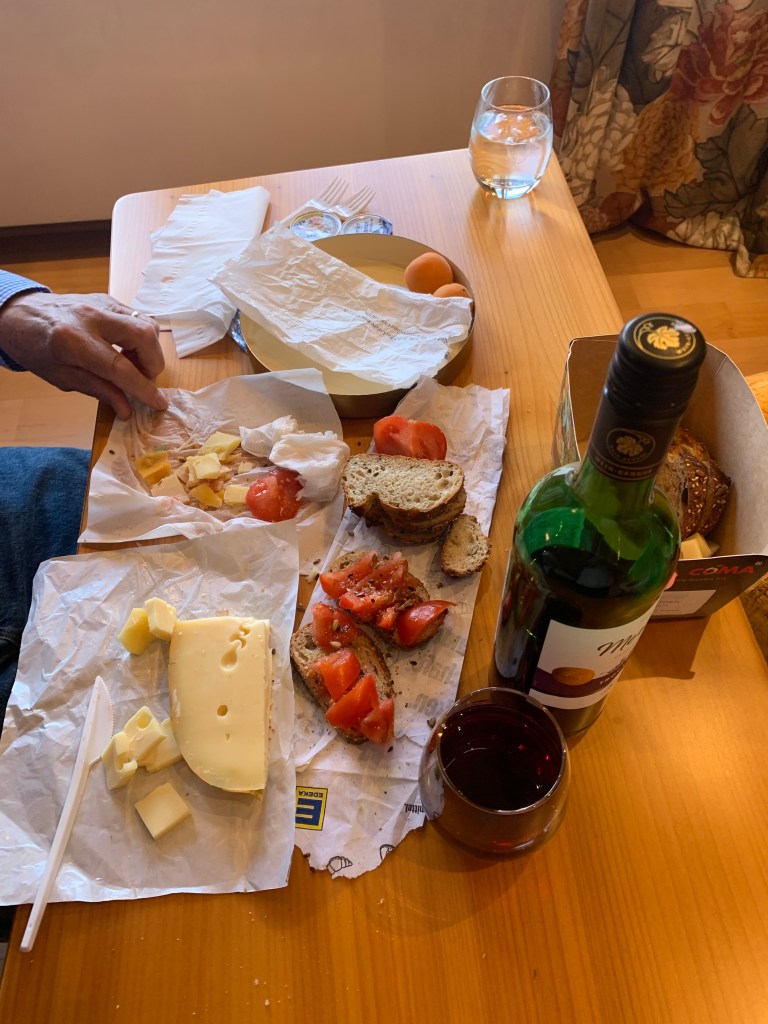
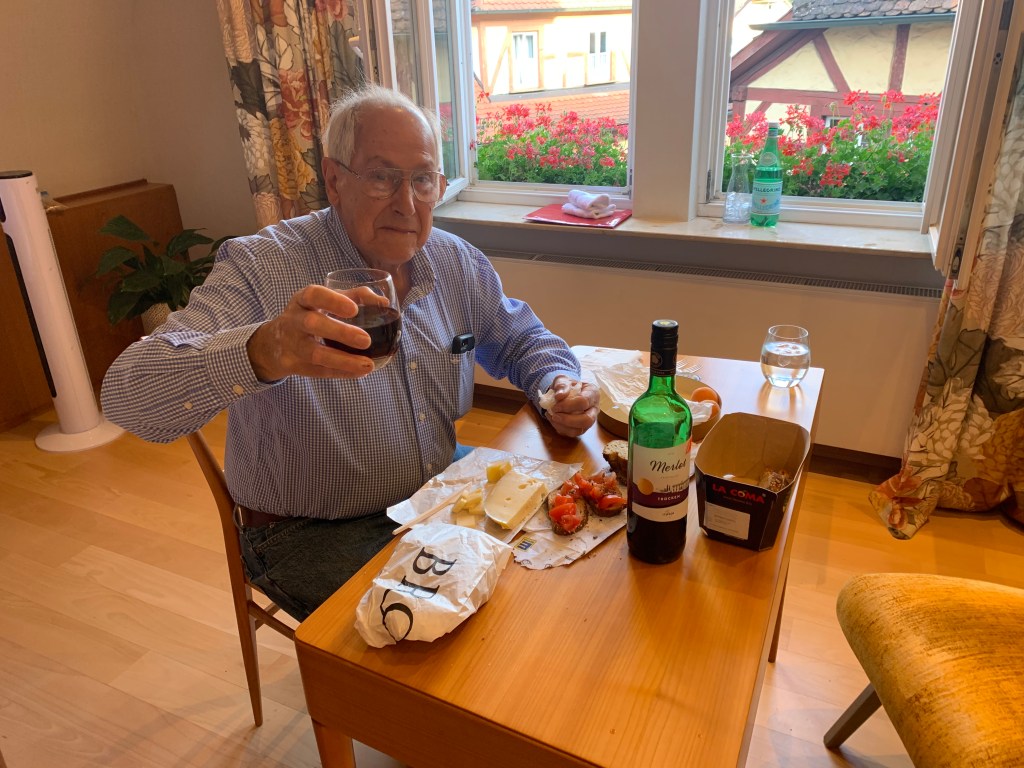
Even with the medicine, I still could not sleep in bed, so decided to sit up and do some writing. About an hour later, Santo texted me that he was having lunch at a sidewalk café and sent pictures of his choices. I was so glad he was enjoying a good meal and being out and about in Paris. In another hour, I was getting really weary and decided to try to sleep again. Just as I was getting into bed, Santo came back. He would rest in our solarium while I tried to sleep and heal. He had purchased tickets for the night cruise from the hotel that could be used any time. He had also brought back bread and cheese, so we could stay in for dinner, then enjoy the cruise.
I finally was able to get some sleep. When I woke up, Santo was writing at the small table in the solarium. He smiled, “You finally got some sleep!”

“Yes, thank God,” I said. “I’ll freshen up in a few minutes.”

“You’re not going anywhere tonight. You need to keep resting. We can do the cruise tomorrow night if you’re up for it. The most important thing is for you to get better.”
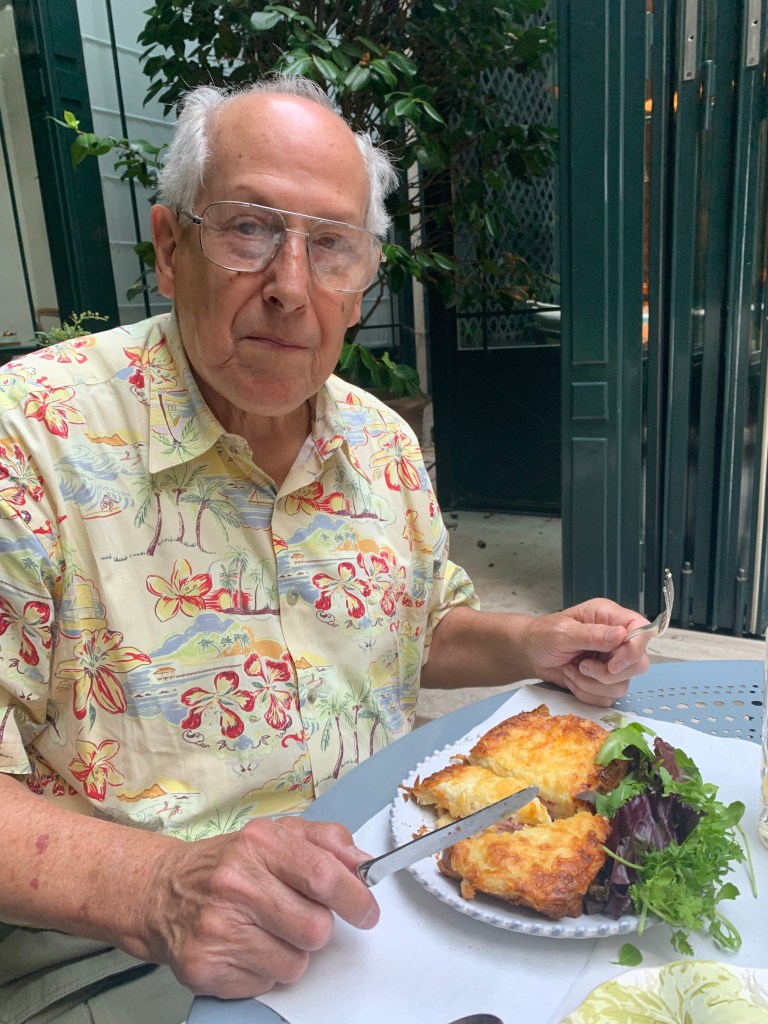
As much as I hated to spoil the evening for Santo, I was very relieved not to have to get up and out. We enjoyed our French picnic (we were getting very good at these European picnics), I took my medicines, Santo sipped wine from the bottle he had purchased, and we enjoyed Paris as best we could.

Day 14 – Sunday, July 9

Our final breakfast on the terrace at Schloss Berge with our favorite waitress. She was so excited for us that we were going to Paris, almost swooning when I told that was where we were headed. I put my hand on my heart and said, “Wir bringen Sie mit.” (We’re bringing you with us.) She clasped her hands under her chin, smiling and making a tiny bow. There were promises about “nächstes Mal” (next time) and seeing one another again. It didn’t matter that we knew that were not true; it was the heart’s desire that mattered.

The cab we had ordered the night before arrived early and we were on our way to the Oberhausen train station before 8 am. The day promised to be even warmer than the one before. This cab, finally, was air-conditioned, so I had hopes for a more comfortable day.

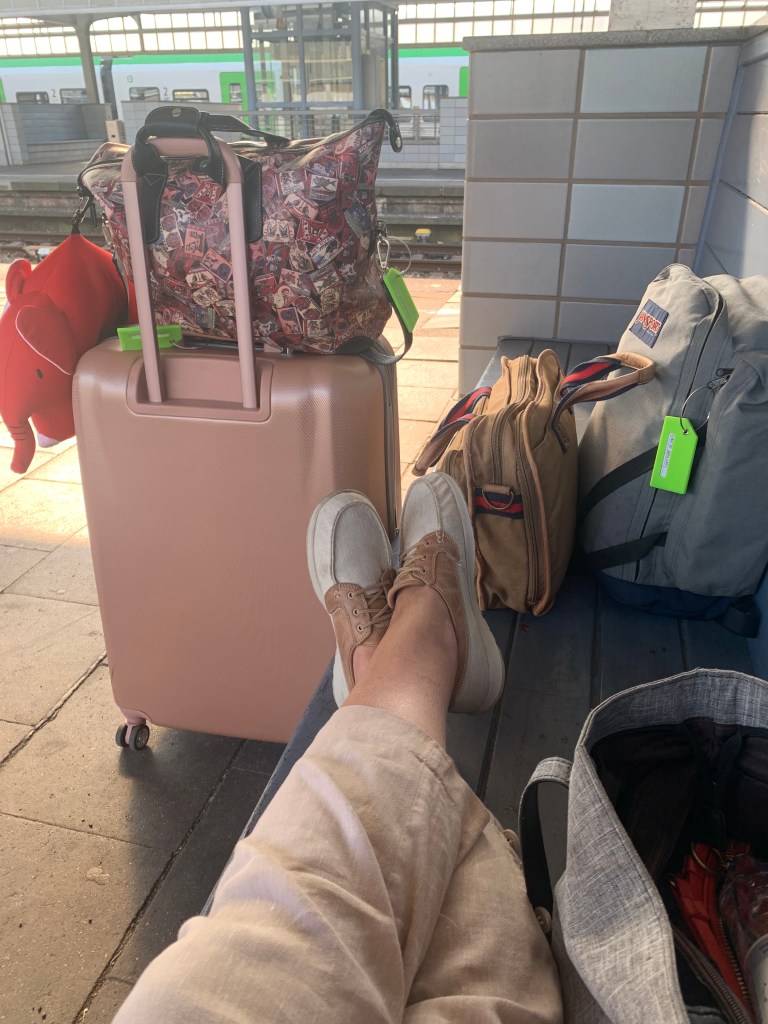
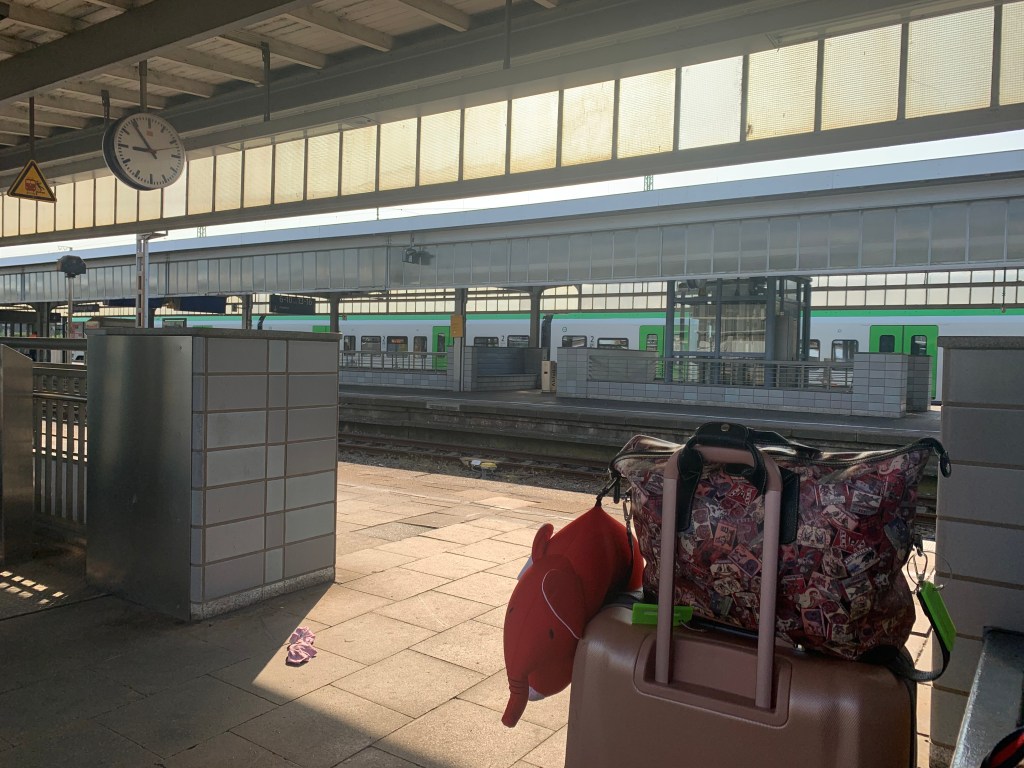
About 15 minutes and 80 Euros later (cabs in Germany charge extra for trips on the Autobahn), we were at the station and on our platform 1 hour and 45 minutes before our train. The desk clerk at Schloss Berge had suggested leaving at 8 am, so we had agreed, even though I thought it was awfully early. We found a long bench in the shade, settled our bags around us, and waited. We strategized about the best way to get all six bags onto the train: Santo would board first with his two small bags, I would move the larger bags to him and help him left them up and into the train, then I would board with my two small bags.

When I checked the electronic sign on our platform, I noticed Wagen (car) numbers for our train and letters which corresponded to large letter signs along the platform: A, B, C, D, E. We checked our tickets and realized for the first time that we had assigned seats. We were in Wagen 37, Seats 93 and 95, and should stand at letter E. This was at the far end of the platform, so a few minutes before the train was scheduled to arrive, we made our way there. When the train got there, we did not see any Wagen numbers, but I did notice on the car that pulled up in front of us the Seat Numbers 59 to 99. “This must be us,” I said to Santo. Luckily, I knew to press the button to open the doors. We knew the train would not stop long, so in the rush our well-laid plans went awry and we scurried to get everything up the steps and into the car. Somehow we did it!

Our seats were in the first compartment on the right. There were 5 seats, and 3 young men seated there. One was sleeping, but the other two were quick to help us with the heavy luggage. He managed to lift Santo’s garment bag, along with our hand luggage, up to the overhead rack. The largest suitcase we were able to place against the wall just outside the door and out of the way of the aisle. The young men moved so we could have our assigned seats: one by the window and the one next to that. They spoke perfect English and after thanking them profusely, we chatted for a bit. They asked if we had children, and I told them a son who was 30 and a daughter who was 26. “Those are exactly our ages!” one of them said.

The car was not as cool as I would have liked, but manageable. I was very tired, but was not able to sleep. This leg of the trip was only 2 hours anyway.

Changing trains in Frankfurt, we again strategized about the luggage. Several people were in the vestibule waiting with us and everyone offered to help. People are so nice. When the doors opened, before I knew it a tall black man lifted my suitcase and handed it down to Santo. Just like that we were on the platform. Our next train was two tracks away. We just needed to go to the end of our platform and over two tracks—all on the level.

The Frankfurt train station is large and open, so the warm air that clung to us from Gelsenkirchen continued to smother us. We found seats at a tall table, mostly for a place to drop our luggage while we waited. Santo went in search of food. I was too hot to eat. The train was at the platform early, so we made our way down to our assigned car number. We were lucky that just inside the doors was an area for large luggage and we were able to store both of our large bags as well as our carry-on luggage. We had two forward facing seats with plenty of legroom. Everyone else on the train, including Santo, seemed comfortable but I was still dripping with sweat. I felt like I had been waiting to get SOMEWHERE cool forever. Would it ever happen? My hopes were on Paris.

Our high-speed train traveled at over 300 kmh (that’s 186 mph) and got us to Paris in four hours. Since Paris was the last stop, we waited to get up and retrieve our luggage. Again, people around us were helpful and we were on the platform and on our way in no time. Cabs were waiting just outside the station. Next stop: Hotel de l’Abbye in St. Germain, our splurge accommodation.

Driving through Paris on our way to the hotel we were again overcome with the sheer beauty of this city. It is without equal. Street after street of light-colored buildings with wrought-iron French balconies, and enormous double doors painted in rich gem tones (deep greens, reds, and blues) that gave entrée to the inner courtyards. Sidewalk cafes dotted every block: beige-and-brown patterned chairs with bentwood backs and small round tables that seem to expand to accommodate whatever was ordered. All under the shade of striped awnings.

The hotel was on a narrow street. Gates opened to a courtyard with iron two tables and a red carpet leading to the double glass doors. At last!

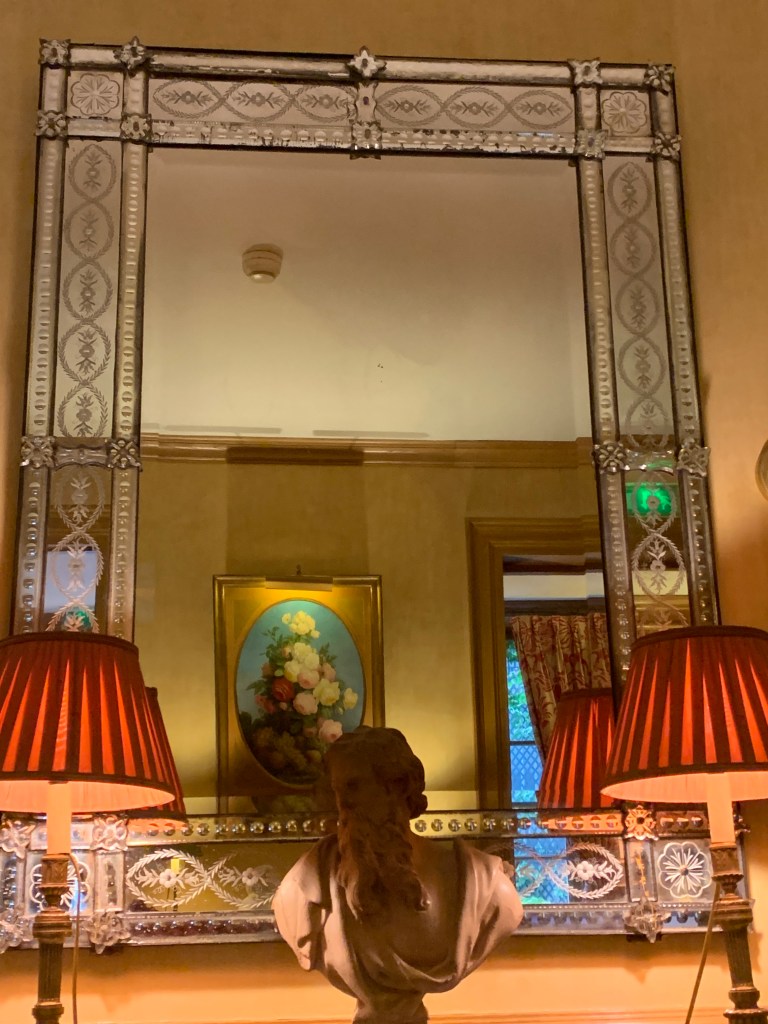
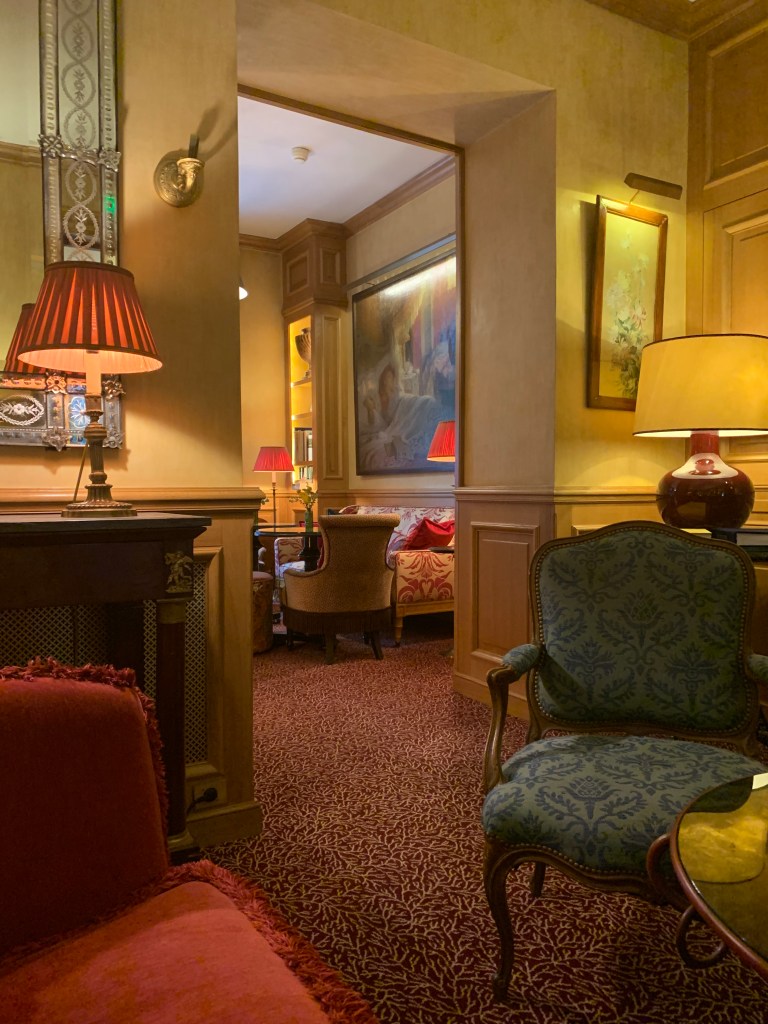
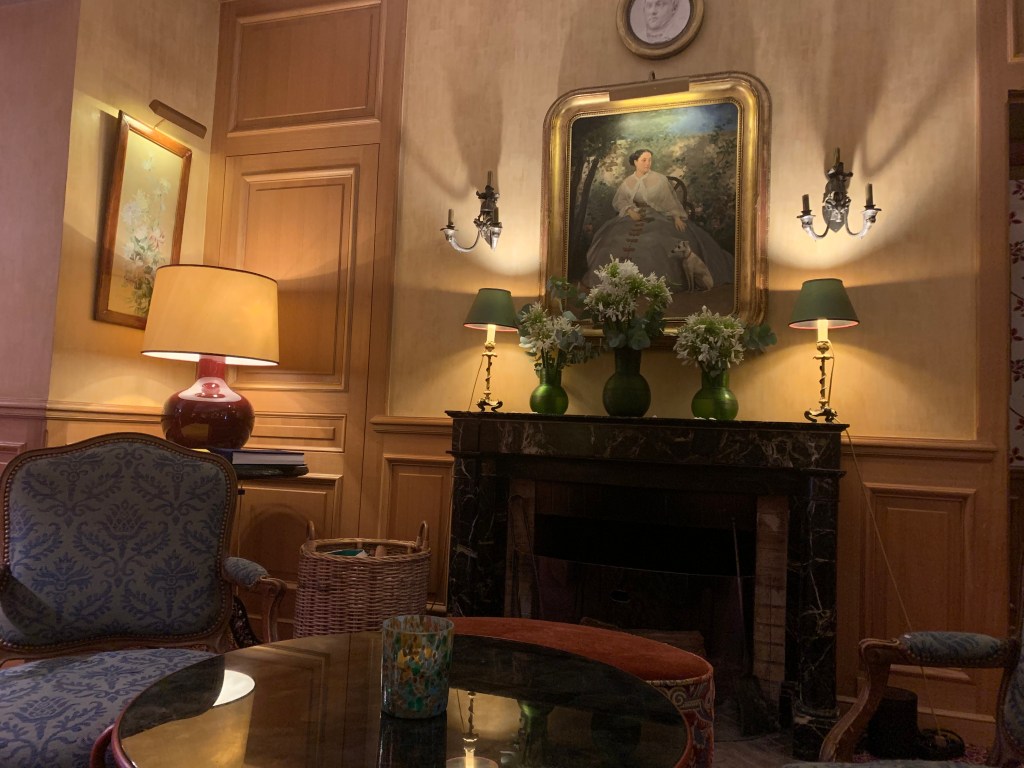
Inside, everything was warm, welcoming, and elegant, including the staff. Several small “living rooms” made up the lobby, each with an intimate seating area of sofas and chairs, wall sconces, small lamps with striped shades on marble-topped tables, and café or coffee tables. The walls were of pale cherry wood, outlined with simple and elegant moldings. Original paintings with lighted frames lined the walls. Deep burgundy and gold carpeting tied all the rooms together and added to the overall feeling of ease and comfort.

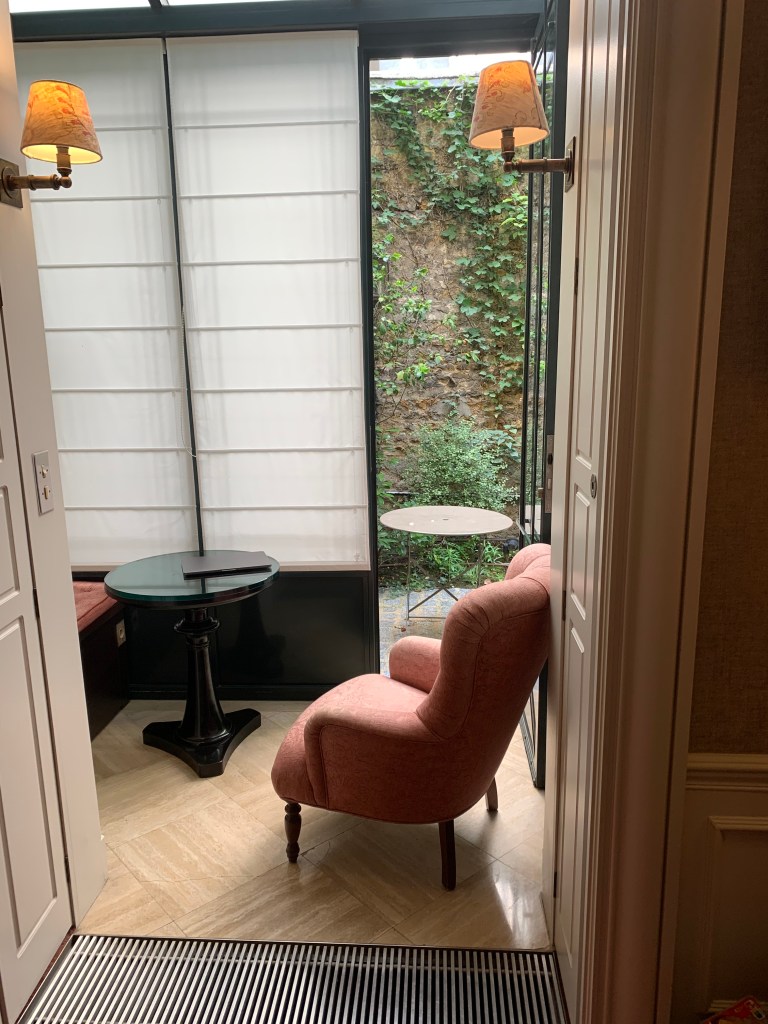
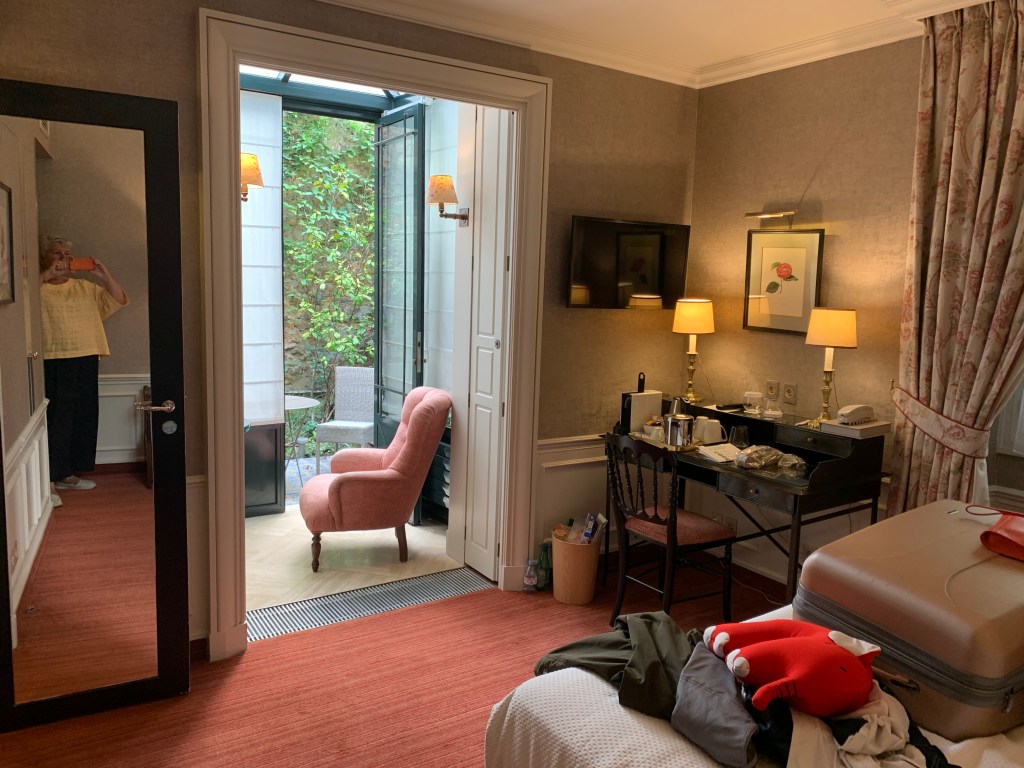
The desk clerk and another man helped us get our bags to the room, a first floor chambre that opened onto the interior courtyard. The room had the same genteel tone as the lobby areas. It was not as large as we had expected, but it had a solarium that opened directly onto the courtyard furnished with a cushioned wall seat, a small table, and a comfy chair. And, blessedly, the room was air-conditioned! “Not as cool as you have in America,” the clerk said, and then showed us how to turn it to the coolest setting. As soon as he left, I collapsed onto the bed’s cool pillows. I had been waiting so long for this moment!
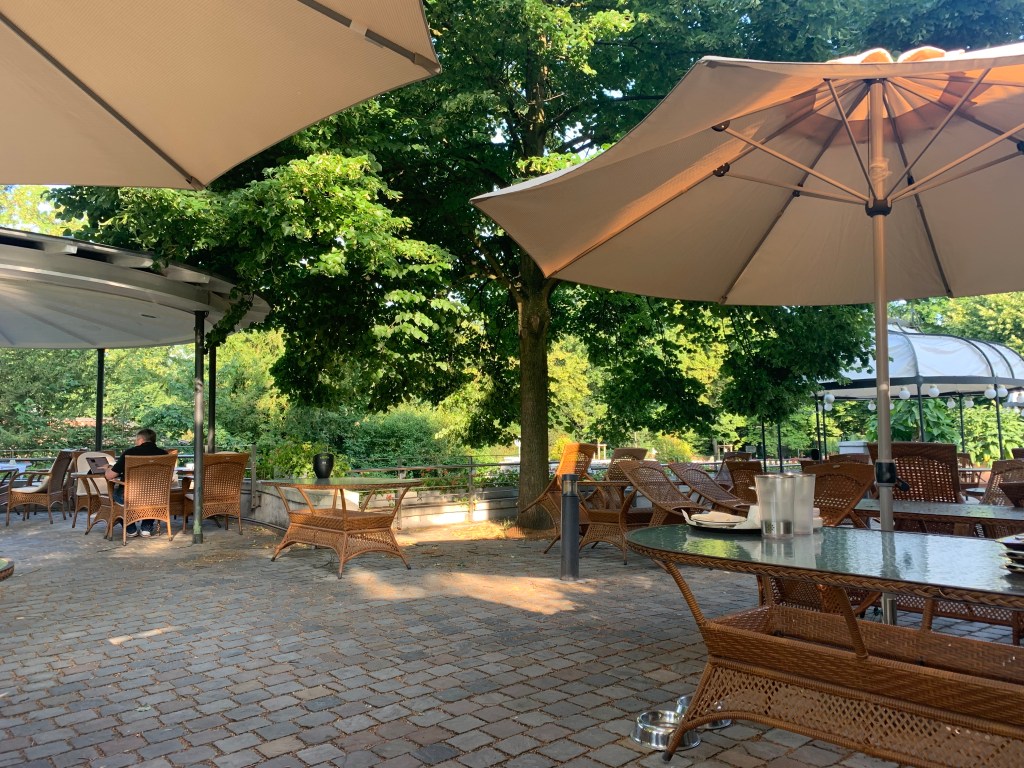
We decided to eat at the courtyard café of the hotel; I could not think of leaving this comfort until at least the morning. The café served light fare, which suited us perfectly. Santo wanted to eat right away, but I needed a shower and change before I would be ready to face the world. The walk-in marble shower was marvelous. Even though I had trouble understanding the complicated instructions for operating the rain head, hand held, and side jets, I managed to get the cool water I needed to come out of the hand held and doused myself, washing away the sweat, exhaustion, and frustration of the last few days. Unfortunately, I was not able to wash away the bronchitis that had been plaguing me, but I did feel better.
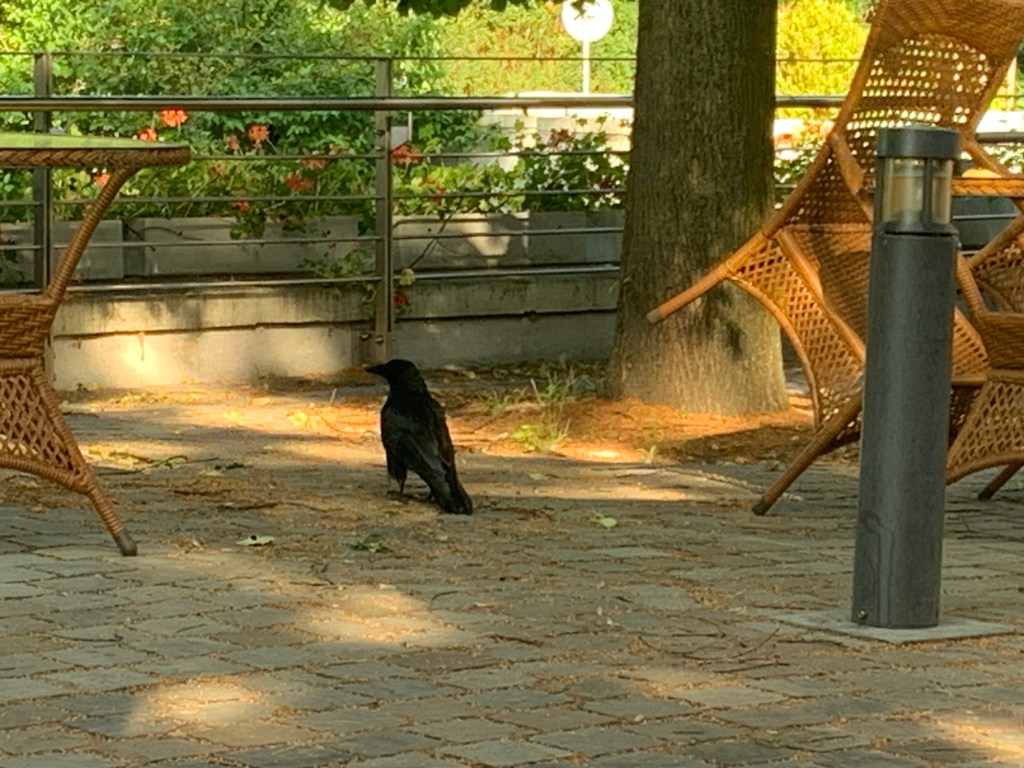
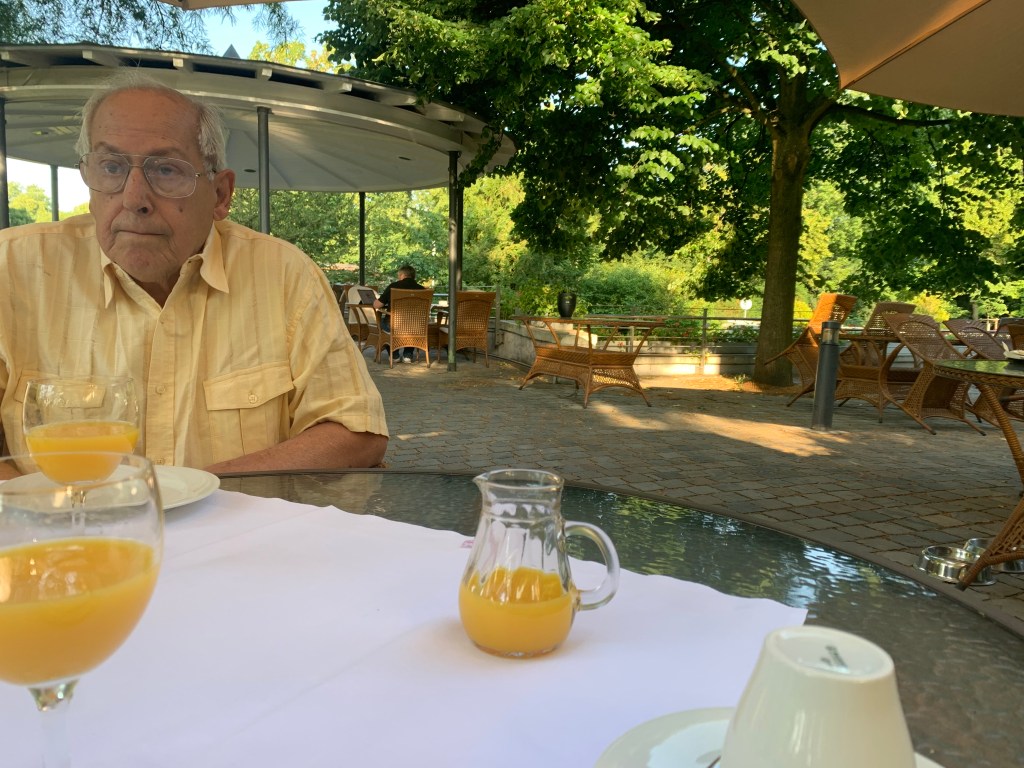
The courtyard was lovely, enclosed by the creamy walls of the building and overflowing with lush greenery. Water flowed gently from a tarnished bronze fountain mounted against the back wall. Seven or eight tables filled the space, some for two, some for four, each with cushioned chairs in shades of cream and blue. Santo ordered the Croque Monsieur, I had the gazpacho and avocado toast. The large white bowl of gazpacho looked like more than I could handle, but the saltiness of the tomato and vegetable puree was just the thing for my throat and I was more than happy to finish it.

Getting back to the crisp white sheets of our air-conditioned room, still fresh from my shower, I could hardly wait to fall into bed. The sensation of the first few minutes was pure delight. But I could not lay down for more than a few minutes before my hacking cough returned. The force of my exertions caused so much pressure in my skull that I thought my head would explode. Luckily, I still had the Ricola lozenges we had gotten in Rotheburg, but I had to have one in my mouth every minute, and even then the cough would break through. I barely slept. If I propped myself up on pillows, I could keep the cough at bay, but I could not sleep. If I lay down, the cough kept me awake. I was still very grateful to finally be cool, but I knew I had to do something about this sickness. It had just been too long and I was not getting better. And now my coughing was keeping Santo up, too.

Day 13 – Saturday, July 8

Day 13. This is the day the trip went south. And I’m not talking geography here.

Started off OK but not great. It was hot in our un-air-conditioned third floor apartment, my sore throat and cough were not getting any better, and an even hotter day was in store.

Breakfast was the usual delight, this morning served outside on the terrace, again with a delightful waitress. She truly could have served us anything and it would have been wonderful—her gracious hospitality was that enchanting. We even had another bird keeping a watchful eye on us–and our food!
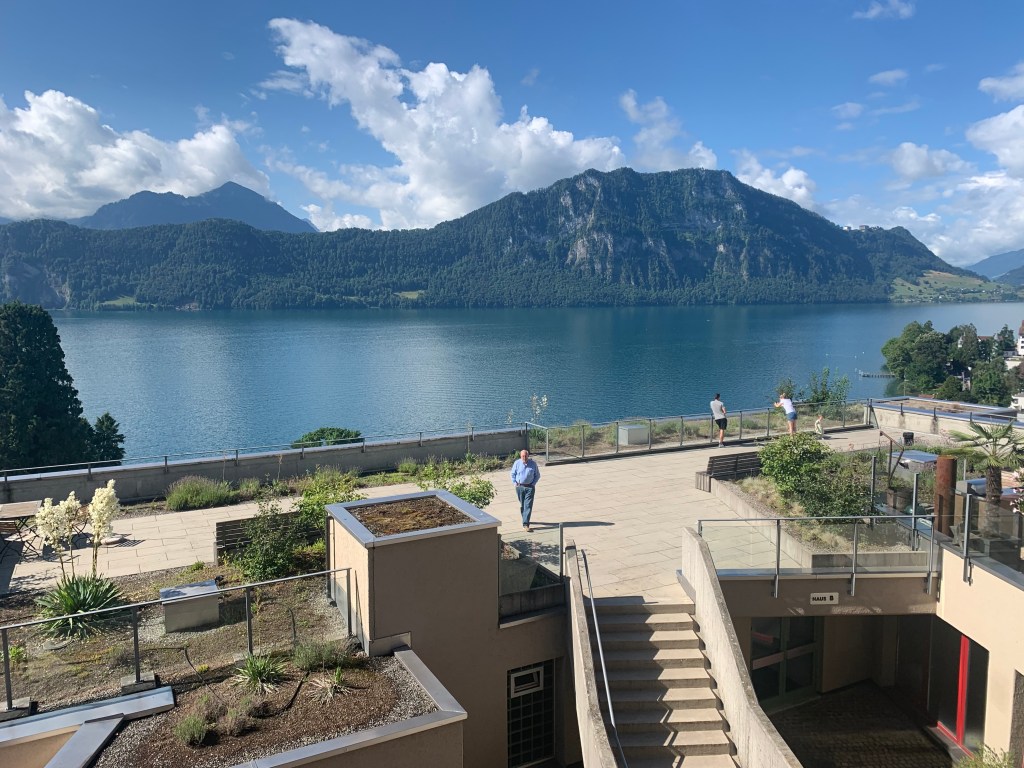
After breakfast, we lingered in the shade for a bit, then made the short walk to the car to bring in all of our bags so we could re-pack everything in the room in preparation for the next leg of the trip. Thus far, our two large suitcases had never been out of the car. Our goal now was to make all the hand carry items as heavy as possible so the biggest suitcase would be easier to handle getting on and off of trains the next day.

After that chore, and a bit of writing and relaxing in the room, including another now-familiar picnic lunch, we headed to the car, heavy suitcases in tow, for the last day of visiting family sights. Our destination was Oberhausen, a larger city about a half hour away. It is the city where Oma and Opa were married. The address I had there was for the last place Oma had lived before coming to America.

Our first stop would be the Avis location where we were to drop off the car in the morning. We wanted to confirm how long it would take and make sure we knew the way. When we got to the location the GPS told us was the place, we didn’t see any Avis sign. There was a car dealership and a small repair shop in a large, asphalt parking area. We pulled in. A man was coming out of the repair shop. He looked like he was locking up. I stopped him to ask about Avis. He didn’t seem to know anything about it. I explained more, and nope, there was no Avis, no car rental place here. “Perhaps my colleague knows more,” he said, leading me towards the car dealership and calling out to someone. Another gentleman came out and I explained again. He, too, had never heard of an Avis location here. He asked if I had the address, so I got my phone and looked it up. 13-15 Wehrstrasse. “That is not here,” he said. “That is about 5 km away. Do you have GPS?” “Yes,” I answered. He wanted to wait for me to enter the address in our GPS to be sure we would be able to get there. They were both so sweet, so concerned for us, and so determined to help.
“Where are you from?” they asked. “America. New York. But not the city,” I said. “I am from Lebanon,” one man said, “and he is from Turkey.” “Wir sind alle Ausländer!” (We are all foreigners!) I said, and they both smiled.

The day was exceedingly hot and even being out of the car for that short time had me drenched in sweat. Was it a fever or just the heat?

We made our way to the new address and YES, there was an Avis there! We cheered at the red and white sign. Then we drove up. It was closed. We looked at the door. It closed at noon on Saturday (today) and was not open at all on Sunday. From the beginning, the plan had always been to drop off the car in Oberhausen on Sunday morning. No one from Avis ever told us the location would not be open. We had bought our tickets for the train to Paris from Oberhausen Hauptbahnhof (main train station) specifically because Oberhausen was the Avis drop-off location. We didn’t see any drop-box for keys or any sign saying what to do when the location was closed.

What to do now?

I hadn’t brought any of my paperwork with me, so we were anxious to get back to the hotel where I would have all of that plus Wifi. But since we were already in Oberhausen, it made sense to stop by Oma’s address first.

My mind was swimming with possible solutions: maybe we could change our train, drive the car to closer to Paris and take a train from there. Or find an Avis location that was open on Sunday and was close to a train station. Maybe an airport location would be our only choice. But how would that work with the train situation?

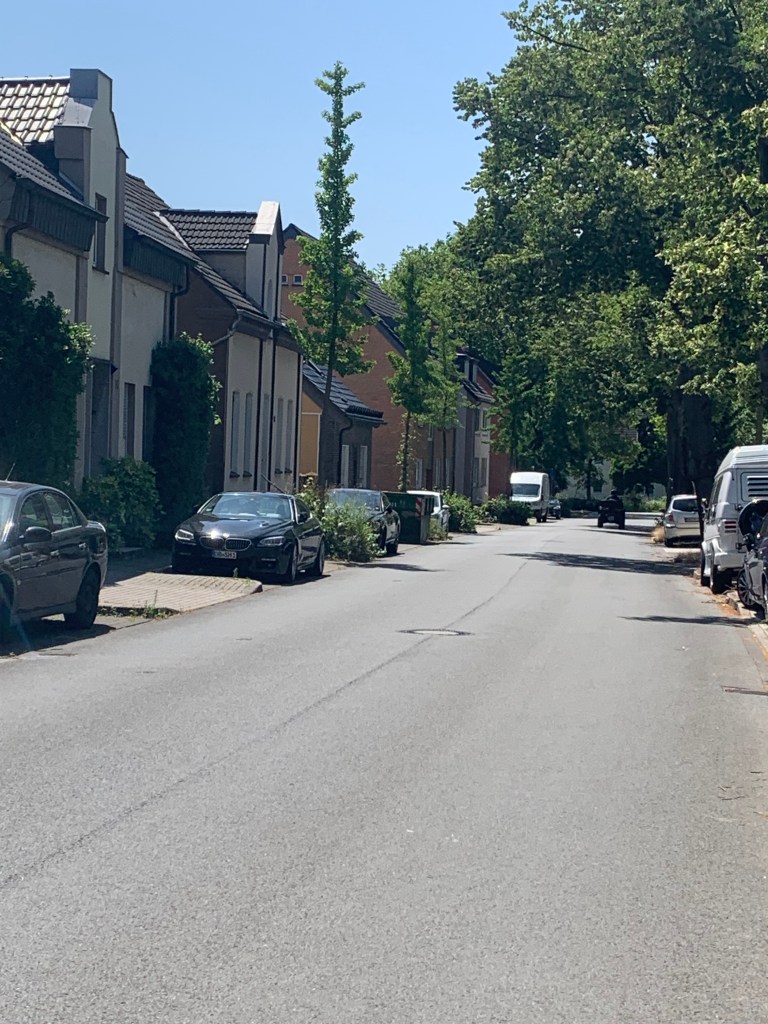
When we got to Michelstrasse 14, it was hard for me to focus on where we were. The building at number 14 was very new—a plain brick house that had a very stark appearance. It was a free-standing house, like most of the houses on this street, unlike the attached apartment buildings we had seen in Gelsenkirchen. Who knows what this street looked like in 1923 when Oma left? Even the trees which lined both sides of the street looked too young to have been here then. I had the strange feeling that Oma was never meant to have been here, at least not to have stayed here. Another life was already awaiting her.

Back at Schloss Berge, our room was even hotter than we remembered, our frustration not helping to cool us off any. I checked the train tickets (not refundable or changeable). Santo found the Avis location at the Düsseldorf Airport that was open today and would be open at 7 am tomorrow. But Düsseldorf was 40 minutes away from Gelsenkirchen and 20 minutes from Obehausen. We could drop the car in the moring and get a taxi to Oberhausen to make our 10 am train. But Santo really wanted to get the car returned today and be done with it. He did not want any hassles in the morning that would mess up our getting to Paris.

We tried to call Avis and spent nearly an hour on the line with someone who told us that the Rental Agreement Number we had was wrong, even though it was on the contract printed out at the Avis in Naples. Then he asked for the number on our car keys, and said that was wrong too. How could that be? We had the keys in our hands, and we had been driving this car for ten days. The agent was trying to find out if it would cost us more to return the car to Düsseldorf since this was not our original drop-off location, but was unable to get the information because of the “wrong” numbers. In the end, he gave us a number to call Customer Service. “I thought this WAS Customer Service,” I said. “No,” this is the reservation line.” “So we have to start all over with Customer Service?” “Yes.”

This time I let Santo make the call. All the phone options were the same as for the last call. When we got to a person, we asked if it was Customer Service and they said, no, it was the reservation line. “You need to call Customer Service.” THAT’S WHAT WE JUST DID!!!!! Santo explained our situation as briefly as possible and said: “Can you PLEASE connect me to someone in Customer Service who can help with this?” Finally we got a person on the phone who seemed to understand what we were saying. She had no problem finding up our Rental Agreement Number. She put us on hold to look into it … THEN THE CALL DROPPED!!!! “Let’s just take the car to Düsseldorf now and be done with it. Then we can relax in the morning,” Santo said. Seemed like a good idea, even though I was so hot and sick I could hardly imagine making our way back from Düsseldorf by train and then taxi.
First we had to schlep our heavy bags that we had just schlepped TO the car BACK up to the room so we could return the car. By the time I did the  circuit — to the car, to the hotel, back to the car – I thought I would melt.

The drive to Düsseldorf was not too bad, and after one mistake finding the car rental return area, we got the car to the right place. We were told just to leave the keys in the car and go. So we did. If Avis ever tried to charge us more or gave us a problem, we would have it out with them later. Then we walked to the terminal to find out how to get a train back to Gelsenkirchen. The air seemed even heavier, even hotter, if that was possible. The Weather Channel told us it was 94 degrees Fahrenheit.

Luckily, a train was leaving in 10 minutes so we quickly bought tickets and made our way to the train station via the airport tram—NOT AIR CONDITIONED. Made our connection to the train. Santo thought it was air-conditioned but I didn’t feel it. I was dying. Coughing. Hot. Headache from coughing. Tired from not sleeping. And I knew I had another un-air-conditioned night ahead of me.

We got to the Gelsenkirchen train station and found a cab to take us to Schloss Berge. Should I have been surprised that it had no more air conditioning than on the train?

When we got back to our room, I went straight to the bathroom and starting filling up the tub with cold water. I didn’t think there was any other way I could get my body cooled down. We decided to have dinner at the hotel restaurant under the trees on the terrace and hope for the best. At least we would be served. The bath helped, at least enough for me to get dressed and down to dinner. Thank God, we had our wonderful waitress from the morning. She truly made the unbearable bearable. We found light meals to order: chicken in orange sauce with basmati rice for Santo and a wonderful grilled trout amandine for me with boiled potatoes that had just a hint of butter and parsley. We asked for ice and water—and to keep them coming—and made it through the meal feeling a bit more relaxed. At least our car worries were over.

We even had enough energy after dinner for the short walk to Lake Berge. Dusk was beginning to settle on the lake, muting the heat of the day’s sun ever so slightly. A young couple were walking with a baby in a carriage as we neared the lake. I couldn’t resist looking in at the baby. Think dark hair framed her delicate sleeping face. “Jemand ist mude” (Someone is tired), I commented to the couple and they smile. We continued to the semicircular patio overlooking the lake and watched the large carp and ducks swimming leisurely below as pinks began to overtake the sky. It had been a tough day, but we were feeling blessed.

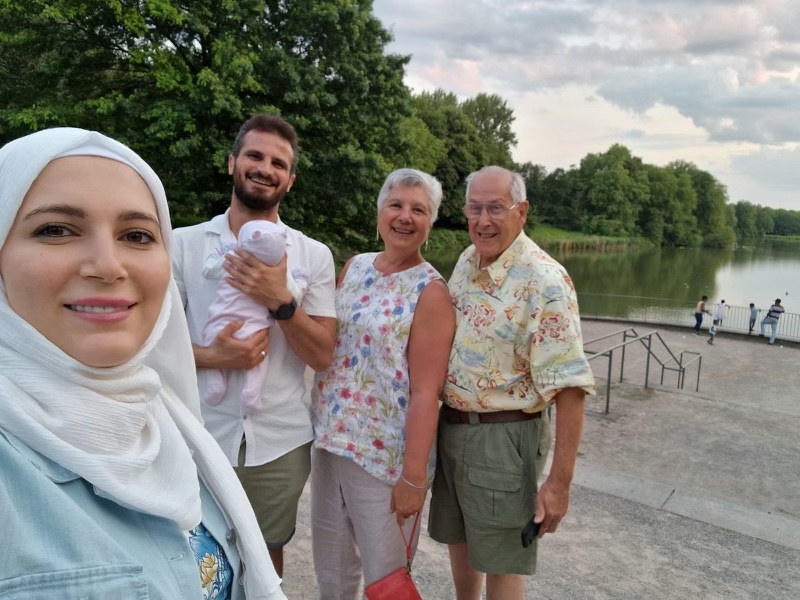
Heading back up to the hotel, the same couple stopped us, wanting to show us something. They had taken pictures of us looking out over the lake. They were just beautiful. “Could you send us a copy?” I asked in German. “I can give you my phone number to text them.” “Do you have WhatsApp?” the woman asked. It took us several minutes to figure out how to get Santo’s WhatsApp number to her so she could send the photos. Meanwhile, we talked. They were from Syria and lived in a town just a few minutes away. Their little girl was named Rita. “A German name,” the father said. We told them about our journey and my connection to Gelsenkirchen. Rita started to fuss while all this was going on, so the dad picked her up and held her. Santo and Rawun, the mother, finally figured out the technology. They wanted to take another close-up picture of us, and we wanted pictures of them. Rawun even managed to take a selfie of all of us.

We come from here. We travel to there. We change our lives and start new ones. Everywhere we go there are strangers–and friends.

Day 12 – Friday, July 7

I only got a few hours sleep due to the warm temperature of the room and my cold, but wasn’t too worried since we did not have a big agenda for the day: just to go into Gelsenkirchen and visit the two street addresses I had: one where  Oma had lived as a girl, one that was listed on Opa’s pilot’s license for the Royal Navy dated 1919.

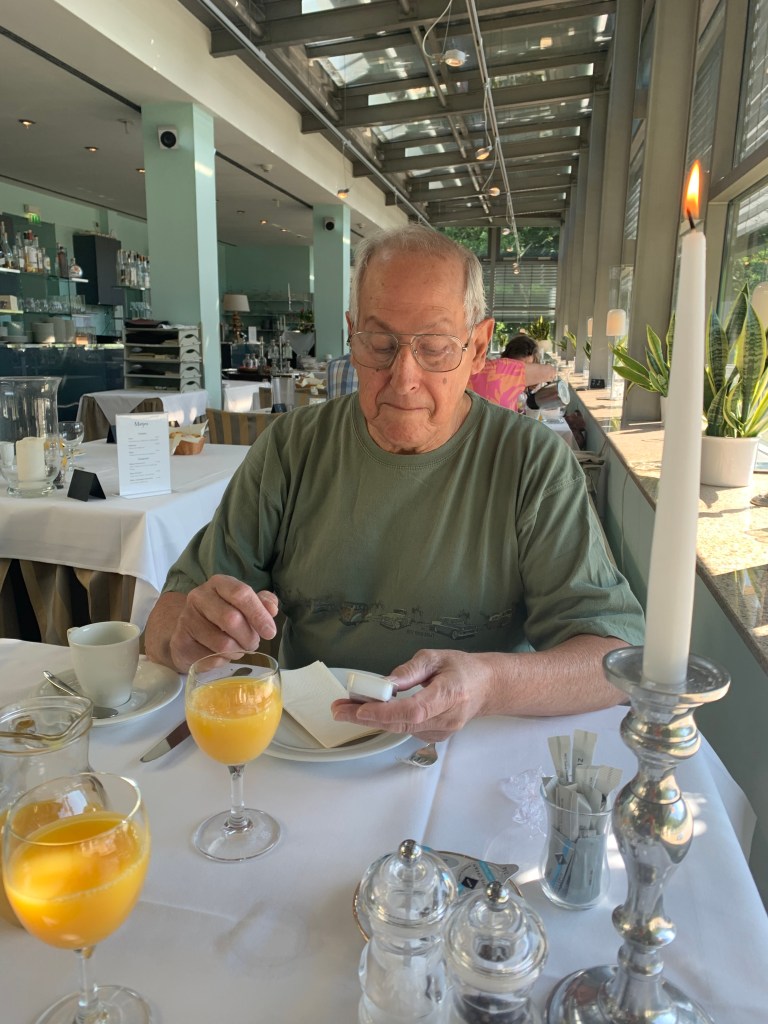
I took a long shower, enjoying the cool and comforting stream of water in the walk-in shower. Feeling refreshed, we went down to breakfast, which was included with our room. The dining room in the morning was just as elegant as in the evening. Luckily, we had a different server—a delightful young woman who understood what true hospitality was!

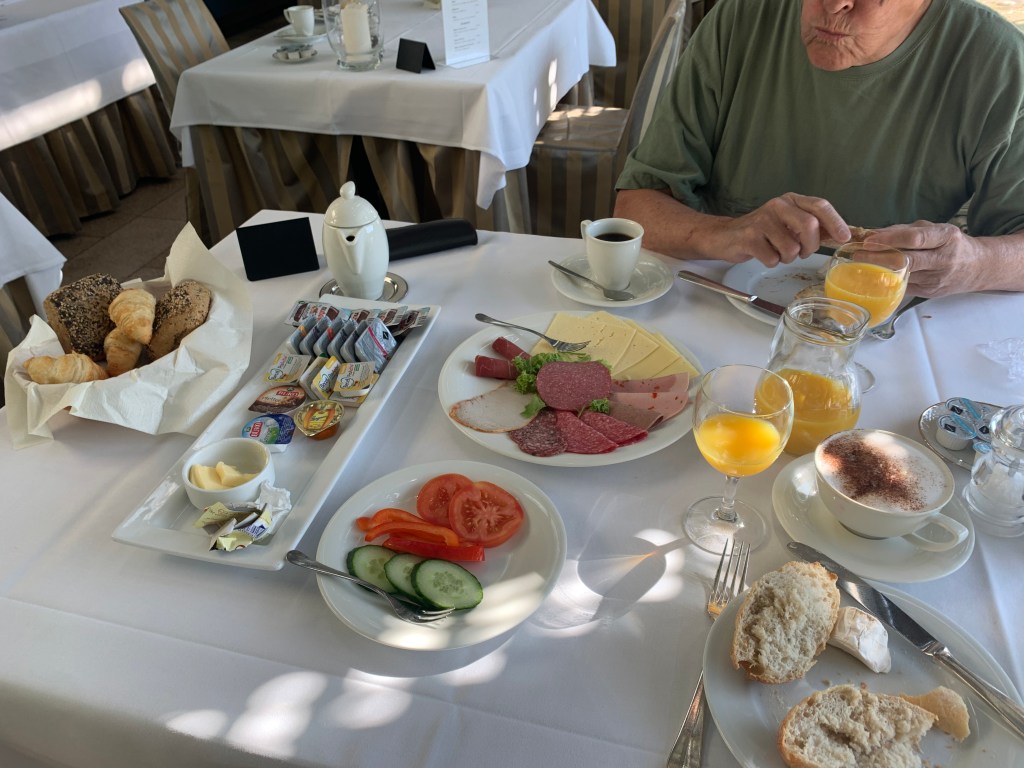
We ordered coffee and Santo ordered fried eggs, which I found out were called Spiegel Eier. Literally translated, this means “Mirror Eggs.” They were cooked in a circular pan and came out on a round plate. Perhaps the yolks were the eyes staring back at you (like a mirror)?

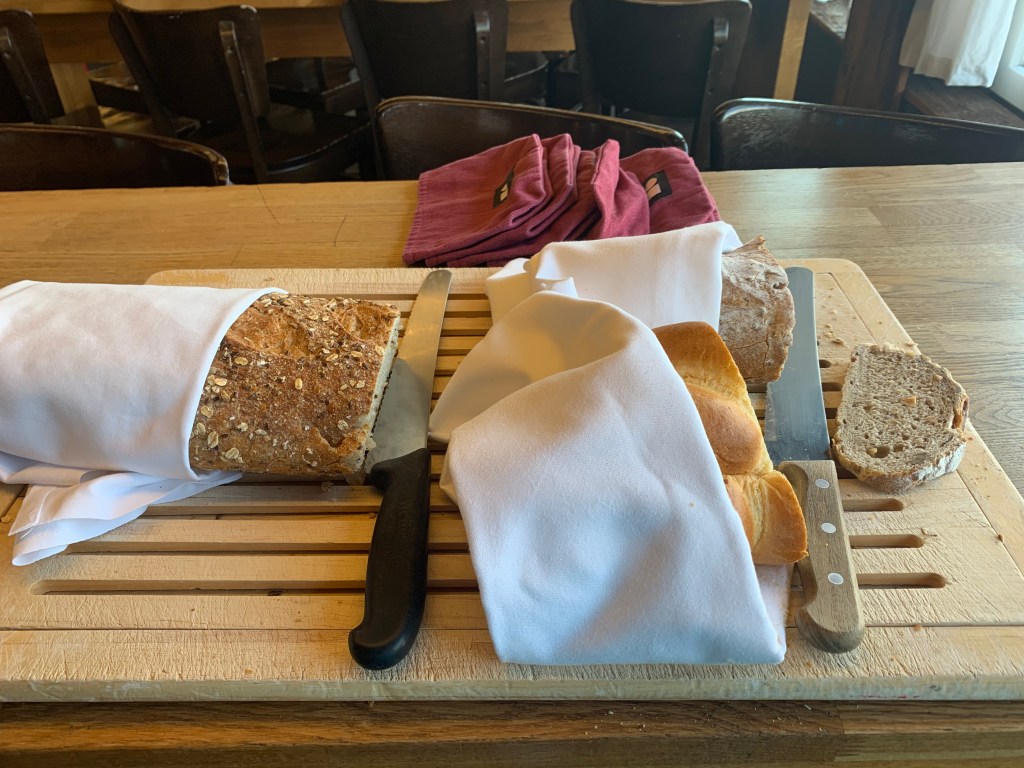
Platters of meats, cheeses, jams and jellies were brought to us along with a pitcher of freshly-squeezed orange juice and a basket of fresh rolls and croissants. Heaven!

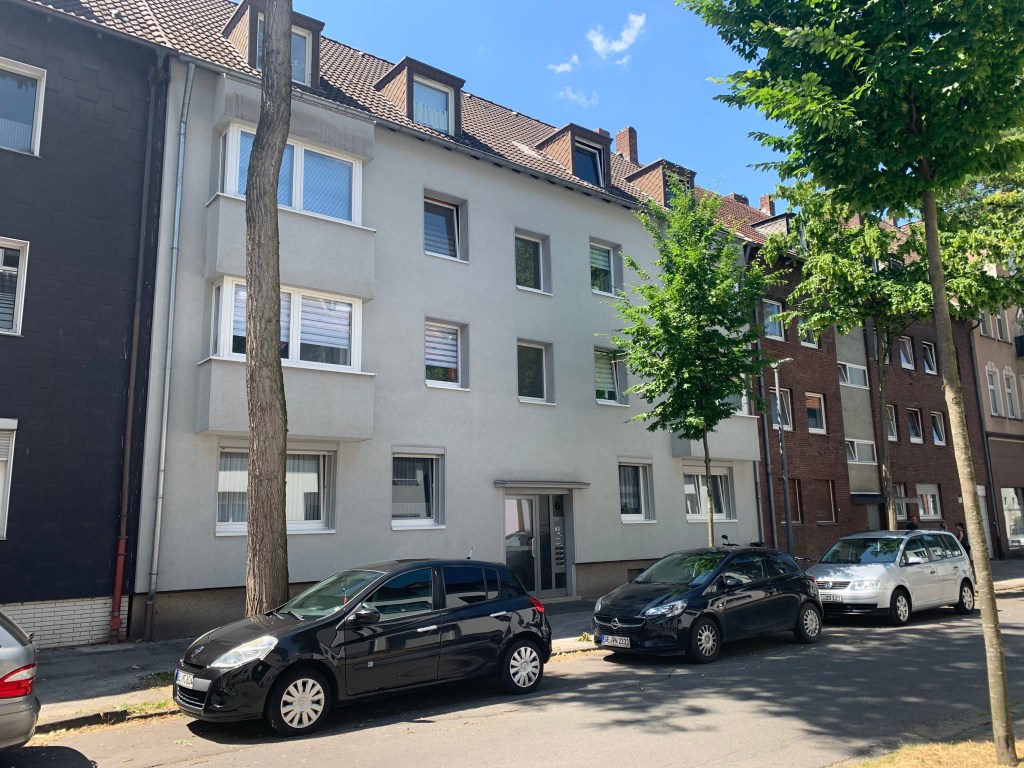
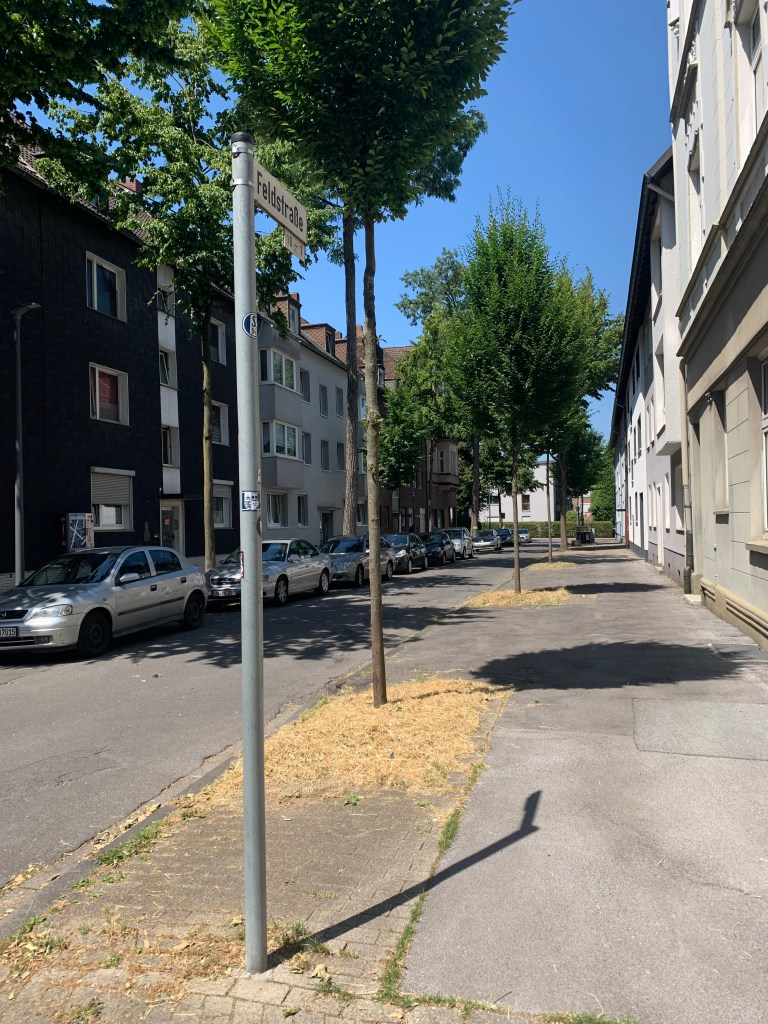
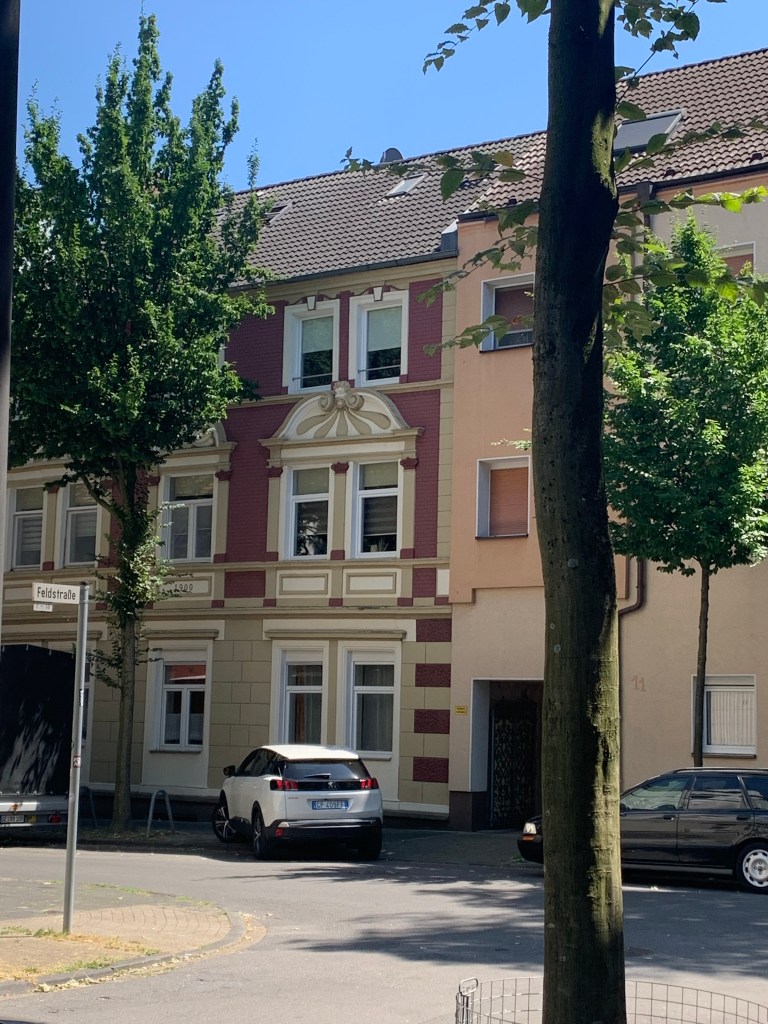
After breakfast we headed to the car. I entered an address into the car’s GPS and we headed to Gelsenkirchen. Our first stop would be Oma’s street: Feldstrasse 6. It was a short street, only one block long with five three-story buildings on each side. Some looked old, but most had probably been built in the 1960s: smooth stucco walls in muted colors, glass entrance doors, and evenly spaced windows facing the street, many with their outside metal roller blinds closed. The few that were open revealed lace curtains similar to ones I had seen in pictures of Oma’s coal company house in Scranton. There appeared to be six apartments in each building.

The narrow street was lined with cars on the right side where parking was allowed. Unable to find a place, Santo dropped me off and found a place just around the corner at the end of the street. He stayed in the car in case he had to move it. I walked to the sidewalk across the street from the light gray building that bore the same address as Oma’s childhood address and started to take photos. I was trying to imagine Oma walking down this street, walking to school, or to the glass factory where she worked. But I couldn’t. It was a street in a German city but I struggled to connect it to her. As I was taking pictures, a man came out of the building next door and, understandably, looked curious about what I was doing. I explained about Oma and also asked if he knew where the mines in Gelesenkirchen where Opa had worked might have been. He told me about a place called Zeche Ewald (and helped me enter it in my phone so I got the correct spelling). I thanked him warmly, glad to have made a human connection here. Somehow, it made all the difference.

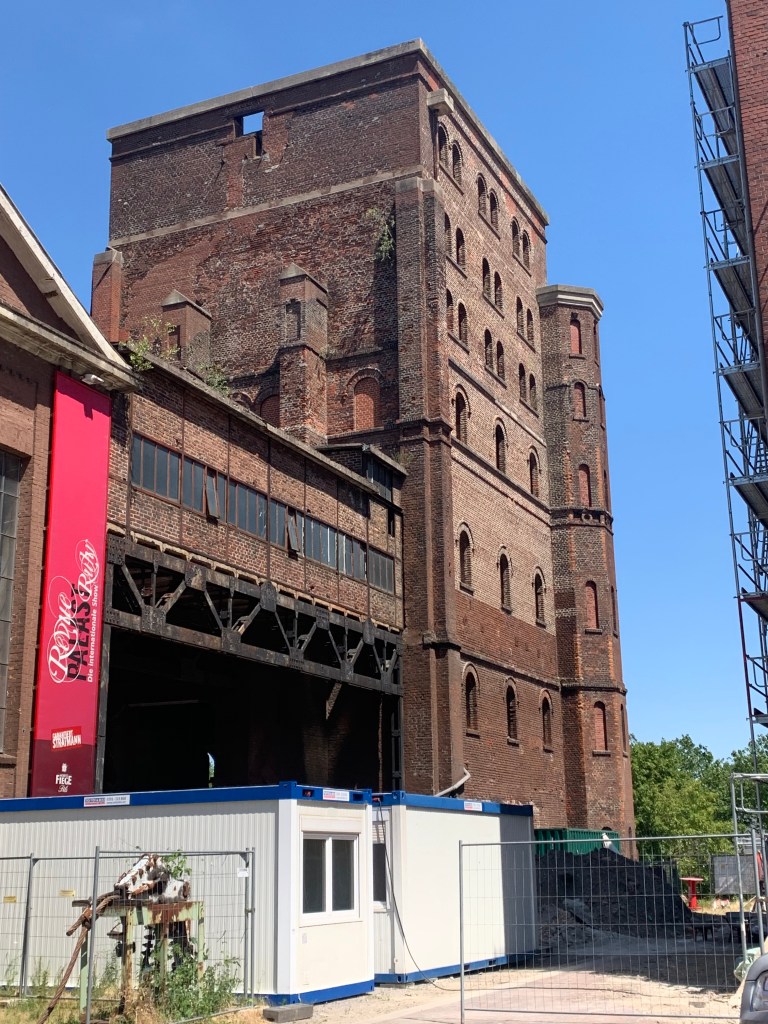
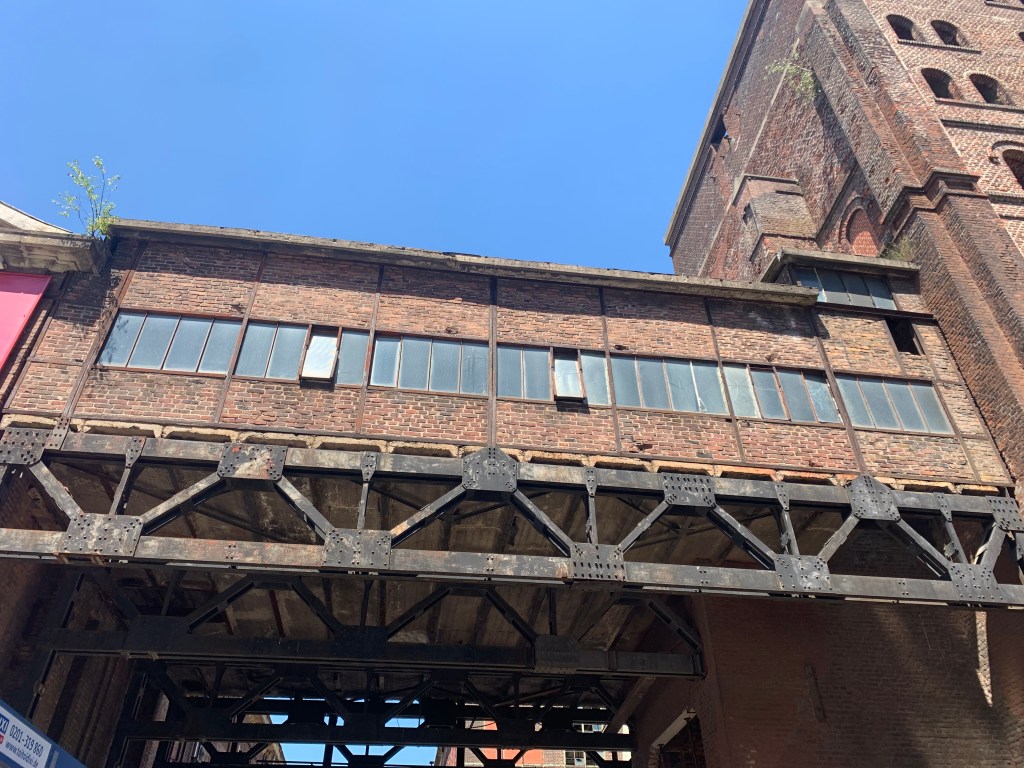
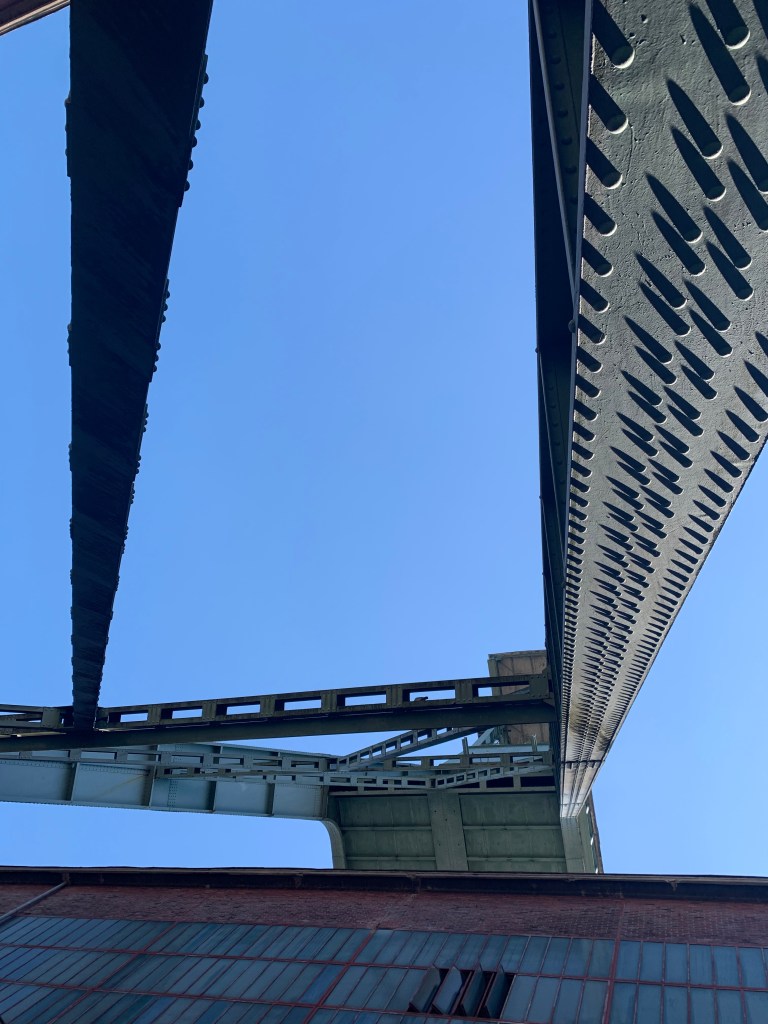
It turns out that “Zeche” means “colliery.” How had I not known this? The area, Zeche Ewald, is a place where a colliery had been and two of the structures still stand–heavy, steel triangles reaching high into the sky. At their base were old brick buildings, long since abandoned. Through the broken windows, I saw more heavy steel beams. A small canal ran through one building. The structures were not like the breakers I was familiar with in Scranton, but I could see how they might serve the same purpose. Across from this was a new park. Signs indicated that the area was being repurposed to be a destination for families, bikers, etc.

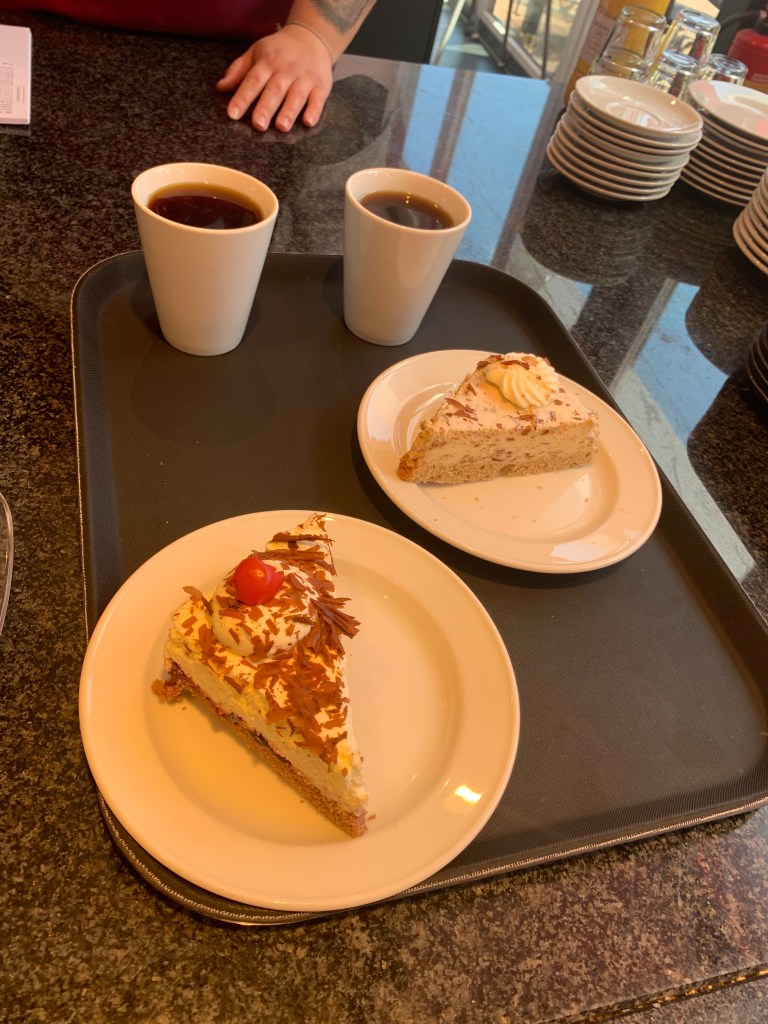
Just as the man had told me, there was a café nearby with outside seating under shade trees. We went inside and viewed all the treats in the glass cases. Santo chose a nutty cheesecake, I picked a “Schwarzwald Kuchen” (Black Forest Cake). We took our desserts and two coffees and found a table on the park side of the building. As I enjoyed this green space and wonderful food, it was hard to imagine that this may have been the place where Opa had gone underground to work in the mine.

The desserts would tide us over until dinner.

Our next stop was Elisabethstrasse 7, the address on Opa’s pilot’s license from 1919. Elisabethstrasse was closer to the city center than Oma’s street. Unlike Feldstrasse, there were no trees here. The buildings were larger and a bit more ornate, but still sat one attached to another in a long row. The building that had been Opa’s looked like one of the older buildings, but I do not know if it had been there in 1919. It now houses an Asian restaurant downstairs. I stare at the building and down the street. So many questions. So much that has been lost to history. I’m looking for something that matters, but maybe it is not here. Even if I knew this was the very same building, if I knew which apartment had been his and who he had lived with, if I knew precisely where the mine entrance had been that he entered each day, would I know him any better?

Santo was waiting outside the car when I was ready to leave. He asked me what I was feeling, sensing that there was something wrong. I paused a long time. “Honestly, I don’t know,” I said. Then Santo noticed some pigeons landing on the street and hopping along in search of food. “Look,” Santo said, “They’re looking for Opa!” Opa had raised, raced, and loved homing pigeons his whole life. “YES,” I said. “Yes, they’re looking for Opa!” I started to smile as I chased the birds, taking photos. They could feel Opa’s presence here, even if I couldn’t. In my heart, I thanked them for helping me to find him.

Earlier in the day, we had decided to go to Aldi’s (really, how could we NOT?) before returning to the hotel to purchase some things for dinner in our room or outside in the bier garten: cheese, bread, fruit, chocolate. I’m not sure if we were avoiding the waiter-from-hell, the food, or both. We both enjoyed shopping in Aldi’s, which was much nicer than the Aldi’s at home. I should say, Santo enjoyed the shopping. I enjoyed the air conditioning. Fully provisioned, we headed back to Schloss Berge. The temperature had risen, and even the outside tables in the shade offered no protection from the heat. With the fan on in our comfy room, we were able to enjoy a restful picnic dinner of our own making, along with some of the leftovers from the night before. It was perfect.

I didn’t look forward to another night battling my cough and the heat to try to get some rest. But we both did our best, still grateful for where we were and all the helpers God had put in our path. Even the pigeons!

Day 11 – Thursday, July 6

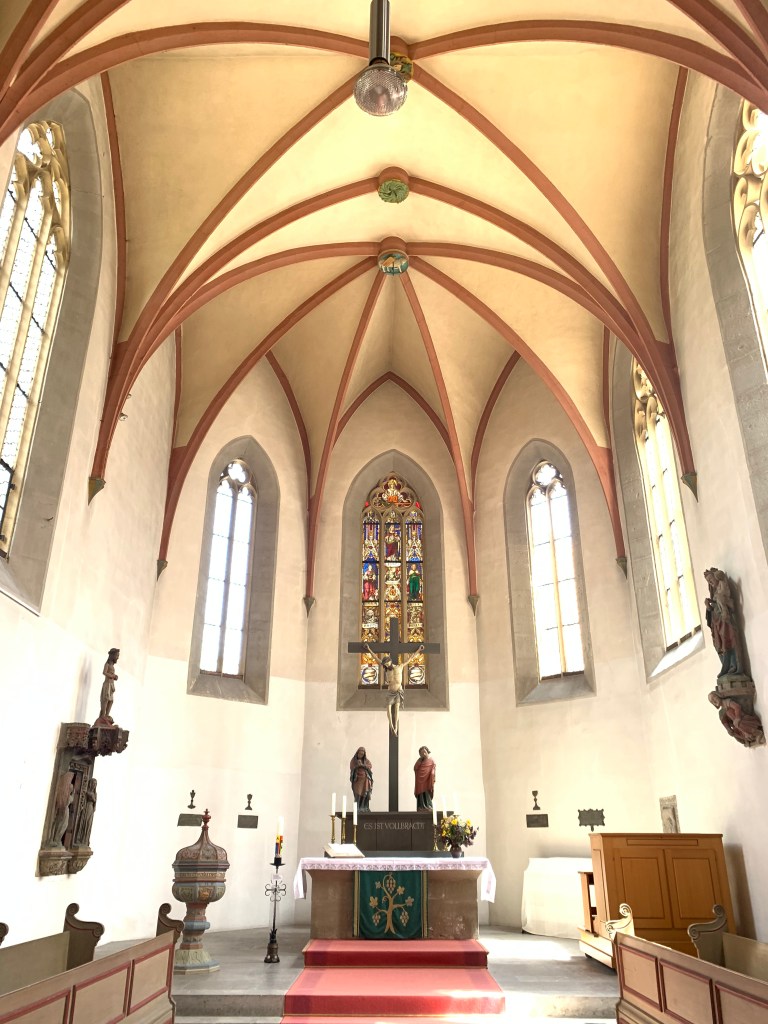
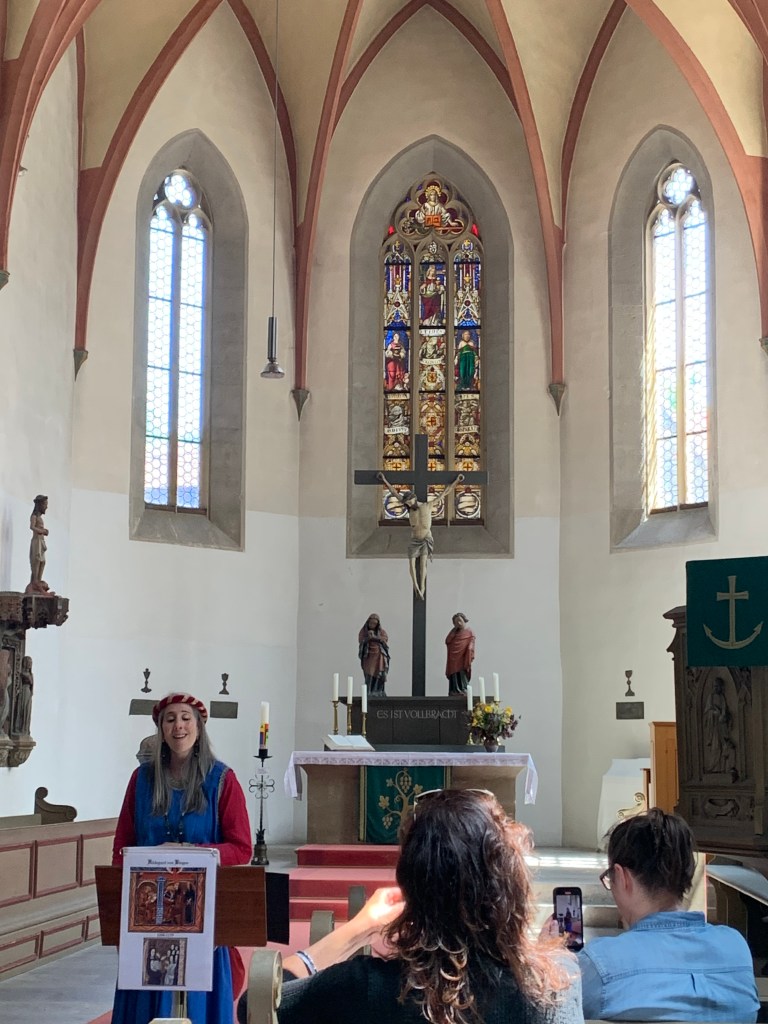
A happenstance from yesterday I forgot to mention. During our stroll around Rothenburg, we came upon a small church with a sign that said, “Bitte eintretten. Wir sind geöffnet” (Come on in. We’re open.) So we did. It was more of a chapel with an arched nave and ceiling crisscrossed with dark wood. The creamy walls made the space light and welcoming. A woman in traditional dress stood at the front of the aisle. There were three other people in the pews. Apparently, we had walked in on a stop on the musical tour of Rothenburg. The woman advised us that she would be singing a song that would last about three minutes and we were welcome to stay. So we did. The pureness and clarity of her voice were amplified by the fantastic acoustics in the small interior. What a delight! If we were staying another day, we likely would have signed up for the entire musical tour. Such a special way to see—and hear—this magical city.

One to today: With a shorter drive ahead of us (about 4 ½ hours), we enjoyed a leisurely breakfast in the hotel restaurant. Then we waited a few minutes in the lobby while our car was brought round to the front door. We set the GPS for Schloss Berge in Gelsenkirchen.

The terrain between Rothenburg and Gelsenkirchen was again familiar. The trees, forests, and rolling farmland were not as dramatic as previous drives but gentle and relaxing. As we got close to Gelsenkirchen, large modern buildings dotted the motorway—companies that were perhaps part of the growing solar energy industry that was revitalizing the old coal and steel city. It reminded me of the 128 technology loop around Boston.

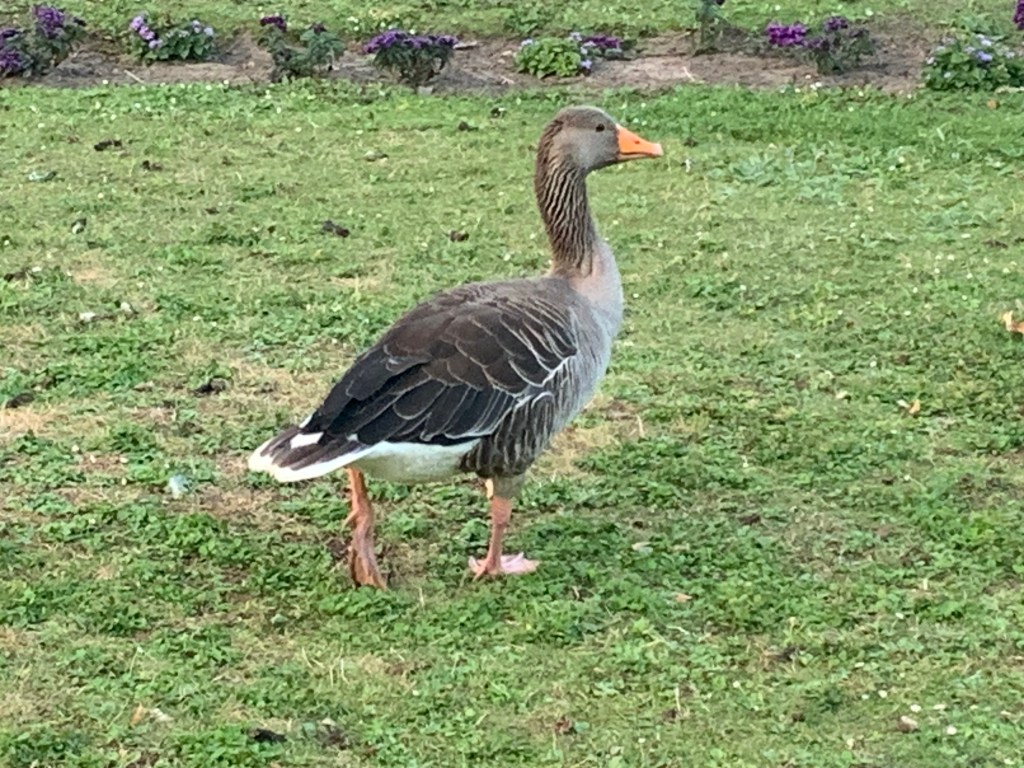
Once off the motorway, we drove on broad “allees” (boulevards) lined with trees. Gelsenkirchen was much greener than I had expected. Within about ten minutes, we were at the entrance to Schloss Berge, on the outskirts of the city. It turned out that Schloss Berge was not only the name of the hotel where we would be staying, but also a large public park with a small lake (Berger See), gardens, shaded walkways, bike paths, and even a bier garten. There were many cars parked in the public area and many people enjoying the park on this warm and sunny day. We drove as close to the hotel as we could get and took just our overnight bags up the tree- and flower-lined path to the entrance, going over a small bridge where families of geese and ducks glided in the dark water.

The hotel was U-shaped. Between the two sides were numerous brown wicker tables and chairs and large umbrellas for shade. People were dining in this area on pressed white tablecloths, clinking wine glasses, laughing, and offering us “Guten Tags” as we passed by.

We checked in and asked about reservations for dinner. The desk clerk told us they were not necessary. We decided to get settled in our room, then come down to dinner later.

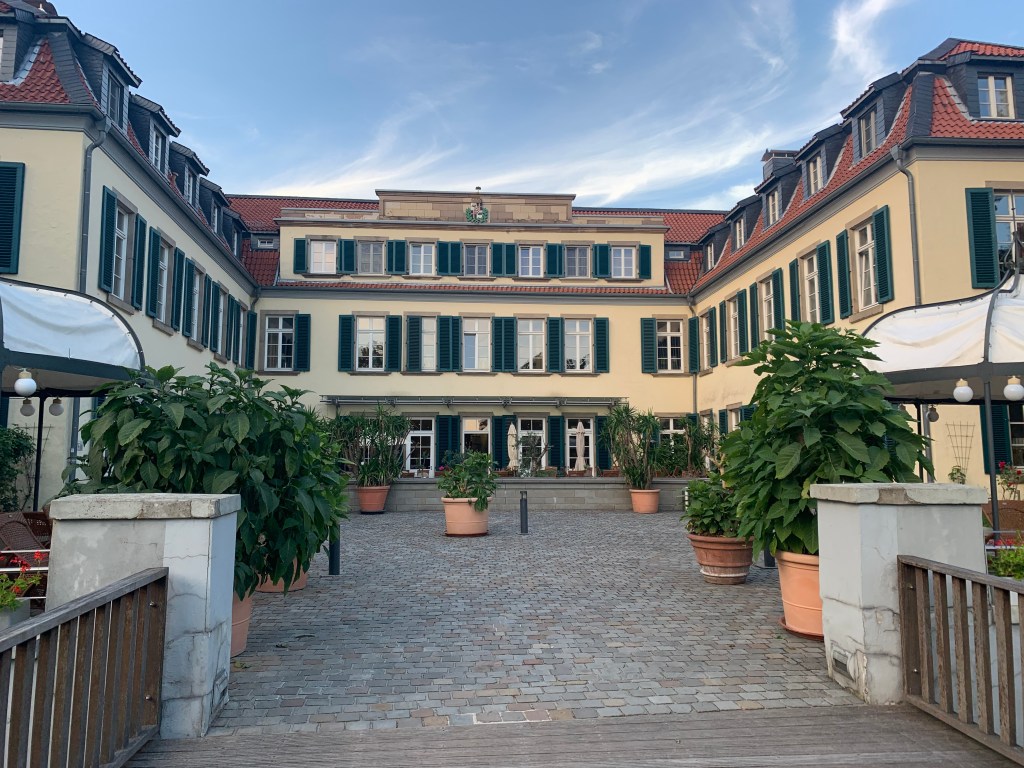
The home of barons and counts since the 14th Century, Schloss Berge as it stands was first built in the 16th Century and then partially demolished and rebuilt between 1785 and 1788. It is a lovely buttery yellow color with dark green shutters and a red-tiled mansard roof with dormers. Our room was at the end of the left wing on the 3rd floor. We had windows on three sides facing the entrance patio, the front of the hotel and lake, and the side gardens. There was an enormous living room with couch, two comfy leather chairs, coffee able, desk, large fridge and coffee maker. The bathroom was all white and spacious, with a real walk-in shower and a whirlpool size tub. Another home away from home.

We made our way to the dining room around 8 pm. A short, white haired, very professional-looking waiter asked us if we had reservations. I told him “no” and he immediately frowned, dismissing us with a shake of his head. I tried to explain that the clerk had told us we didn’t need reservations, but he had already summed us up as hicks. Making a show of just how much trouble it was to seat us, even though the restaurant was only about half full, he gave us a table at the far end of the long narrow sunroom overlooking the gardens that was the dining room. The white tablecloths were thick and crisp, made of a fine fabric that whispered “elegance.” Flourishing a lighter he whisked deftly from his pocket, the waiter lit the tall white candle on our table. Even though the waiter looked down his nose at us, we felt we had arrived.

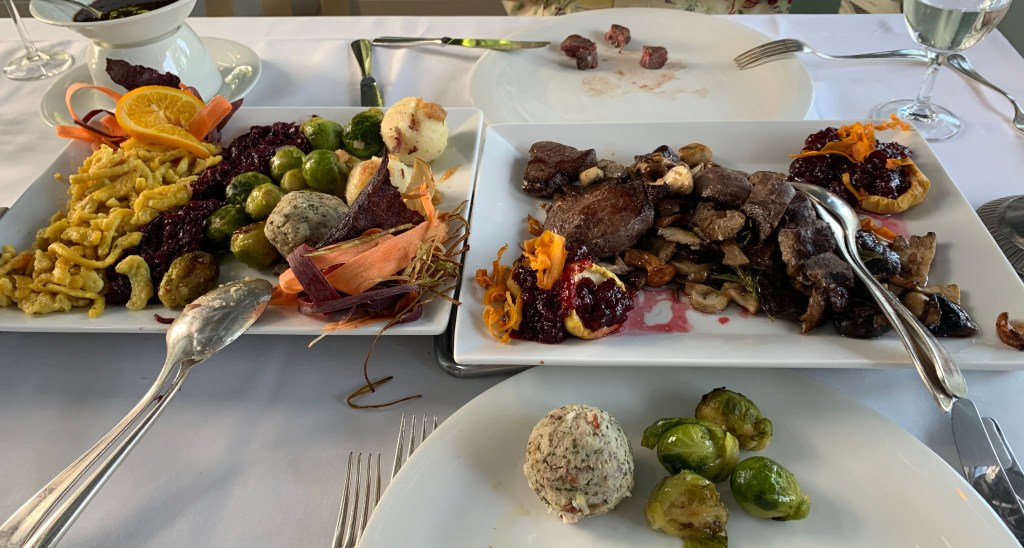
I did my best translating the menu for Santo and we decided on the “Wildplatte,” a “Wild Plate” for two that included two kinds of deer, wild pig, and rabbit. Santo took a look at wine list and decided to order a glass of Riesling (a real German wine in Germany). This did not please the waiter at all. He spoke to me, since I could understand German. “Virklich?” he asked. “Really?” I nodded yes and he shook his head again. I knew he meant that we should order a RED wine with the meat we had ordered. This kind of arrogance, I think, is NOT hospitality.

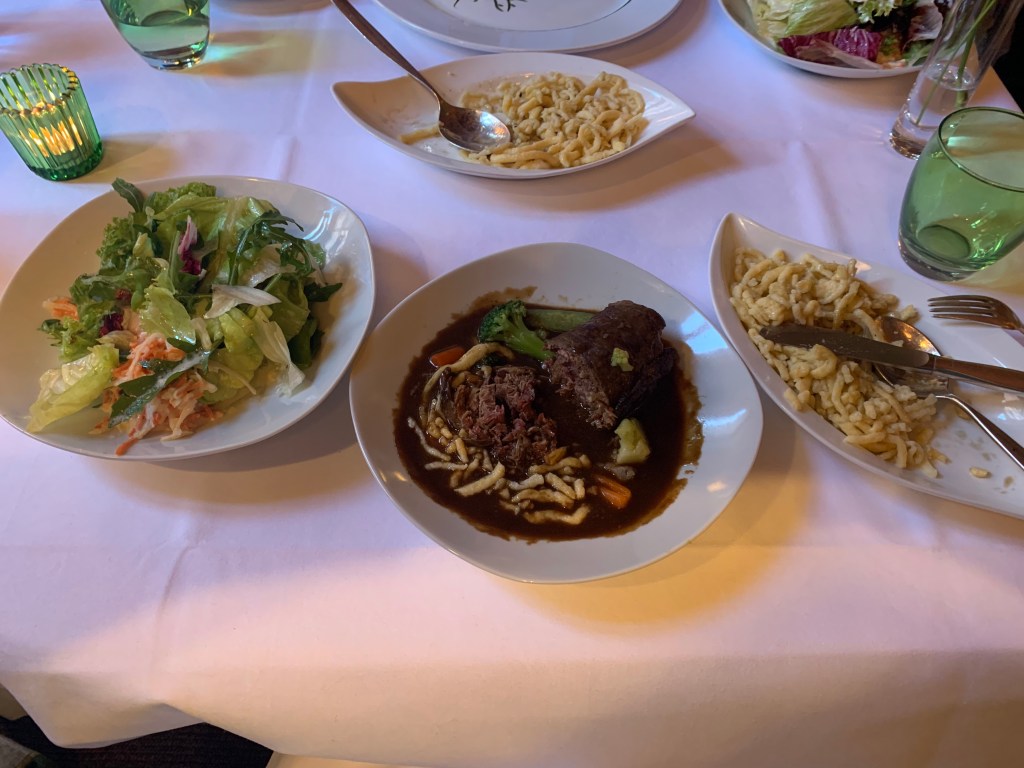
Before our dishes came out, the waiter brought three (count ‘em, three!) long, low hot plates. Oh my God, what kind of a feast were we getting? We soon found out. Platters and platters of meats in mushroom, berry, and wine sauces. One large platter contained our vegetables in diagonal rows: buttery fried spaetzle, red cabbage, and Brussels sprouts. On the edge were four large dumplings. There were also warm bowls with additional sauces. Each platter held two large spoons to serve ourselves. The meats were delicious, less salty than in Rotheburg, but still heavy. I took only a small taste of a dumpling and felt it sit in my stomach like a lead ball. Even the spaetzle was too rich, fried in butter. We were glad we had tried it, and it certainly was an experience, but we would not order it again. Maybe we wouldn’t even eat in the restaurant again. We didn’t want to deal with the snooty waiter again.

We took a short walk in the gardens, past the beer garten where a kiosk sold wurst in a roll, French fries, and beer. Under the shade of some delicate trees were scattered numerous wooden tables with folding wood slatted chairs. There was only one table of guests enjoying the garten. We thought we might come back here another night.

Without air conditioning (we had not had air conditioning in Weggis or Rothenburg either), our top floor room was a bit warm. Santo angled the oscillating floor fan towards our bedroom and we opened windows hoping for a breeze that didn’t come. My cough and sore throat were not better, and I felt I desperately needed a good night’s sleep. I prompted myself up on several pillows and hoped for the best. Luckily, we had bought Ricola lozenges in Rotheburg so I was able to suck on one after another during the night.

How I longed for this cold to go away!

Day 10 – Wednesday, July 5

Started the day with a wonderful German breakfast, this time served to us on white tablecloths in the dining room. We had heard a gentle rain on the red tiled roofs during the night, and the clouds were still hovering in the morning. We both took some time to write in our “apartment” while we waited for the weather to clear a bit.

By late morning, the skies were more blue than gray, so we ventured out. The hostess at the front desk had given us a map and directed us to route that would loop around the southern half of the city, much of it atop the wall, built before 1400, that ringed the city. First stop, though, was the small grocery across the street. Santo wanted to “check out’ what they had. I think he was just experiencing grocery-shopping withdrawal. Of course, he had to check out every inch, loving every minute. You can take the many away from Wegmans but …. We bought a few items which Santo brought back to the room, then we headed for the wall.

We climbed the steep, uneven stone stairs and found ourselves about twenty feet off the ground. The walkway was enclosed by a stone wall on the outer side, an overhanging roof, and a wooden railing on the inner side. From this vantage point, we got an overview of the city and the many red-tiled roofs, meandering streets, and medieval houses. Santo kept to the wall side, his acrophobia keeping him from anywhere near the railed edge. We squeezed ourselves against the wall whenever we needed to let someone pass. He tried valiantly but was really uncomfortable and not enjoying this at all. We passed a few of the many towers spaced along the wall until we came to one with stairs that would take us back to terra firma.

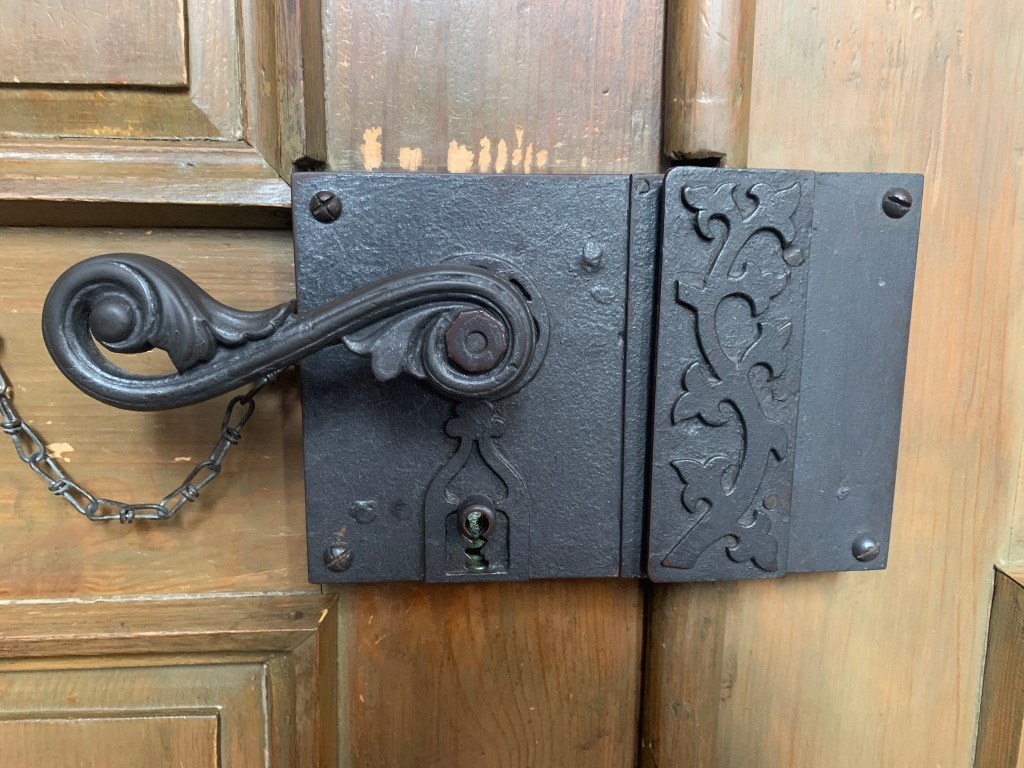
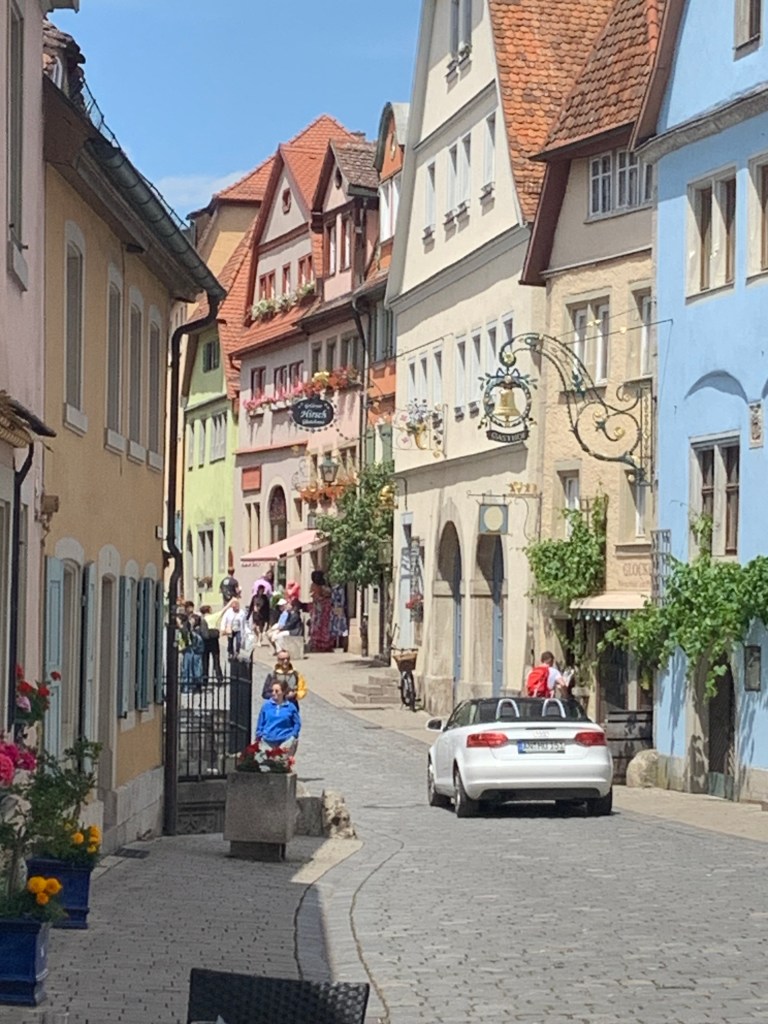
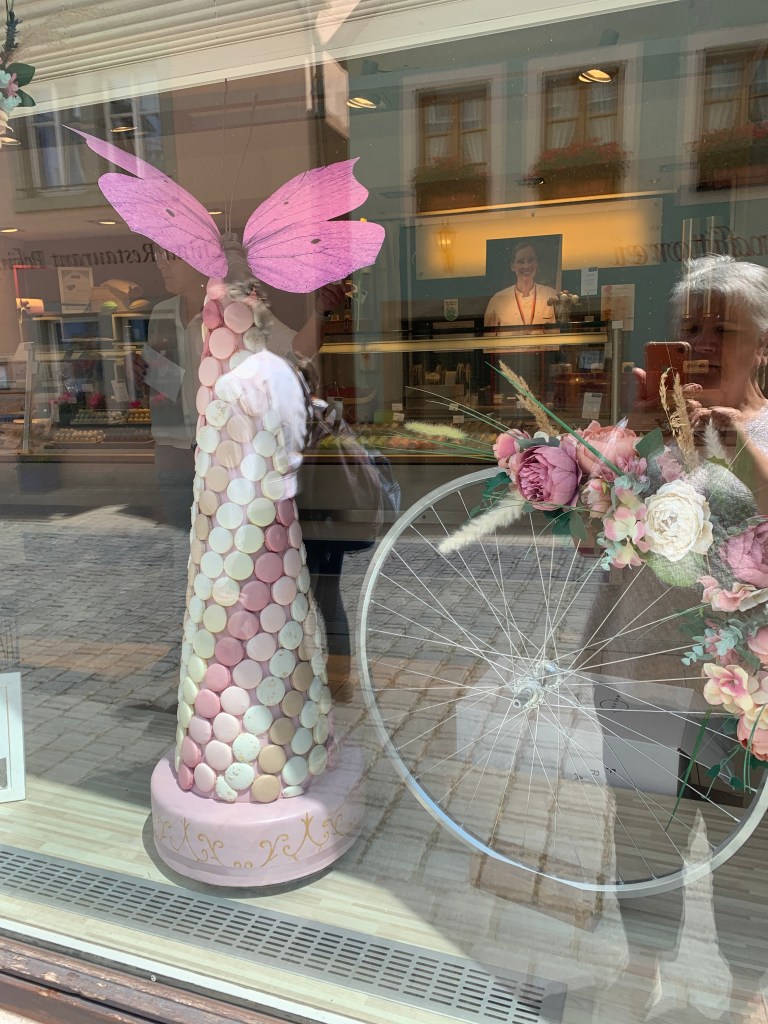
The city was really more enjoyable from this vantage point. Keeping the wall basically to our left, we circled the city, then turned to head into the center again. This place was like Disneyland but REAL! Each of the colorful houses had some sort of fascinating detail in the shutters, doors, knockers, hinges, windows, or entrance ways. As we got closer to the city center, there were more and more shops and restaurants. Chocolate shops, bakeries, butcher shops, cafes, plus a variety of stores appealing to tourists with cuckoo clocks, Christmas decorations, jewelry, and clothing. In one shop I found a black-and-white shawl to wear for the black-and-white gala on the Queen Mary 2, along with some jewelry. We also found a necklace for Natalia and one that perfectly matched a set of earrings I had gotten for the trip.

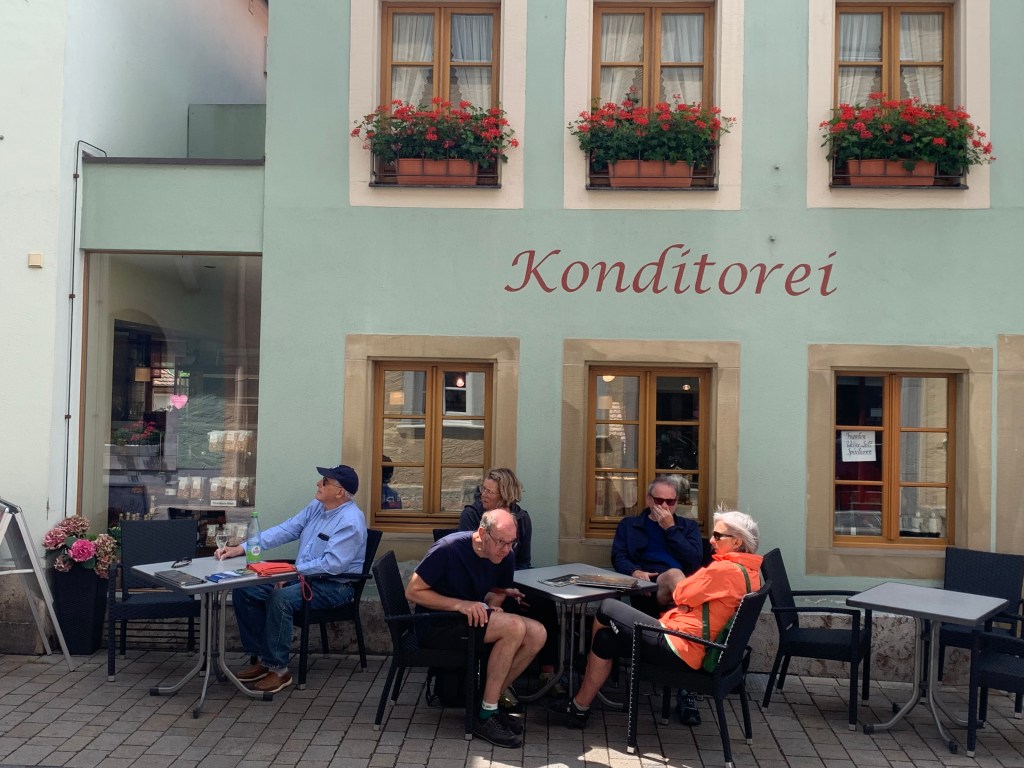
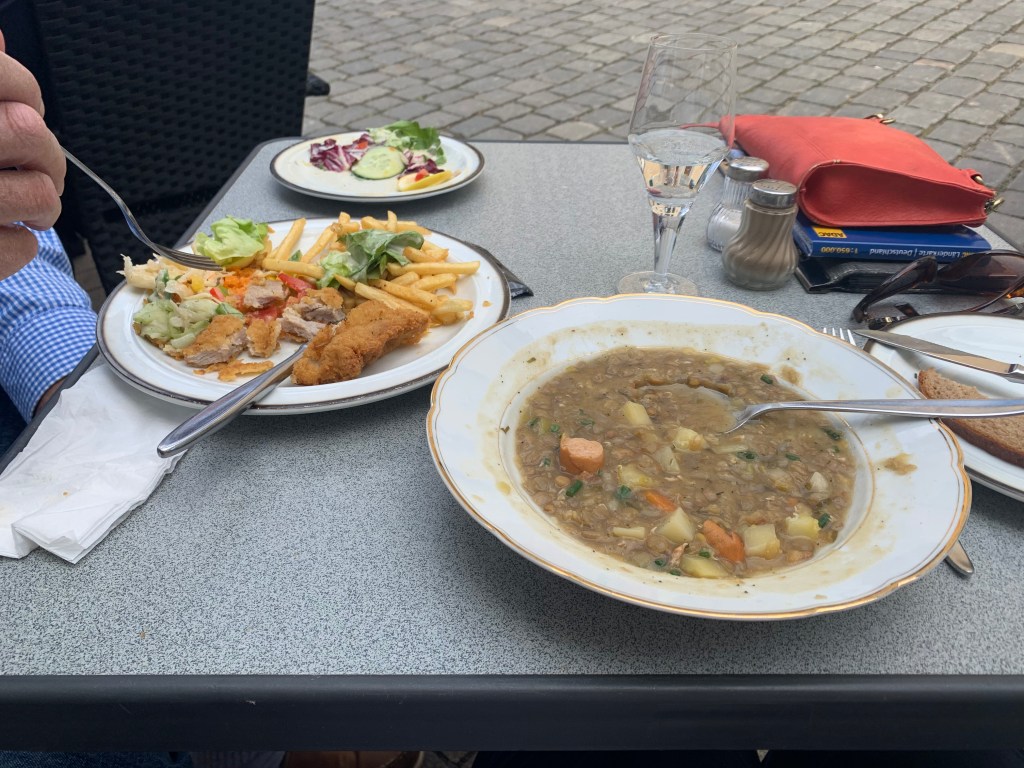
Around 2 pm we were getting hungry. Not wanting another heavy German meal, we had decided to eat lunch out, then purchase bread, cheese, and fruit for a picnic dinner. We chose a place with outdoor seating: perfect spot for people- and dog – watching. Santo went for the Wiener Schnitzel and French fries. I opted for a lentil soup with wurst and bread, saving room for one of the “Eis-spezialitaten” I had seen on the menu. The ice cream specialties were described as works of art. The masterpiece I chose was a Black Forest sundae: vanilla and chocolate ice cream, cherry sauce with whole cherries, chocolate sauce, and whipped cream in a tall vase-shaped glass. We had to ask for an extra spoon for Santo—no way I could eat it all myself.

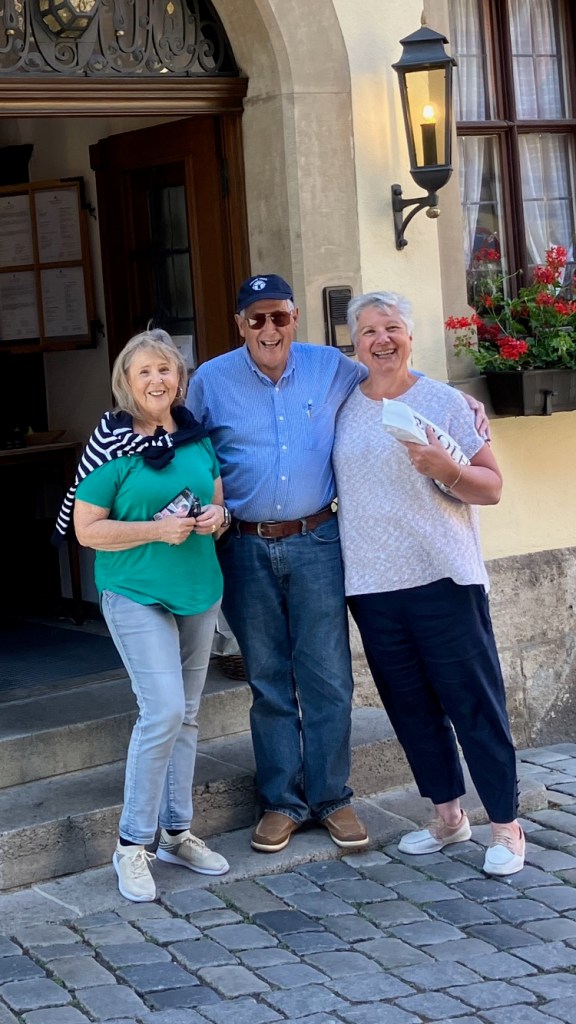
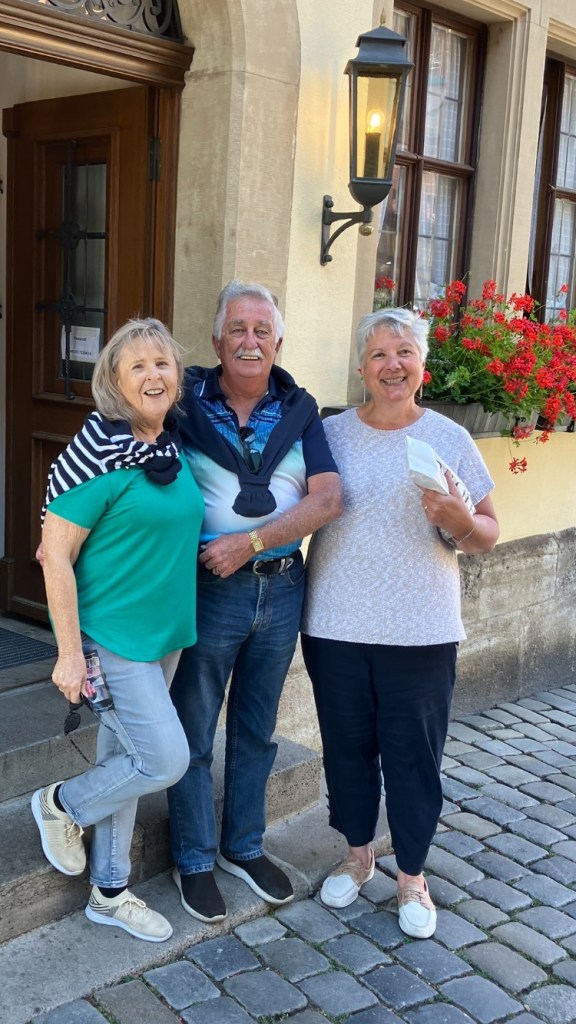
After lunch, we ambled back to the hotel, window shopping along the way. It was magical to be in this space, truly a step back in time. Each corner presented a new wonder.  We marveled at how all of this could have been so well preserved over so many centuries. In front of our hotel, Santo wanted to take a picture of me on the stone-stepped entrance. As I began to pose for the shot, I saw two people walk up to Santo as he framed the photo. It was our Australian friends from the rest area! Since we had been in Europe, this was the second time we had just run into someone we knew. We laughed and talked. They had just arrived; we were leaving the next day. We finally got their names: Linda and Baz (for Barry). I said I would remember Linda because that was my best friend’s name. Then she said that her best friend’s name was Debra. I love these happenstances!

By the time we got back to our apartment, the sore throat that had started in Weggis was coming on strong. In addition to a cough, I was beginning to feel a bit flushed and weary. So we napped in the cool breezes blowing in over the tile roofs.


When I woke up, Santo had our dinner laid out on the table/desk, which he had moved so we could sit on either side. He had gone to the small grocers across the street and bought our provisions. All delicious, especially my chocolate covered marzipan for dessert!

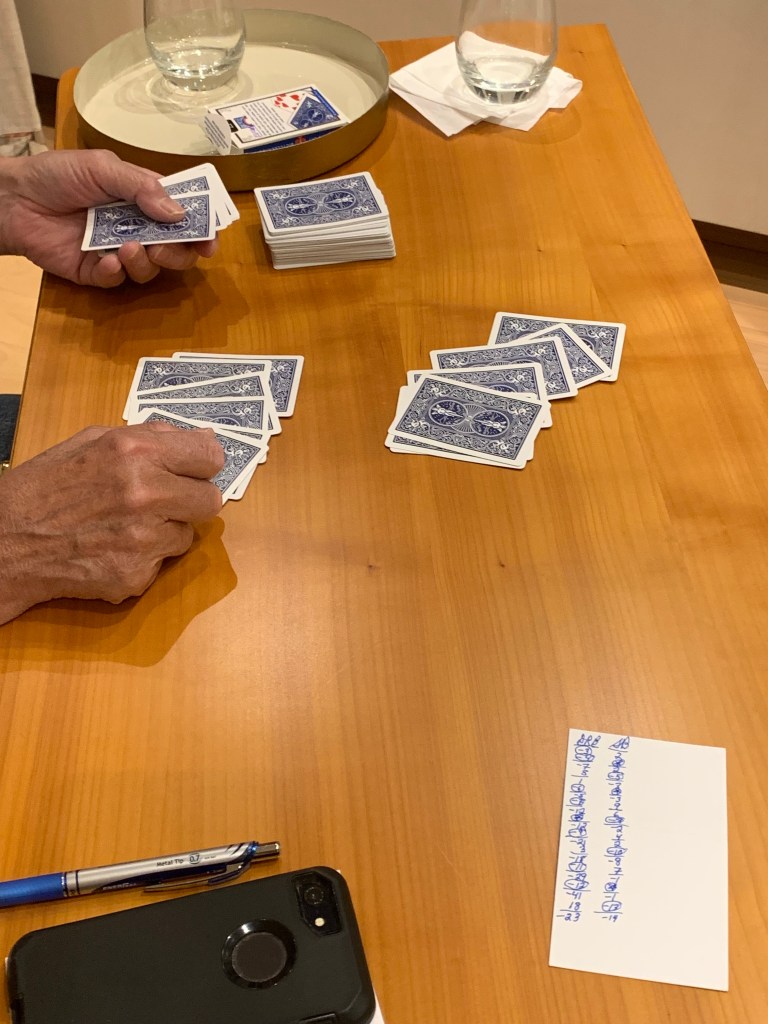
Still not feeling well, we decided to stay in. We did some more writing, then next thing I knew Santo had set the table up for cards! He had not wanted to pack two decks of cards, but I knew there would be some time during the trip when we would enjoy playing cards. And we did! It was a close game of Three-Fourteen, but Santo edged me out in the end. Felt like a little bit of home, though we missed our usual partners.

The next day, we would head to Gelsenkirchen, where my grandmother, Oma, grew up, and Opa had lived for a time. We would also visit Oberhausen, where they were married and where Oma lived right before she boarded the ship for America. I began to feel nervous. Not sure why. Was I afraid to feel something? Or was I more afraid NOT to feel something? Perhaps I realized I could go back to the place, but not the time. Was I bound to be disappointed?

Day 9 – Tuesday, July 4

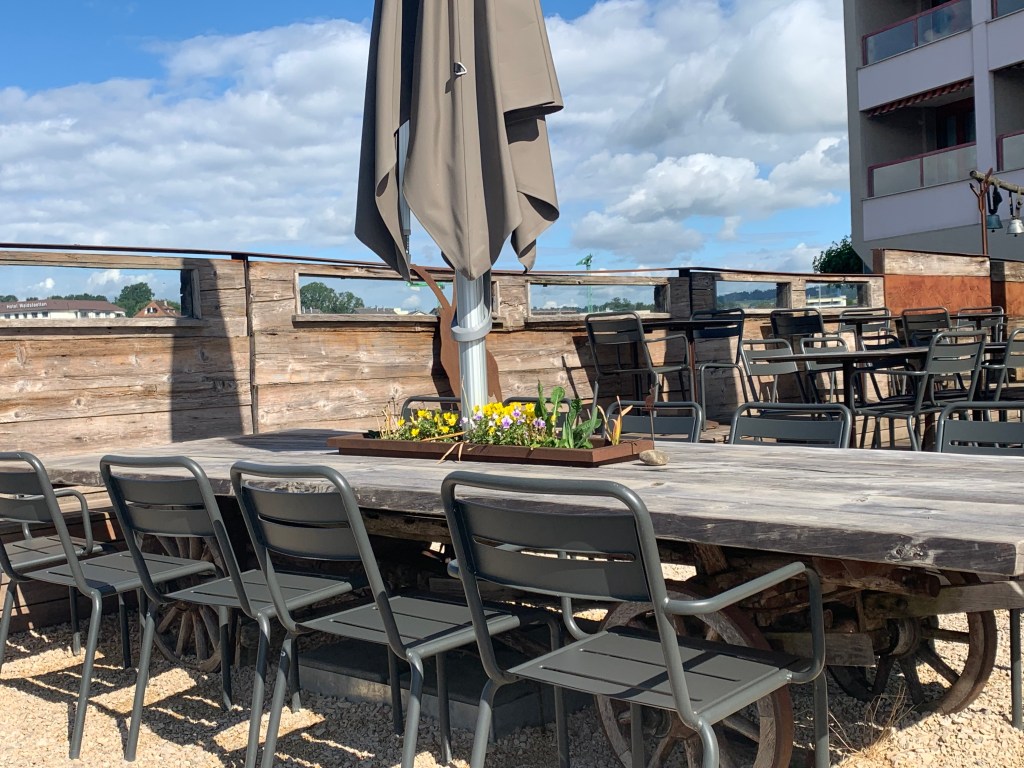
In the morning, amidst wonderful sunshine and swirling clouds, we said goodbye to Weggis. After breakfast, we sat on the expansive wooden deck (where we would have enjoyed dinner if the restaurant had been open during our stay). We tried to breathe in the deep peace so we could carry it with us on the road north – to Germany.

After about a half hour’s drive to Zug, Switzerland, we emerged from the drama of the Alps. Fifteen minutes later we found ourselves in Zurich—literally in Zurich! No bypasses here. We drove a zigzagging route on city streets, giving Santo his first glimpse of a Swiss city. While the driving was slow going, the traffic lights were well timed and we were soon back on the motorway. North of Zurich, we found ourselves in a gentler landscape of rolling hills and farmland that reminded us of home.

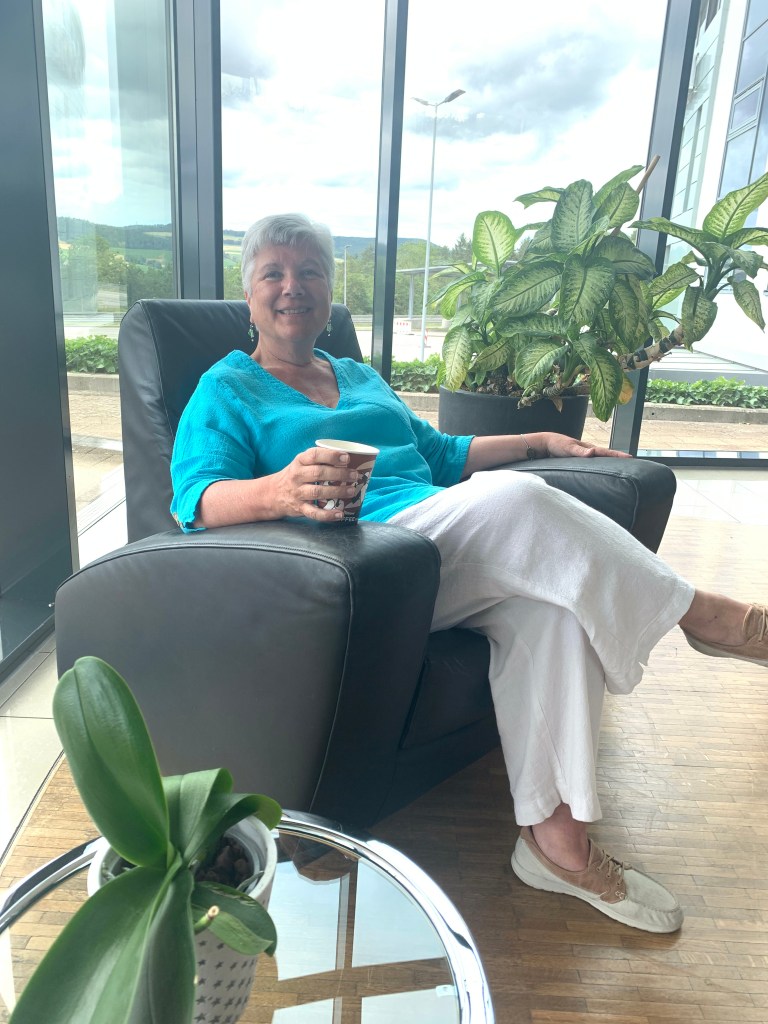
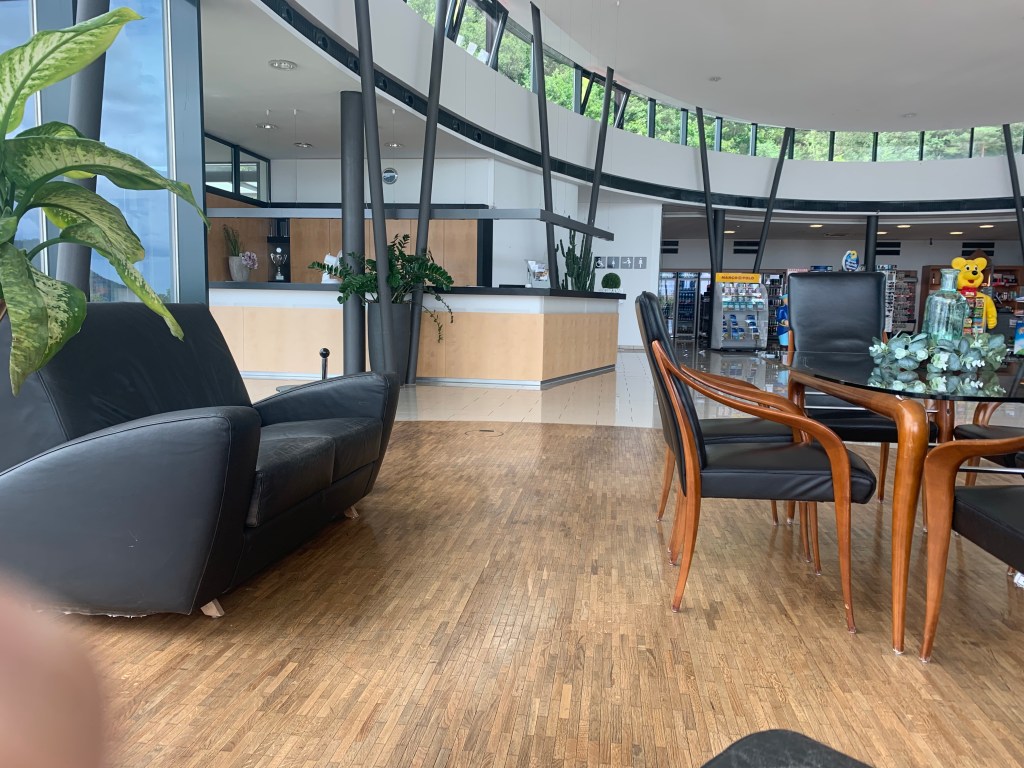
We crossed over into Germany and stopped at the first rest area, a massive complex with restaurant, hotel, and shopping, as well as the usual amenities of a rest area. Not only was the modern architecture stunning, but there was a – wait for it – COMFY CHAIR! The middle schooler in Santo could not resist taking a photo of me under the sign that said “Gute Ausfahrt.” Ha ha.

As we were leaving the rest area, a couple about our age approached us, noticing that we, too, were speaking English. We exchanged the usual where-are-you-froms (Australia–north of Sydney and New York–the state not the city). They were spending over 3 months in Europe and had just completed a loop by car from Amsterdam through northern Germany to Poland, then south to the Czech Republic, east through Austria and Switzerland, and now back north through Germany to Amsterdam. Like us, they were avoiding the big cities. They’d stopped where they pleased and find a place to stay. Braver souls than me, though I would have, and did, do the same in my youth. Their next leg would be a cruise down the Rhine and Mosel Rivers. We parted with smiles and the sentiments “Ain’t retirement grand?” and “Safe travels!”

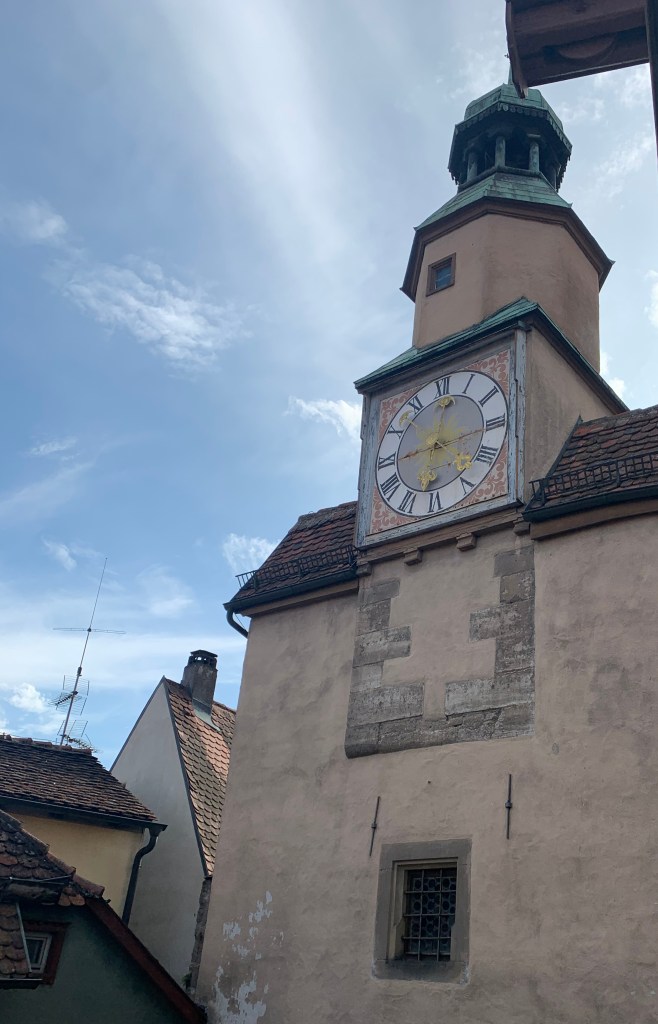
Continuing on roads we found more familiar than any on the trip so far, we continued to our next destination: Rothenburg ob der Tauber (or o.d.T.). This perfectly preserved, walled, medieval German city is something of a tourist trap, but still well worth a visit. Our hotel was within the walled portion of the city, and they told us to drive up to the door and a valet would park our car. Late in the afternoon, we entered the city through a narrow archway in one of the towers dotting the fortress walls. Now on cobbled streets as narrow as the ones in Avigliano, we made our way through the maze of short blocks, dodging tourists and dogs, until we came to the Romantik Hotel Markusturm (so named because it was located right next to the ancient Markus tower). Grabbing our overnight bags, we went through the thick wooden doors to the small lobby. The walls were of dark wood, the carpeting deep red, and the furniture was throne-like (and looked royally uncomfortable). Check-in was efficient, and soon we were headed up two flights of stairs to our room.

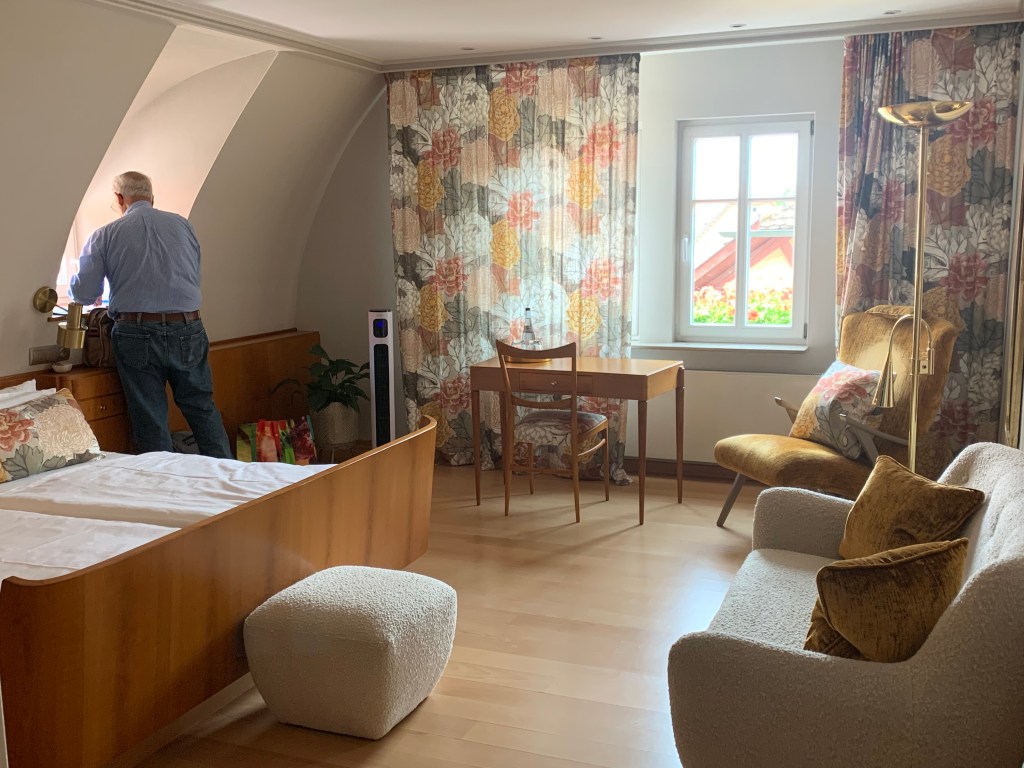
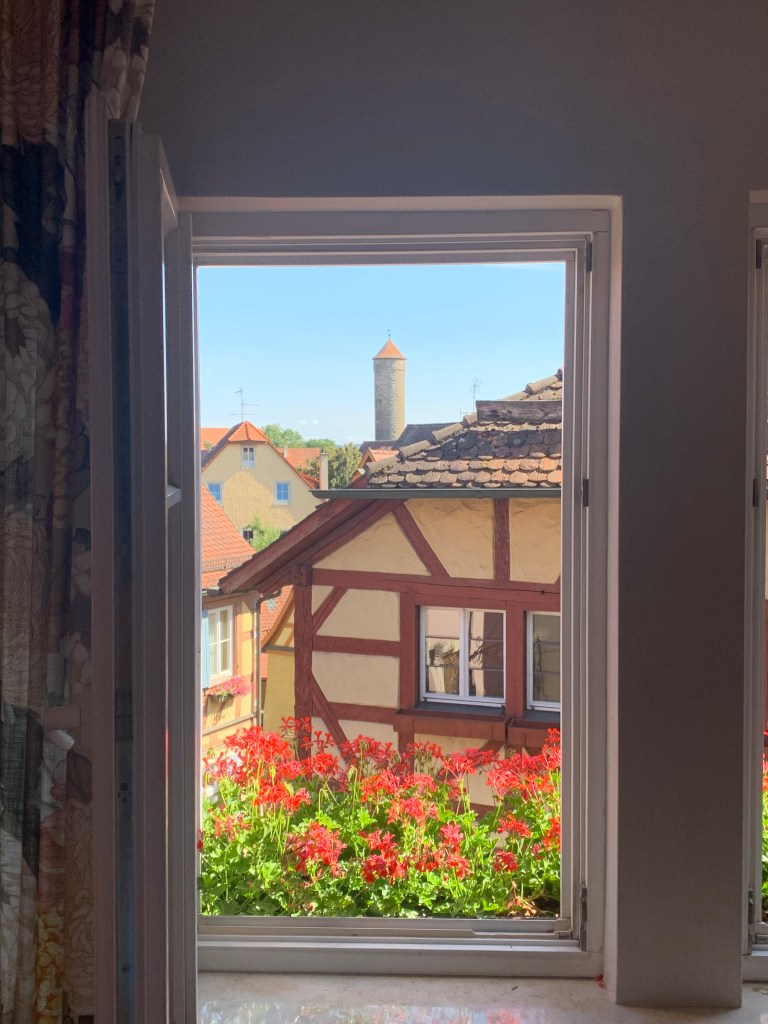
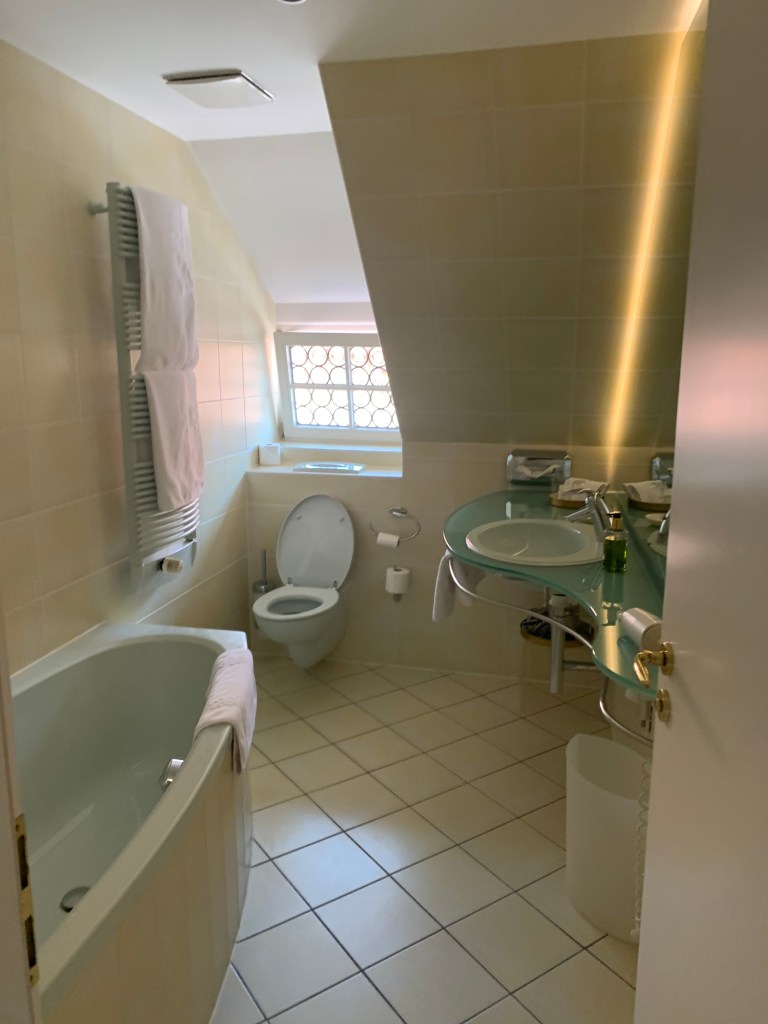
Entering the room was a stark transition from the dark browns and reds, and the heaviness, of the hotel lobby and stairs. The room was bright and modern, but somehow the light style seemed perfectly appropriate. It was more like a small apartment than a hotel room. The woods were in hues of blonde (floor) and light cherry (furniture). Windows on two sides offered views of the medieval rooftops in shades of red and brown. A free-standing desk/table of simple design was in front of the double windows facing the front of the hotel, a tall comfy chair was in the corner, and a modern white loveseat with nested glass side tables faced the foot of the bed. Curtains and pillows had a large floral pattern in muted tones of beige, brown, and ochre. The bathroom, though, may have been my favorite place. The green glass countertop curved gracefully along the long mirrored wall an dthe mirror was backlit on all sides with a gentle light. The bathtub and sink picked up the light green tint of the glass. Overall, it had the restful aura of a pampering spa. Ahhhh!

We opened the screenless windows to let in the cool air (no air conditioning here, just a tower fan). Santo was tired from the drive and I was fighting an oncoming cold, so we lay down for a medieval slumber before going downstairs to the hotel restaurant for dinner.

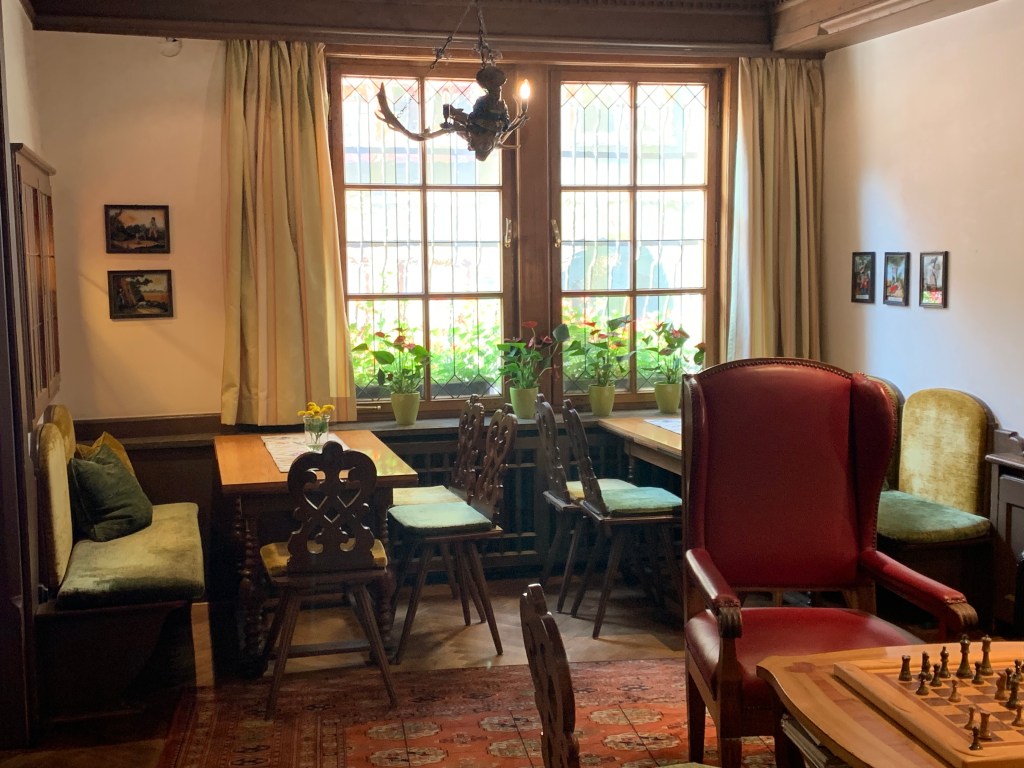
Our table was in the back of the long, narrow room. The front room, facing the street, had the dark wood and red heaviness of the lobby. Just behind it, the room we were in had a softer feel with green cloth-covered walls, cream-colored drapes, and pale wood.  

A long table next to the wall hosted a group of about fourteen Japanese tourists. The group leader was able to speak English, so she hustled around the table communicating with the staff for everyone. All the staff spoke perfect English, so used to Americans and other tourists. The entire front room was taken up with a group of Americans celebrating the 4th of July. “You’re in Germany, folks,” I thought. I had noticed a small American flag on one of the tables when we passed through and was afraid they might be a group of Trumpers. In Europe, it is embarrassing to be an American.

The wait staff were dressed in traditional German garb to meet tourists’ expectations. I felt bad for them. The two waitresses we had were both lovely, and I felt they were somehow being exploited.

The menu was laden with the heavy German dishes Americans would expect: heavy meats in heavy sauces with dense noodles or roasted potatoes. Santo had venison stew, I had rolladen. I did enjoy the meat, similar to my mother’s but not quite. Still, it felt like everything was just too much: too salty, too rich, too German. I was determined to find something different for our second night, though this wouldn’t be easy within the walled part of the city.

After dinner, we took a short stroll to the central plaza (Marktplatz) and back, window shopping along the way. We had all of tomorrow to explore.

Our genteel apartment overlooking the city awaited us.

Day 8 – Monday, July 3

The mountain filled my view as I opened my eyes. Clouds dimmed the light but not the beauty. They were in motion, giving hope for sun later in the day.

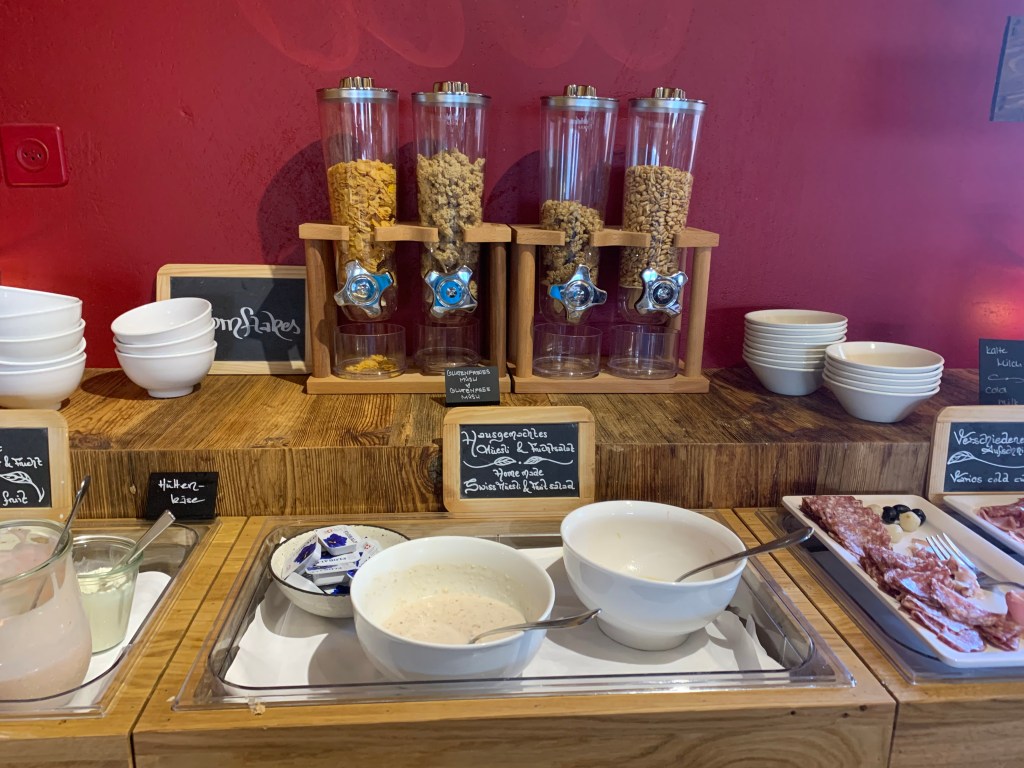
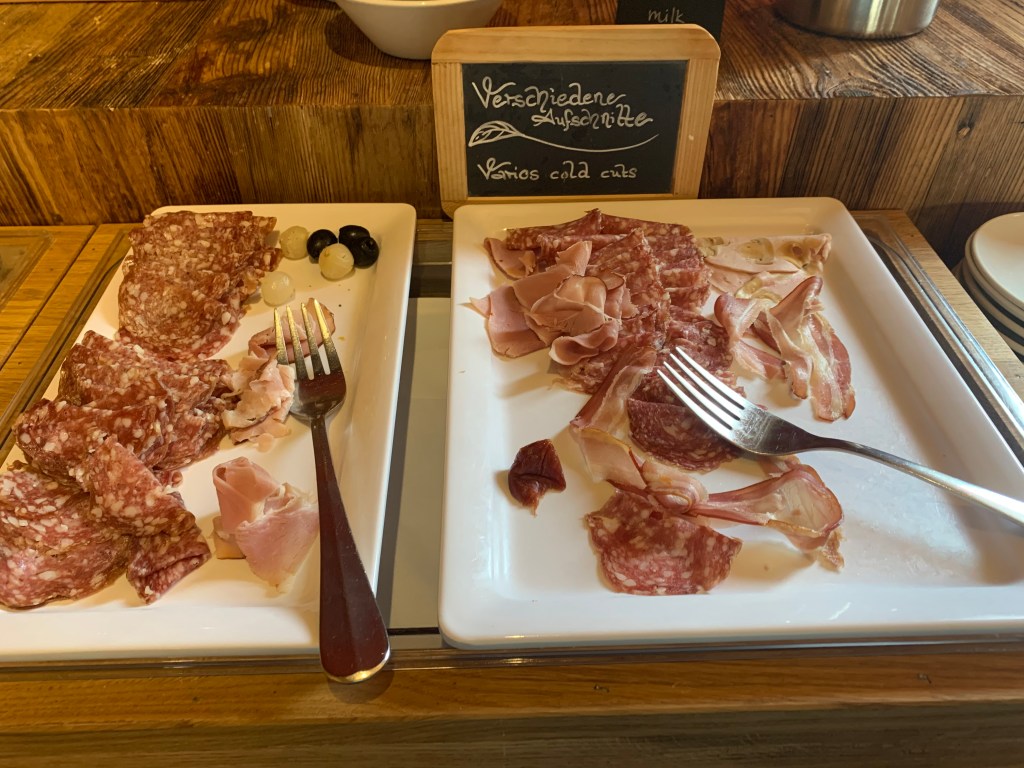
We made our way to the restaurant for breakfast. Wonderful breads, meats, cheese, fresh eggs you cooked yourself in a pot of boiling water, fruit, and real Swiss muesli. We enjoyed everything, especially the coffee which was closer to what we are used to than the espresso in Italy.

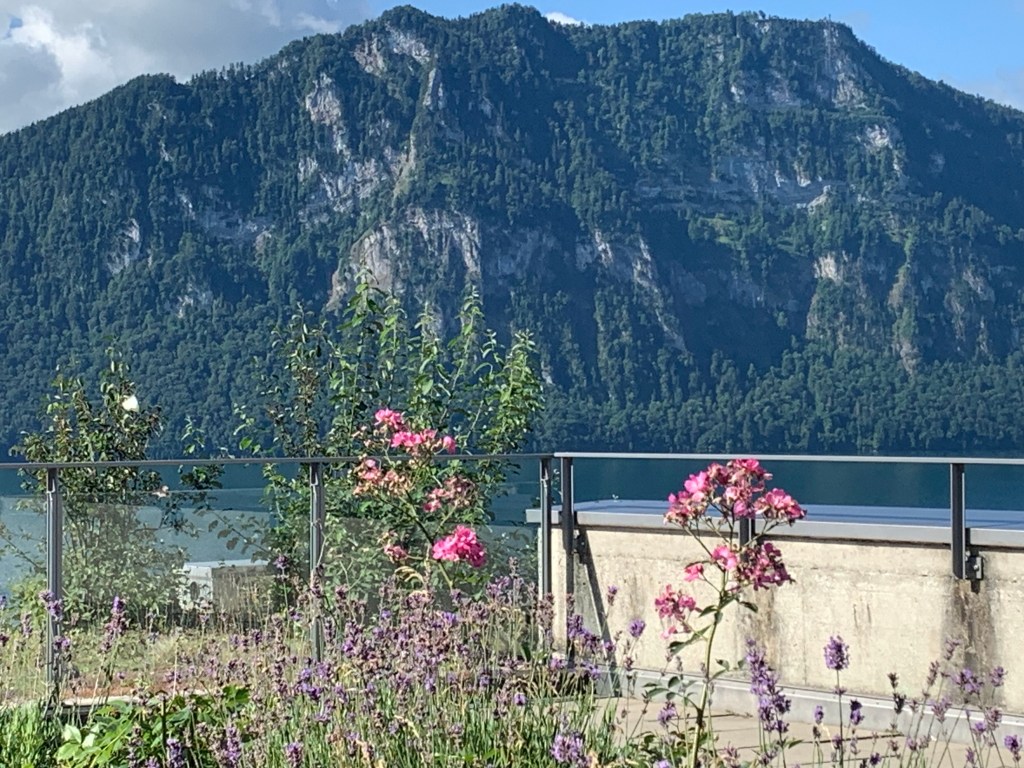
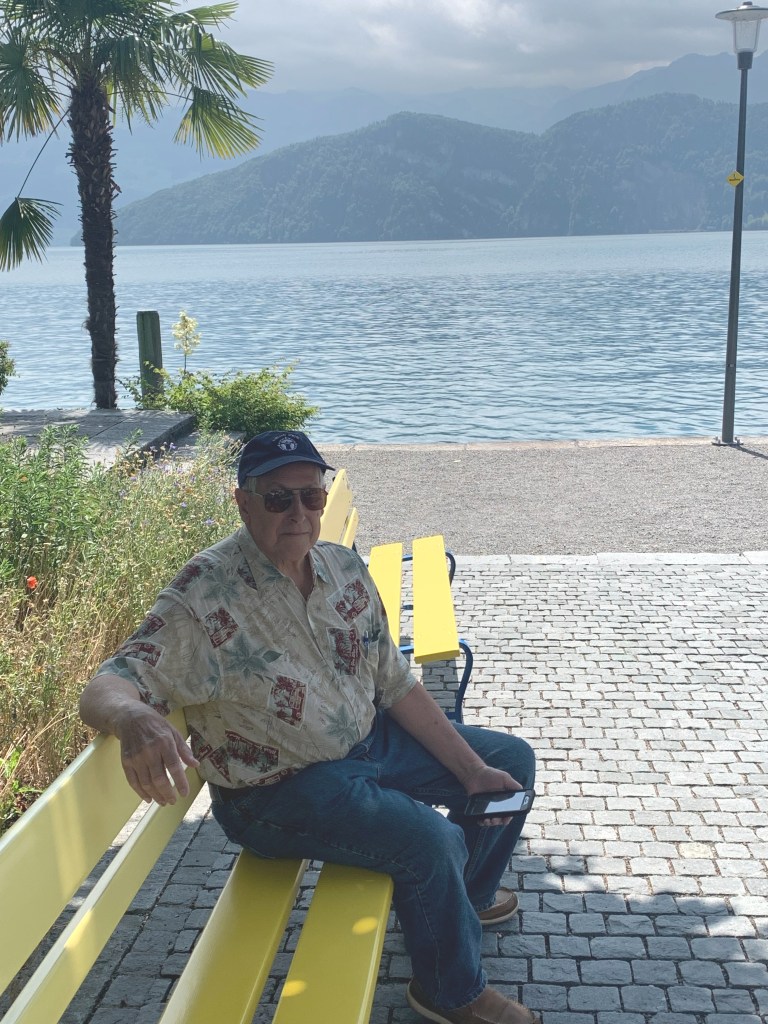
After breakfast, I had time to write at the table and chairs on our balcony as we waited for the clouds to part. By noon, we made our way down to the village and the lazy park stretching along the lake front.

We went to the cruise office and found that the next cruise to Flüelen was in about one hour. We bought tickets and looked for a place to have a coffee while we waited.

Everything in Weggis was much more expensive than anywhere we had been so far. Coffee with a table at an outdoor café would be over $10 each! We decided to buy waters, and an amazing lemony dessert, from a kiosk in the park and sit on a bench to wait.

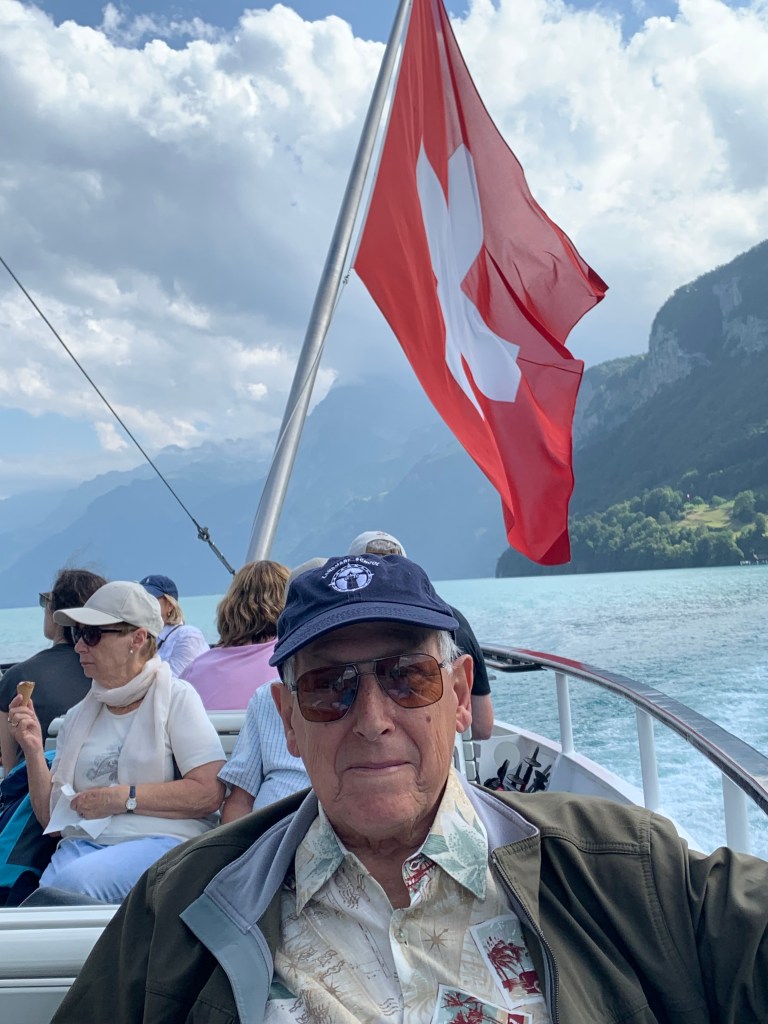
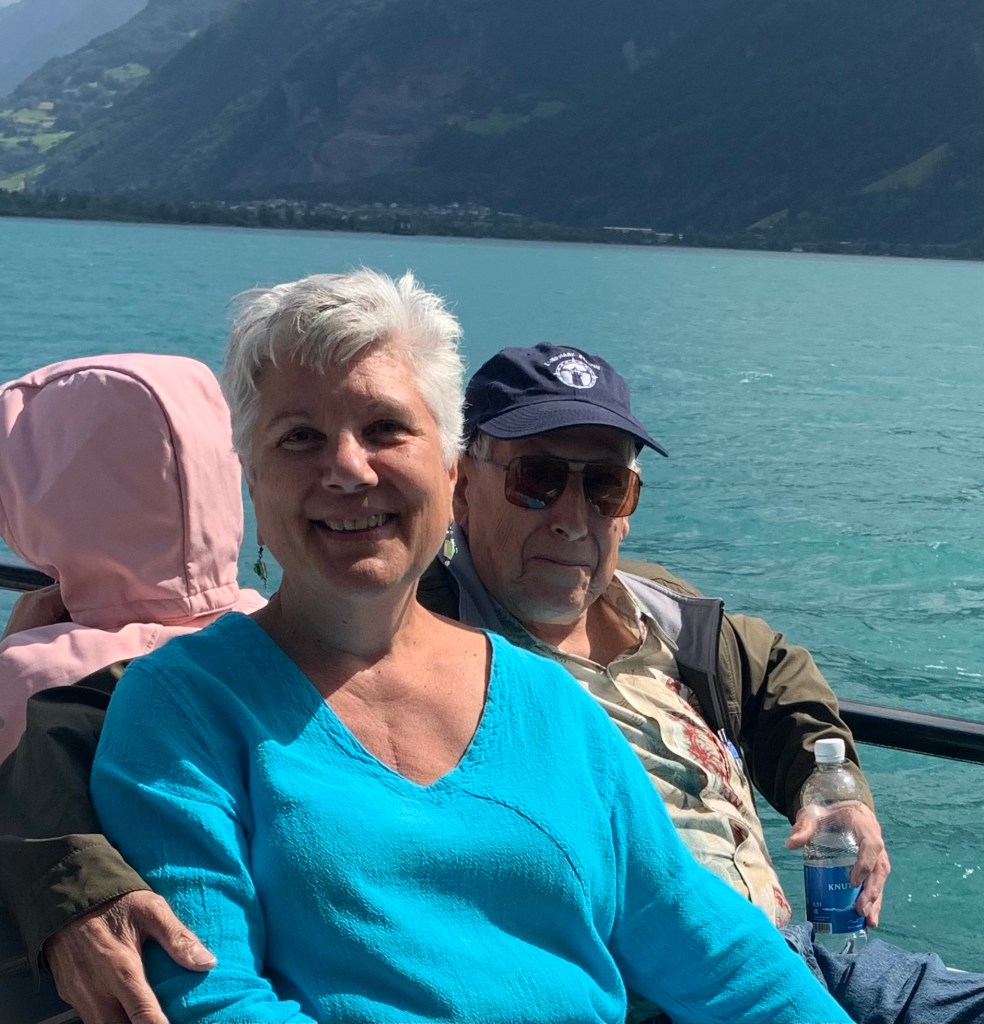
The ship boarded right on time (think Swiss watches) and we found seats first inside at a table, then a better spot outside on a wide bench facing the east side of the lake. We would have the western view on the way back. The ship was only about half full, so there was plenty of room and people moved around easily. Everyone seemed relaxed, even locals who were using the ferry just to get from one place to another.

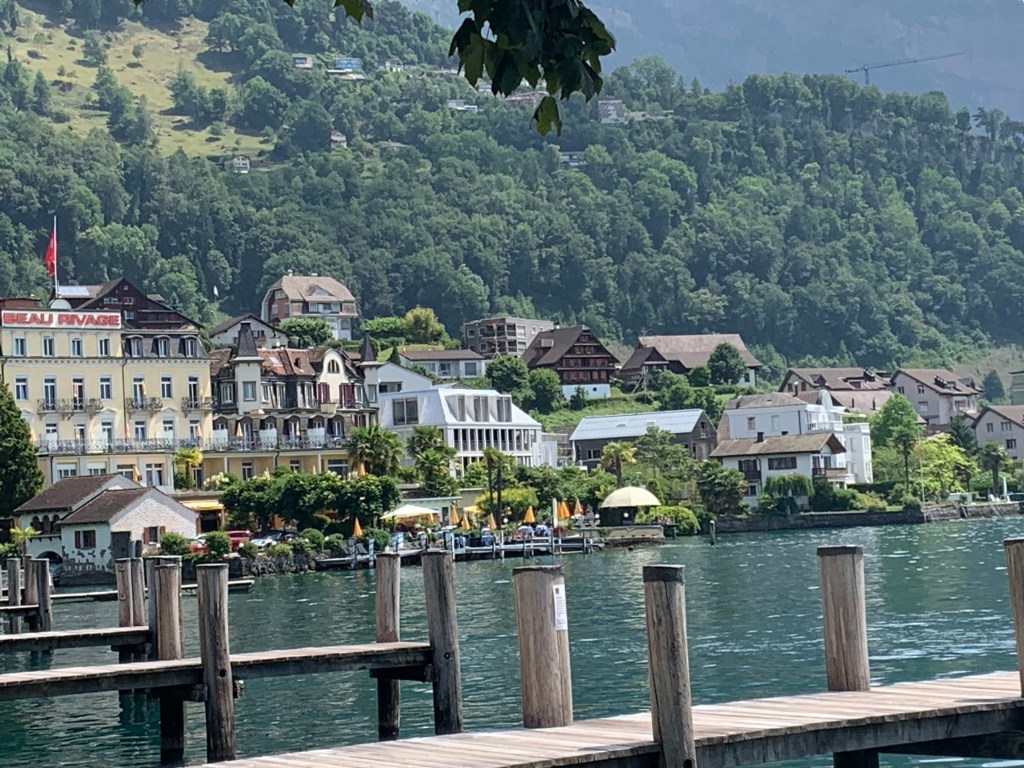
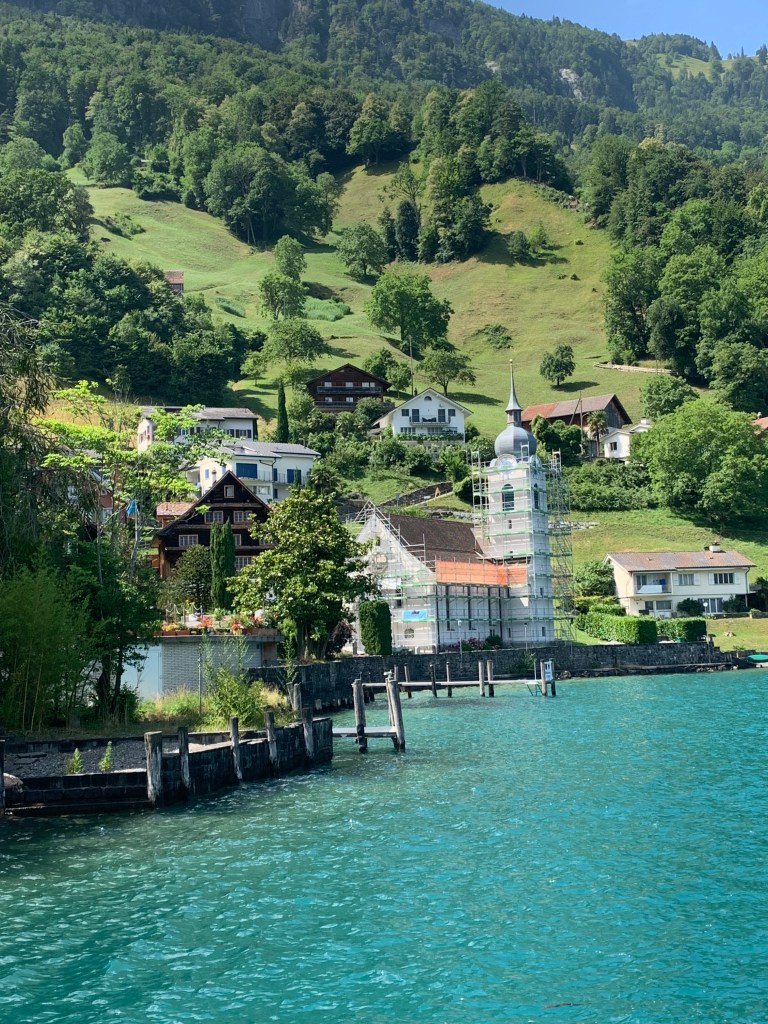
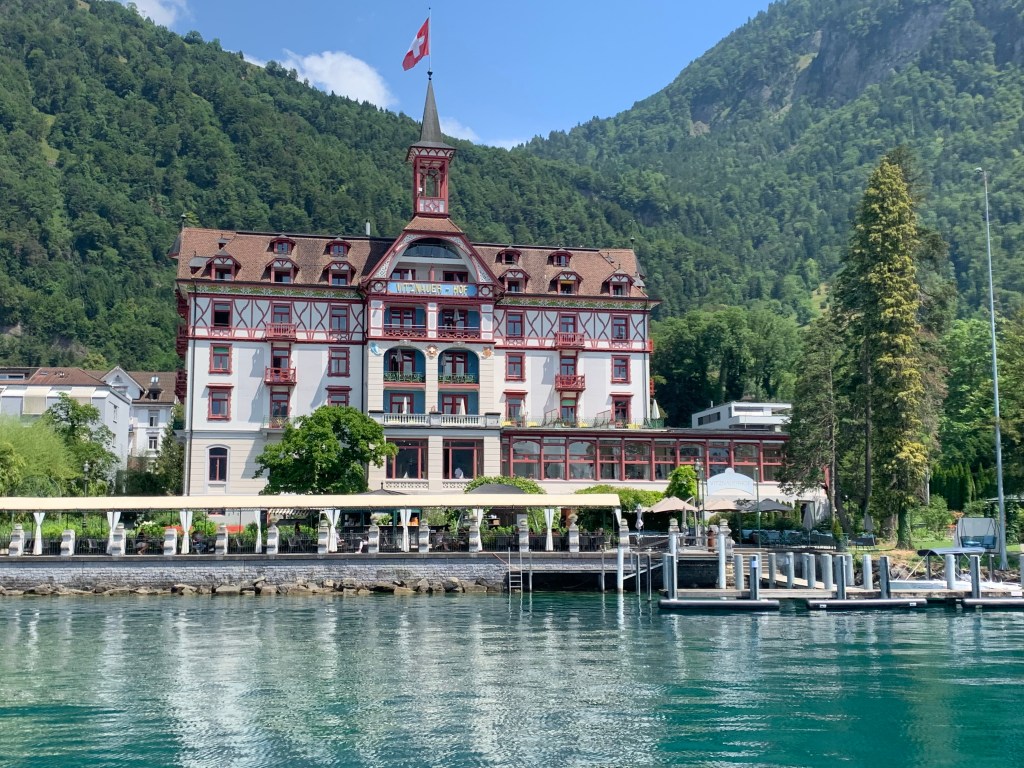
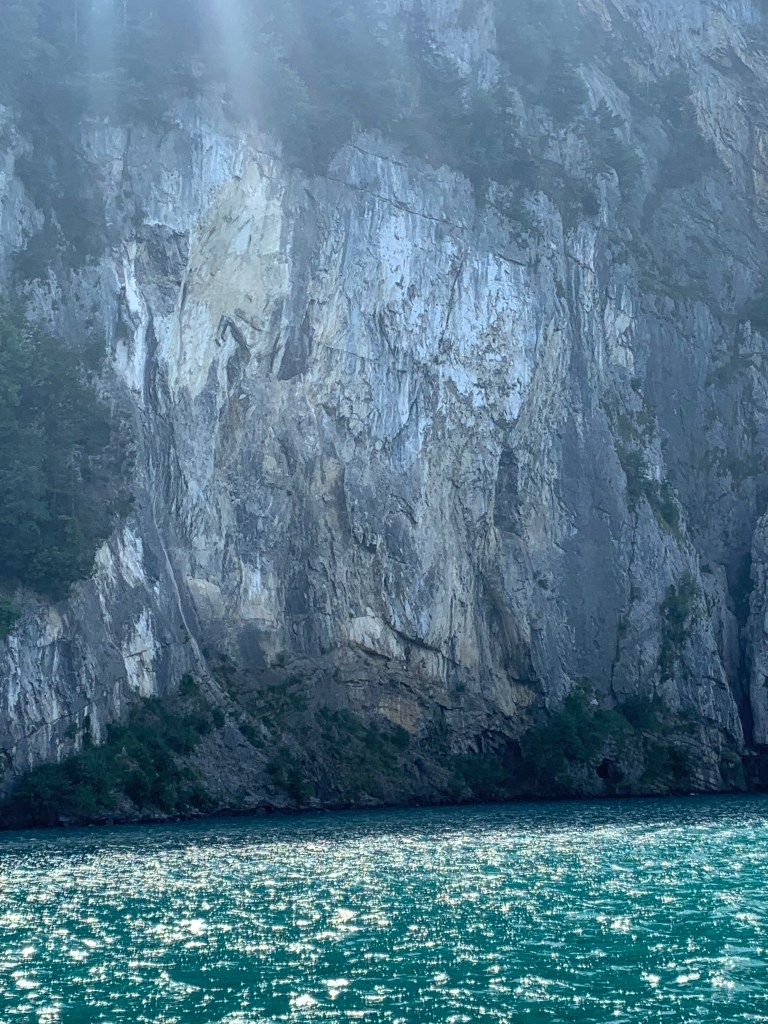
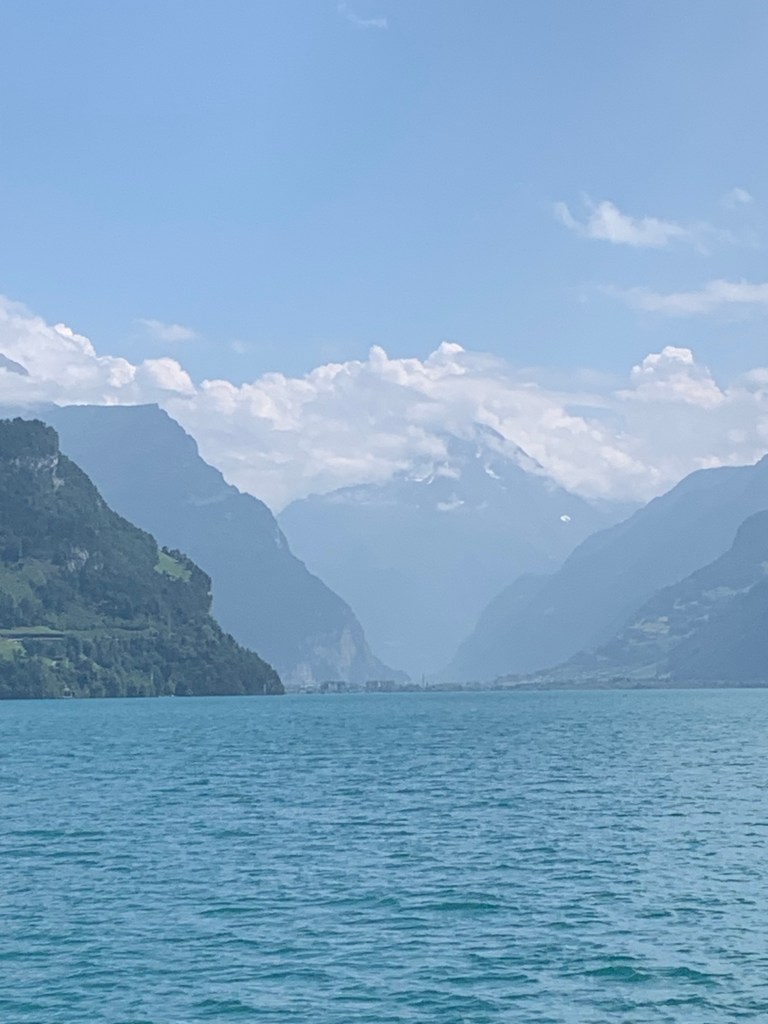
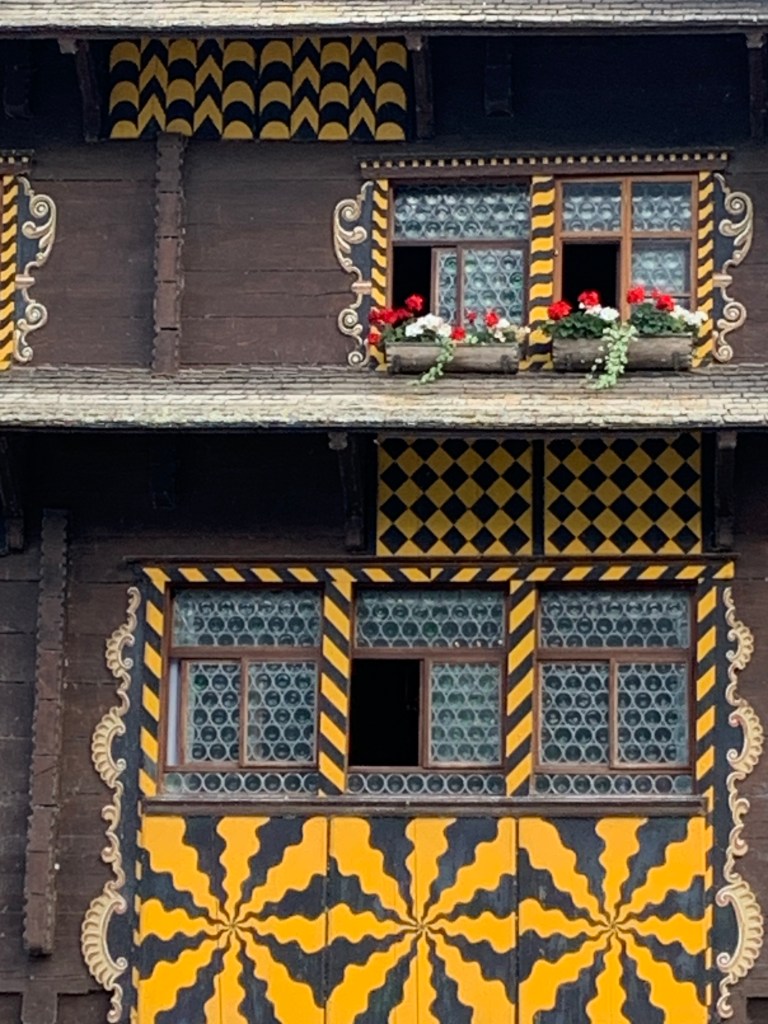
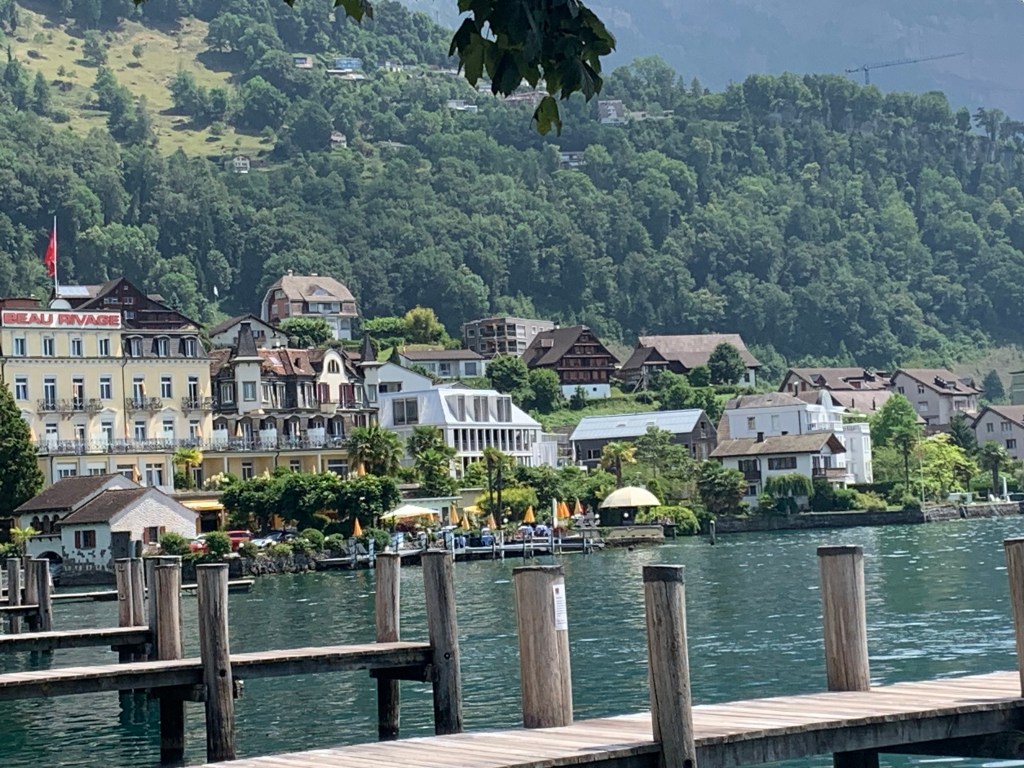
It is difficult to describe the absolute majesty of the unrelenting views. Colors that cry out “peace” – varying shades of blue and green in the water, trees, grasses; earthy browns in the houses and on the even darker rooftops; sparks of white on peaks and on the elegant hotels gracing the shore at each stop. The steepness is what bends the mind. Looking at the houses, I feel that if I stepped out one of those doors I would just tumble down the mountainside into the lake. Impossible roads etch sharp lines back and forth up the slopes.

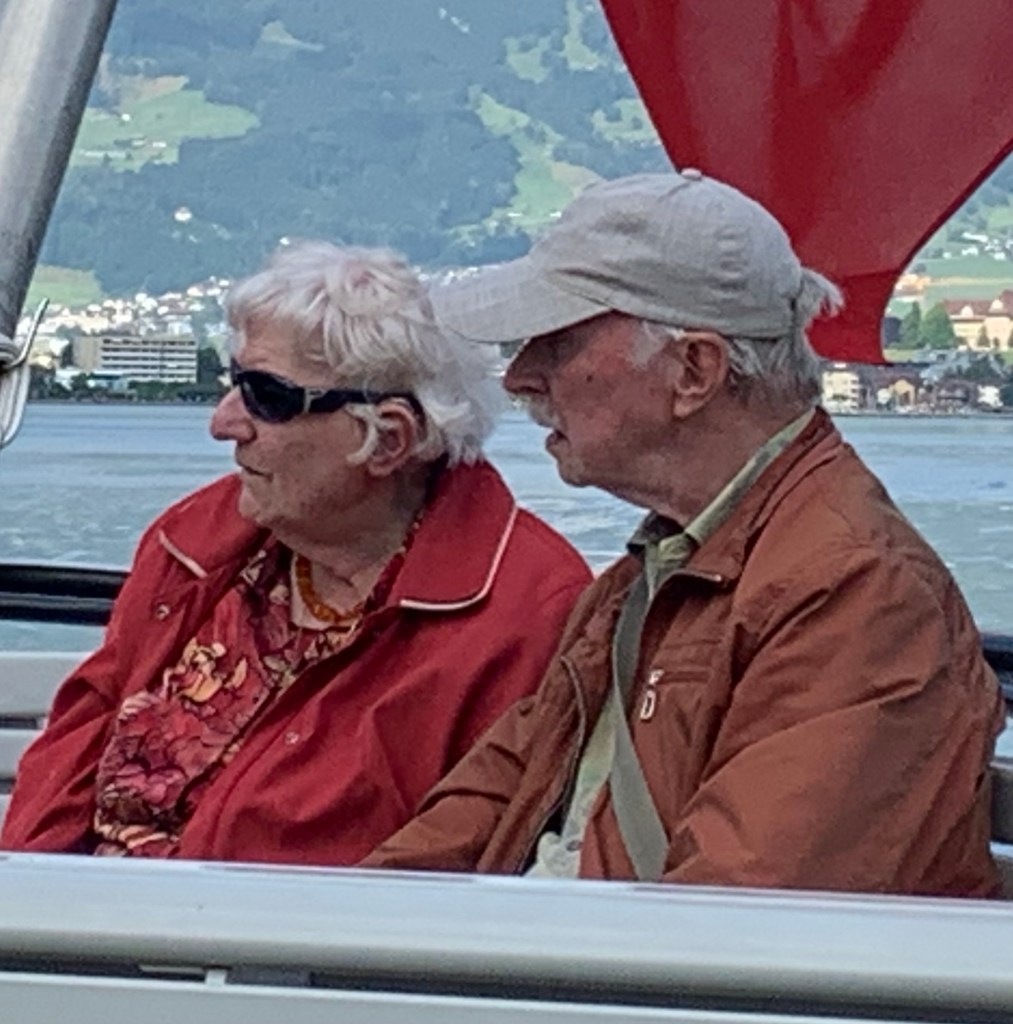
The four hours sailed by as we stopped at villages up and down the lake, passengers getting on and off: hikers with their boots and walking sticks (ironically smoking), teenagers with backpacks, couples young and old, including one older couple who followed one another around the boat, finding a seat for a time, then moving to another. They never walked together. The old man walked stooped over with his mouth open, his shoes never leaving the deck as he shuffled from one foot to the other. He reminded me of Tim Conway’s impression of an old man on the Carol Burnett Show. They always found each other. She was usually the one finding him. But once we saw him shuffling back to her with two ice creams he had purchased from the café.

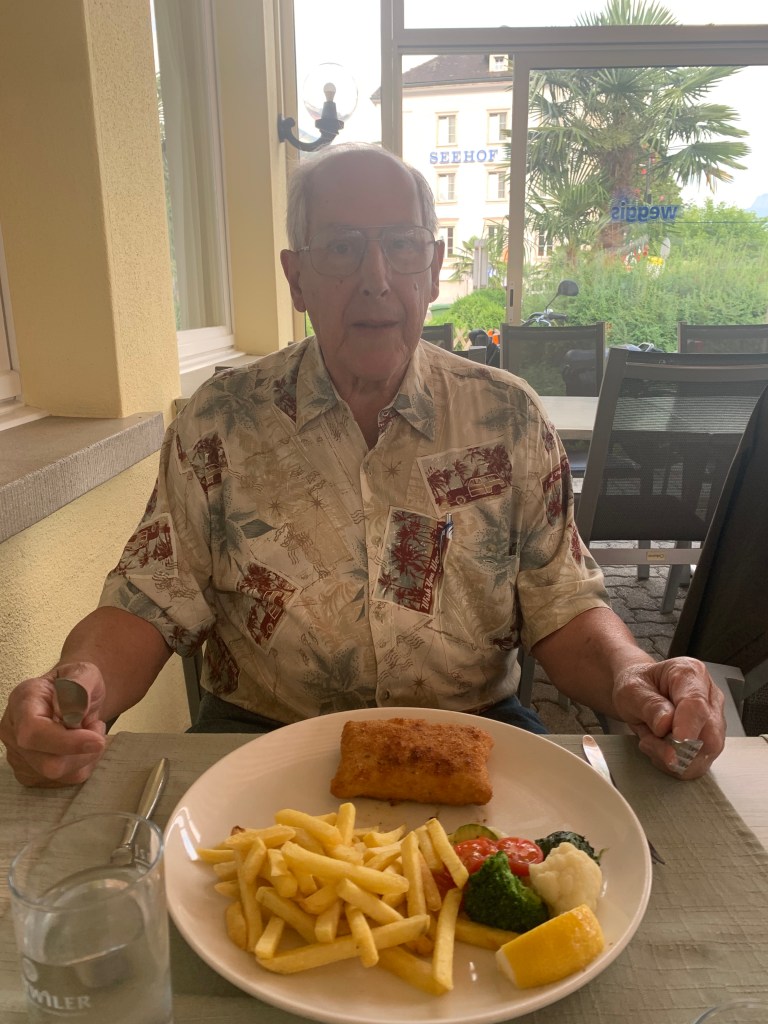
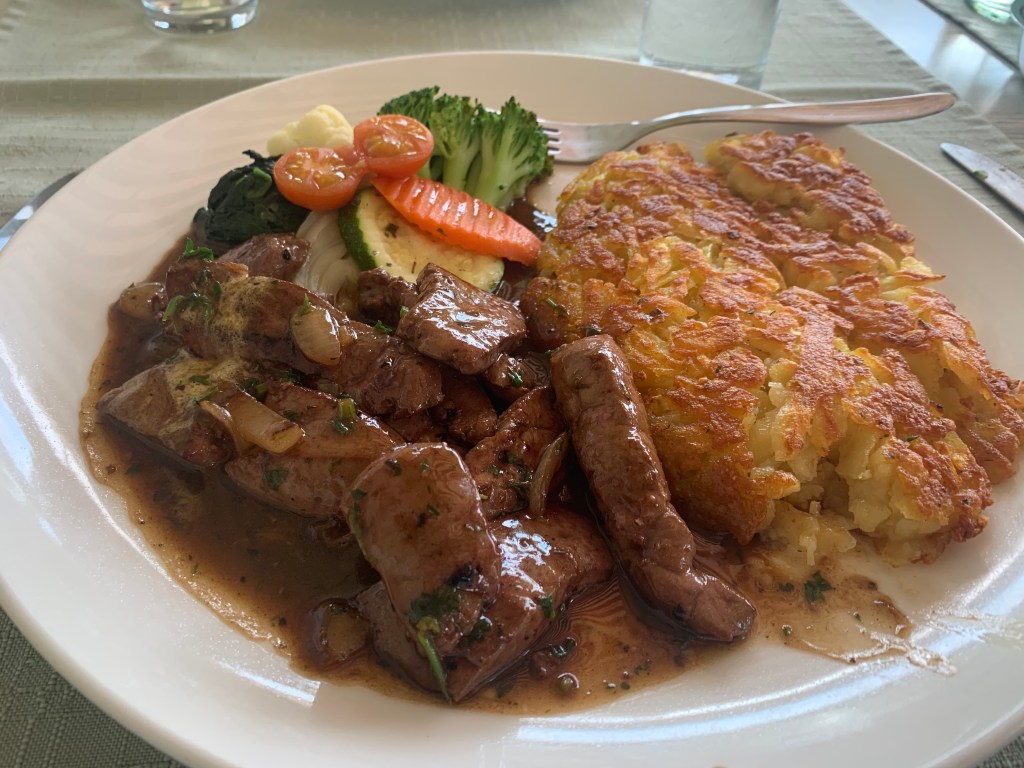
We decided not to eat on the boat since the dessert before we left seemed to be tiding us over. We arrived back at Weggis at 6 p.m. and walked to the Hotel Viktoria, which someone had recommended as a place we could find traditional Swiss food. I had hoped to get fondue or raclette on our one night in Switzerland, but the man at the restaurant told us that these were served only in the winter months; they were not warm weather foods. That made sense! So we stayed at an outdoor table on the lake and ordered pork cordon blue with French fries (Santo) and veal liver with rösti (me).

The climb back up the hill to our hotel was difficult but I made it. I sat on the balcony in the cooling night air then went to bed early, feeling the beginnings of a sore throat.

Of all the places Mark Twain visited in Europe, Mark Twain found Weggis to be his favorite. He returned once for a 10-week stay when he was mourning the death of his daughter and was looking for a quiet place to regroup. He wrote:

“This is the charmingest place we have ever lived in for repose and restfulness. The scenery is beyond comparison beautiful … Sunday in heaven is noisy compared to this quietness.”

In this stillness, I rested.