I only got a few hours sleep due to the warm temperature of the room and my cold, but wasn’t too worried since we did not have a big agenda for the day: just to go into Gelsenkirchen and visit the two street addresses I had: one where Oma had lived as a girl, one that was listed on Opa’s pilot’s license for the Royal Navy dated 1919.
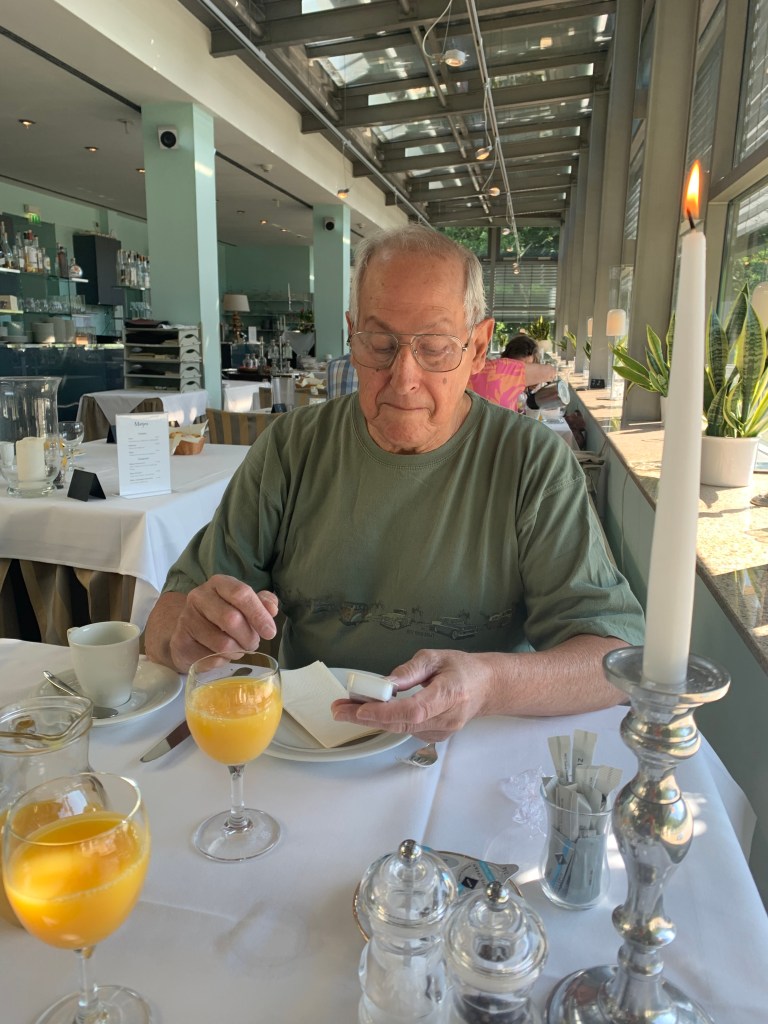
I took a long shower, enjoying the cool and comforting stream of water in the walk-in shower. Feeling refreshed, we went down to breakfast, which was included with our room. The dining room in the morning was just as elegant as in the evening. Luckily, we had a different server—a delightful young woman who understood what true hospitality was!
We ordered coffee and Santo ordered fried eggs, which I found out were called Spiegel Eier. Literally translated, this means “Mirror Eggs.” They were cooked in a circular pan and came out on a round plate. Perhaps the yolks were the eyes staring back at you (like a mirror)?
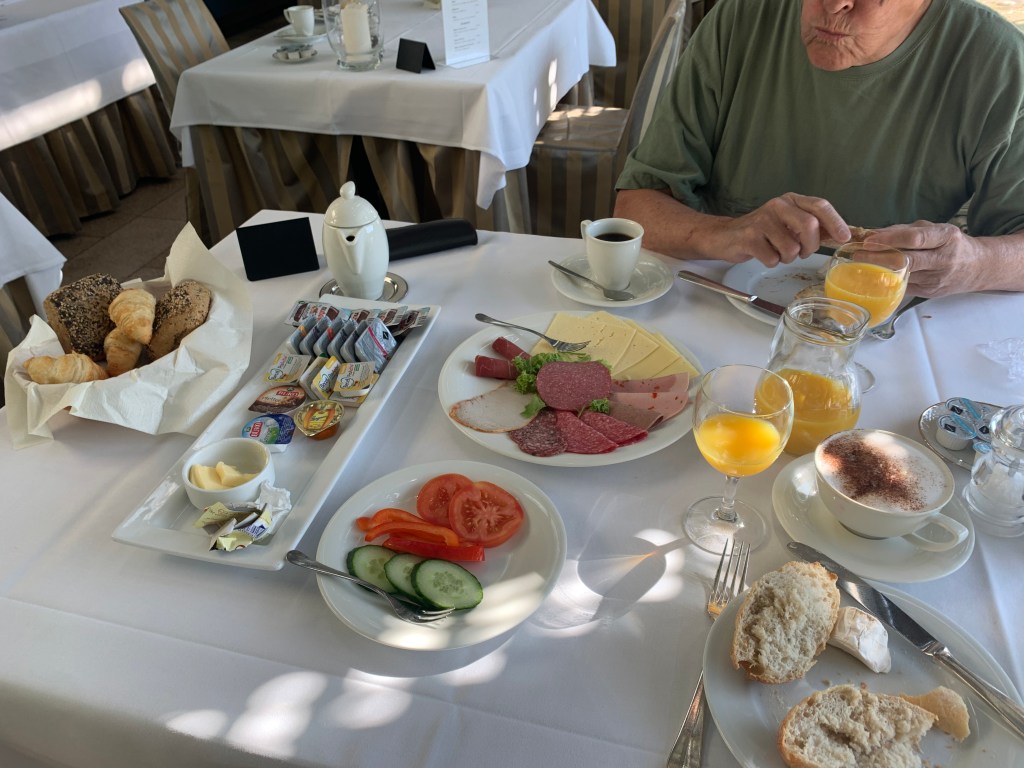
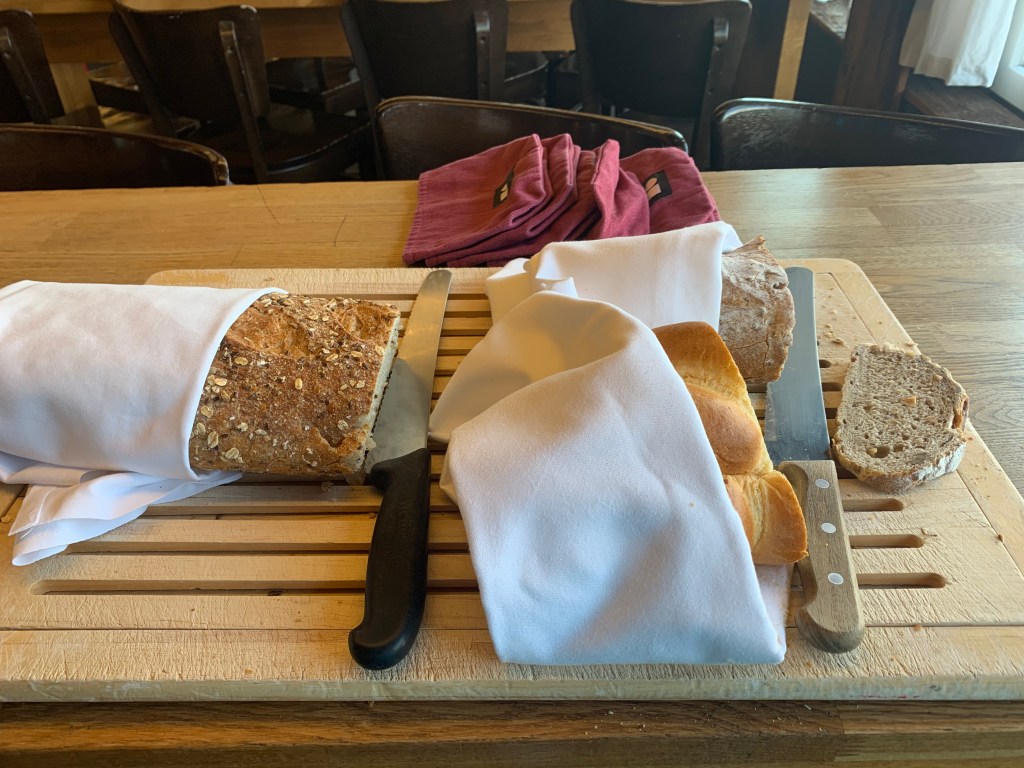
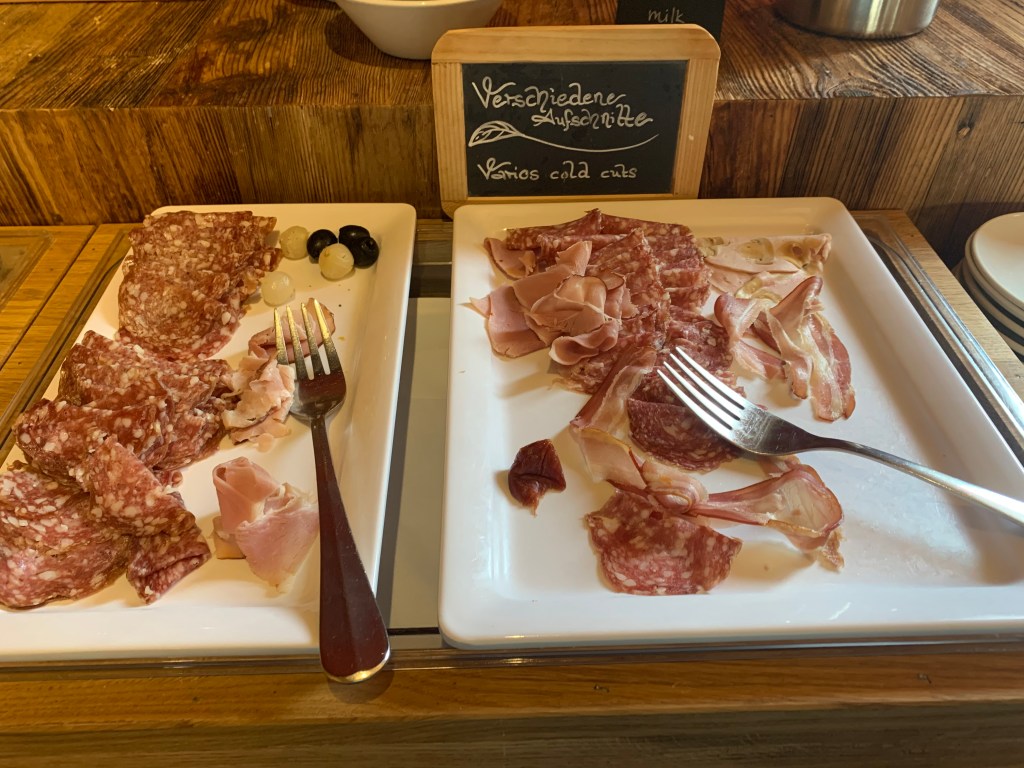
Platters of meats, cheeses, jams and jellies were brought to us along with a pitcher of freshly-squeezed orange juice and a basket of fresh rolls and croissants. Heaven!
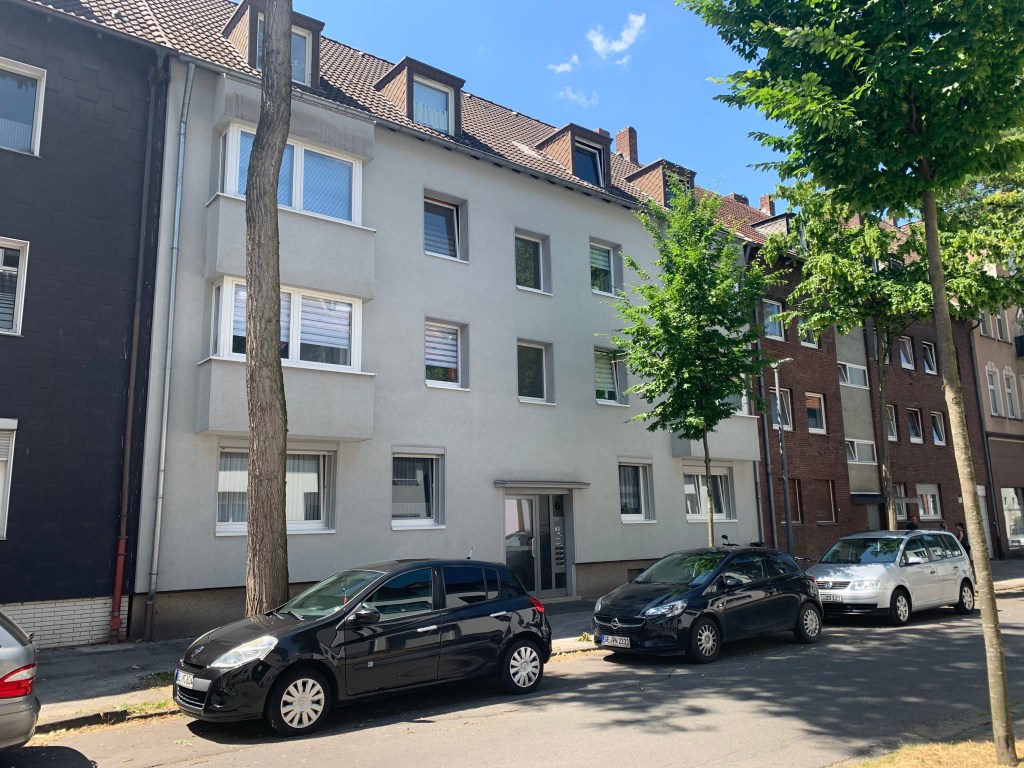
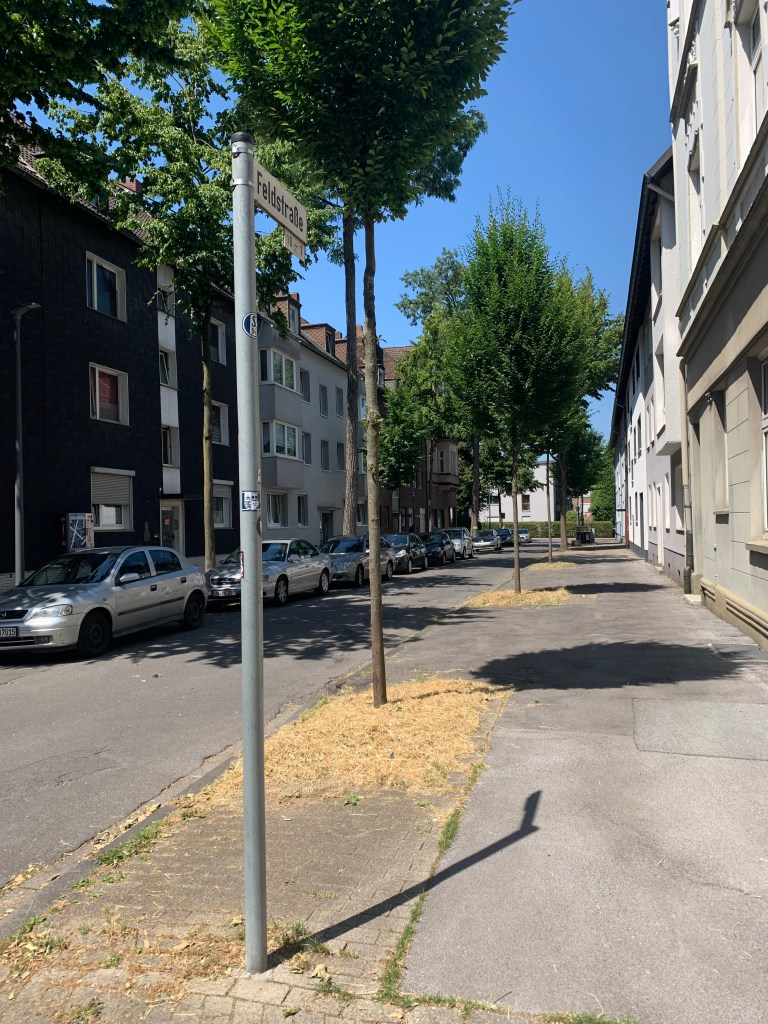
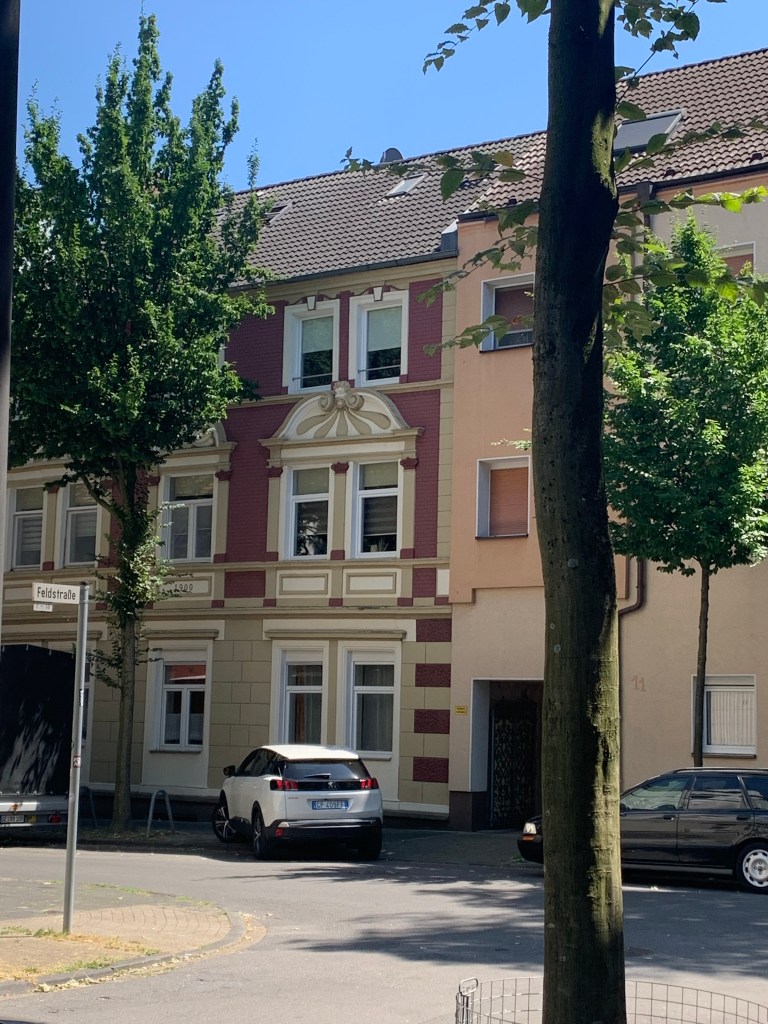
After breakfast we headed to the car. I entered an address into the car’s GPS and we headed to Gelsenkirchen. Our first stop would be Oma’s street: Feldstrasse 6. It was a short street, only one block long with five three-story buildings on each side. Some looked old, but most had probably been built in the 1960s: smooth stucco walls in muted colors, glass entrance doors, and evenly spaced windows facing the street, many with their outside metal roller blinds closed. The few that were open revealed lace curtains similar to ones I had seen in pictures of Oma’s coal company house in Scranton. There appeared to be six apartments in each building.
The narrow street was lined with cars on the right side where parking was allowed. Unable to find a place, Santo dropped me off and found a place just around the corner at the end of the street. He stayed in the car in case he had to move it. I walked to the sidewalk across the street from the light gray building that bore the same address as Oma’s childhood address and started to take photos. I was trying to imagine Oma walking down this street, walking to school, or to the glass factory where she worked. But I couldn’t. It was a street in a German city but I struggled to connect it to her. As I was taking pictures, a man came out of the building next door and, understandably, looked curious about what I was doing. I explained about Oma and also asked if he knew where the mines in Gelesenkirchen where Opa had worked might have been. He told me about a place called Zeche Ewald (and helped me enter it in my phone so I got the correct spelling). I thanked him warmly, glad to have made a human connection here. Somehow, it made all the difference.
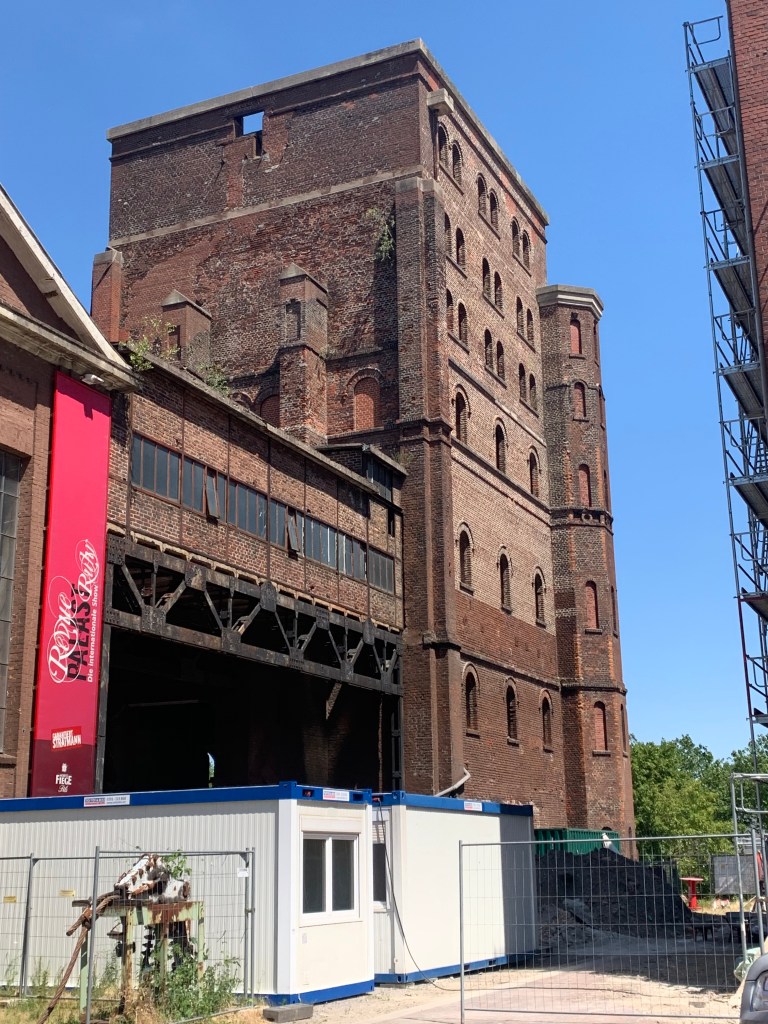
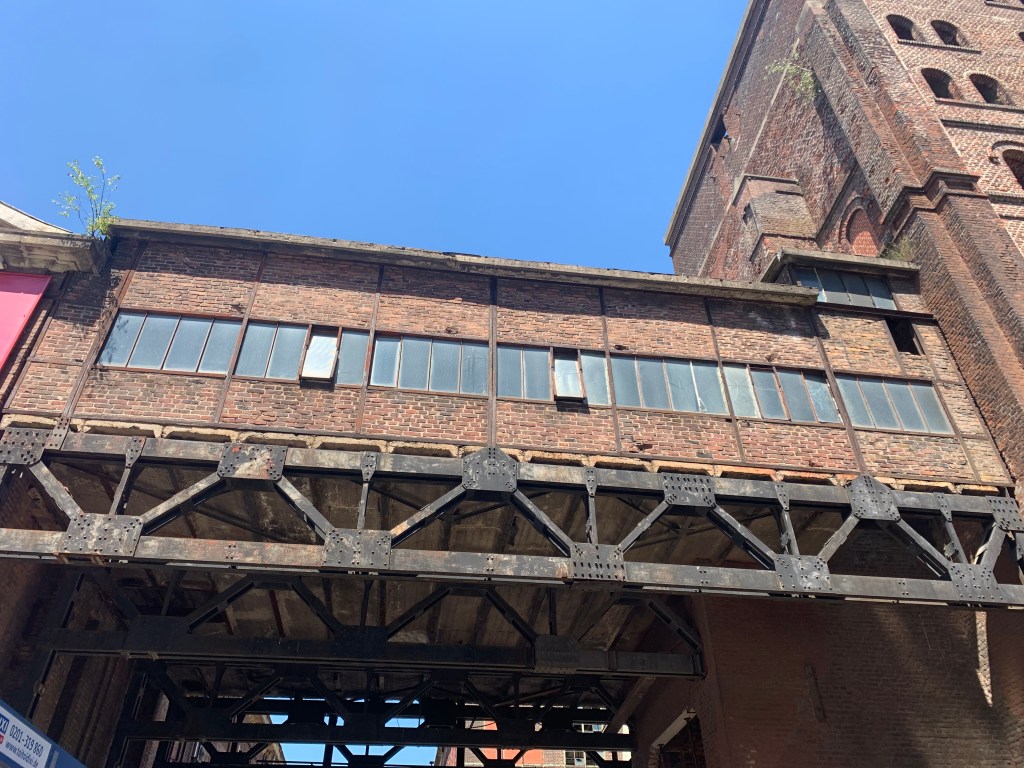
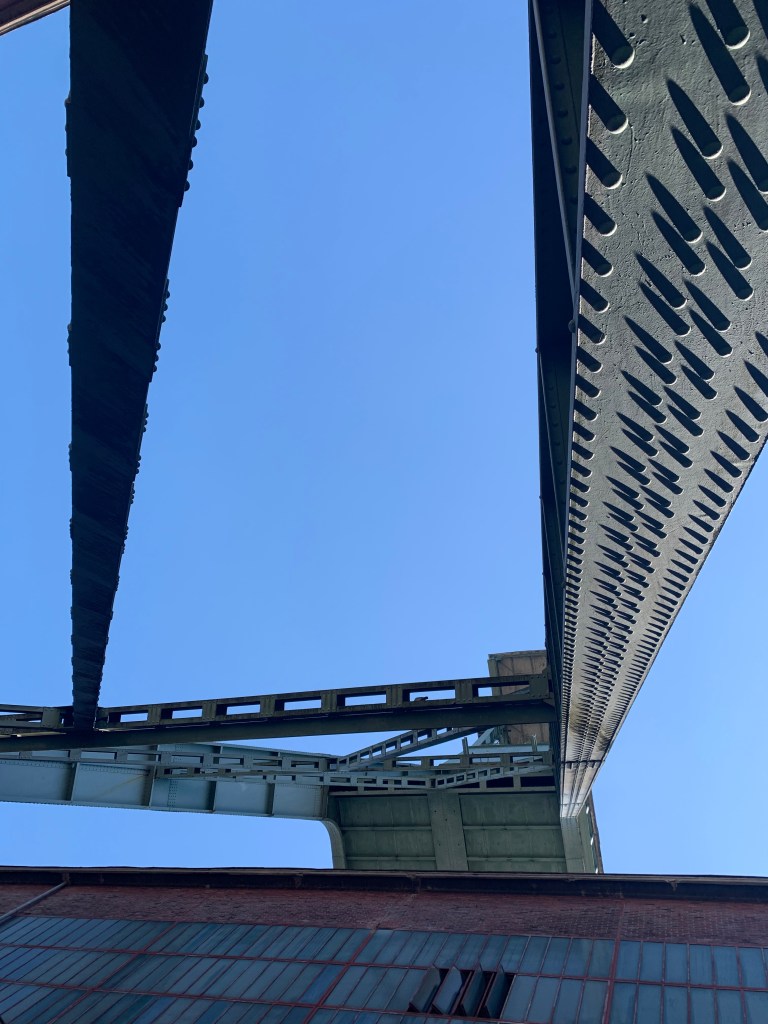
It turns out that “Zeche” means “colliery.” How had I not known this? The area, Zeche Ewald, is a place where a colliery had been and two of the structures still stand–heavy, steel triangles reaching high into the sky. At their base were old brick buildings, long since abandoned. Through the broken windows, I saw more heavy steel beams. A small canal ran through one building. The structures were not like the breakers I was familiar with in Scranton, but I could see how they might serve the same purpose. Across from this was a new park. Signs indicated that the area was being repurposed to be a destination for families, bikers, etc.
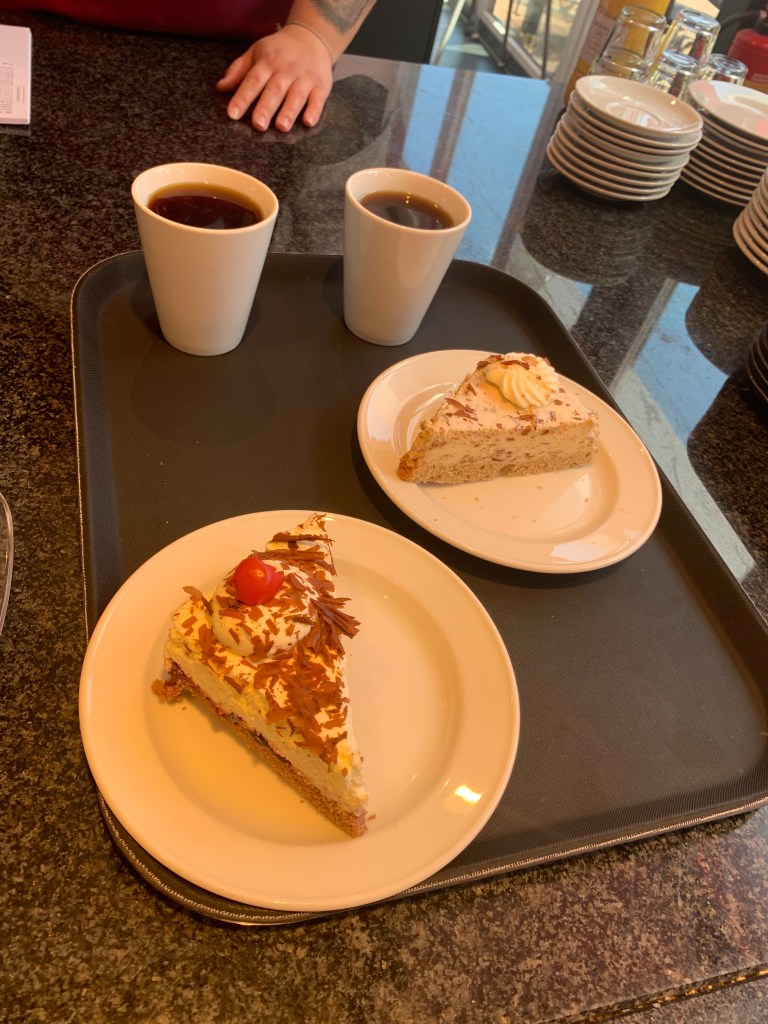
Just as the man had told me, there was a café nearby with outside seating under shade trees. We went inside and viewed all the treats in the glass cases. Santo chose a nutty cheesecake, I picked a “Schwarzwald Kuchen” (Black Forest Cake). We took our desserts and two coffees and found a table on the park side of the building. As I enjoyed this green space and wonderful food, it was hard to imagine that this may have been the place where Opa had gone underground to work in the mine.
The desserts would tide us over until dinner.
Our next stop was Elisabethstrasse 7, the address on Opa’s pilot’s license from 1919. Elisabethstrasse was closer to the city center than Oma’s street. Unlike Feldstrasse, there were no trees here. The buildings were larger and a bit more ornate, but still sat one attached to another in a long row. The building that had been Opa’s looked like one of the older buildings, but I do not know if it had been there in 1919. It now houses an Asian restaurant downstairs. I stare at the building and down the street. So many questions. So much that has been lost to history. I’m looking for something that matters, but maybe it is not here. Even if I knew this was the very same building, if I knew which apartment had been his and who he had lived with, if I knew precisely where the mine entrance had been that he entered each day, would I know him any better?
Santo was waiting outside the car when I was ready to leave. He asked me what I was feeling, sensing that there was something wrong. I paused a long time. “Honestly, I don’t know,” I said. Then Santo noticed some pigeons landing on the street and hopping along in search of food. “Look,” Santo said, “They’re looking for Opa!” Opa had raised, raced, and loved homing pigeons his whole life. “YES,” I said. “Yes, they’re looking for Opa!” I started to smile as I chased the birds, taking photos. They could feel Opa’s presence here, even if I couldn’t. In my heart, I thanked them for helping me to find him.
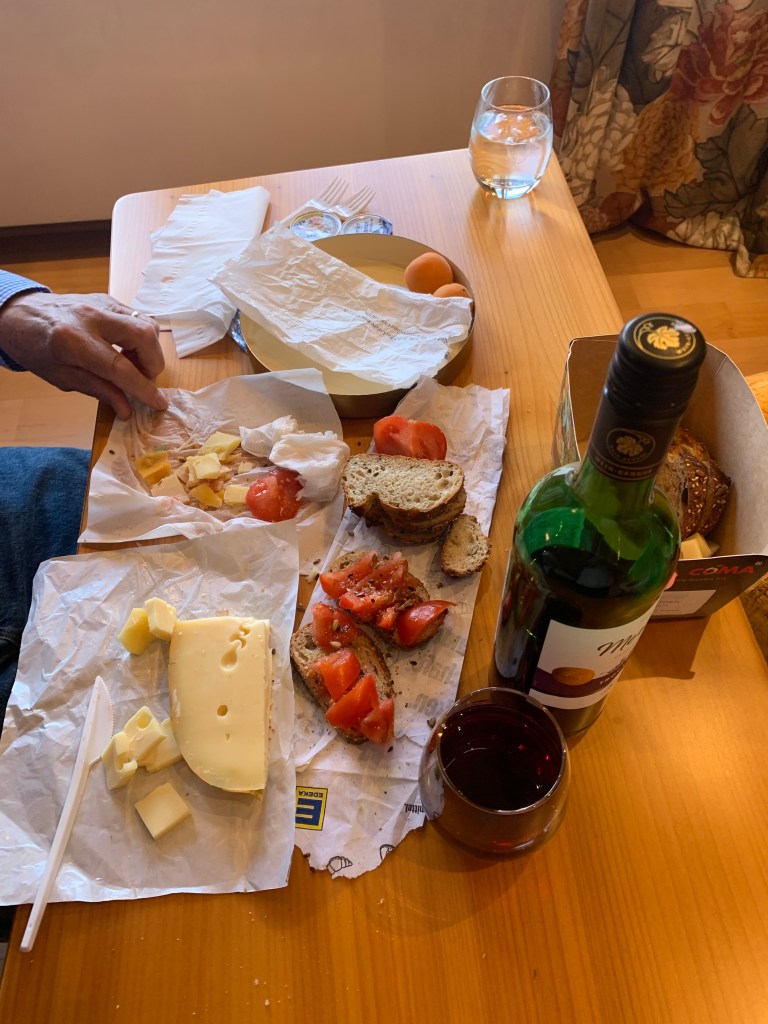
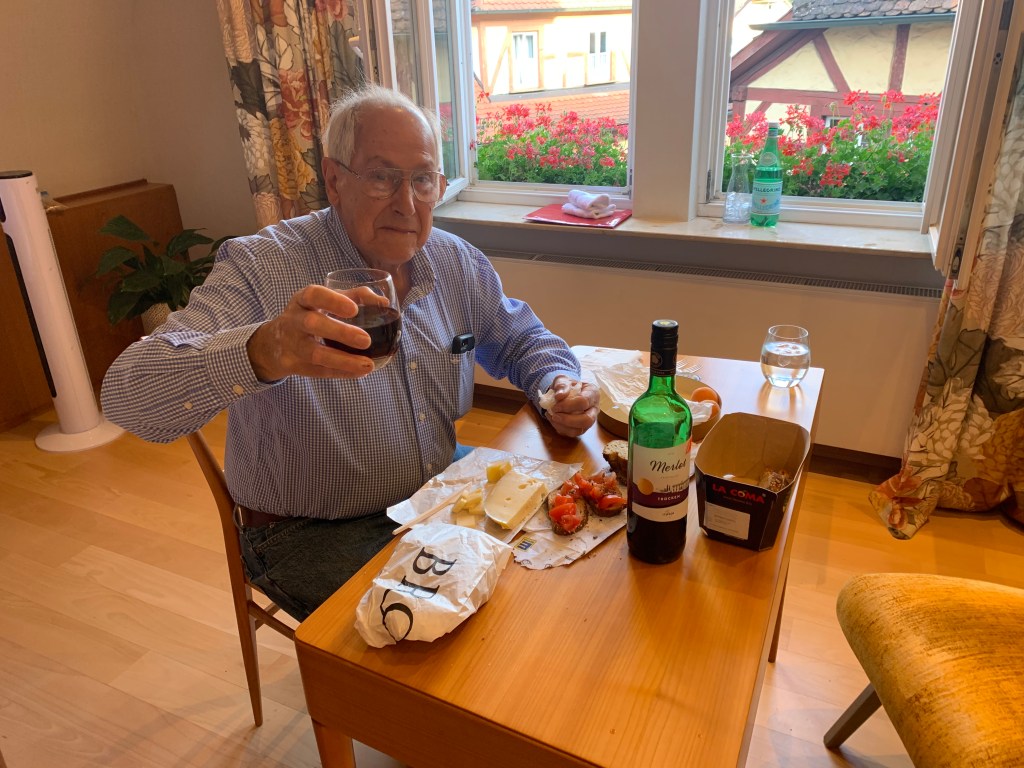
Earlier in the day, we had decided to go to Aldi’s (really, how could we NOT?) before returning to the hotel to purchase some things for dinner in our room or outside in the bier garten: cheese, bread, fruit, chocolate. I’m not sure if we were avoiding the waiter-from-hell, the food, or both. We both enjoyed shopping in Aldi’s, which was much nicer than the Aldi’s at home. I should say, Santo enjoyed the shopping. I enjoyed the air conditioning. Fully provisioned, we headed back to Schloss Berge. The temperature had risen, and even the outside tables in the shade offered no protection from the heat. With the fan on in our comfy room, we were able to enjoy a restful picnic dinner of our own making, along with some of the leftovers from the night before. It was perfect.
I didn’t look forward to another night battling my cough and the heat to try to get some rest. But we both did our best, still grateful for where we were and all the helpers God had put in our path. Even the pigeons!
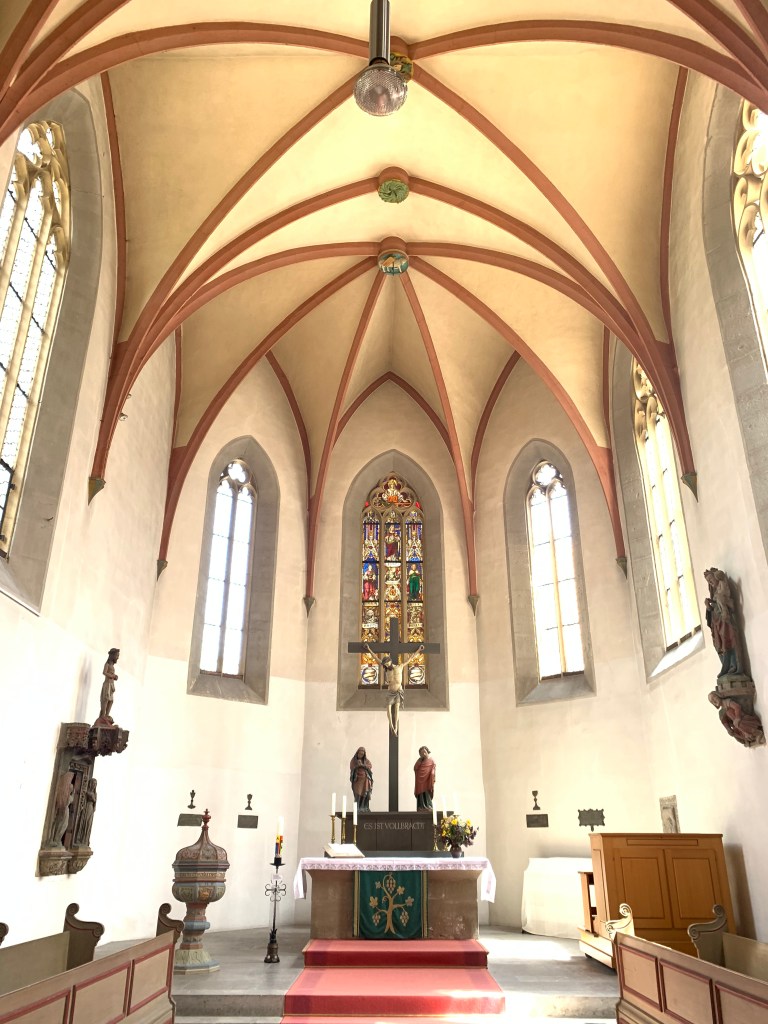
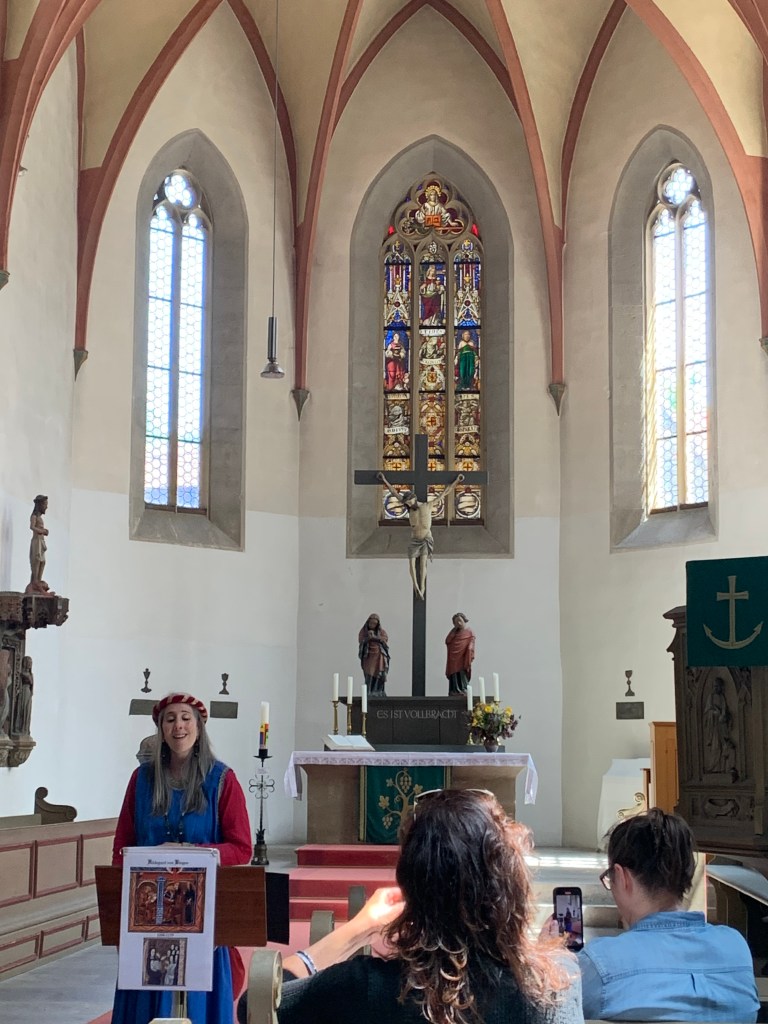
A happenstance from yesterday I forgot to mention. During our stroll around Rothenburg, we came upon a small church with a sign that said, “Bitte eintretten. Wir sind geöffnet” (Come on in. We’re open.) So we did. It was more of a chapel with an arched nave and ceiling crisscrossed with dark wood. The creamy walls made the space light and welcoming. A woman in traditional dress stood at the front of the aisle. There were three other people in the pews. Apparently, we had walked in on a stop on the musical tour of Rothenburg. The woman advised us that she would be singing a song that would last about three minutes and we were welcome to stay. So we did. The pureness and clarity of her voice were amplified by the fantastic acoustics in the small interior. What a delight! If we were staying another day, we likely would have signed up for the entire musical tour. Such a special way to see—and hear—this magical city.
One to today: With a shorter drive ahead of us (about 4 ½ hours), we enjoyed a leisurely breakfast in the hotel restaurant. Then we waited a few minutes in the lobby while our car was brought round to the front door. We set the GPS for Schloss Berge in Gelsenkirchen.
The terrain between Rothenburg and Gelsenkirchen was again familiar. The trees, forests, and rolling farmland were not as dramatic as previous drives but gentle and relaxing. As we got close to Gelsenkirchen, large modern buildings dotted the motorway—companies that were perhaps part of the growing solar energy industry that was revitalizing the old coal and steel city. It reminded me of the 128 technology loop around Boston.
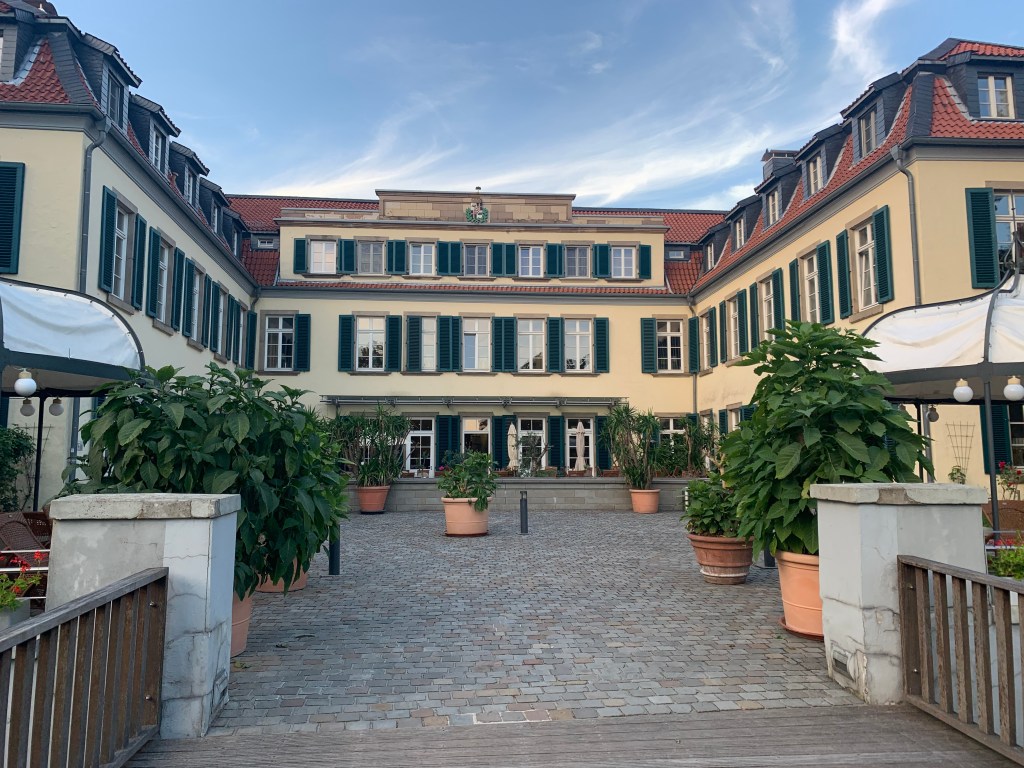
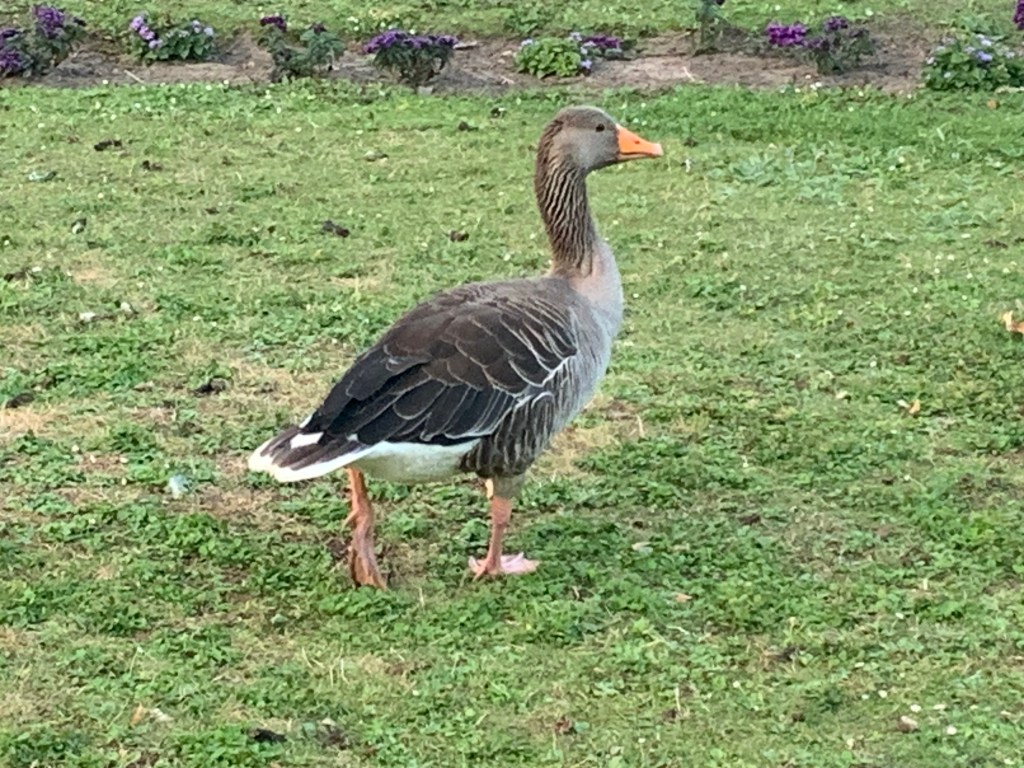
Once off the motorway, we drove on broad “allees” (boulevards) lined with trees. Gelsenkirchen was much greener than I had expected. Within about ten minutes, we were at the entrance to Schloss Berge, on the outskirts of the city. It turned out that Schloss Berge was not only the name of the hotel where we would be staying, but also a large public park with a small lake (Berger See), gardens, shaded walkways, bike paths, and even a bier garten. There were many cars parked in the public area and many people enjoying the park on this warm and sunny day. We drove as close to the hotel as we could get and took just our overnight bags up the tree- and flower-lined path to the entrance, going over a small bridge where families of geese and ducks glided in the dark water.
The hotel was U-shaped. Between the two sides were numerous brown wicker tables and chairs and large umbrellas for shade. People were dining in this area on pressed white tablecloths, clinking wine glasses, laughing, and offering us “Guten Tags” as we passed by.
We checked in and asked about reservations for dinner. The desk clerk told us they were not necessary. We decided to get settled in our room, then come down to dinner later.
The home of barons and counts since the 14th Century, Schloss Berge as it stands was first built in the 16th Century and then partially demolished and rebuilt between 1785 and 1788. It is a lovely buttery yellow color with dark green shutters and a red-tiled mansard roof with dormers. Our room was at the end of the left wing on the 3rd floor. We had windows on three sides facing the entrance patio, the front of the hotel and lake, and the side gardens. There was an enormous living room with couch, two comfy leather chairs, coffee able, desk, large fridge and coffee maker. The bathroom was all white and spacious, with a real walk-in shower and a whirlpool size tub. Another home away from home.
We made our way to the dining room around 8 pm. A short, white haired, very professional-looking waiter asked us if we had reservations. I told him “no” and he immediately frowned, dismissing us with a shake of his head. I tried to explain that the clerk had told us we didn’t need reservations, but he had already summed us up as hicks. Making a show of just how much trouble it was to seat us, even though the restaurant was only about half full, he gave us a table at the far end of the long narrow sunroom overlooking the gardens that was the dining room. The white tablecloths were thick and crisp, made of a fine fabric that whispered “elegance.” Flourishing a lighter he whisked deftly from his pocket, the waiter lit the tall white candle on our table. Even though the waiter looked down his nose at us, we felt we had arrived.
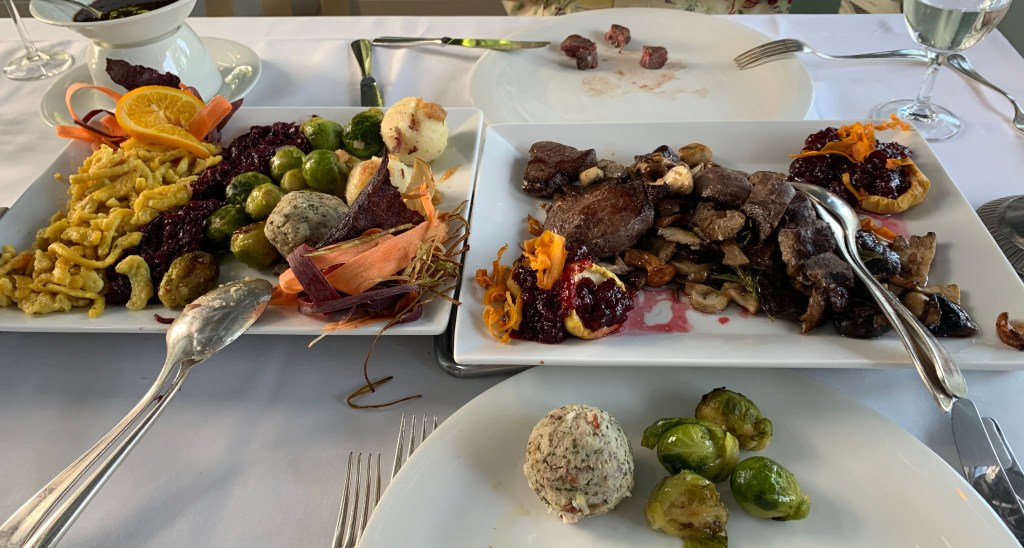
I did my best translating the menu for Santo and we decided on the “Wildplatte,” a “Wild Plate” for two that included two kinds of deer, wild pig, and rabbit. Santo took a look at wine list and decided to order a glass of Riesling (a real German wine in Germany). This did not please the waiter at all. He spoke to me, since I could understand German. “Virklich?” he asked. “Really?” I nodded yes and he shook his head again. I knew he meant that we should order a RED wine with the meat we had ordered. This kind of arrogance, I think, is NOT hospitality.
Before our dishes came out, the waiter brought three (count ‘em, three!) long, low hot plates. Oh my God, what kind of a feast were we getting? We soon found out. Platters and platters of meats in mushroom, berry, and wine sauces. One large platter contained our vegetables in diagonal rows: buttery fried spaetzle, red cabbage, and Brussels sprouts. On the edge were four large dumplings. There were also warm bowls with additional sauces. Each platter held two large spoons to serve ourselves. The meats were delicious, less salty than in Rotheburg, but still heavy. I took only a small taste of a dumpling and felt it sit in my stomach like a lead ball. Even the spaetzle was too rich, fried in butter. We were glad we had tried it, and it certainly was an experience, but we would not order it again. Maybe we wouldn’t even eat in the restaurant again. We didn’t want to deal with the snooty waiter again.
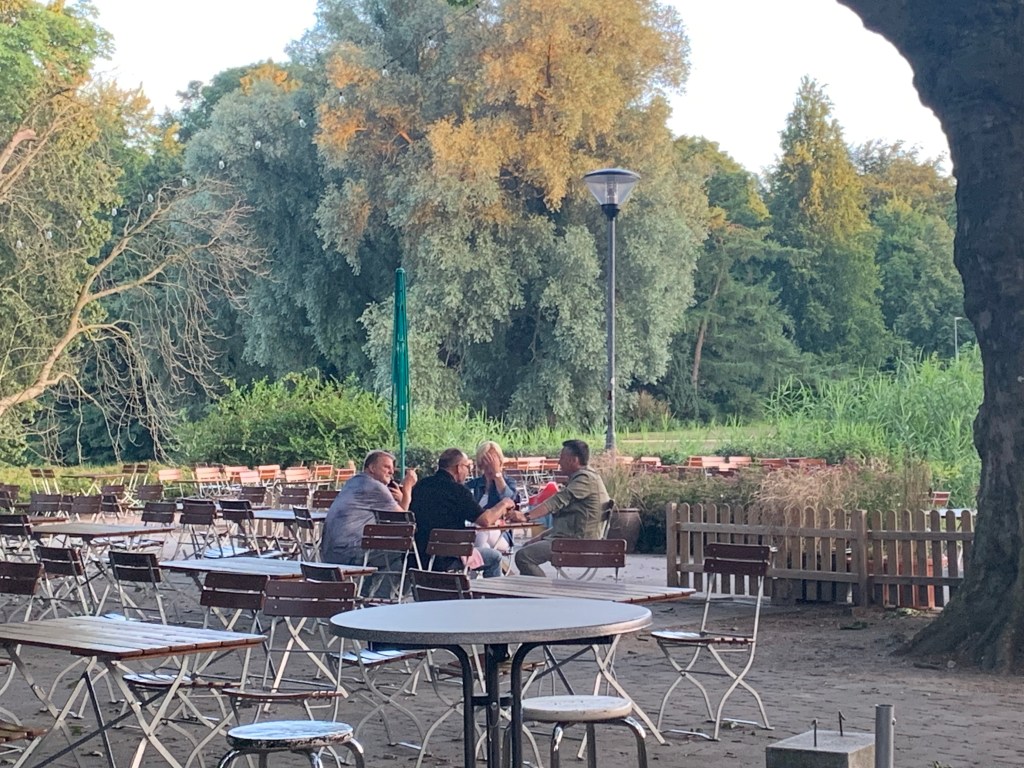
We took a short walk in the gardens, past the beer garten where a kiosk sold wurst in a roll, French fries, and beer. Under the shade of some delicate trees were scattered numerous wooden tables with folding wood slatted chairs. There was only one table of guests enjoying the garten. We thought we might come back here another night.
Without air conditioning (we had not had air conditioning in Weggis or Rothenburg either), our top floor room was a bit warm. Santo angled the oscillating floor fan towards our bedroom and we opened windows hoping for a breeze that didn’t come. My cough and sore throat were not better, and I felt I desperately needed a good night’s sleep. I prompted myself up on several pillows and hoped for the best. Luckily, we had bought Ricola lozenges in Rotheburg so I was able to suck on one after another during the night.
Started the day with a wonderful German breakfast, this time served to us on white tablecloths in the dining room. We had heard a gentle rain on the red tiled roofs during the night, and the clouds were still hovering in the morning. We both took some time to write in our “apartment” while we waited for the weather to clear a bit.
By late morning, the skies were more blue than gray, so we ventured out. The hostess at the front desk had given us a map and directed us to route that would loop around the southern half of the city, much of it atop the wall, built before 1400, that ringed the city. First stop, though, was the small grocery across the street. Santo wanted to “check out’ what they had. I think he was just experiencing grocery-shopping withdrawal. Of course, he had to check out every inch, loving every minute. You can take the many away from Wegmans but …. We bought a few items which Santo brought back to the room, then we headed for the wall.
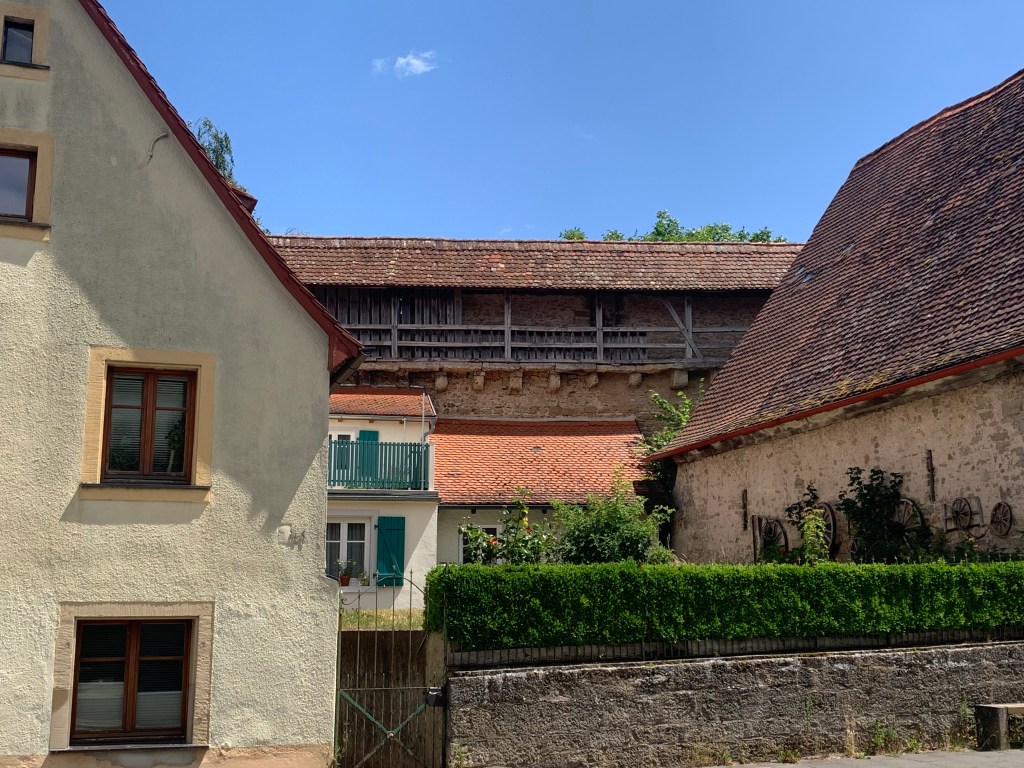
We climbed the steep, uneven stone stairs and found ourselves about twenty feet off the ground. The walkway was enclosed by a stone wall on the outer side, an overhanging roof, and a wooden railing on the inner side. From this vantage point, we got an overview of the city and the many red-tiled roofs, meandering streets, and medieval houses. Santo kept to the wall side, his acrophobia keeping him from anywhere near the railed edge. We squeezed ourselves against the wall whenever we needed to let someone pass. He tried valiantly but was really uncomfortable and not enjoying this at all. We passed a few of the many towers spaced along the wall until we came to one with stairs that would take us back to terra firma.
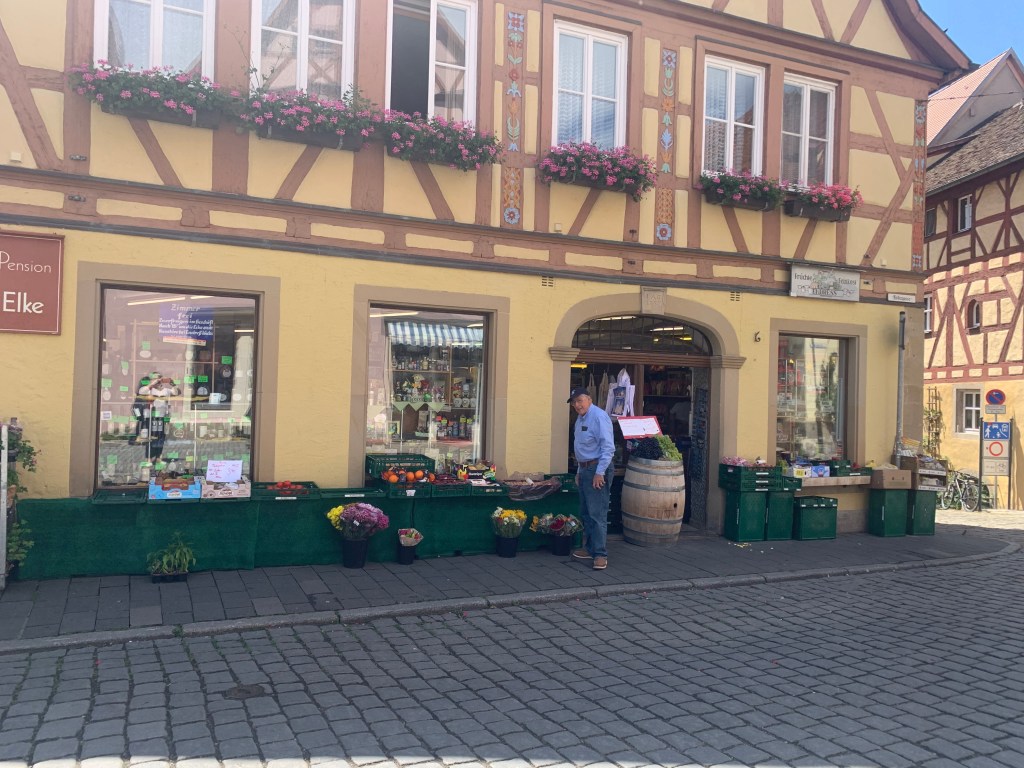
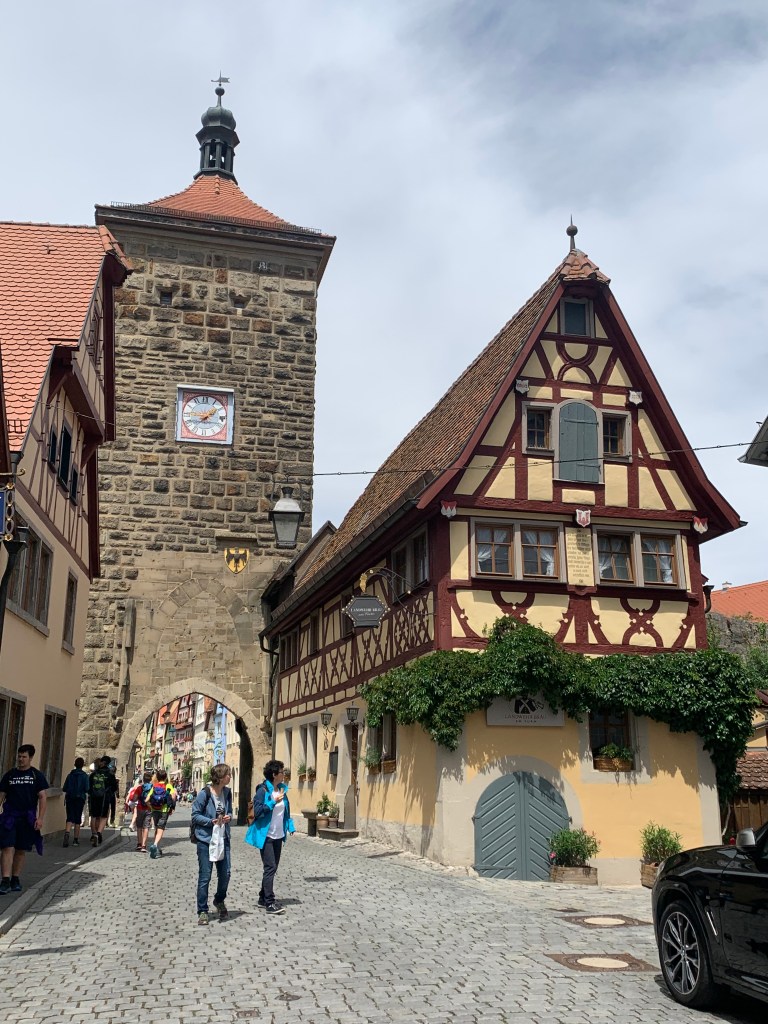
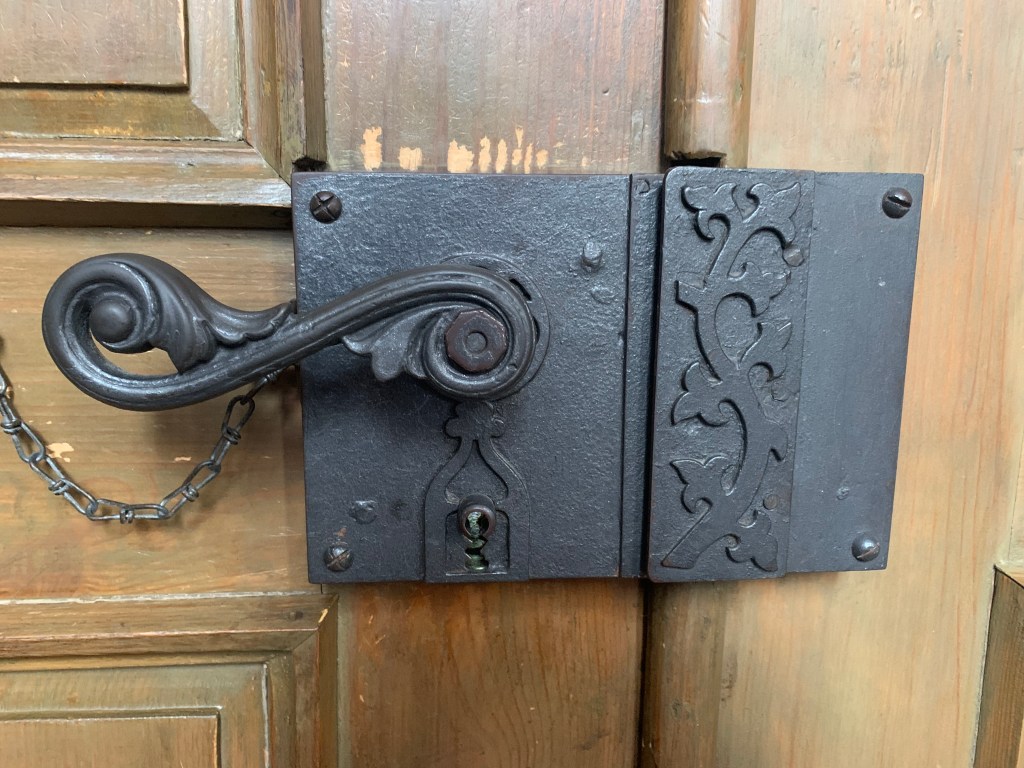
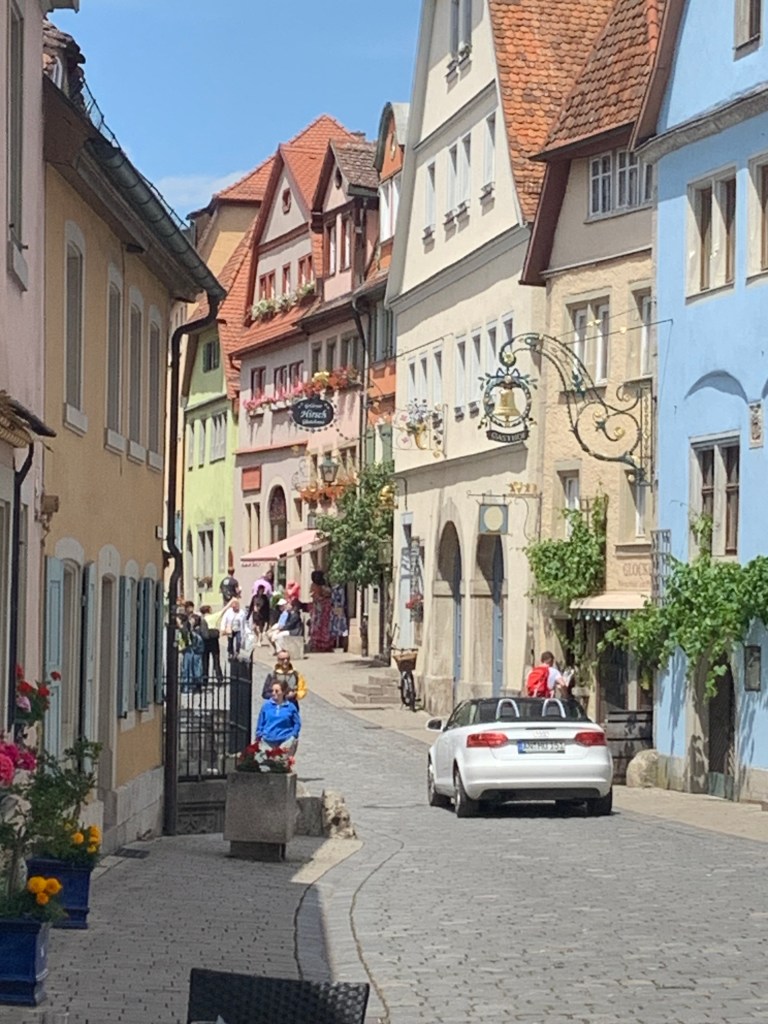
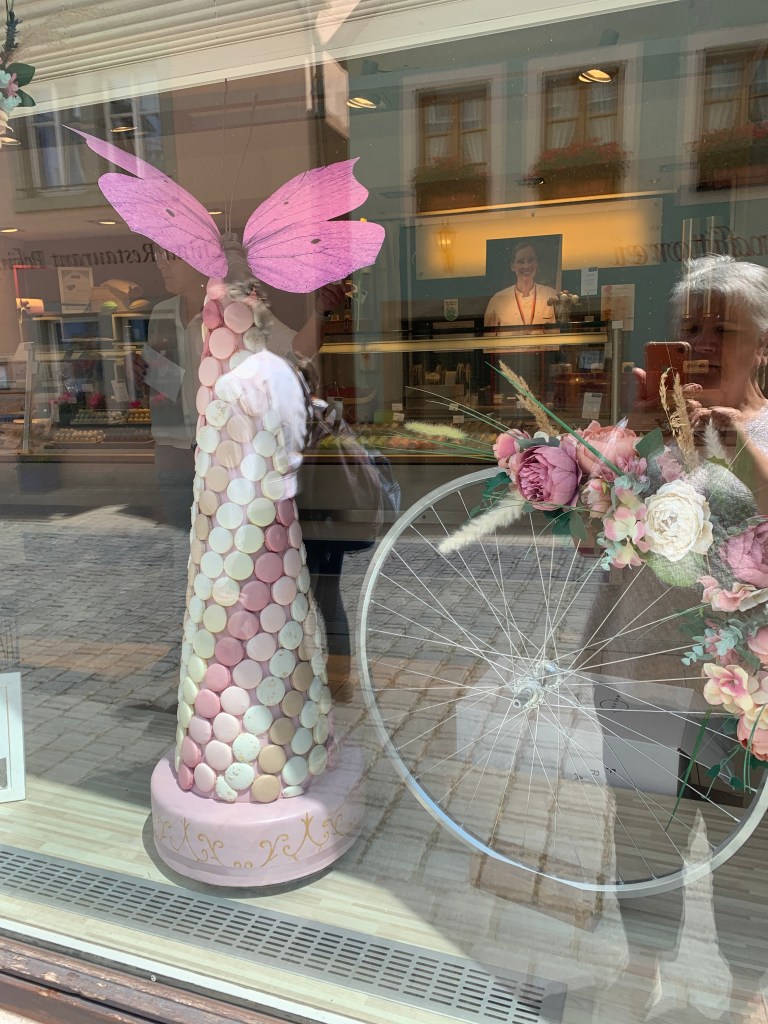
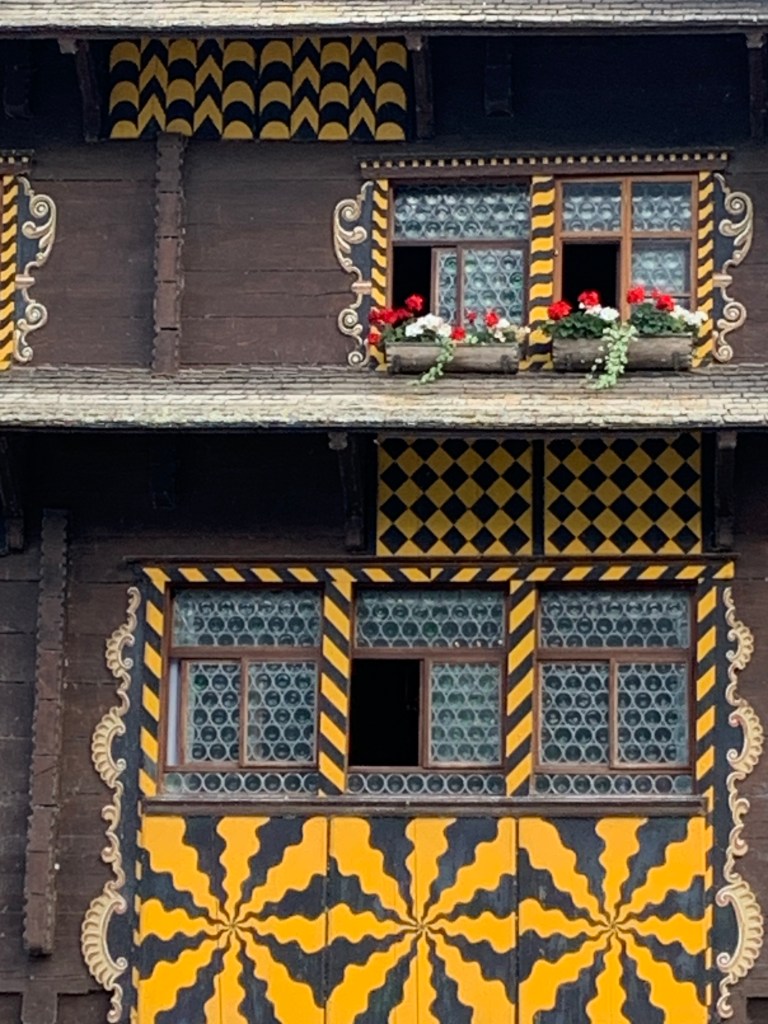
The city was really more enjoyable from this vantage point. Keeping the wall basically to our left, we circled the city, then turned to head into the center again. This place was like Disneyland but REAL! Each of the colorful houses had some sort of fascinating detail in the shutters, doors, knockers, hinges, windows, or entrance ways. As we got closer to the city center, there were more and more shops and restaurants. Chocolate shops, bakeries, butcher shops, cafes, plus a variety of stores appealing to tourists with cuckoo clocks, Christmas decorations, jewelry, and clothing. In one shop I found a black-and-white shawl to wear for the black-and-white gala on the Queen Mary 2, along with some jewelry. We also found a necklace for Natalia and one that perfectly matched a set of earrings I had gotten for the trip.
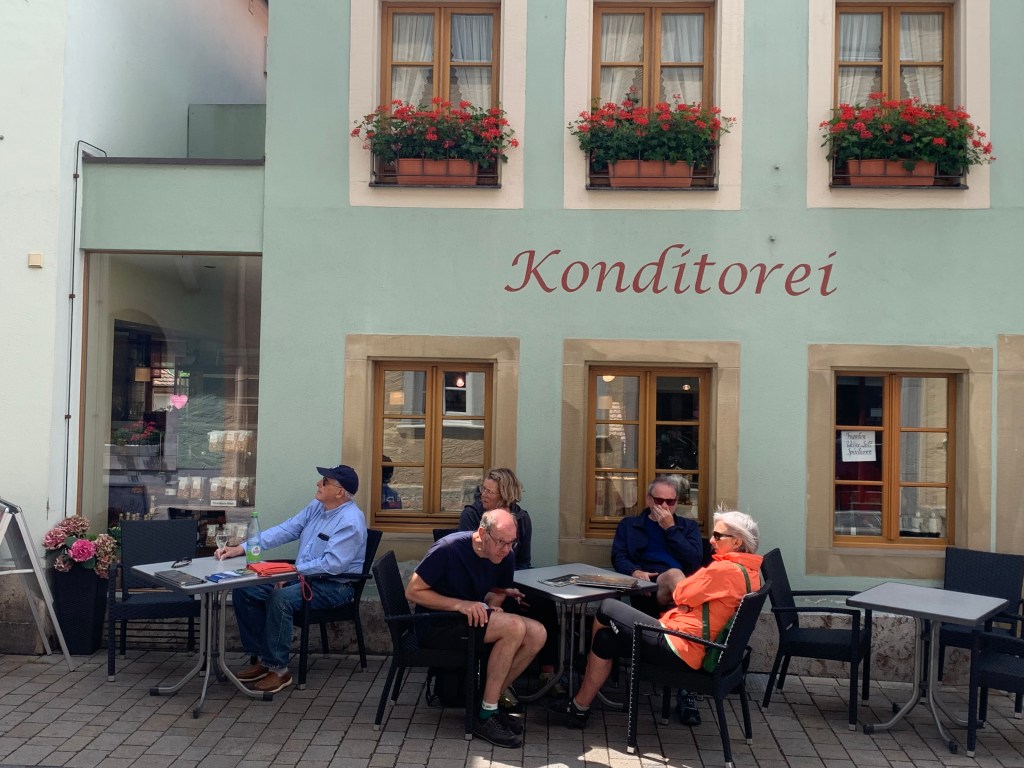
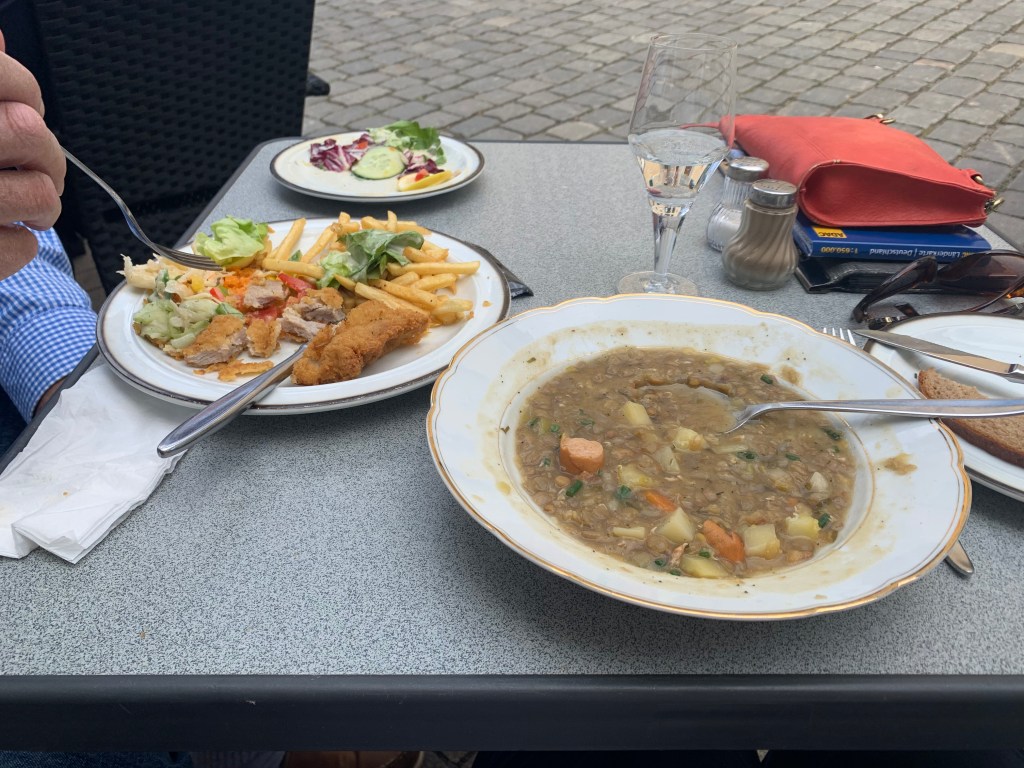
Around 2 pm we were getting hungry. Not wanting another heavy German meal, we had decided to eat lunch out, then purchase bread, cheese, and fruit for a picnic dinner. We chose a place with outdoor seating: perfect spot for people- and dog – watching. Santo went for the Wiener Schnitzel and French fries. I opted for a lentil soup with wurst and bread, saving room for one of the “Eis-spezialitaten” I had seen on the menu. The ice cream specialties were described as works of art. The masterpiece I chose was a Black Forest sundae: vanilla and chocolate ice cream, cherry sauce with whole cherries, chocolate sauce, and whipped cream in a tall vase-shaped glass. We had to ask for an extra spoon for Santo—no way I could eat it all myself.
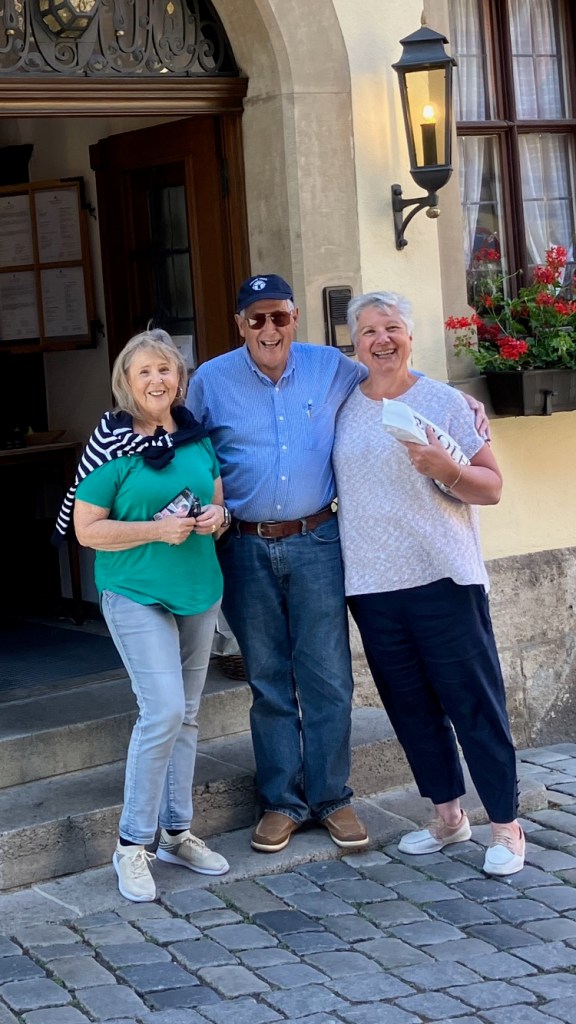
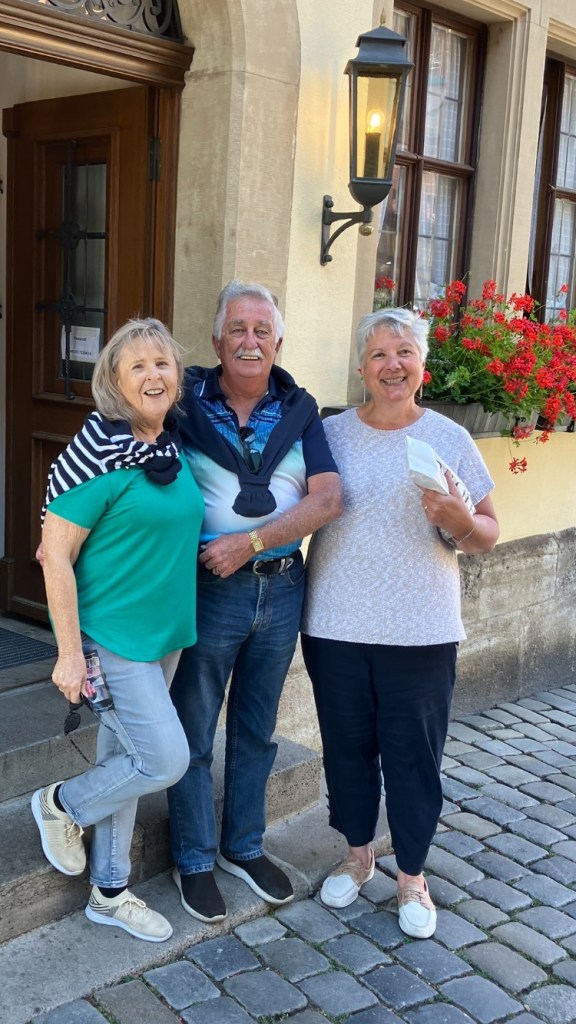
After lunch, we ambled back to the hotel, window shopping along the way. It was magical to be in this space, truly a step back in time. Each corner presented a new wonder. We marveled at how all of this could have been so well preserved over so many centuries. In front of our hotel, Santo wanted to take a picture of me on the stone-stepped entrance. As I began to pose for the shot, I saw two people walk up to Santo as he framed the photo. It was our Australian friends from the rest area! Since we had been in Europe, this was the second time we had just run into someone we knew. We laughed and talked. They had just arrived; we were leaving the next day. We finally got their names: Linda and Baz (for Barry). I said I would remember Linda because that was my best friend’s name. Then she said that her best friend’s name was Debra. I love these happenstances!
By the time we got back to our apartment, the sore throat that had started in Weggis was coming on strong. In addition to a cough, I was beginning to feel a bit flushed and weary. So we napped in the cool breezes blowing in over the tile roofs.
When I woke up, Santo had our dinner laid out on the table/desk, which he had moved so we could sit on either side. He had gone to the small grocers across the street and bought our provisions. All delicious, especially my chocolate covered marzipan for dessert!
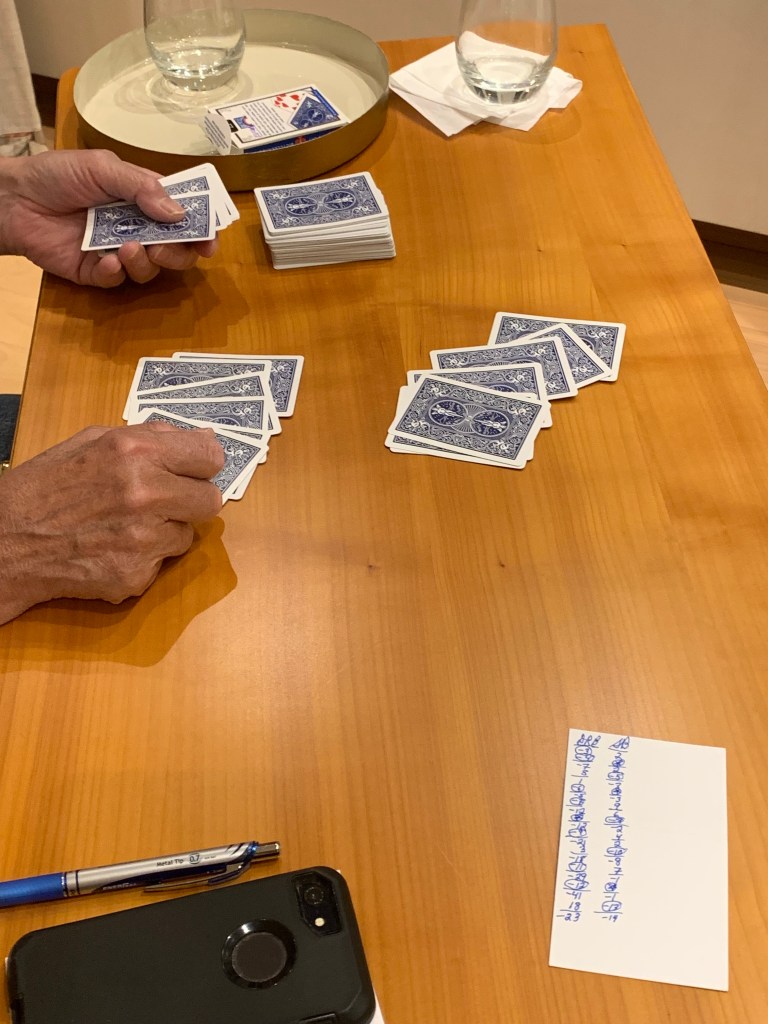
Still not feeling well, we decided to stay in. We did some more writing, then next thing I knew Santo had set the table up for cards! He had not wanted to pack two decks of cards, but I knew there would be some time during the trip when we would enjoy playing cards. And we did! It was a close game of Three-Fourteen, but Santo edged me out in the end. Felt like a little bit of home, though we missed our usual partners.
The next day, we would head to Gelsenkirchen, where my grandmother, Oma, grew up, and Opa had lived for a time. We would also visit Oberhausen, where they were married and where Oma lived right before she boarded the ship for America. I began to feel nervous. Not sure why. Was I afraid to feel something? Or was I more afraid NOT to feel something? Perhaps I realized I could go back to the place, but not the time. Was I bound to be disappointed?
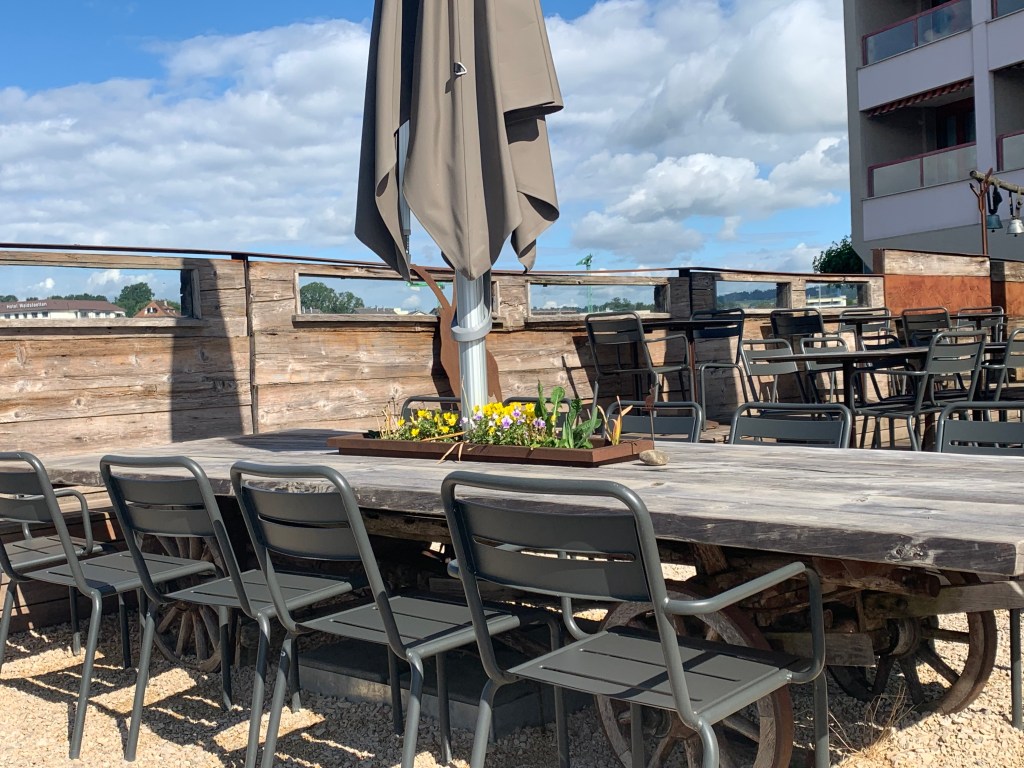
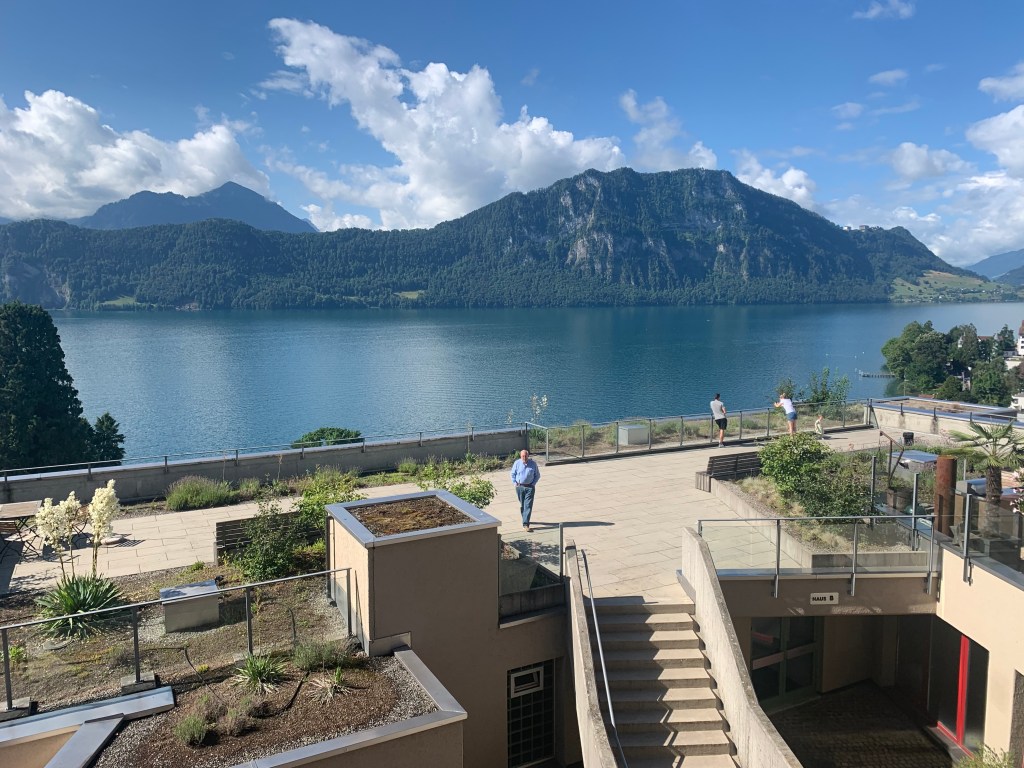
In the morning, amidst wonderful sunshine and swirling clouds, we said goodbye to Weggis. After breakfast, we sat on the expansive wooden deck (where we would have enjoyed dinner if the restaurant had been open during our stay). We tried to breathe in the deep peace so we could carry it with us on the road north – to Germany.
After about a half hour’s drive to Zug, Switzerland, we emerged from the drama of the Alps. Fifteen minutes later we found ourselves in Zurich—literally in Zurich! No bypasses here. We drove a zigzagging route on city streets, giving Santo his first glimpse of a Swiss city. While the driving was slow going, the traffic lights were well timed and we were soon back on the motorway. North of Zurich, we found ourselves in a gentler landscape of rolling hills and farmland that reminded us of home.
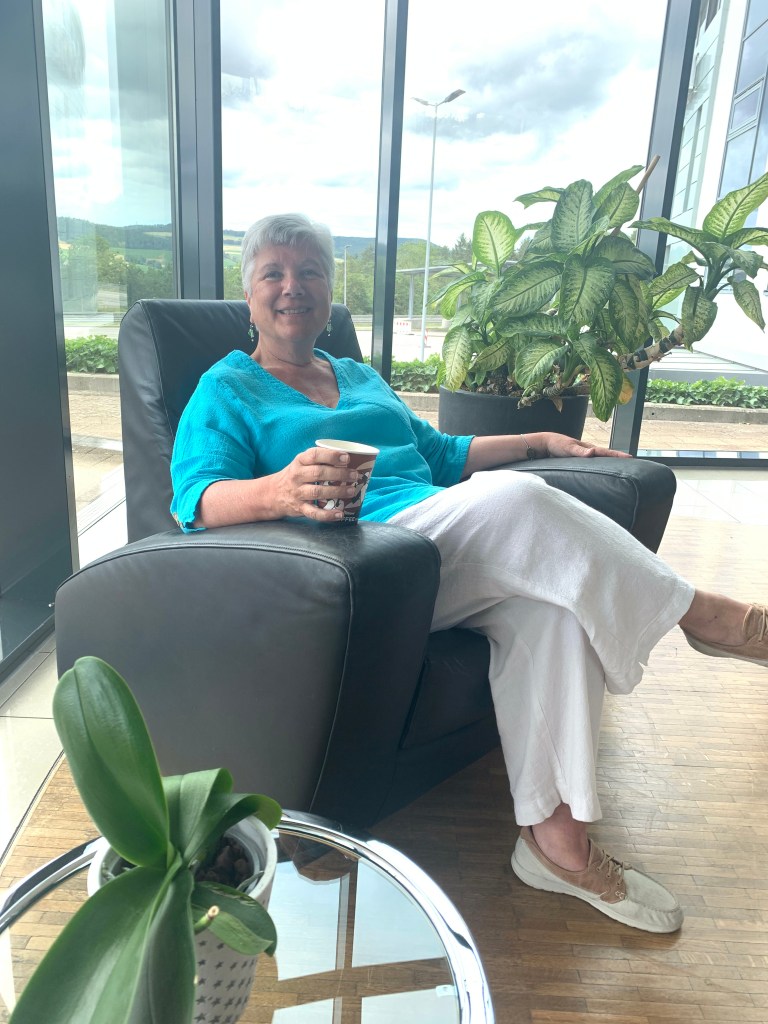
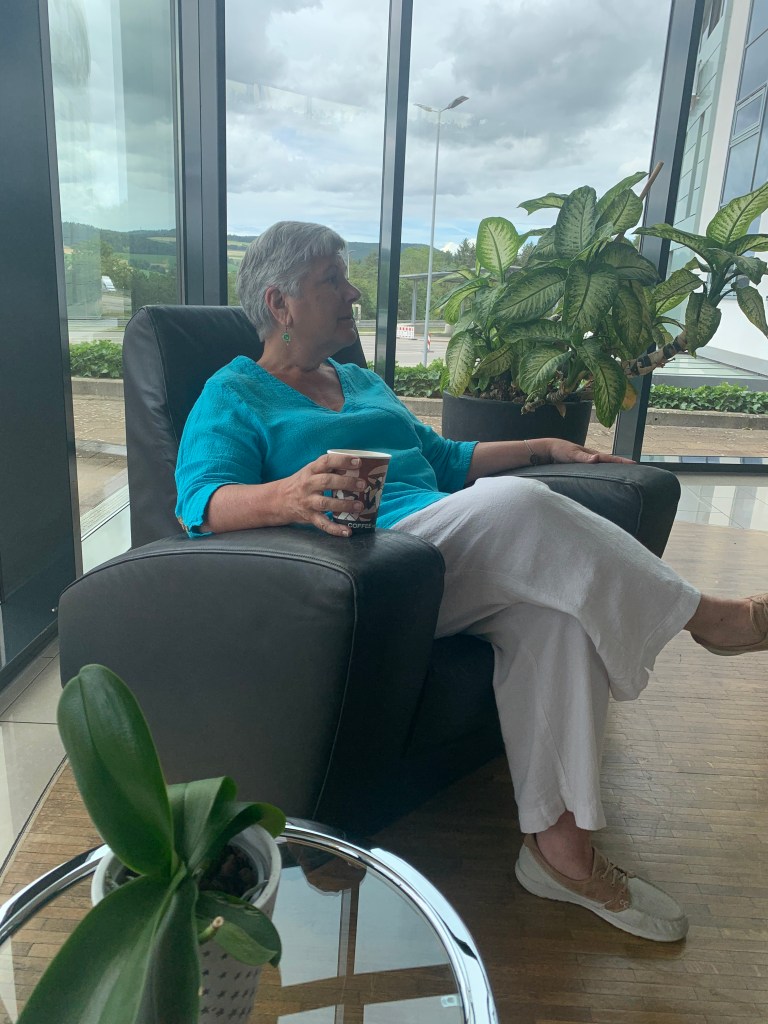
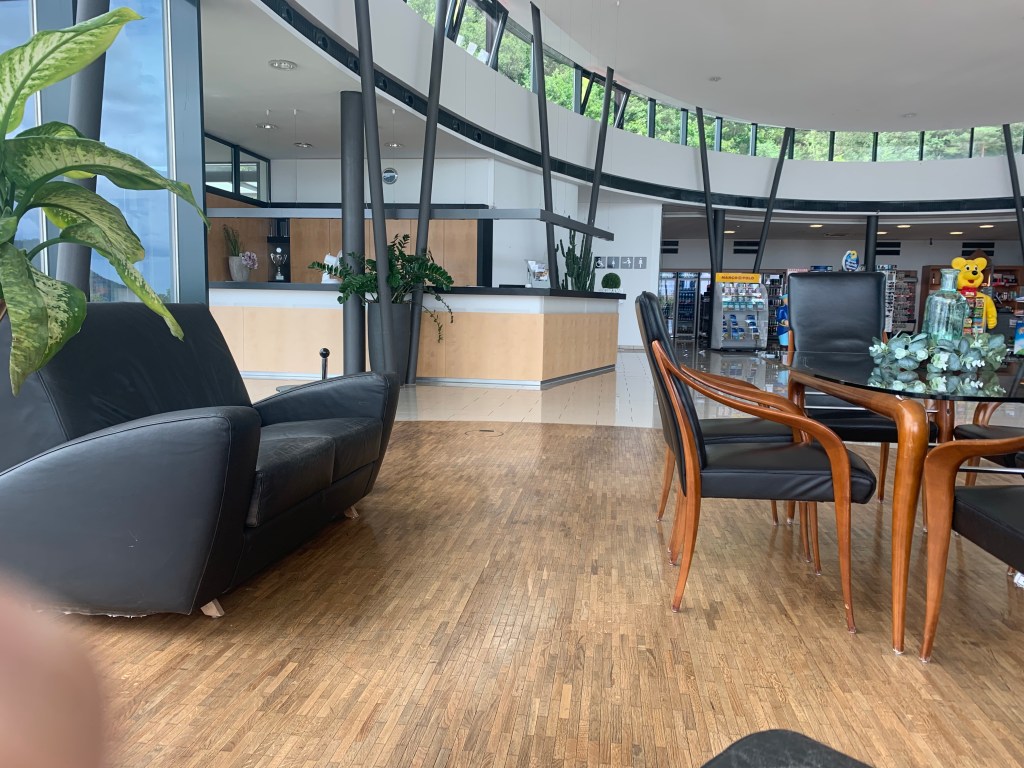
We crossed over into Germany and stopped at the first rest area, a massive complex with restaurant, hotel, and shopping, as well as the usual amenities of a rest area. Not only was the modern architecture stunning, but there was a – wait for it – COMFY CHAIR! The middle schooler in Santo could not resist taking a photo of me under the sign that said “Gute Ausfahrt.” Ha ha.
As we were leaving the rest area, a couple about our age approached us, noticing that we, too, were speaking English. We exchanged the usual where-are-you-froms (Australia–north of Sydney and New York–the state not the city). They were spending over 3 months in Europe and had just completed a loop by car from Amsterdam through northern Germany to Poland, then south to the Czech Republic, east through Austria and Switzerland, and now back north through Germany to Amsterdam. Like us, they were avoiding the big cities. They’d stopped where they pleased and find a place to stay. Braver souls than me, though I would have, and did, do the same in my youth. Their next leg would be a cruise down the Rhine and Mosel Rivers. We parted with smiles and the sentiments “Ain’t retirement grand?” and “Safe travels!”
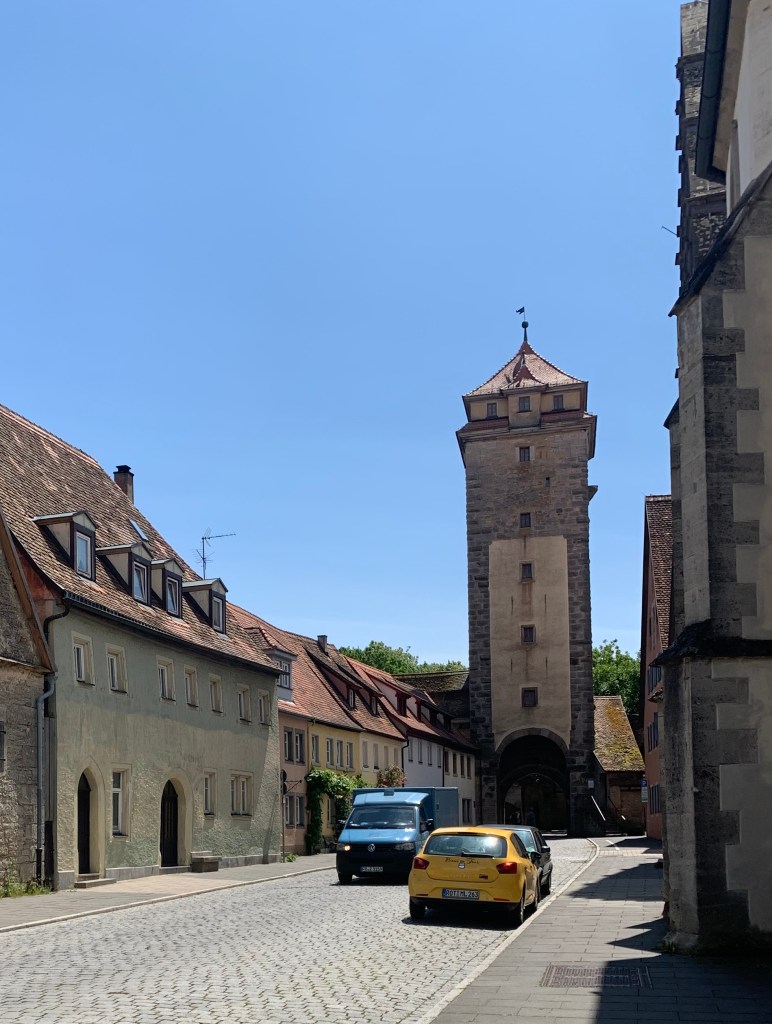
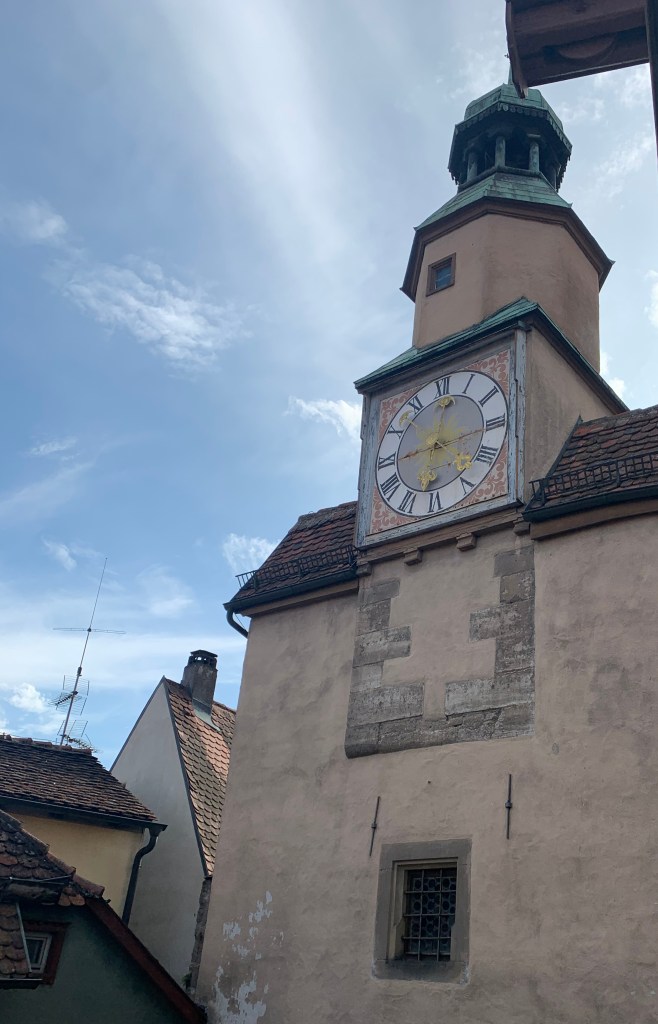
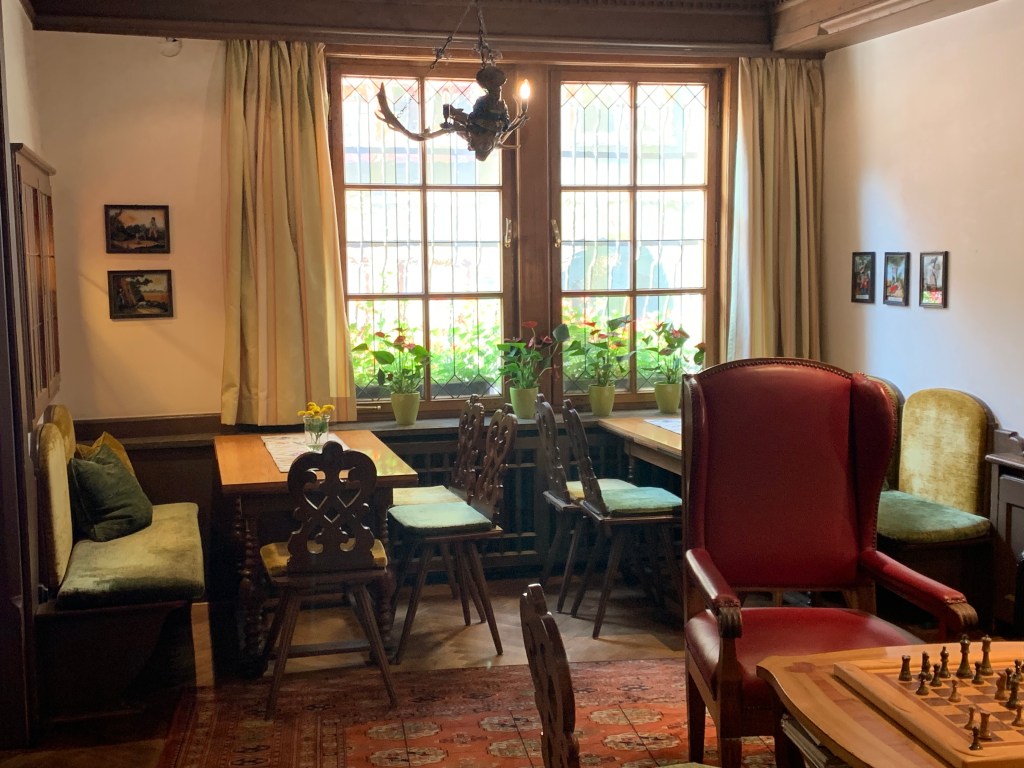
Continuing on roads we found more familiar than any on the trip so far, we continued to our next destination: Rothenburg ob der Tauber (or o.d.T.). This perfectly preserved, walled, medieval German city is something of a tourist trap, but still well worth a visit. Our hotel was within the walled portion of the city, and they told us to drive up to the door and a valet would park our car. Late in the afternoon, we entered the city through a narrow archway in one of the towers dotting the fortress walls. Now on cobbled streets as narrow as the ones in Avigliano, we made our way through the maze of short blocks, dodging tourists and dogs, until we came to the Romantik Hotel Markusturm (so named because it was located right next to the ancient Markus tower). Grabbing our overnight bags, we went through the thick wooden doors to the small lobby. The walls were of dark wood, the carpeting deep red, and the furniture was throne-like (and looked royally uncomfortable). Check-in was efficient, and soon we were headed up two flights of stairs to our room.
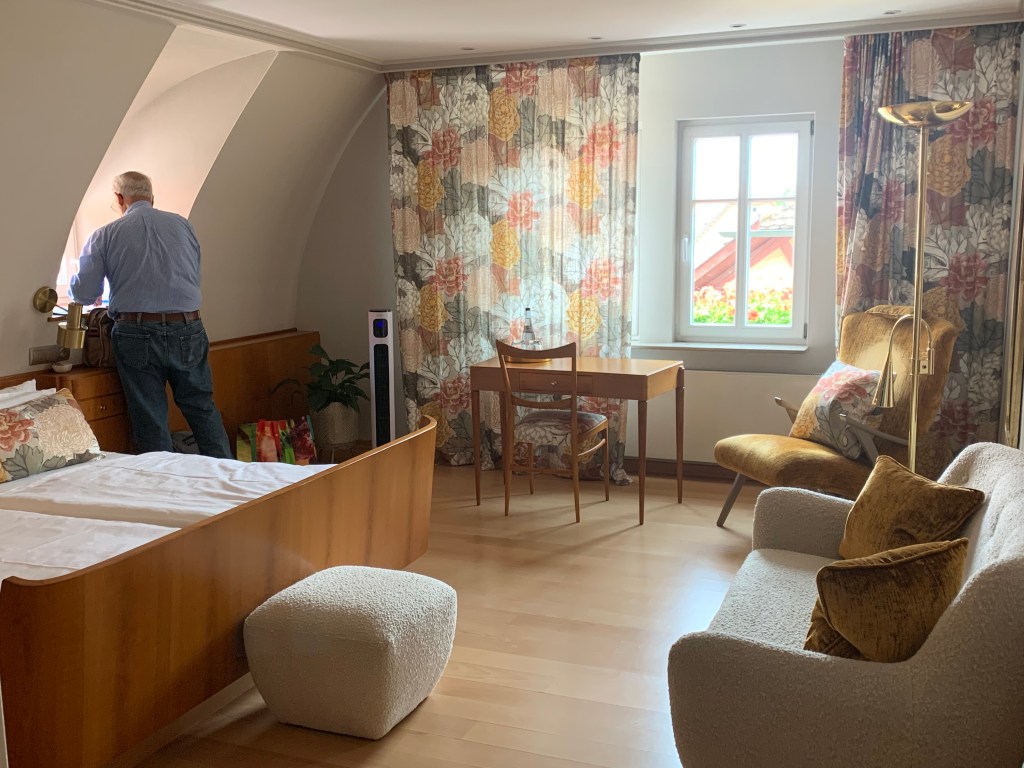
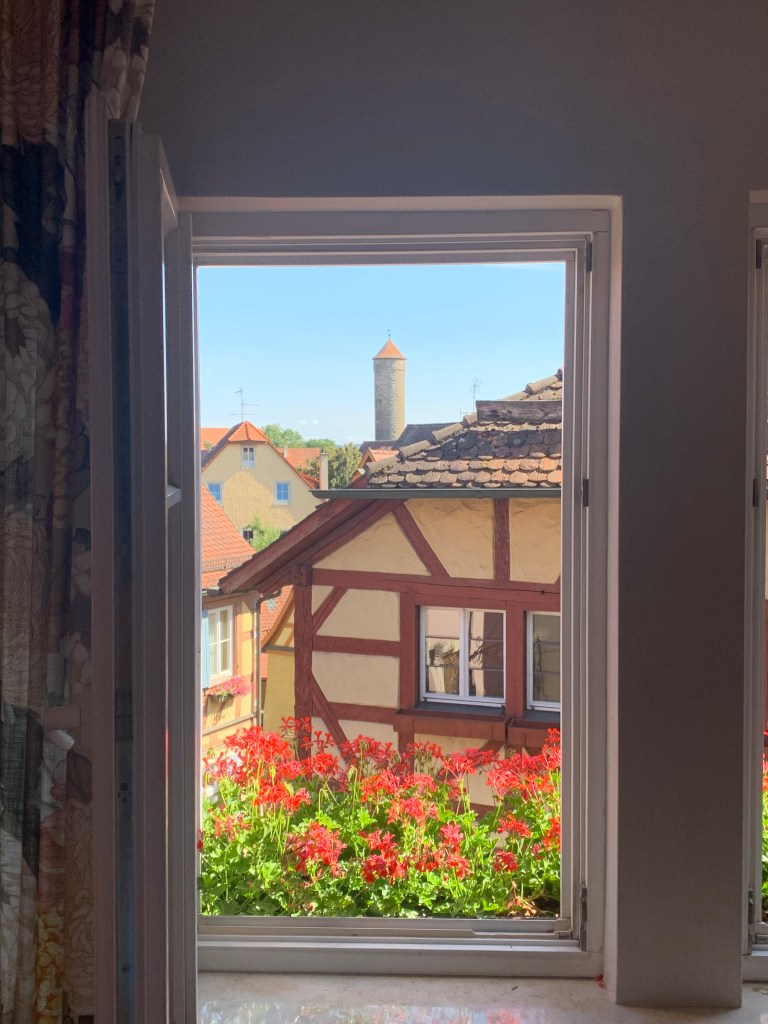
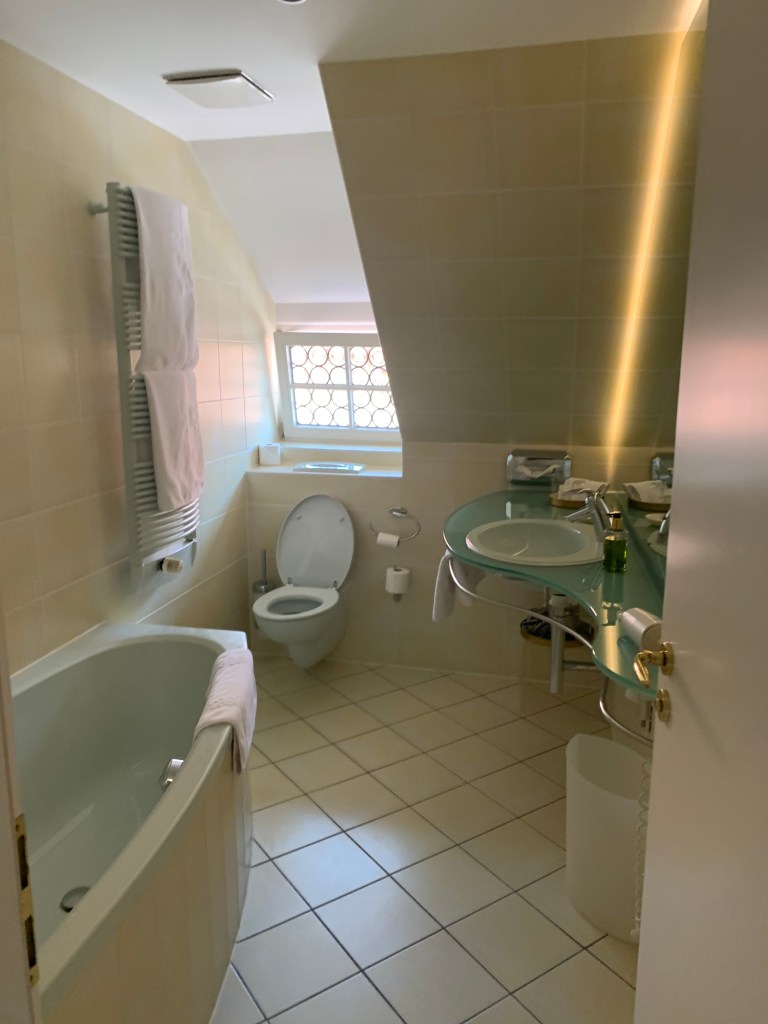
Entering the room was a stark transition from the dark browns and reds, and the heaviness, of the hotel lobby and stairs. The room was bright and modern, but somehow the light style seemed perfectly appropriate. It was more like a small apartment than a hotel room. The woods were in hues of blonde (floor) and light cherry (furniture). Windows on two sides offered views of the medieval rooftops in shades of red and brown. A free-standing desk/table of simple design was in front of the double windows facing the front of the hotel, a tall comfy chair was in the corner, and a modern white loveseat with nested glass side tables faced the foot of the bed. Curtains and pillows had a large floral pattern in muted tones of beige, brown, and ochre. The bathroom, though, may have been my favorite place. The green glass countertop curved gracefully along the long mirrored wall an dthe mirror was backlit on all sides with a gentle light. The bathtub and sink picked up the light green tint of the glass. Overall, it had the restful aura of a pampering spa. Ahhhh!
We opened the screenless windows to let in the cool air (no air conditioning here, just a tower fan). Santo was tired from the drive and I was fighting an oncoming cold, so we lay down for a medieval slumber before going downstairs to the hotel restaurant for dinner.
Our table was in the back of the long, narrow room. The front room, facing the street, had the dark wood and red heaviness of the lobby. Just behind it, the room we were in had a softer feel with green cloth-covered walls, cream-colored drapes, and pale wood.
A long table next to the wall hosted a group of about fourteen Japanese tourists. The group leader was able to speak English, so she hustled around the table communicating with the staff for everyone. All the staff spoke perfect English, so used to Americans and other tourists. The entire front room was taken up with a group of Americans celebrating the 4th of July. “You’re in Germany, folks,” I thought. I had noticed a small American flag on one of the tables when we passed through and was afraid they might be a group of Trumpers. In Europe, it is embarrassing to be an American.
The wait staff were dressed in traditional German garb to meet tourists’ expectations. I felt bad for them. The two waitresses we had were both lovely, and I felt they were somehow being exploited.
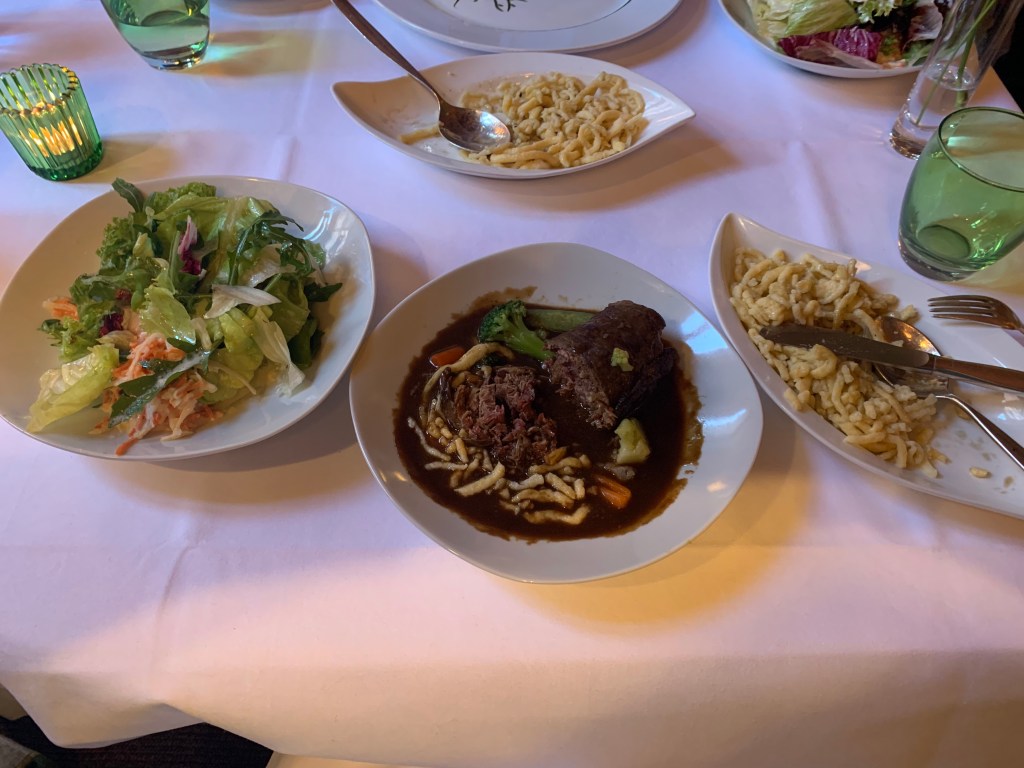
The menu was laden with the heavy German dishes Americans would expect: heavy meats in heavy sauces with dense noodles or roasted potatoes. Santo had venison stew, I had rolladen. I did enjoy the meat, similar to my mother’s but not quite. Still, it felt like everything was just too much: too salty, too rich, too German. I was determined to find something different for our second night, though this wouldn’t be easy within the walled part of the city.
After dinner, we took a short stroll to the central plaza (Marktplatz) and back, window shopping along the way. We had all of tomorrow to explore.
Our genteel apartment overlooking the city awaited us.
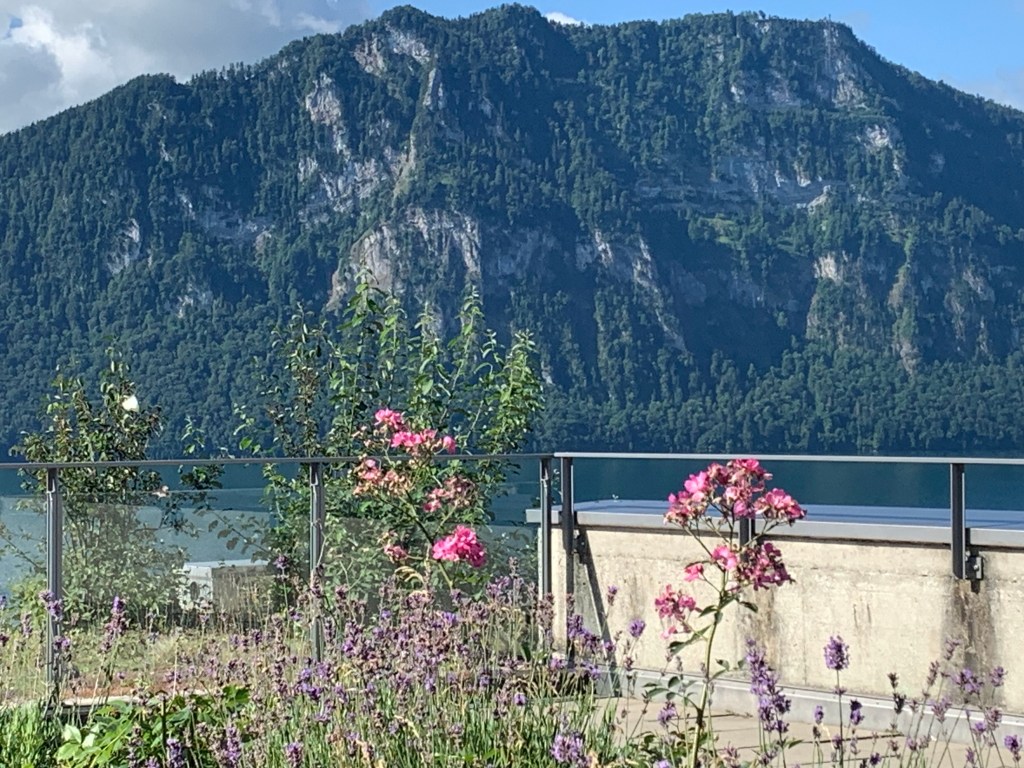
The mountain filled my view as I opened my eyes. Clouds dimmed the light but not the beauty. They were in motion, giving hope for sun later in the day.
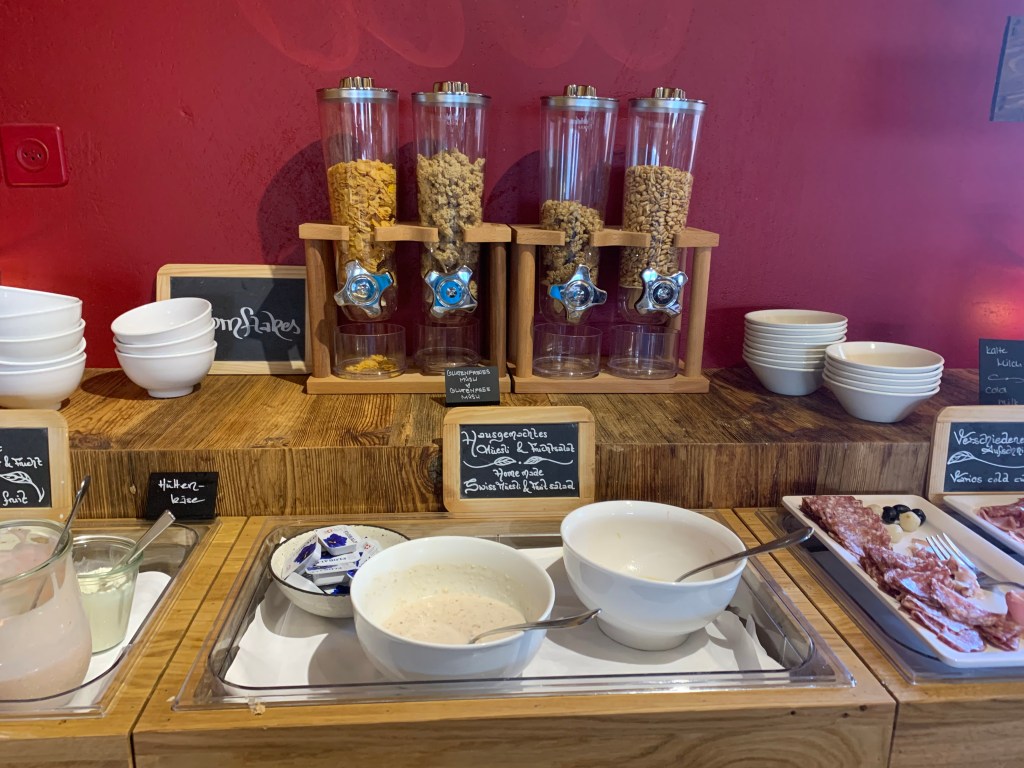
We made our way to the restaurant for breakfast. Wonderful breads, meats, cheese, fresh eggs you cooked yourself in a pot of boiling water, fruit, and real Swiss muesli. We enjoyed everything, especially the coffee which was closer to what we are used to than the espresso in Italy.
After breakfast, I had time to write at the table and chairs on our balcony as we waited for the clouds to part. By noon, we made our way down to the village and the lazy park stretching along the lake front.
We went to the cruise office and found that the next cruise to Flüelen was in about one hour. We bought tickets and looked for a place to have a coffee while we waited.
Everything in Weggis was much more expensive than anywhere we had been so far. Coffee with a table at an outdoor café would be over $10 each! We decided to buy waters, and an amazing lemony dessert, from a kiosk in the park and sit on a bench to wait.
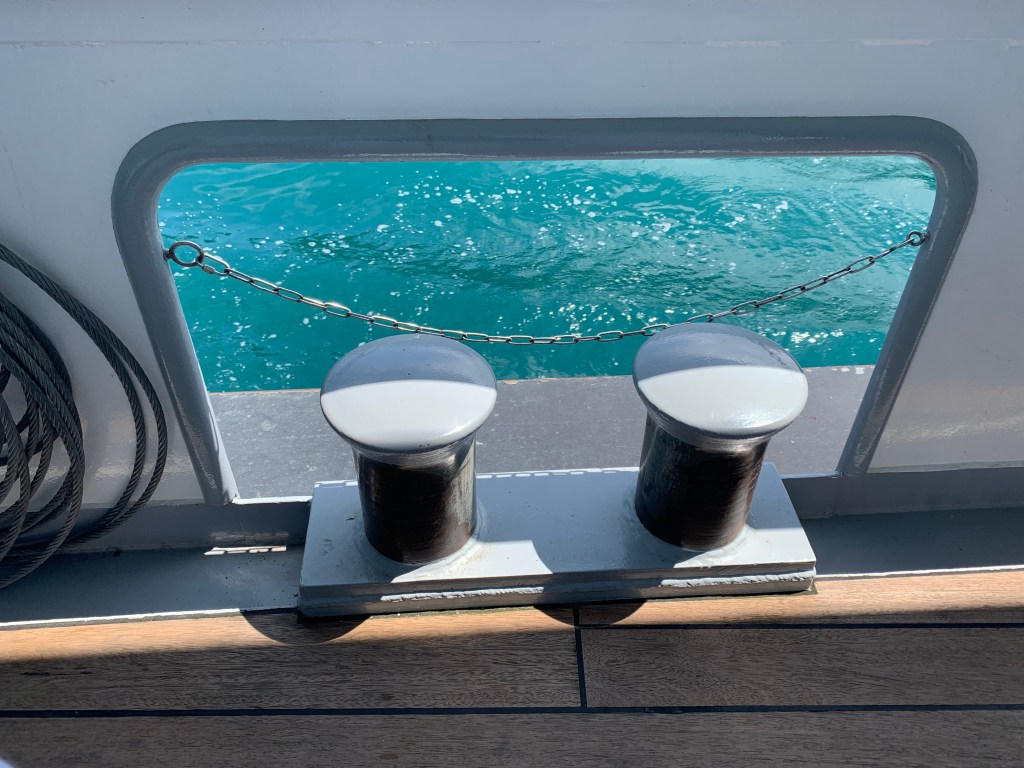
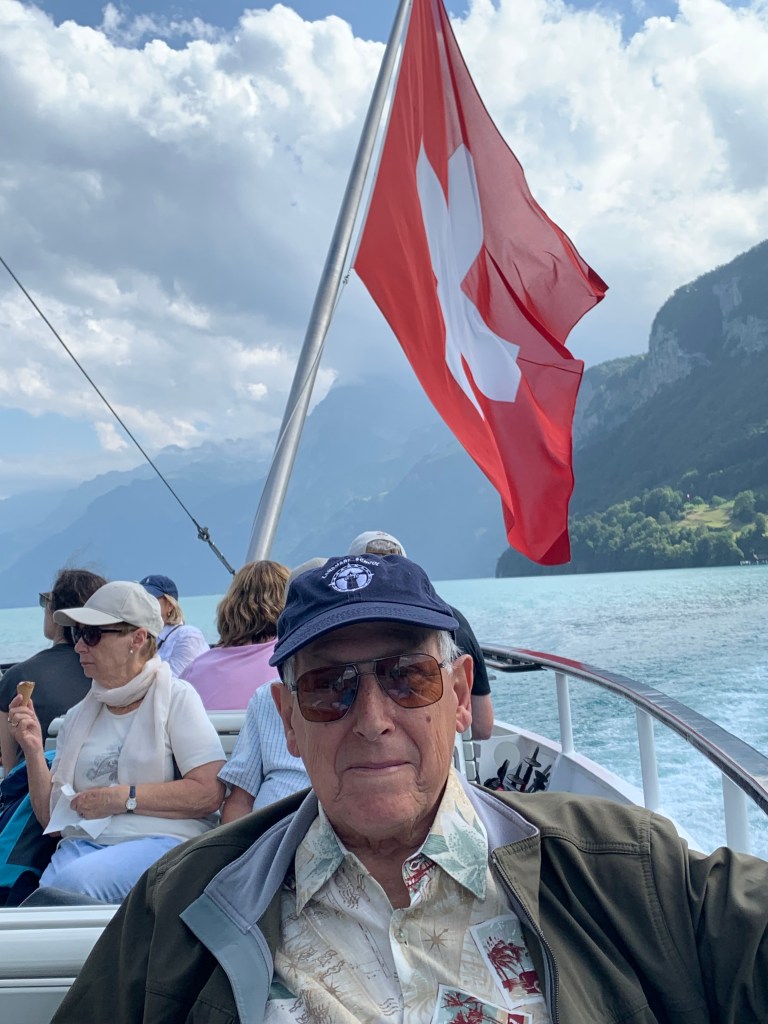
The ship boarded right on time (think Swiss watches) and we found seats first inside at a table, then a better spot outside on a wide bench facing the east side of the lake. We would have the western view on the way back. The ship was only about half full, so there was plenty of room and people moved around easily. Everyone seemed relaxed, even locals who were using the ferry just to get from one place to another.
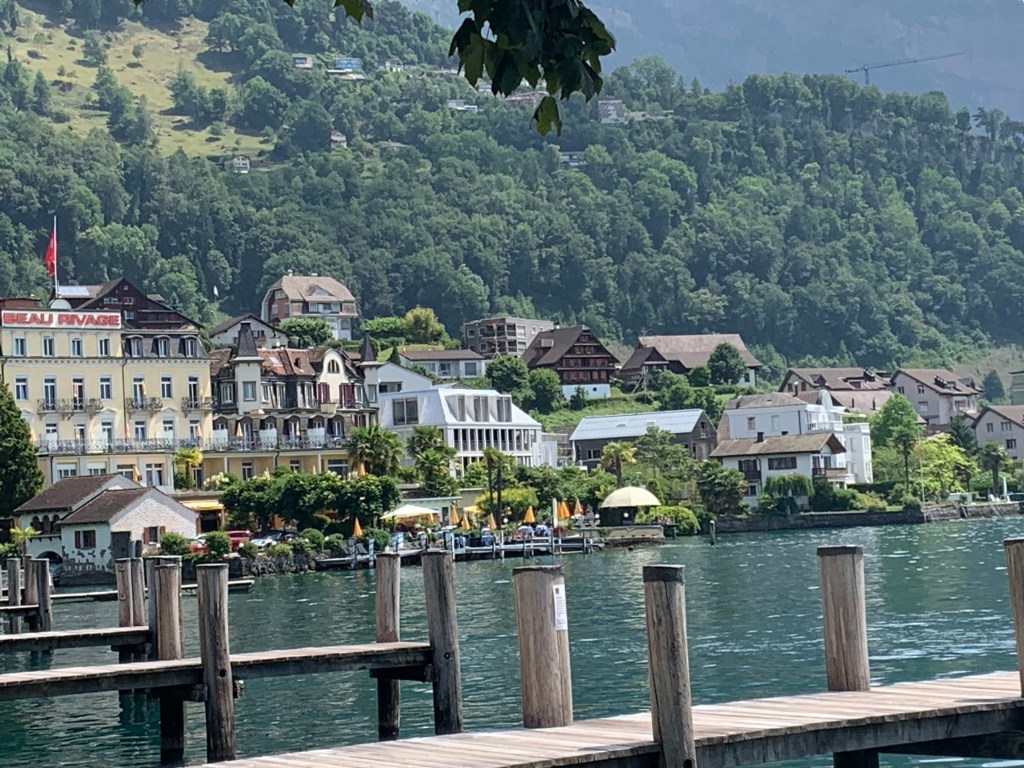
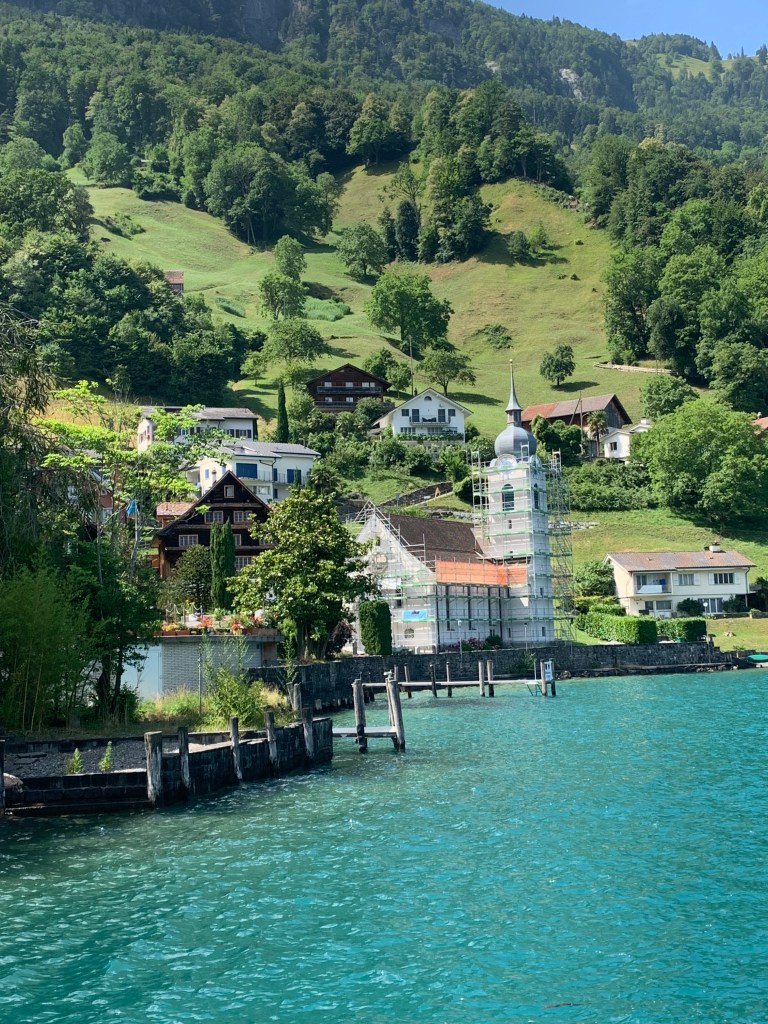
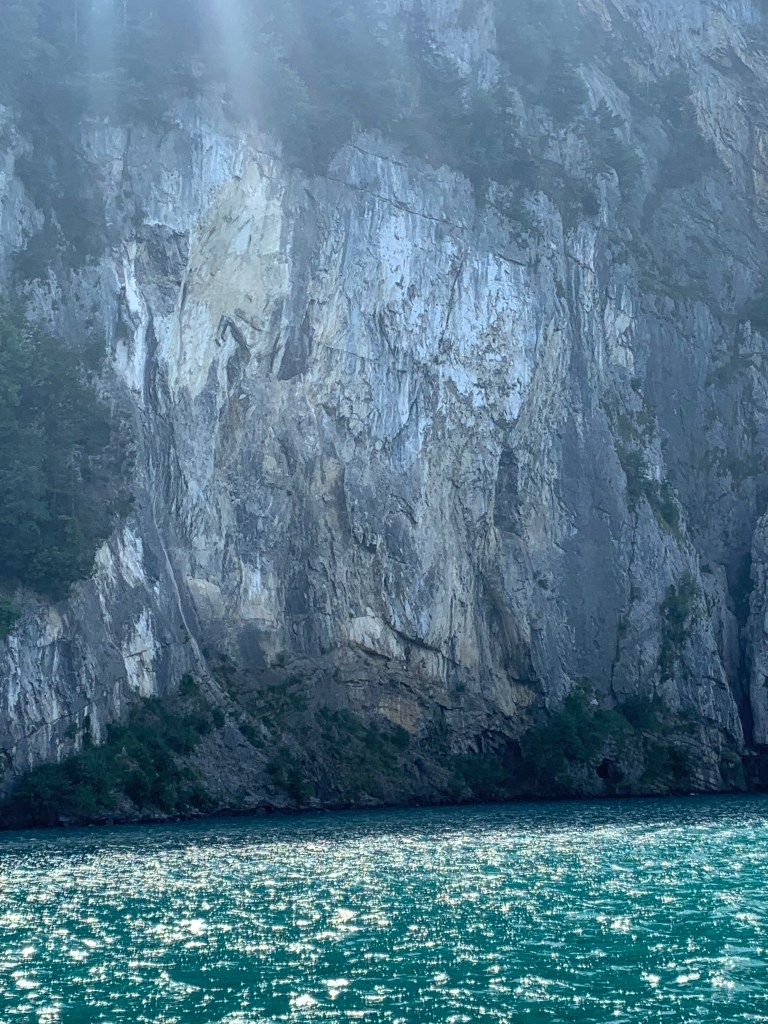
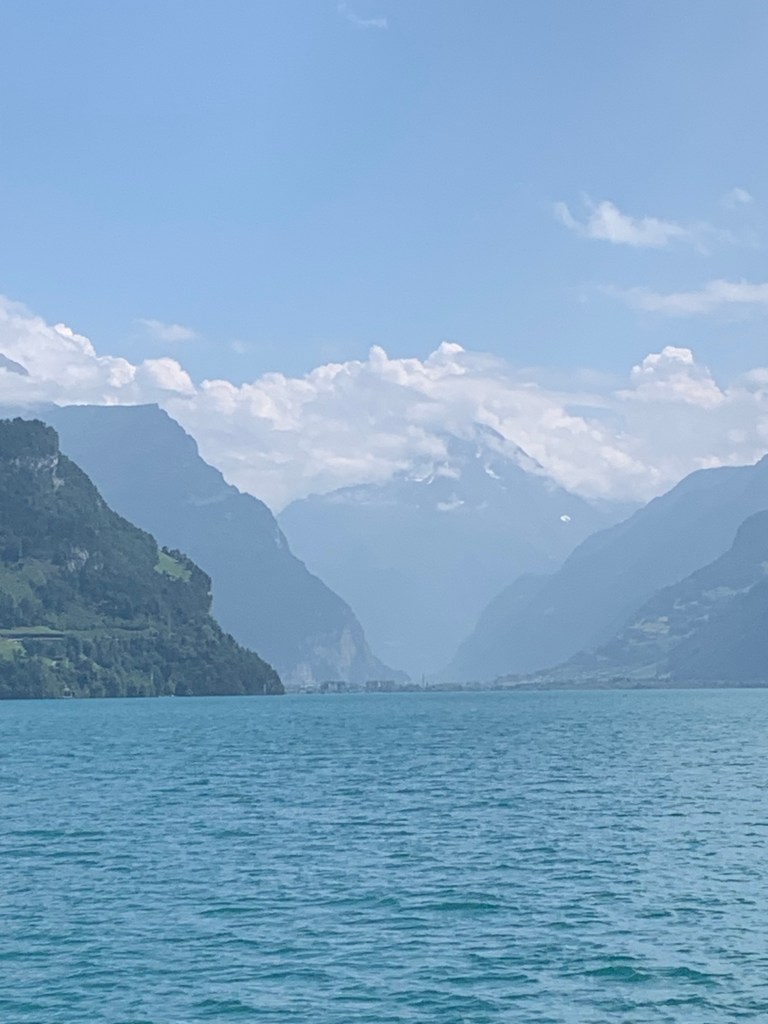
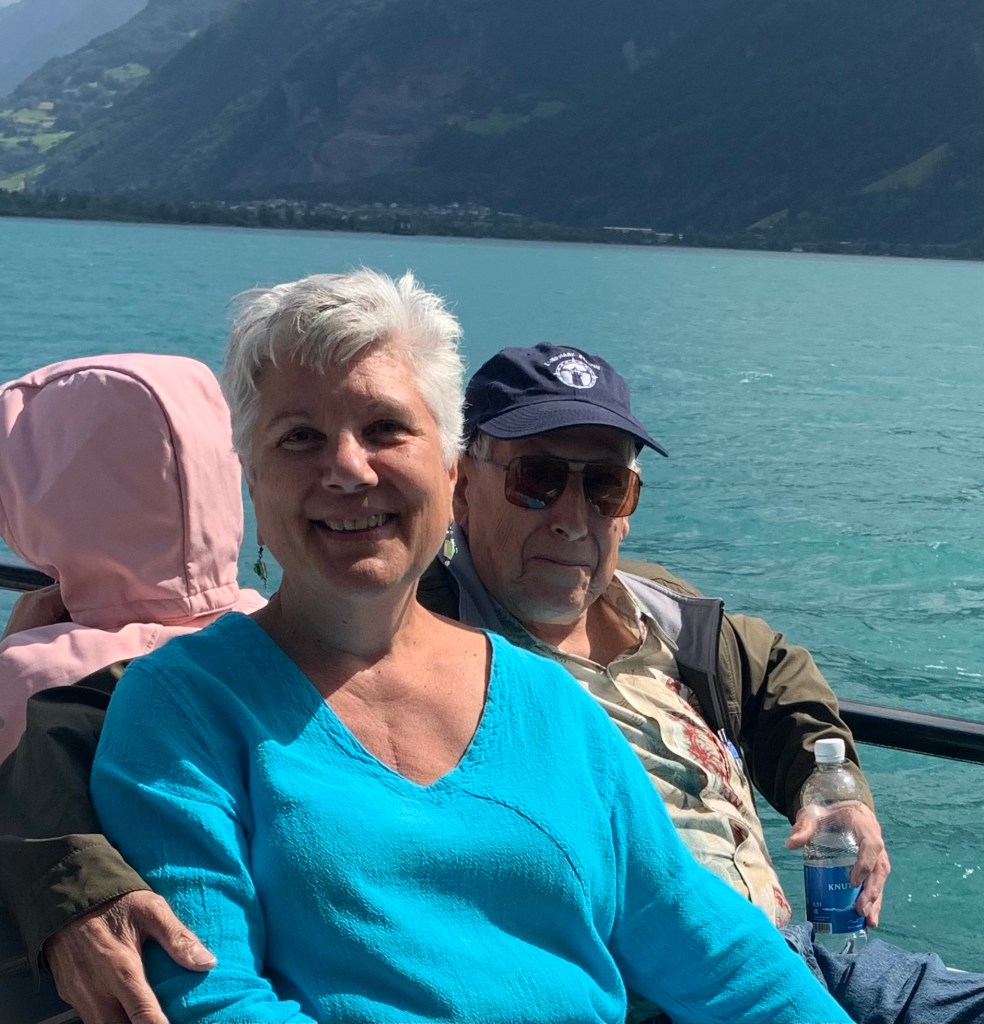
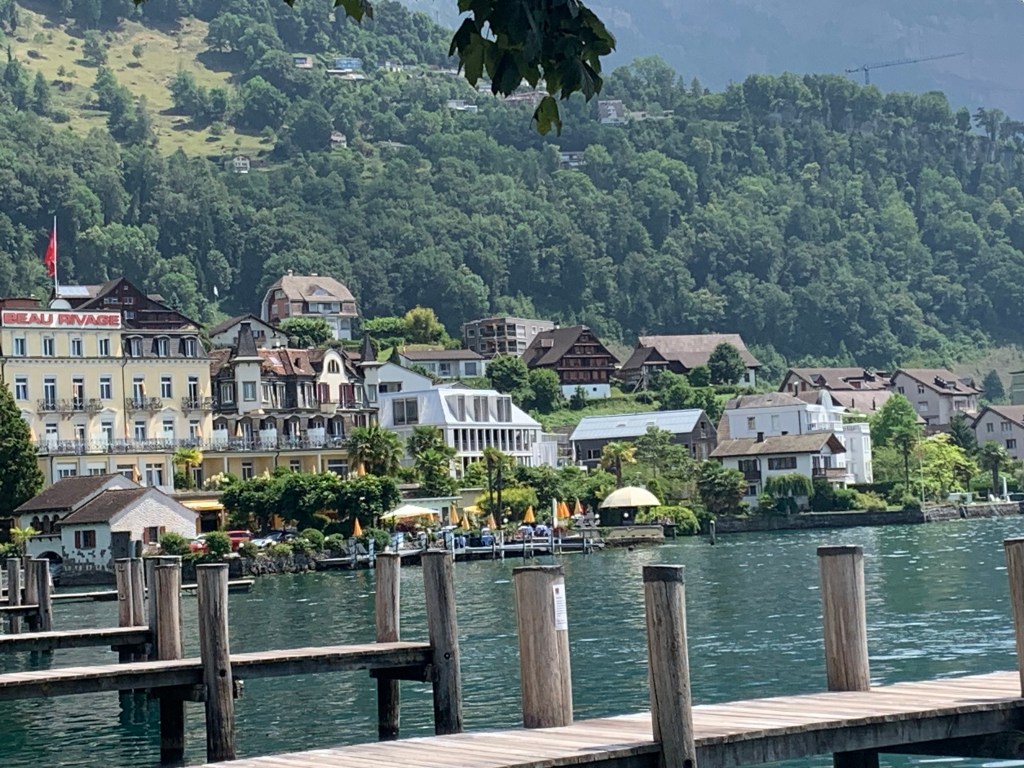
It is difficult to describe the absolute majesty of the unrelenting views. Colors that cry out “peace” – varying shades of blue and green in the water, trees, grasses; earthy browns in the houses and on the even darker rooftops; sparks of white on peaks and on the elegant hotels gracing the shore at each stop. The steepness is what bends the mind. Looking at the houses, I feel that if I stepped out one of those doors I would just tumble down the mountainside into the lake. Impossible roads etch sharp lines back and forth up the slopes.
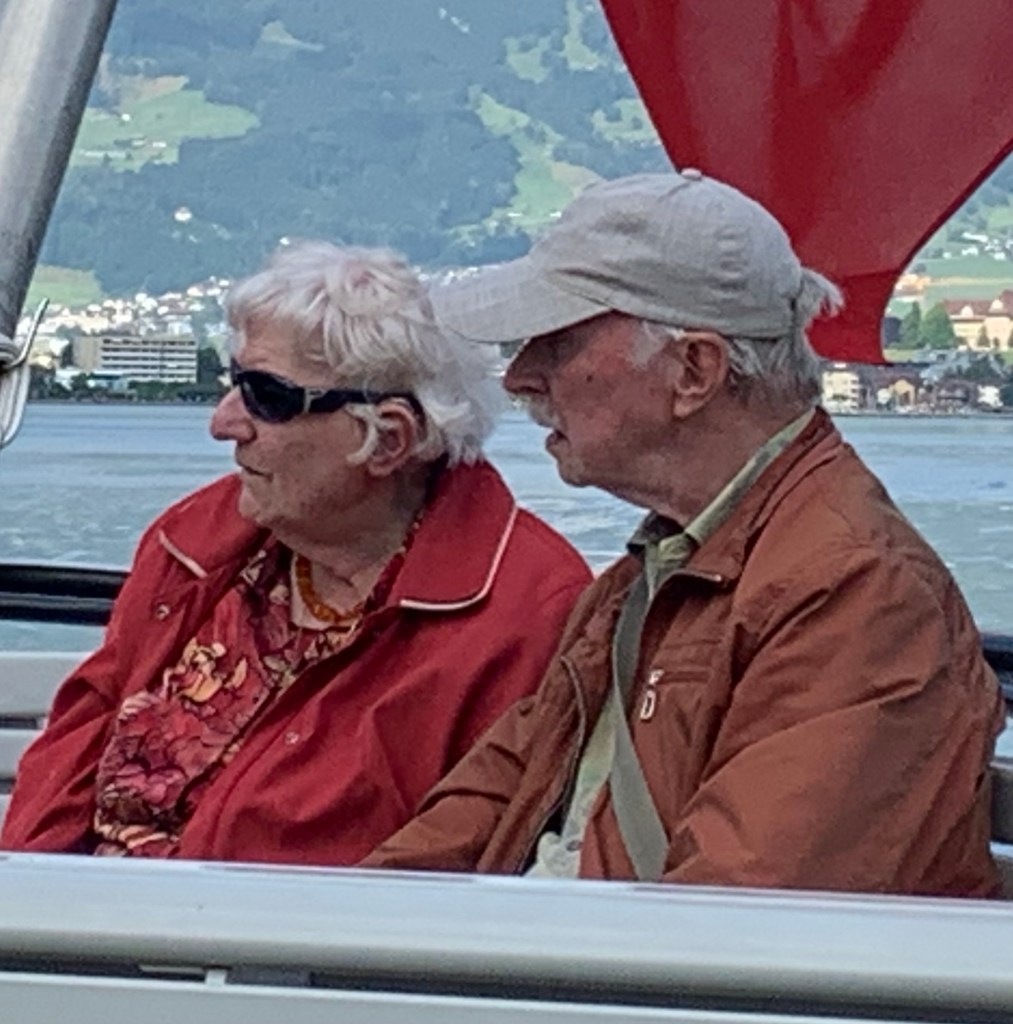
The four hours sailed by as we stopped at villages up and down the lake, passengers getting on and off: hikers with their boots and walking sticks (ironically smoking), teenagers with backpacks, couples young and old, including one older couple who followed one another around the boat, finding a seat for a time, then moving to another. They never walked together. The old man walked stooped over with his mouth open, his shoes never leaving the deck as he shuffled from one foot to the other. He reminded me of Tim Conway’s impression of an old man on the Carol Burnett Show. They always found each other. She was usually the one finding him. But once we saw him shuffling back to her with two ice creams he had purchased from the café.
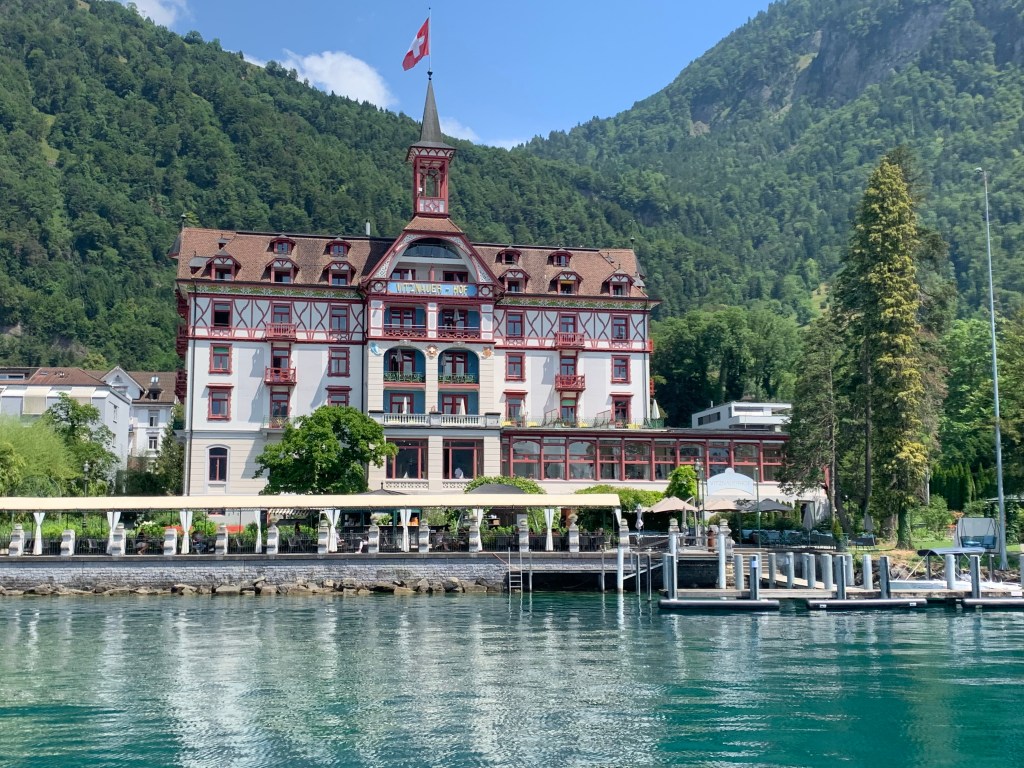
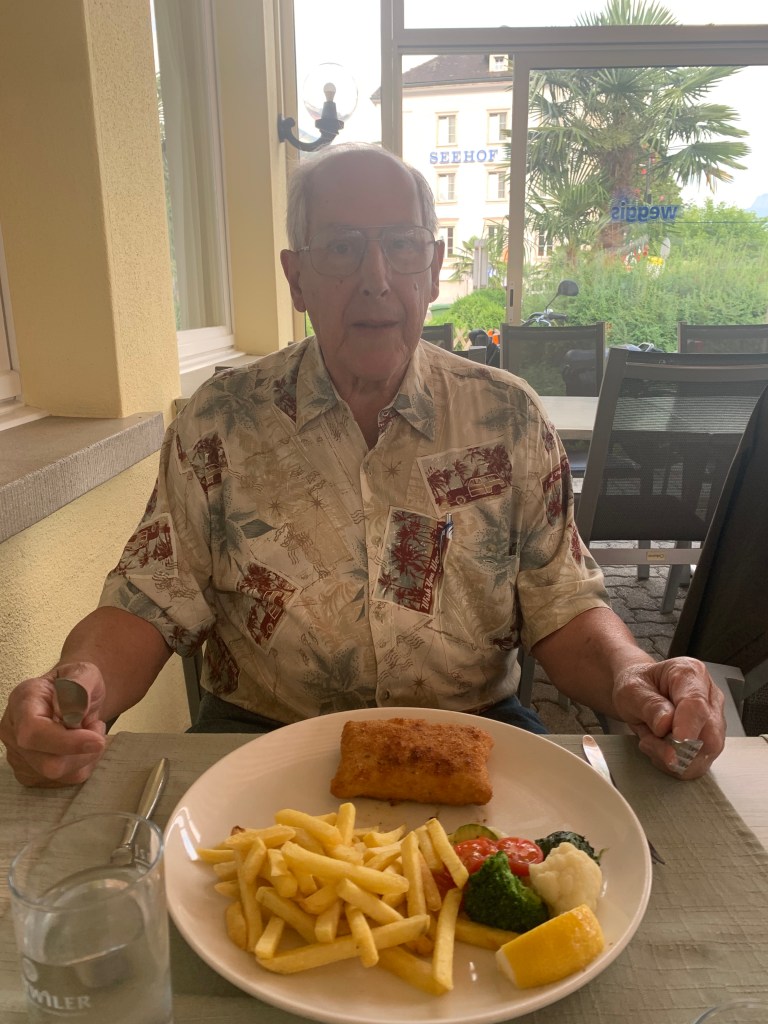
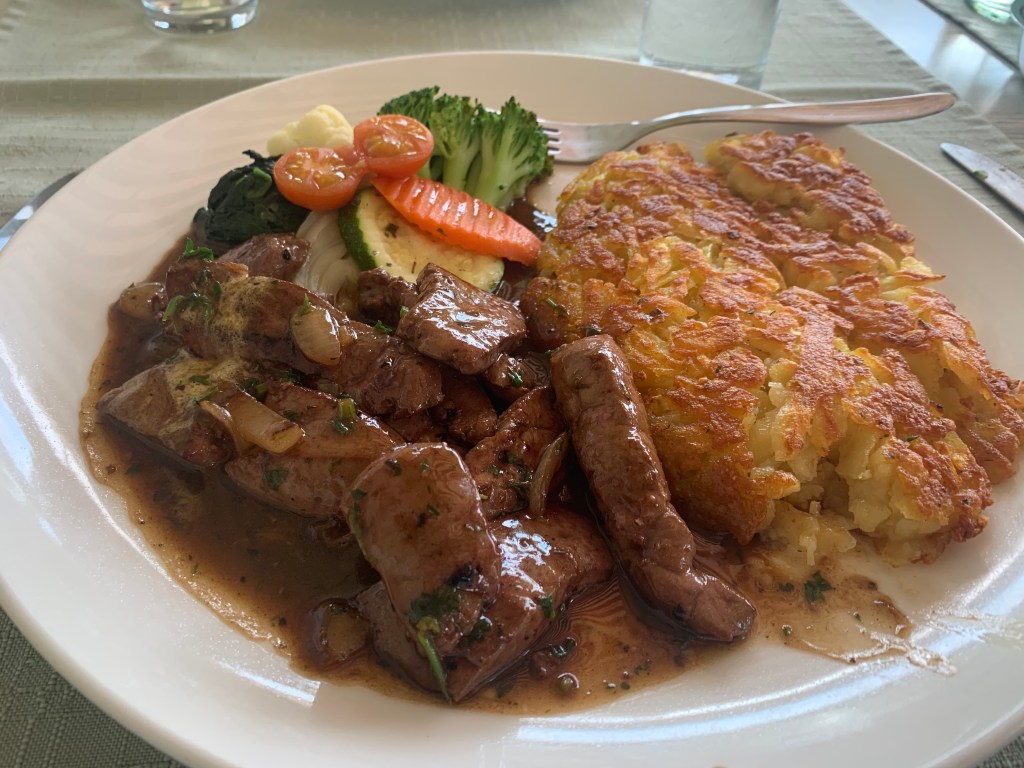
We decided not to eat on the boat since the dessert before we left seemed to be tiding us over. We arrived back at Weggis at 6 p.m. and walked to the Hotel Viktoria, which someone had recommended as a place we could find traditional Swiss food. I had hoped to get fondue or raclette on our one night in Switzerland, but the man at the restaurant told us that these were served only in the winter months; they were not warm weather foods. That made sense! So we stayed at an outdoor table on the lake and ordered pork cordon blue with French fries (Santo) and veal liver with rösti (me).
The climb back up the hill to our hotel was difficult but I made it. I sat on the balcony in the cooling night air then went to bed early, feeling the beginnings of a sore throat.
Of all the places Mark Twain visited in Europe, Mark Twain found Weggis to be his favorite. He returned once for a 10-week stay when he was mourning the death of his daughter and was looking for a quiet place to regroup. He wrote:
“This is the charmingest place we have ever lived in for repose and restfulness. The scenery is beyond comparison beautiful … Sunday in heaven is noisy compared to this quietness.”
With the long drive to Switzerland ahead of us, we got up for an early al fresco breakfast on another beautiful morning. We were sad to say farewell to Alexandra and Trere; they had given us such a welcoming and comfortable home, where we had the time and space to refresh. We said we would come back, meaning it but also knowing that it was probably not true. “Yes, yes,” Alexandra said, “You must come back.” Since she had told us she would be retiring soon, Santo said, “But you won’t be here. Would you come back?” “I’ll come back to work if you will work with me,” she teased him. We all laughed. We said “Arrivederci” knowing we would probably not meet again.
From Faenza, we headed northeast, driving through Bologna and Milan on our way to the Alps, which were on Santo’s bucket list. Just beyond Milan was Lake Como. We didn’t stop, but could see the lake and the town from the road. I had imagined Lake Como to be nestled in a mountainous area with only elegant villas and resorts gracing the lakeside. But we past by only the southwestern tip of the lake at Como, a densely packed city covering the low hills surrounding the lake. At the foothills of the Alps, the mountains were lovely but not yet majestic.
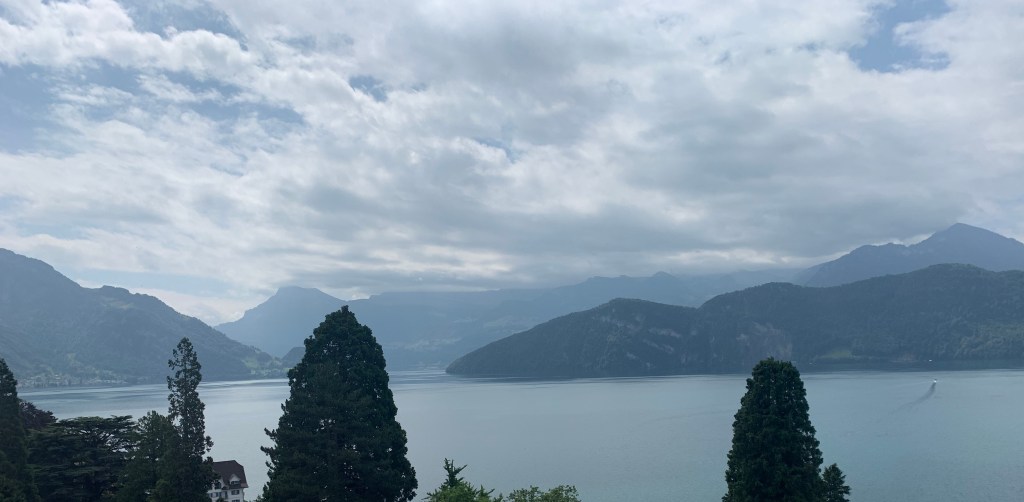
We crossed into Switzerland after Como and had to stop at the border to purchase a pass allowing us to drive on Swiss roads. Forty Euros later, we continued past the lake towns of Lugano and Lucarno, our elevation gradually climbing to over 1300 meters. The Alps emerged in front of us, the peaks looking like the sharp points on an EKG. We descended again so that the mountains seemed to grow around us. We must have passed through more than twenty tunnels carved into the steep hillside as we made our way north. One tunnel was 17 km long! Some of the tunnels had a smaller side tunnel for bikers. Finally, Lake Lucerne (Luzern) came into view on our left. We were at the very southern tip of the lake near Flüelen. From Flüelen to Ingebohl, we were in and out of tunnels, catching glimpses of the deep aqua lake (similar in color to the Adriatic) on our left when we emerged from the tunnels. At Ingebohl, we veered to the east of the lake, losing the view until we reach the top of the lake and turned sharply south to Weggis.
Weggis seemed to sit in a palm of a mountainous hand, nestled safely far below the towering peaks. Our aptly named hotel, Hotel Alpenblick (Alpine View) was on our right. The several story sand stuccoed building sat atop a steep driveway. There was a garage entrance at the bottom of the driveway, but there did not seem to be any way to enter it. We drove to the top, to what look like the main entrance. We parked and walked to the covered entrance. There were sliding glass doors that looked like they should open when you stepped up to them. But they didn’t. We could see a sign inside pointing to “Rezeption” but we couldn’t get in. Now it was beginning to rain. Santo thought maybe there was another entrance further down the road, so we went back to Luzernerstrasse and continued down the hill into the village. No luck. We drove back to the hotel, parked in place along the driveway, and were walking around looking for … something! Finally, a man drove up, parked, and started walking up the hill. I asked him (in German) if he knew where the entrance was and he indicated the spot were we had been. “The doors wouldn’t open,” I said. He was surprised and accompanied us to the doors. Still locked. I told him we had reservations. He was able to let us in a side door with his room key. We walked over to reception, but there was no one there. The restaurant was closed, too. What now?
That’s when we met Michael and Carol. They had come into the reception area via the “locked” doors that had barred our entrance. Michael and I started talking in German and he was able to explain to me that they had received an email from the hotel telling them that reception closed at 6 pm. They had given him a code to get in the door and told him there would be an envelope on the counter with their room key. He found their envelope, then asked us our name and sure enough we had an envelope, too. We were in 112. They were in 113. I had not received the email because, DAMN SPECTRUM!, I had no data on my phone.
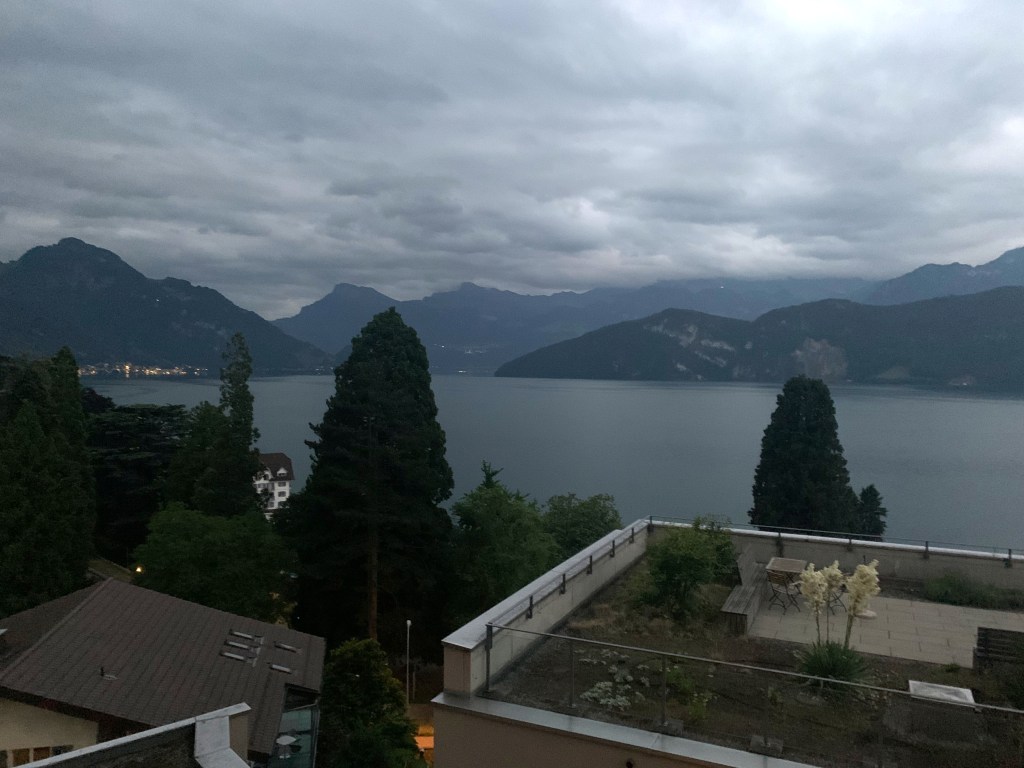
Santo parked the car closer to the top of the hill and we got our bags. Our room was two stories up. As soon as we entered, the magnificent view of the lake and mountains opened up before us through the wide double glass doors to our balcony. Ahhhh!
We had not stopped for lunch, so were very hungry. We had planned to eat in the hotel restaurant, not knowing it was closed on Sundays—and Mondays! Santo tried to find research restaurants and found a Mediterranean take-out with falafel, hummus, etc. I would have preferred a sit-down restaurant but these were either not open or very expensive. We started back down the driveway on foot.
There we met Michael and Carol again, realizing now that they were Canadian and we could all speak English! They were also in search of dinner. The light rain had let up. We decided to look for something and eat together. Santo and Michael walked ahead, Carol and I carried on a lively discussion behind. She was originally from Belfast, Michael was born in Ireland but raised in England. They live in London, Ontario, about 4 hours from Auburn. Michael found a restaurant that had been recommended to them and we went inside. Santo did not want to stay because it was so expensive, but I would have stayed in order to be with our new friends. Luckily, they thought it was too expensive, too, so we all left and found the place Santo had identified. The inside was a small take-out place, but there were 3 small tables and chairs outside on the sidewalk. We ordered our food and sat outside.
There we met Simone and Markus. They were a handsome pair. Simone was blonde with a very open face and twinkling eyes. Markus had long graying hair pulled into a bun, a slight beard. He was tall, handsome, and reserved. Simone immediately greeted us and we started talking in German but she wanted to use her English, which would also allow Santo to understand. She was from the Black Forest, had worked for a cruise line for many years, and had lived in Florida. We all joked about DeSantis and how it was good that she was no longer in Florida. Markus was from Switzerland and they both lived in Weggis now. The six of us had a lively discussion about politics (U.S., Canadian, Swiss), our personal backgrounds, travle, and more. Simone and Markus told us about a 4-hour boat trip that would take us down to the narrower southern part of the lake where steep peaks plunging into the water were reminiscent of Norwegian fjords. It would take us to Flüelen and back, and we could see the parts of the lake that had been hidden by the tunnels, but from below, not above. An idea for tomorrow.
We parted with laughter and promises. Friends are everywhere waiting to be found.
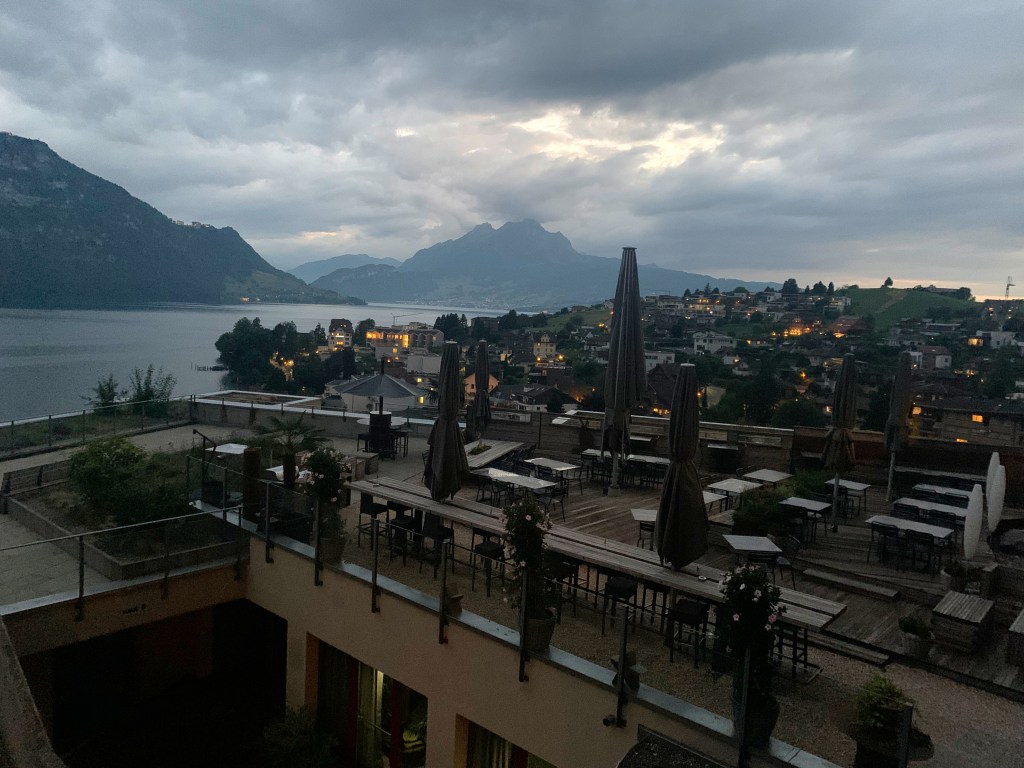
Back in our room, we enjoyed the night view of the lake and the village dotted with lights. We kept the balcony door open to let in the cool air and turned on our fan.
Another good night’s sleep. Is it the Italian beds or our level of relaxation?
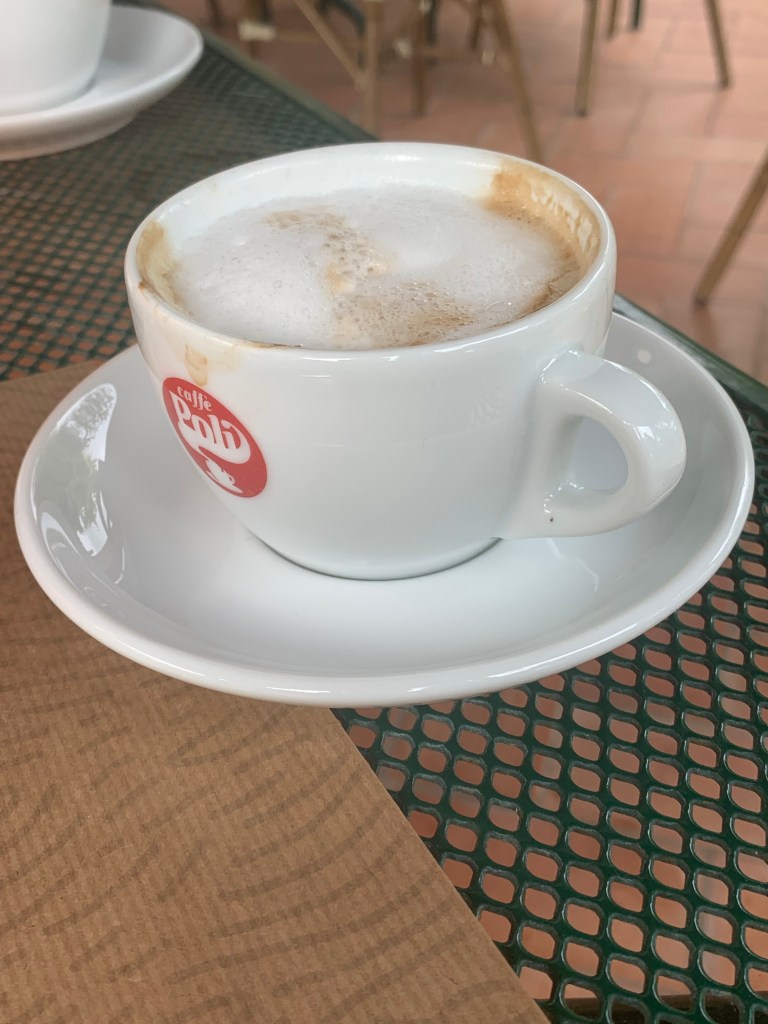
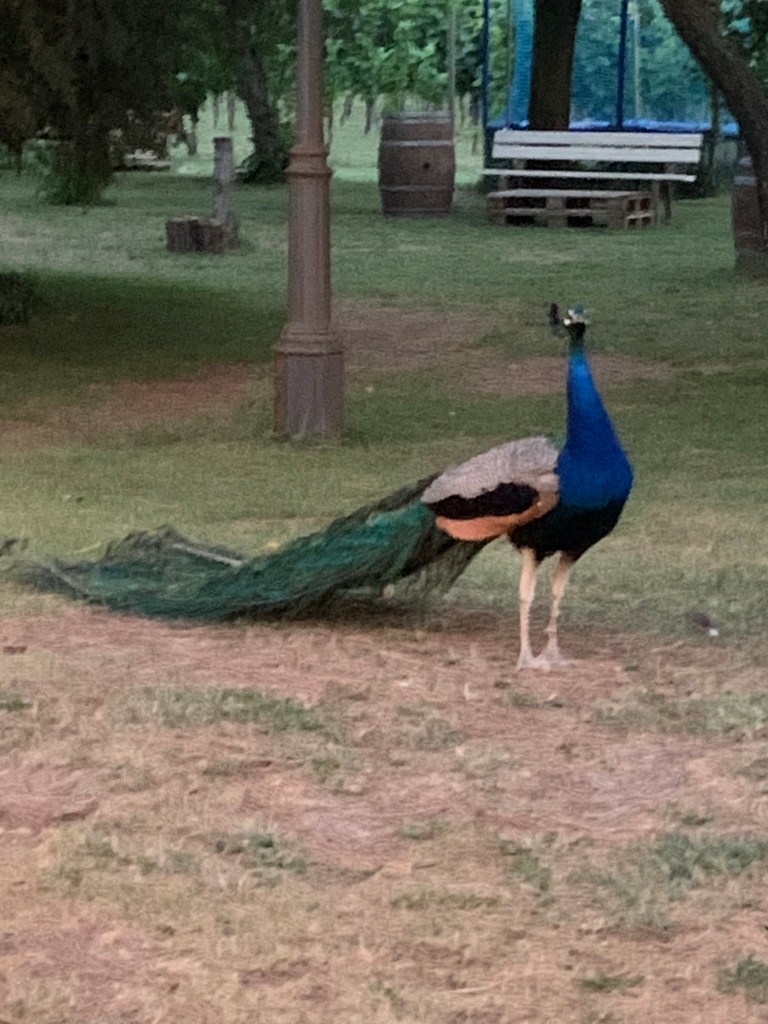
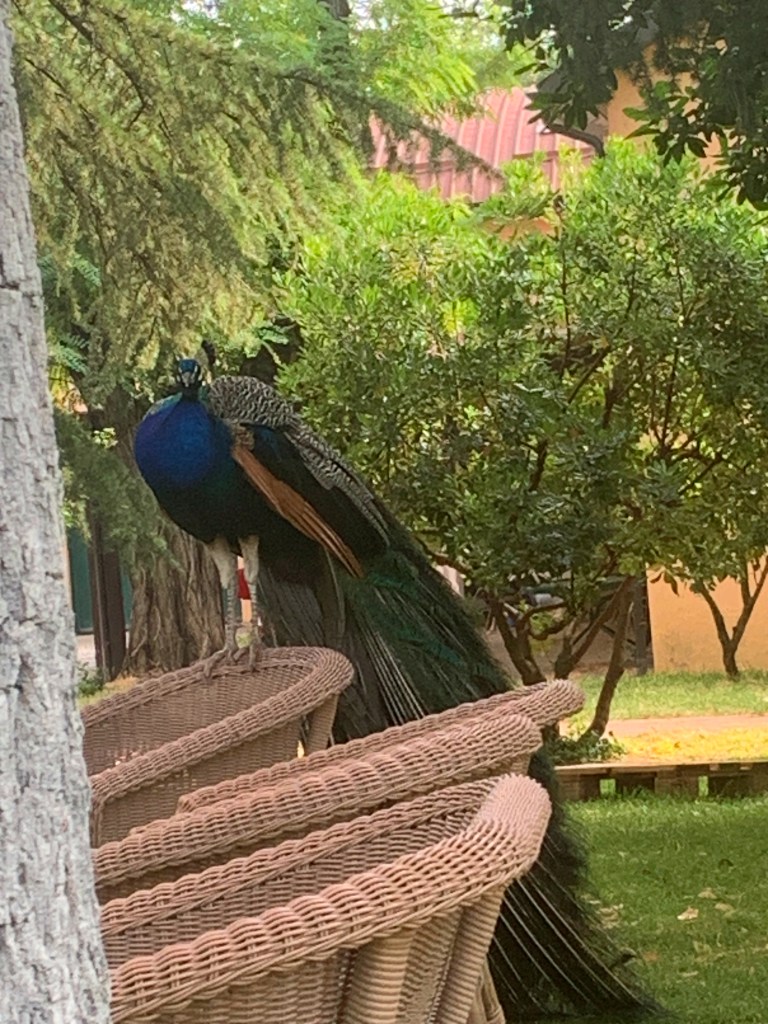
Breakfast on a small patio behind the building. Took our time (two cappuccinos each), enjoying the space, the peacocks of all shapes, sizes, and sexes roaming around us, and the lush pink and white flowering bushes that added a sweet scent to our meal.
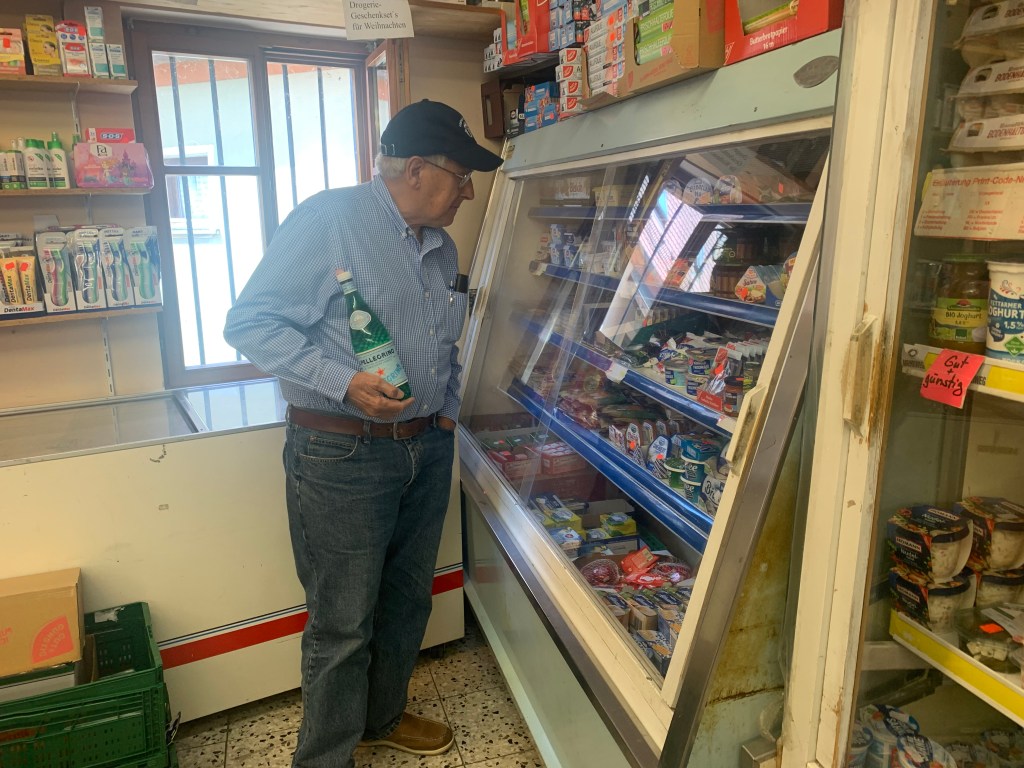
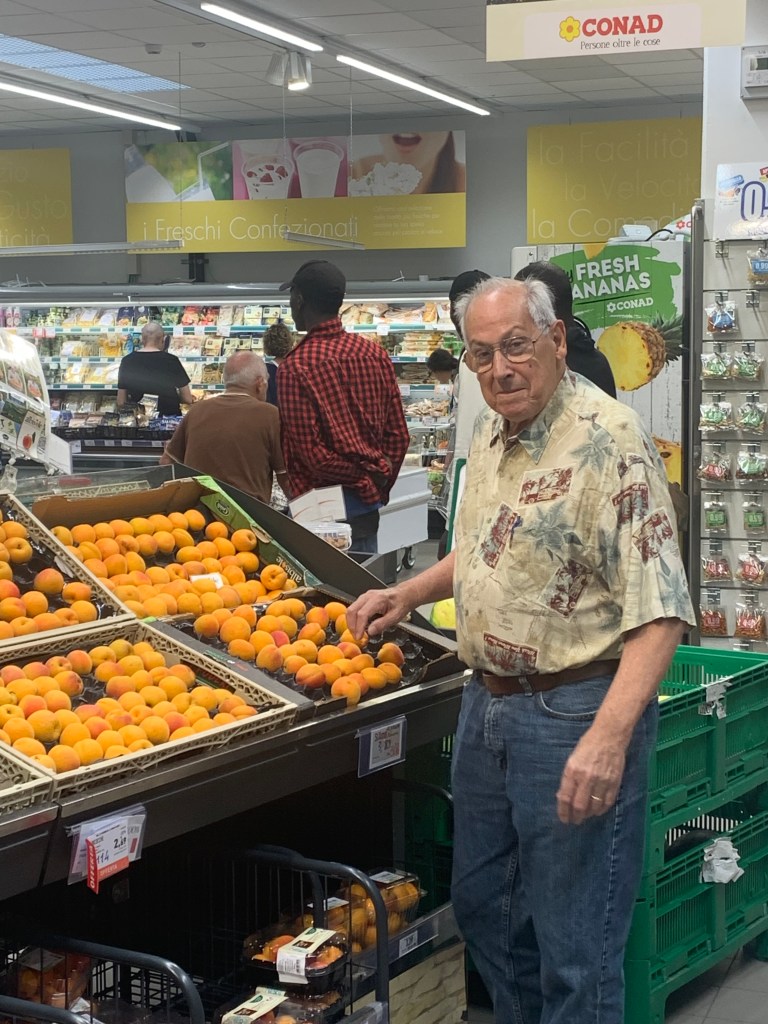
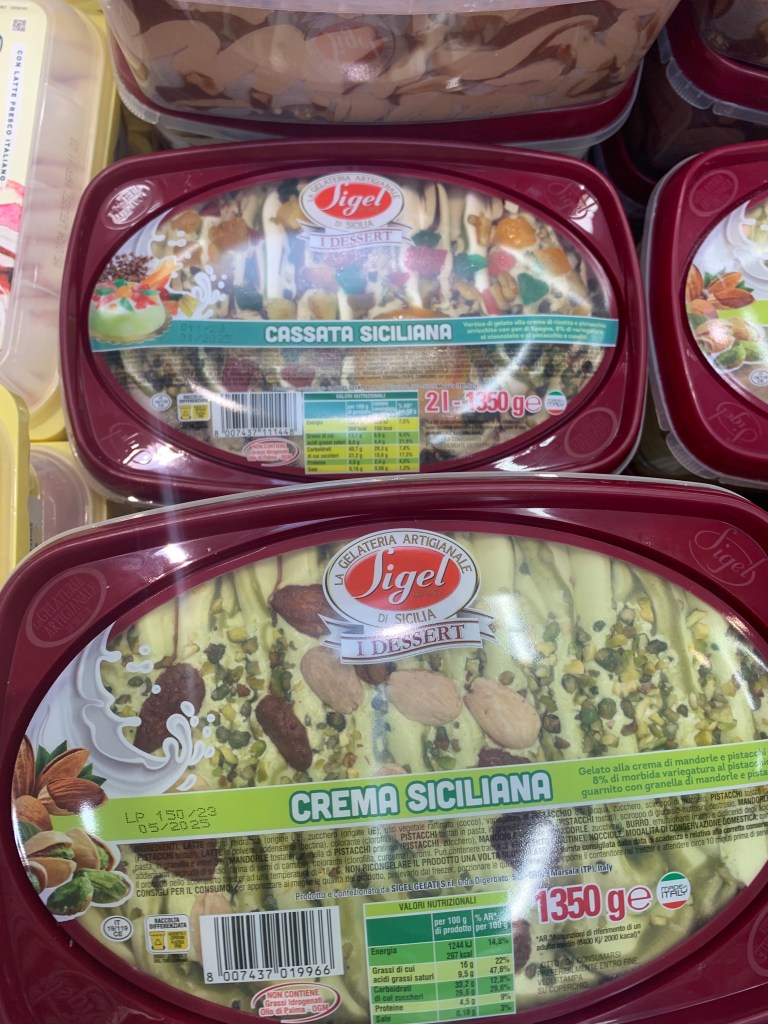
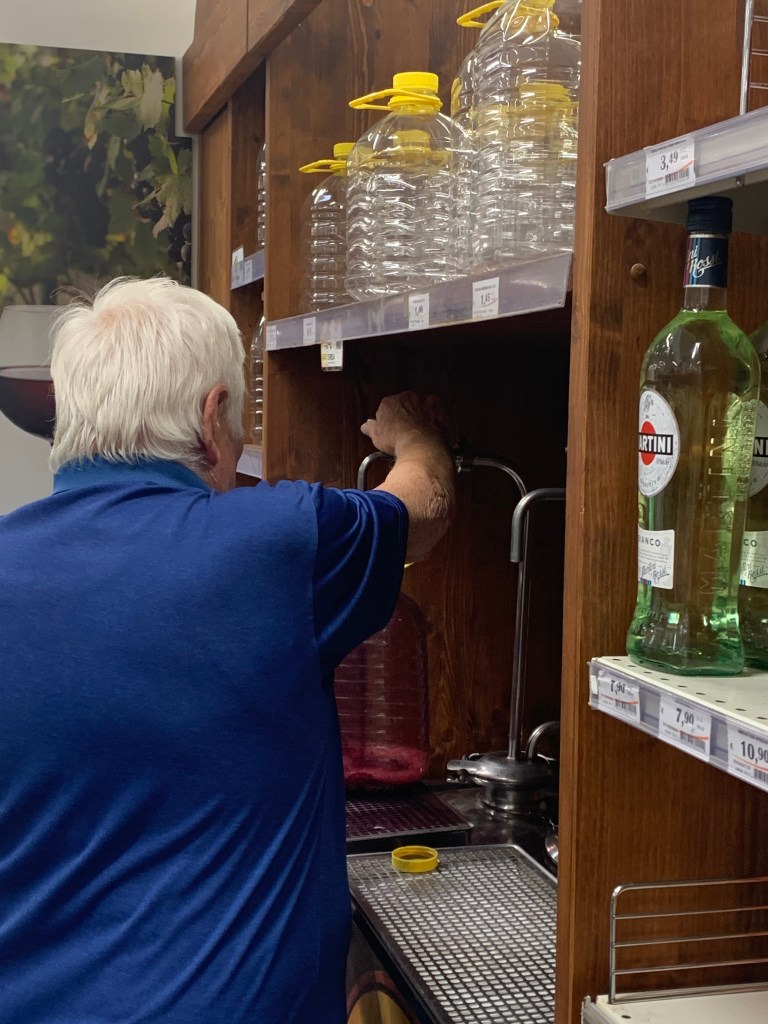
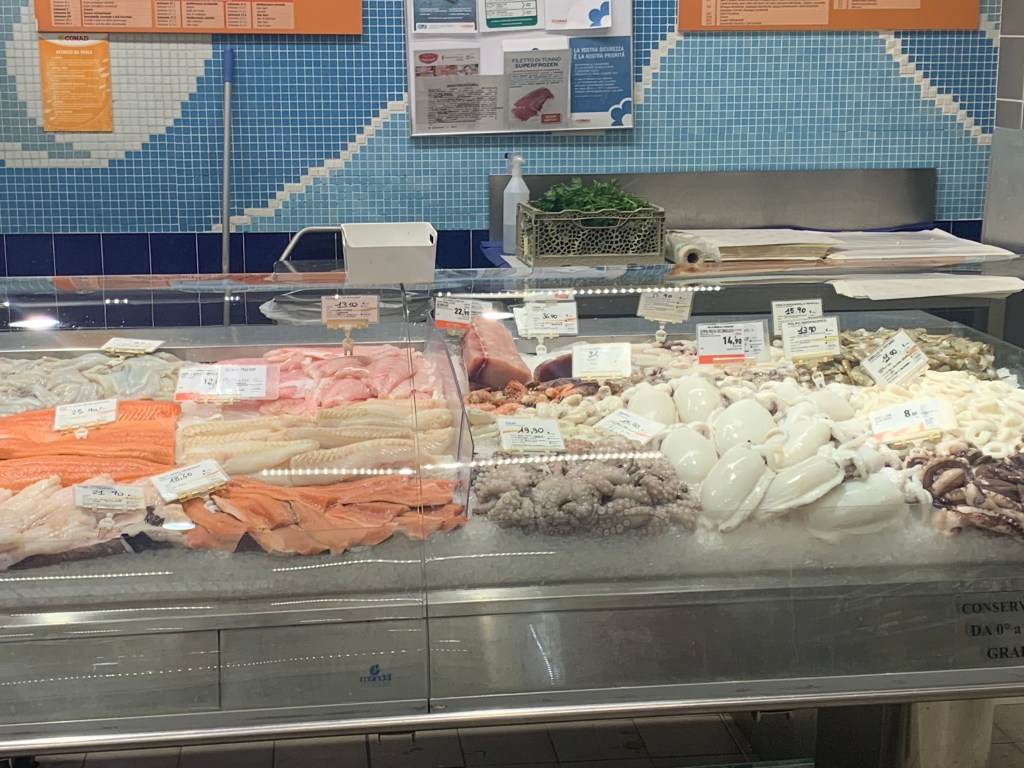
After breakfast we headed to the supermarket to pick up some bread and cheese to add to our leftovers from last night for today’s lunch. Santo was in his glory! The glass case at the back of the store overflowed with fish and seafood, included whole octopus (tentacles and all), squid, shrimp, and more. There was even a spot where you could fill a plastic wine bottle with red or white wine from a tap. (see below)
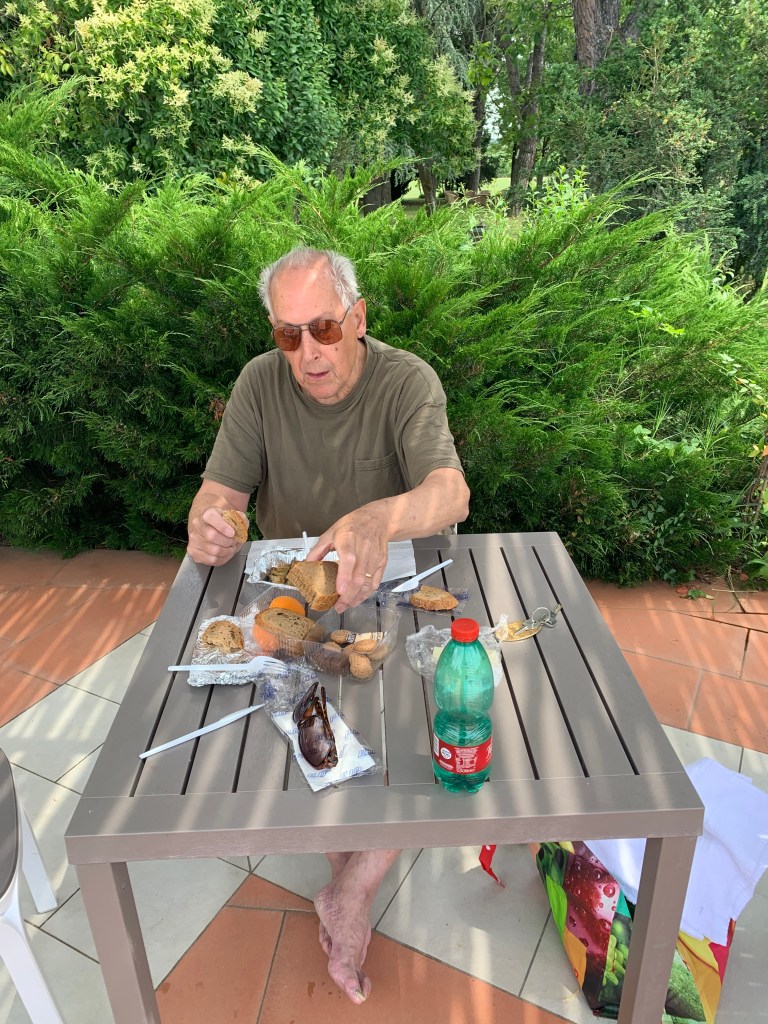
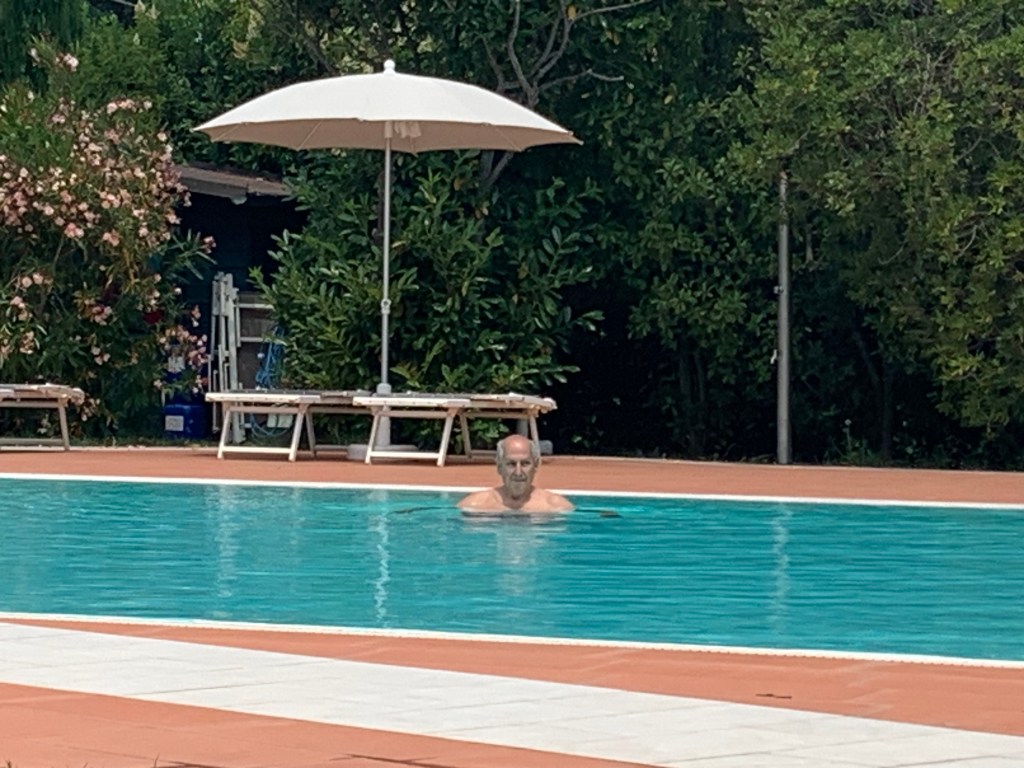
Back to the hotel by noon, the weather had warmed up to a perfect poolside temperature. I headed to the pool with my computer and started writing. Santo joined me after a little bit and took a dip in the pool (cool, he said, even the hot tub!). Then he brought our lunch of cheese, bread, fruit, leftovers, and cookies to a poolside table.
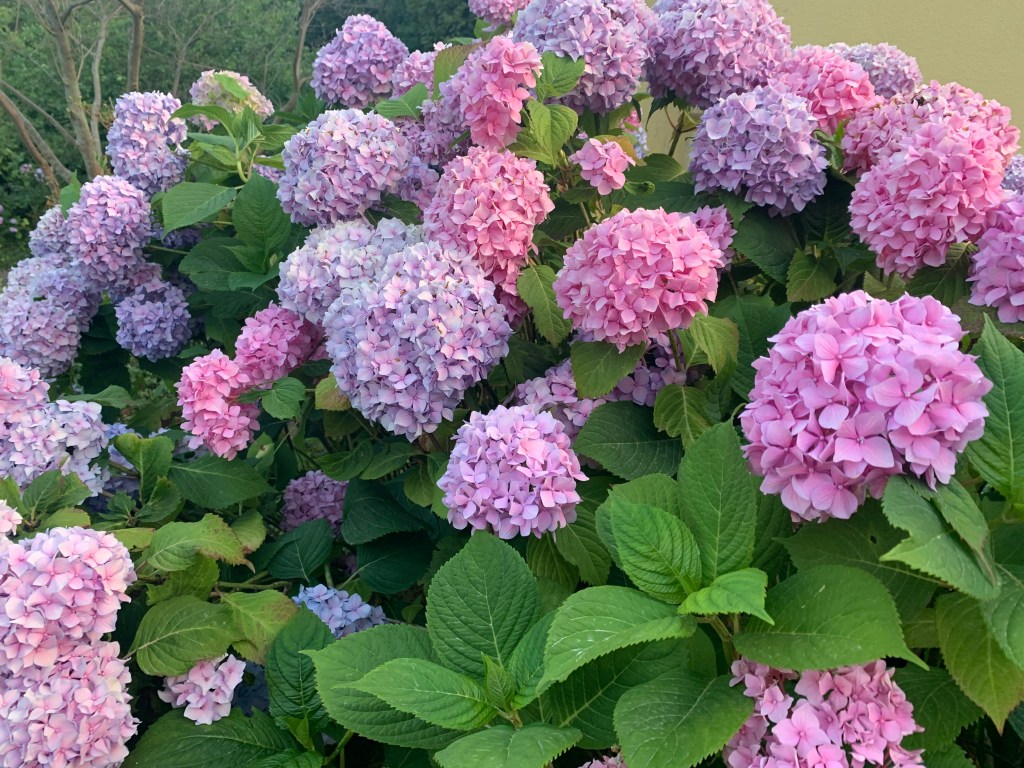
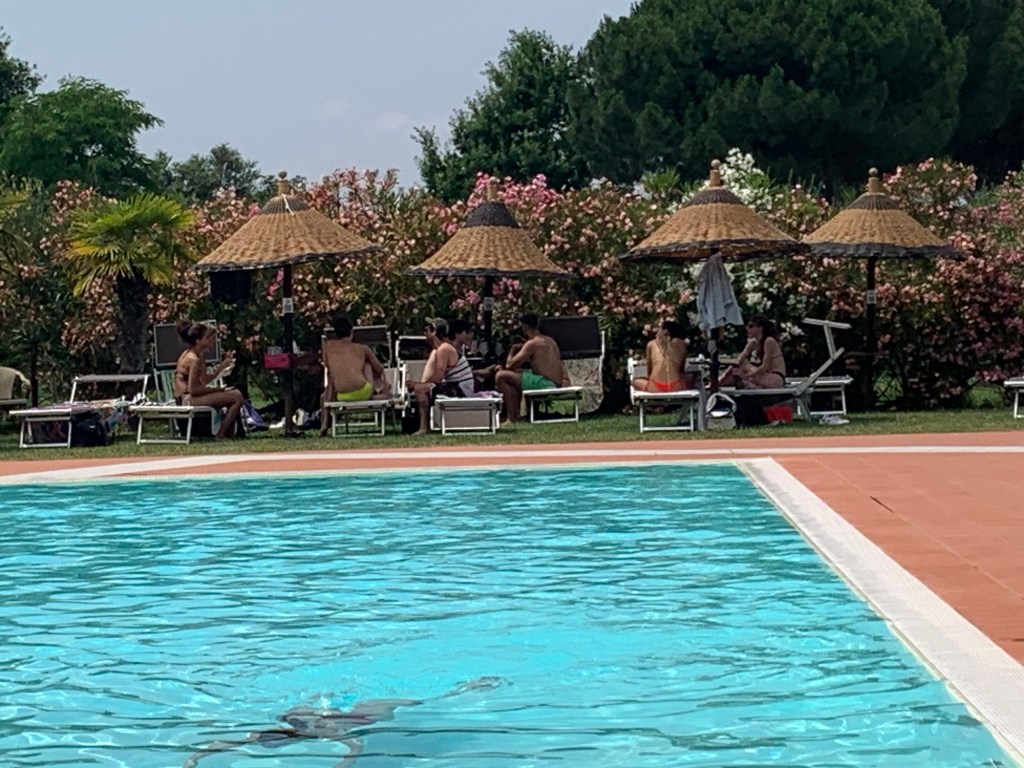
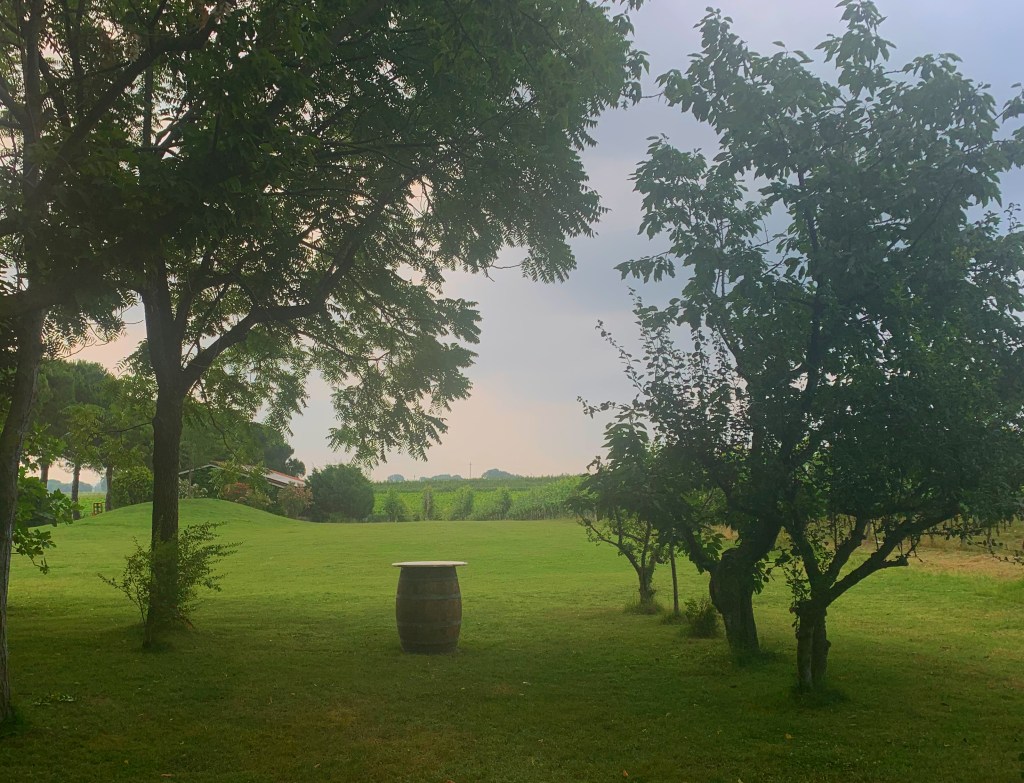
The afternoon at the pool was a pure delight. Comfy lounge chairs, umbrellas for shade, a glorious infinity pool with an infinity hot tub nested inside, all surrounded by lush vineyards and pink and white flowering bushes. We still do not know what they are called (they also line many of the highways), but Santo is determined to find out. Perhaps they will be growing around our pool one day! A group of young people were enjoying drinks and each other in the hot tub. I imagined they all were twenty-something career people in Florence having a weekend getaway to the country. After all the strenuous waling and climbing in Matera, this pastoral respite was just what we needed.
By 5 o’clock, we were ready to take our sun-soaked bodies up to the cool sheets of our air-conditioned room for a pre-dinner nap. Very romantic!
This night, the restaurant and villa was hosting a wedding. Alexandra had told us about it the day before, indicating that they marrying couple was “you know, not so much on the young side.” “You mean like us?” I asked. She laughed. “It will be a nice group. And we will have everything shut down by midnight.” She wanted to assure us of this since our room was just upstairs from the festivities.
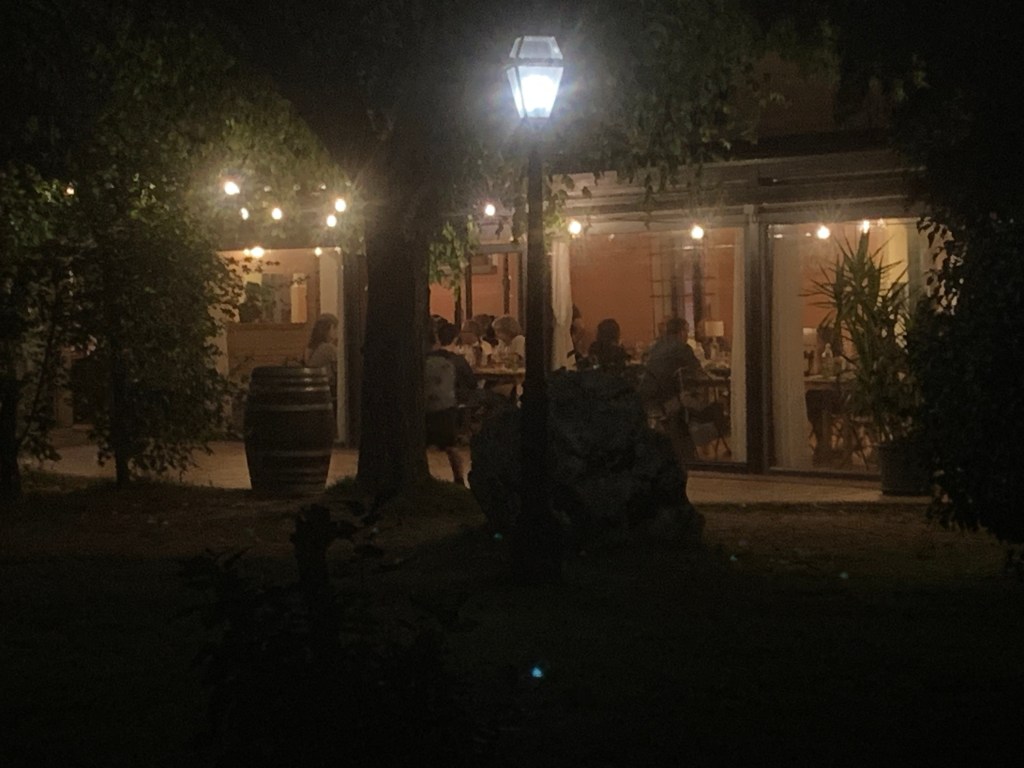
By the time we came down for dinner, the restaurant was filled with wedding guests. The tables had been set with white tablecloths, flowers, and candles, all looking quite lovely under the small lights strung along the wooden beams of the porch. Dinner for the hotel guests would be served on the back patio where we had had breakfast. Before we headed back, we took a peek out front, catching a glimpse of the elegant bride, her blonde hair done up and dotted with white flowers. It did indeed seem like a nice group—how fun it would have been to join them.
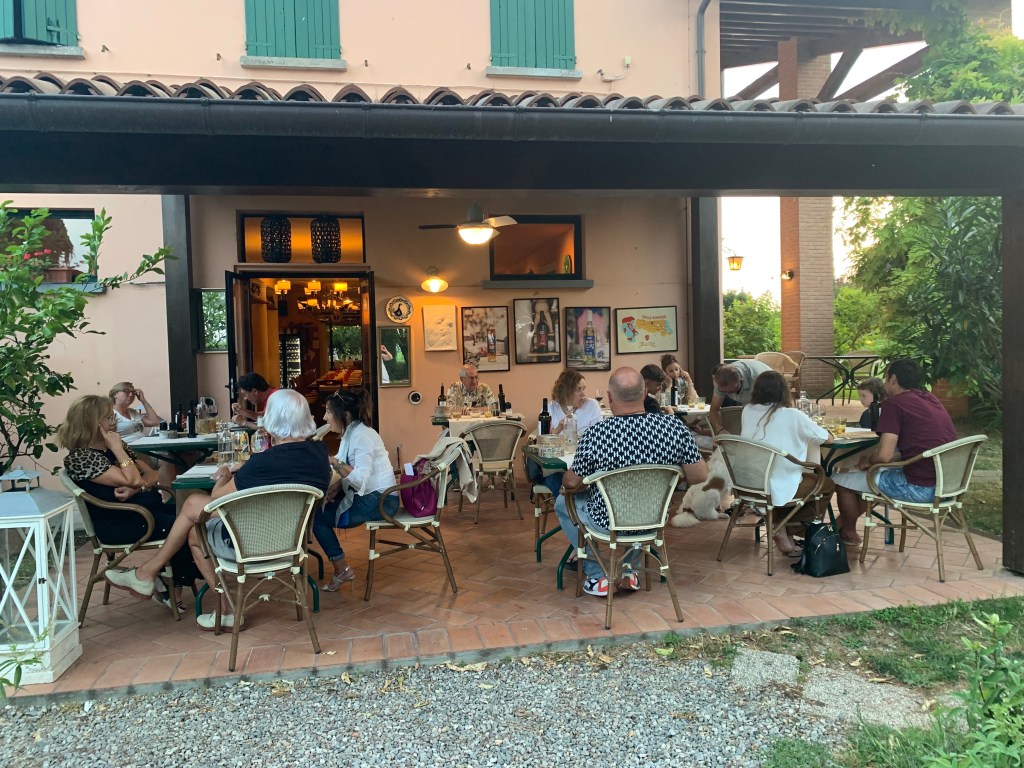
On the rear patio, there were five tables of guests. A family at the table next to us, parents and two teenage boys, were having a weekend getaway from Florence. Their dog Lucky accompanied them. A beautiful white and brown dog, Lucky greeted us gently, then spent most of the meal under the table. At a table for three was a gentleman who seemed to be famous from the way people were sheepishly greeting him. He was probably in his seventies with pure white hair, parted in the middle and hanging to the nape of his neck. He had a deep tan, which seemed to more likely be from a tanning bed than time outdoors, and a look of arrogance. Accompanying him was a small, dark-haired woman in jeans and white shirt and a blonde (dyed) woman of a certain age whose palazzo pants and loudly colored silk top made her look like she walked right out of Dynasty.
The air was perfect, mild with a gentle breeze. By now, we were so used to the resident peacocks that spotting them in the trees around us and hearing their loud, shrill cries barely phased us. In the long room just inside the patio was the children’s table for the wedding. Every once in a while, they would all burst into loud laughter or whooping sounds. They seemed to be having fun—and we all smiled at one another on the patio when we heard them.
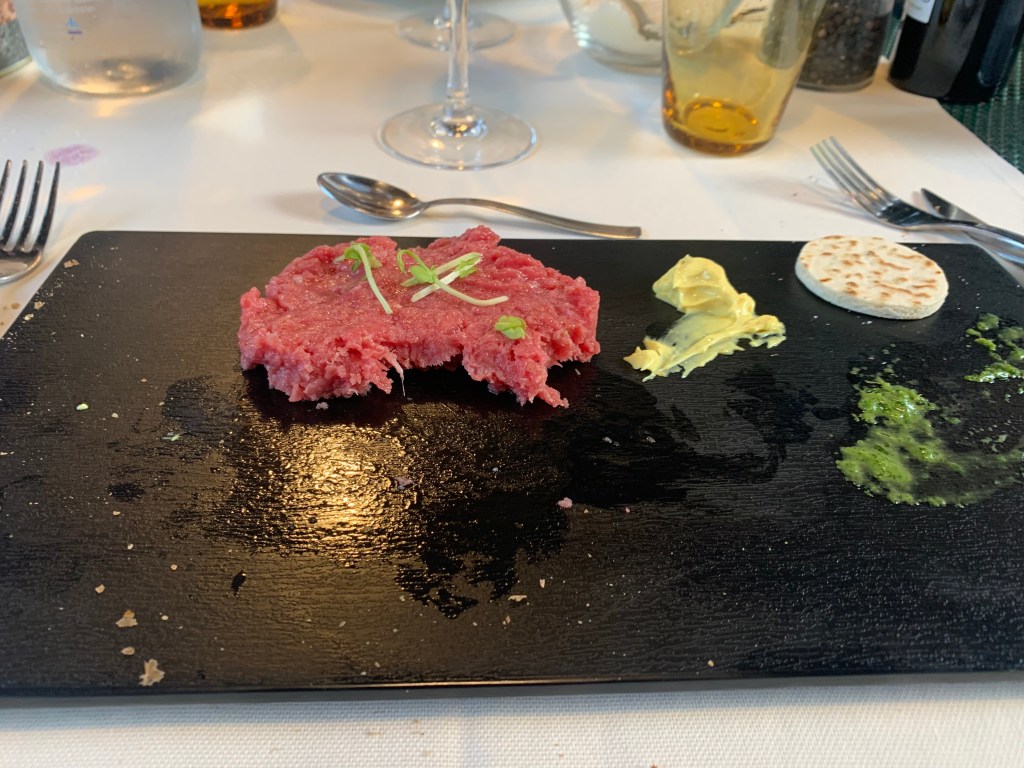
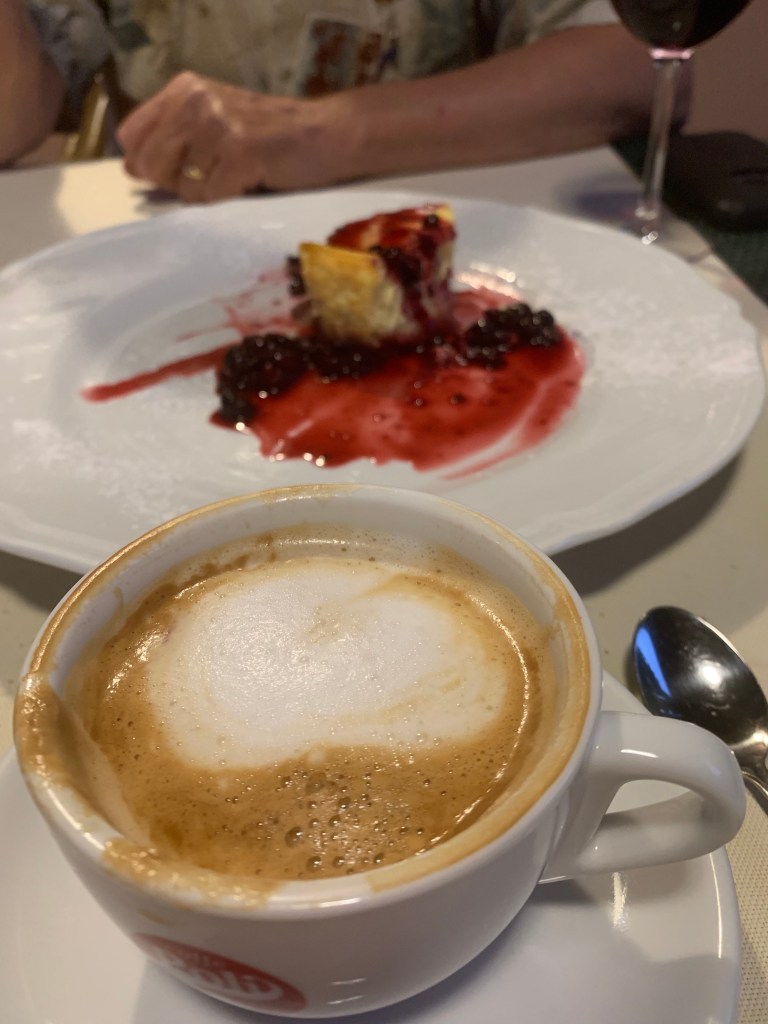
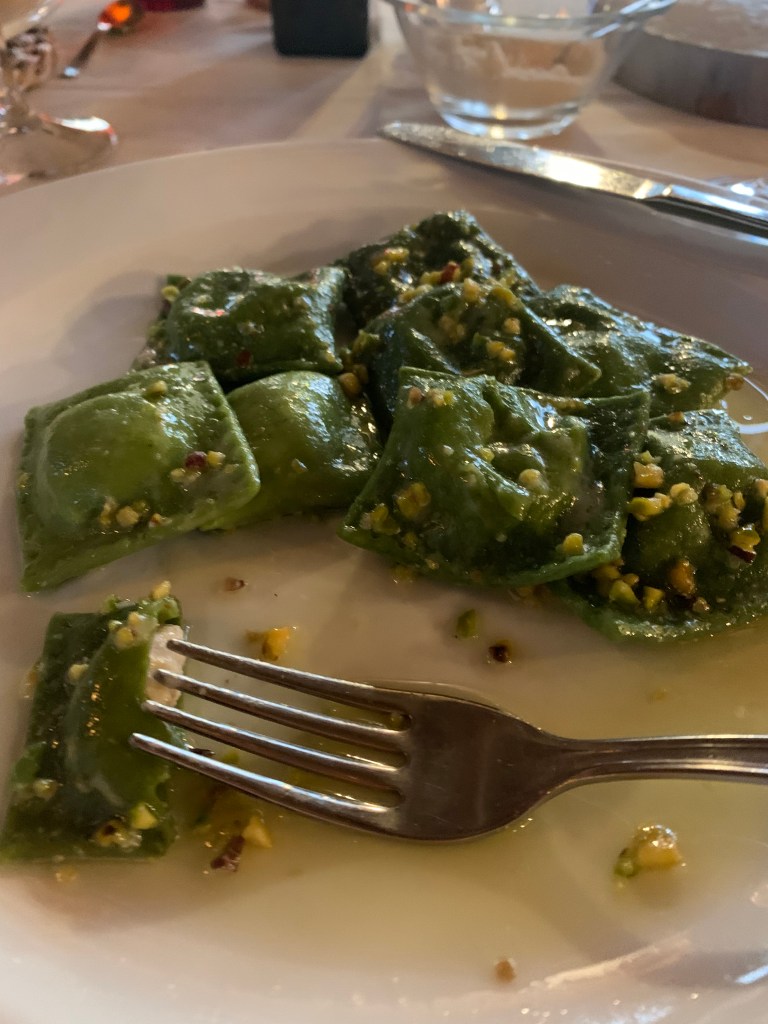
I couldn’t resist having the raviolini with green pasta and pistacchios again. This time I had is for my main course and had steak tartar for my “primi.” Unlike in Matera where the meat was served in ultra-thin slices, here it was ground and shaped like a burger and accompanied by pungent mustard and bits of watercress. Santo repeated his lamb chops from the night before, and ordered the cheesecake with berries for us to share.
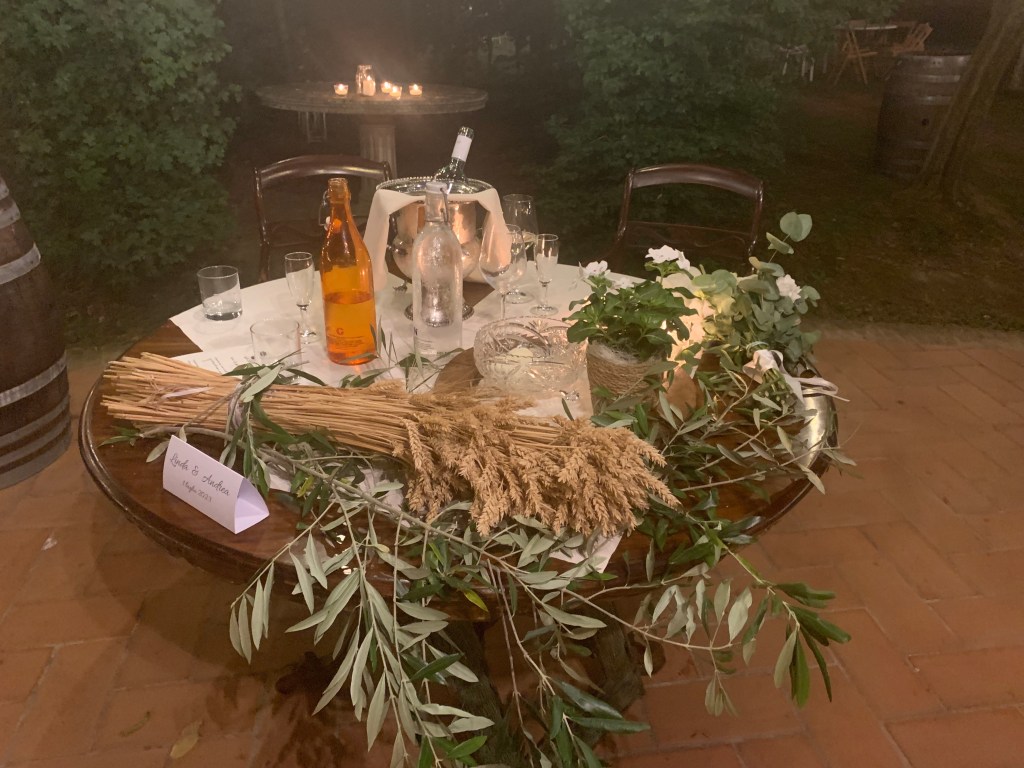
After dinner, we made our way through the tables of wedding guests (the only way to get outside), and went for a stroll in the vineyard. We ran into Lucky and a few peacocks along the way. The DJ’s music from the wedding accompanied us. On the way back through the weddijng reception, we saw the bride and groom’s table.
We continued to be serenaded as we settled in for the night. There were a few traditional Italian songs which had everyone singing along, but most of the music was American rock-and-roll and R&B. When I glimpsed out the window, I could just make out the bobbing heads of some of the guests on the dance floor. Promptly at midnight, as promised, the music stopped.
Breakfast was at a long table in the hotel’s cave restaurant. After packing up, we took some pictures of our cave home, then began the walk back up to the Piazza di Venedetto and our car. With the directions from the hotel, we hoped it would not be as bad as we imagined from our trip down. We took a winding road that sloped gently upward for about ten minutes. Then we hit the stairs. Thank god for my cane! Carrying our bags made the trip particularly arduous. One foot in front of the other, I keep saying to myself. By the time we reached the top, I was dripping. At the garage, I collapsed in a chair while we waited for our car.
Within two minutes of leaving the stones of Matera, we were in the country! Fields spread out on both side of us as we made our way towards Bari and from there to our route north along the Adriatic to Faenza. We gasped at our first glimpse of the Sea. I had always heard of “the blue Adriatic” and now I knew why. Aqua turning to blue, clear and inviting. Lush green hills curved down to the sea. At the places where two hills met in a rounded V, the blue water filled the space like tea in a verdant tea cup. The expansive blue stayed with us for hours, peeking in and out of hills and villages.
For lunch, we stopped in Vasto and found a small café with outdoor seating. The walls of the courtyard were stark white decorated with tropical trees and flowers. At our shaded table, I enjoyed what I had been craving: linguini and clam sauce! Beautiful little clams in brown and white shells!
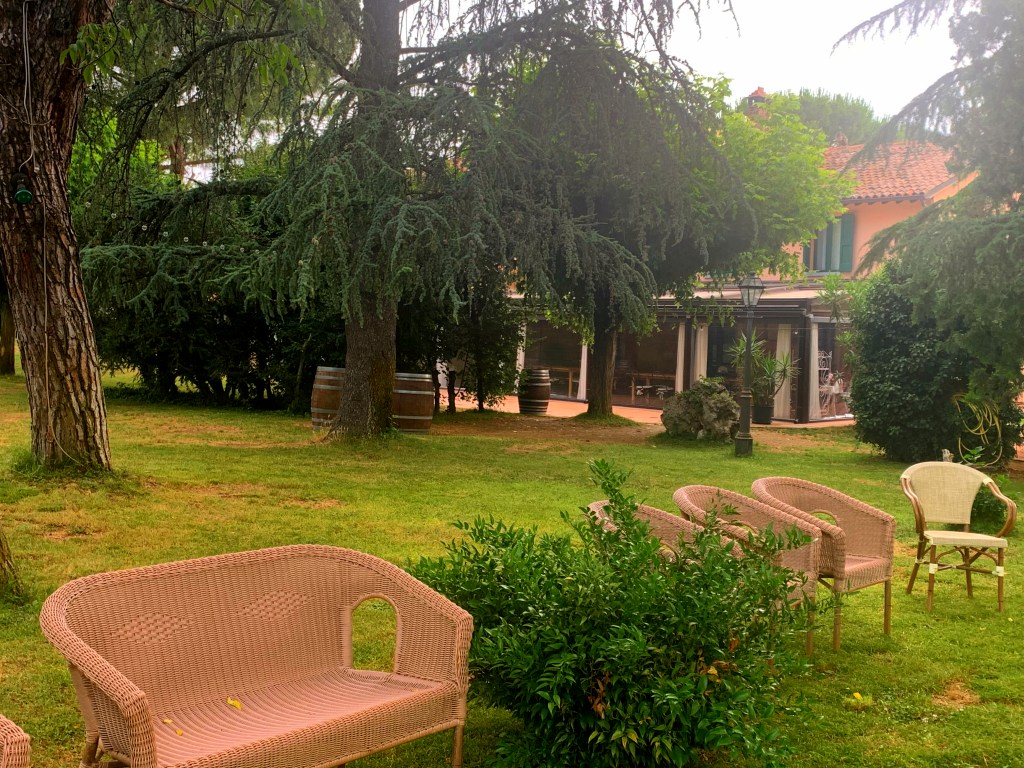
About 30 minutes from Faenza, the road veered inland. Vineyards and orchards lined our route, becoming close as we drove the narrow roads to our Agriturismo: Trere, a vineyard of hundreds of acres. In the middle of the vineyard was the villa/farmhouse that would be our home for two days. Along the light salmon stucco façade was the restaurant: heavy wooden tables in various shapes and sizes, red terra cotta floor and beamed roof.
Our room was upstairs: Rebianco, named after one of the wines made by Trere. A king-size bed made up of two twin beds with heavy dark wooden headboards anchored the room. A dresser and armoir with hanging closets on both side and drawers in the middle, matched the bed. Around the mirror in the bathroom were painted white Italian tiles. While Santo napped, I packed my overnight bag from our large bags in the car. Then I changed into a dress and leather sandals for dinner.
The highlight was my raviolini: homemade green pasta filled with ricotta and top with chopped pistacchios. The cheesecake with cooked berries wasn’t bad either! While we ate, the resident peacocks strolled outside and the resident cats wove in and out of our legs, ever hopeful. Our hostess checked on us several times. She someone reminds me of my old friend Virginia, not so much in looks but in her energy, her warmth, her humor, and her boundless hospitality.
After dinner, we made our way to the brown wicker chairs scattered on the grounds and enjoyed the gentle evening breeze. Less than 30 feet way, grapes ripened on the heavily laden vines.
Left Auburn at 8:30 am leaving Viktor, Jess, Bailey, Oscar and Fenway to take care of the house. Drove to Pompton Lakes, New Jersey, and left our car at my cousins Joe and Judy Messineo’s house (actually in the church parking lot next door). Uber to Newark Airport. Pizza and Chicken Parm at airport restaurant. Flight left a bit late of its 5:40 scheduled departure. Watched Gran Torino on the plane.
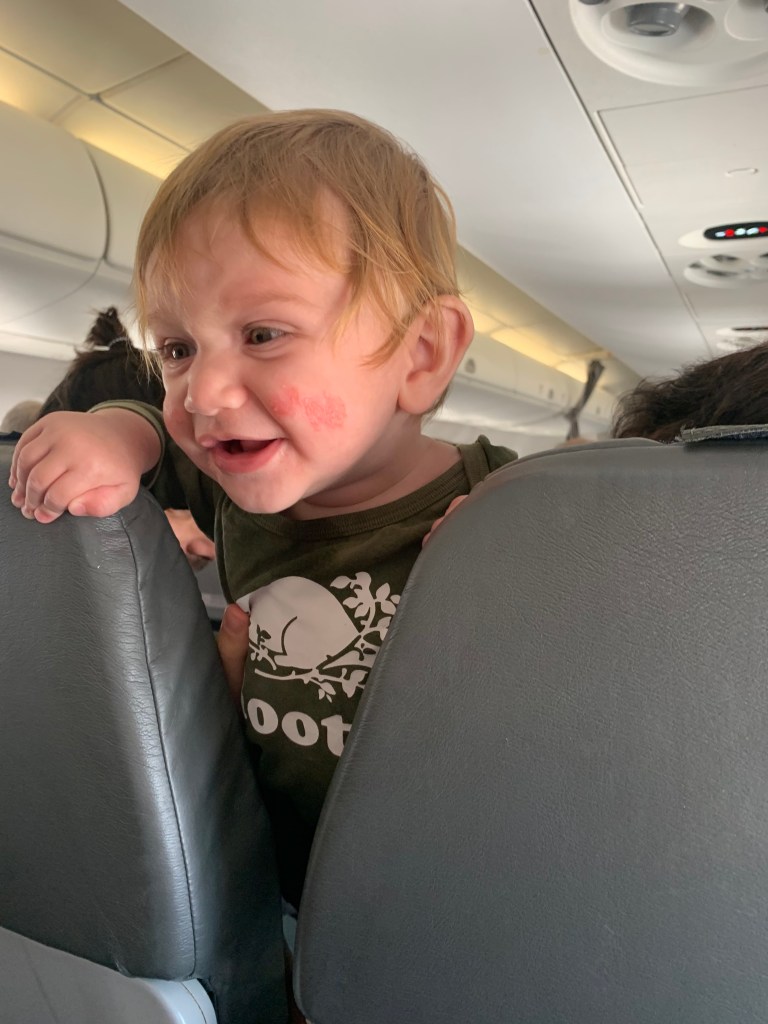
Our first friend of the trip—this little guy who was sitting in front of us. A perfect traveler who loved smiling. Great start!
Arrived Lisbon airport early morning. Less than one hour layover for flight to Naples.
Day 2 – Tuesday, June 27, 2023
Took shuttle bus to car rental area. Managed to get 58 pound overweight bag (charged $140 at airport for it) onto and off of bus. At Avis Rental, we were helped by the wonderful Angelo! Our second friend. He was extremely pleasant, funny, and helpful. They first had us in a car without GPS and we were going to have to pay 17 Euro per day for phone with GPS. But because we were dropping car off in Germany, couldn’t do that. Then we were going to get a GPS only unit for 14 Euros per day. But Angelo kept researching to get us a better deal and a better. He upgraded us twice as we waited and we ended up with a beautiful white Peugot wagon with built-in GPS.
Some early frustration trying to get out of Naples area. Santo was tense driving, I was trying to direct with a GPS I was still figuring out. Drivers were racing around us on both sides, honking their horns. Finally got onto the motorway where things were actually much saner and Santo began relaxing at the wheel—so much so that the car-lady kept telling him to keep his hands on the wheel. “Two wives for the price of one,” I said.
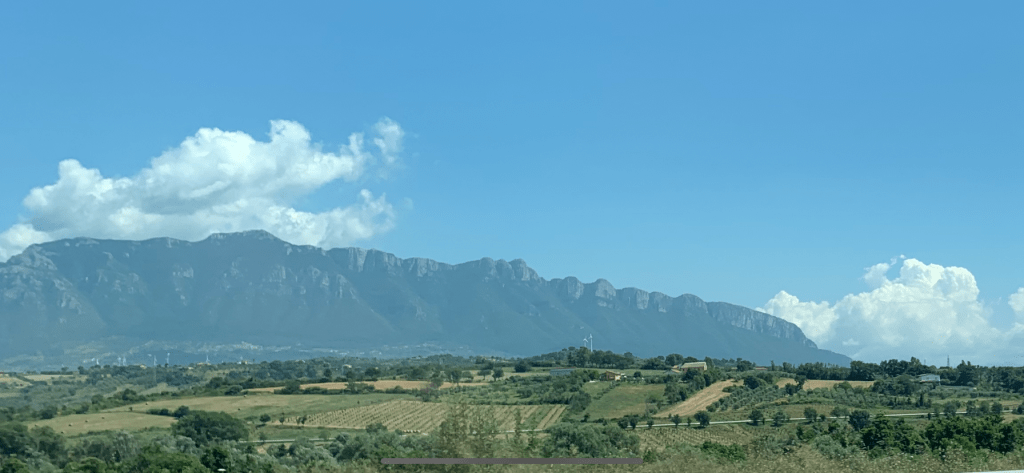
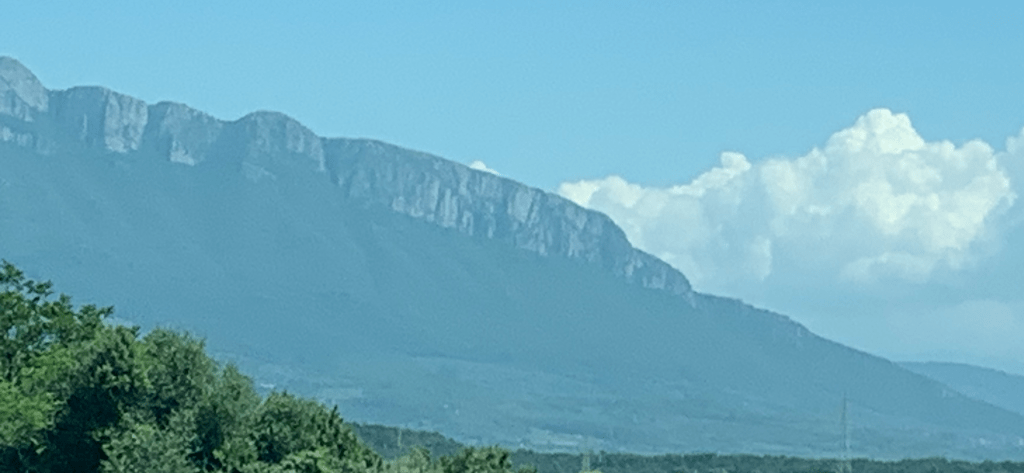
Heading east, we were quickly stunned by the magnificent views all around us. Steep mountain peaks, very close, very tall, green with dramatic rock formations at the very tops. Reminded me of the mountains at Zion Nation Park. The views just kept coming—deep valleys, dotted with red tile roofs, green and stone mountains, some scarred with quarries. “Marble?” we wondered. We went in and out of tunnel after tunnel, over bridge after bridge, going straight through the mountainous terrain. I had never pictured Italy like this. Not sure what I DID picture. But the majesty, the beauty, and the drama, combined with pastoral beauty, awed us for two hours as we made our way to Avigliano.
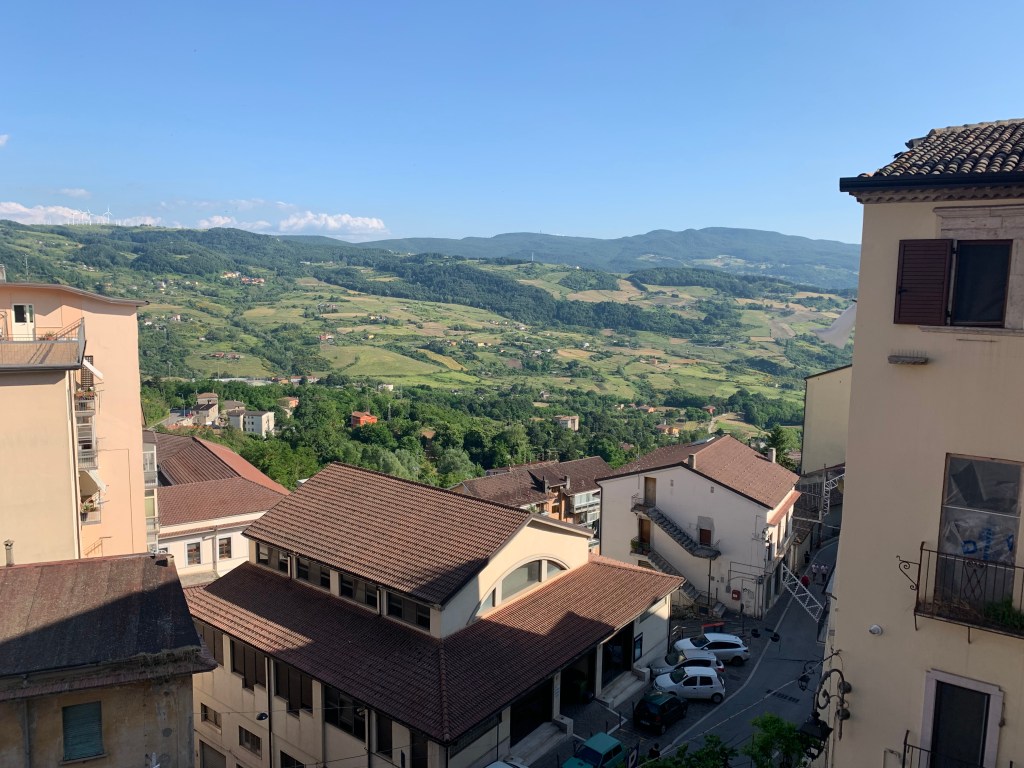
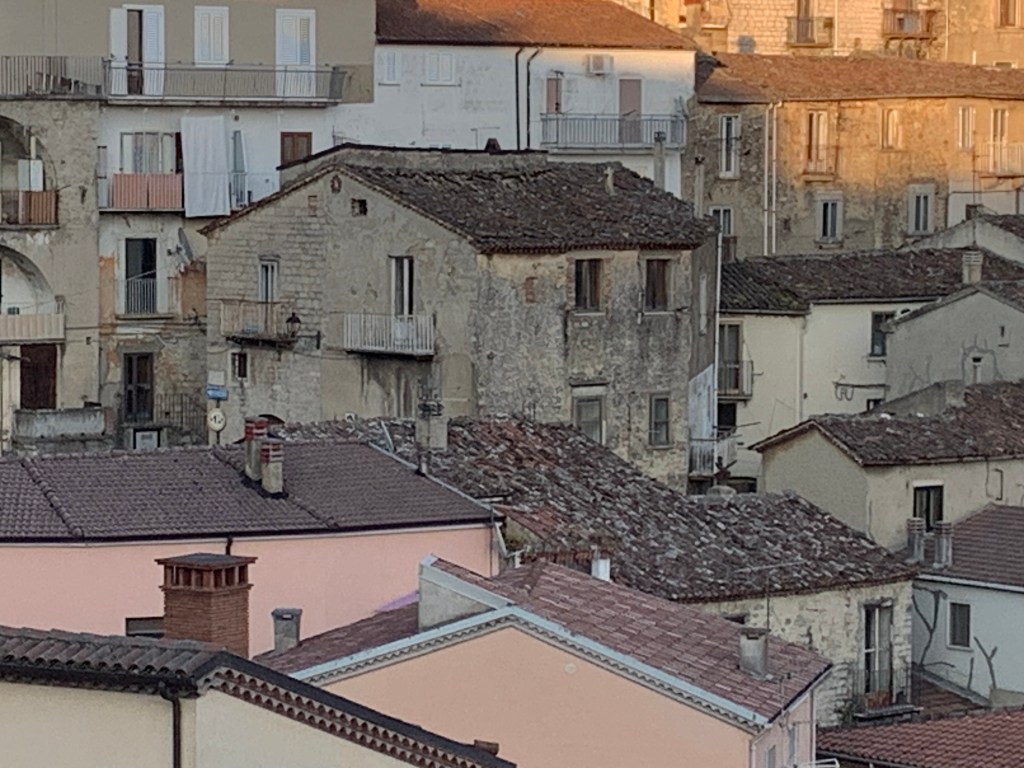
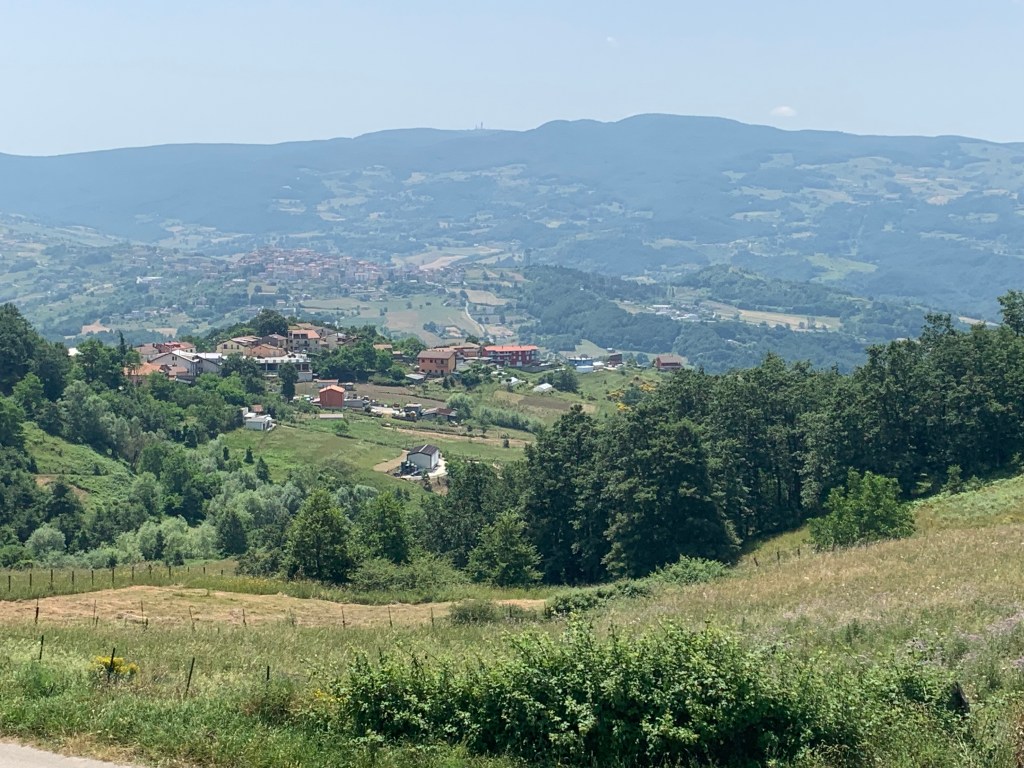
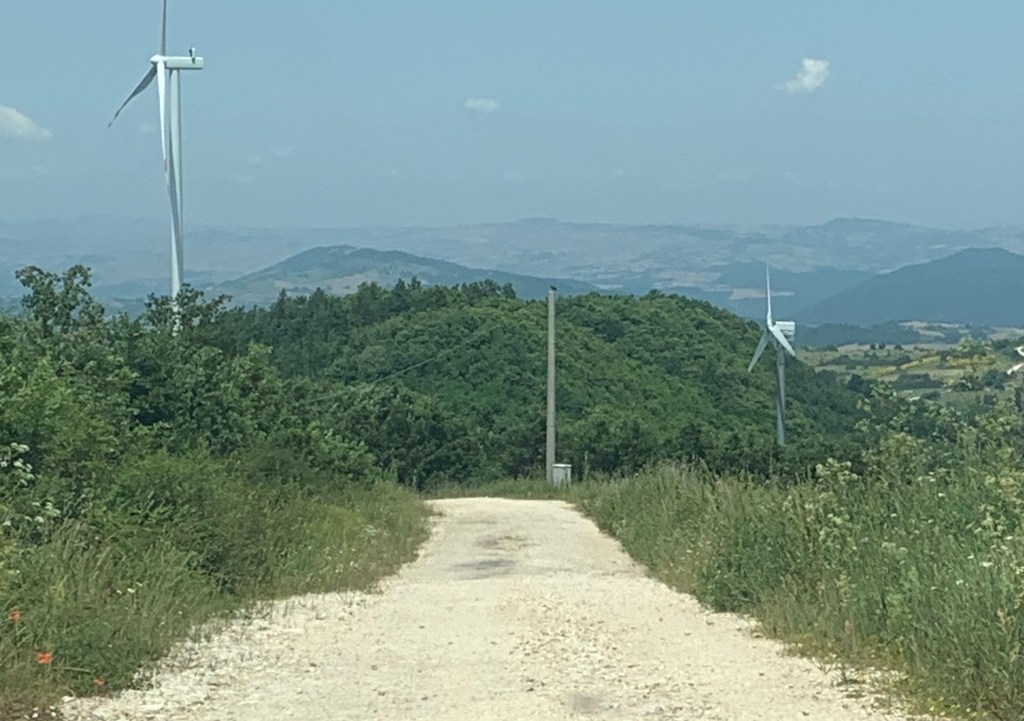
As we entered Potenza and approach the city of Potenza, the landscape shifted. The mountains, though just as high, rounded out at the tops and the valleys were gentler, dotted with more farmland—as well as probably hundreds of white wind turbines. At first they bothered me, ruining this beautiful landscape. But Santo pointed out that we could still see all the beauty. SO TRUE! It doesn’t seem possible, but the views got more and more stunning as we neared Avigliano. Once off the highway, we drove narrow, twisting roads to the town. At one point we saw a sign pointing to Avigliano on the right, but the GPS told us to go left. We followed the GPS for another 12 km or so and arrived in a small rural area with a few houses. On the street where our B&B was supposed to be, we searched for the name: L’Arco Once Bed & Breafast. There was nothing around that look like any kind of business, except for a small bar with tables outside at the corner of the road. We pulled over and called the number I ad for L’Arco. A woman answered. She spoke no English. I spoke no Italian. We could not understand one another. It became increasingly frustrating, though she was trying so hard to figure out where we were and how to help us find them. Finally, I hung up, since it seem useless to stay on the line. We decided to go into the bar to ask for directions. The old men sitting at the outdoor tables looked at us curiously as we went to the door on the right. Inside, there was a woman behind the counter. She didn’t speak Enlish. We pointed to the address of L’Arco on my confirmation. Then a man came over and they spoke to one another in Italian, then to us. “No, no,” they said. “Non Avigliano. Possidente. Non Avigiliano.” We manged to understand that Avigliano was about 12 km away.
We had been travelling for over 24 hours, were exhausted, hungry, and desperately thirsty. Back in the car, the woman from L’Arco called us back. Her husband had Google translate on his phone and we were trying to understand what he was saying. Santo said he thought the man was coming out to meet us. But we were 12 m away!!! We hung up again, and decided to use the GPS on Santo’s phone, instead of the one in the car which couldn’t seem to locate the ACTUAL L’Arco. Santo had data on his phone; I didn’t (that’s another story!). He was able to locate the address and we started again for Avigliano.
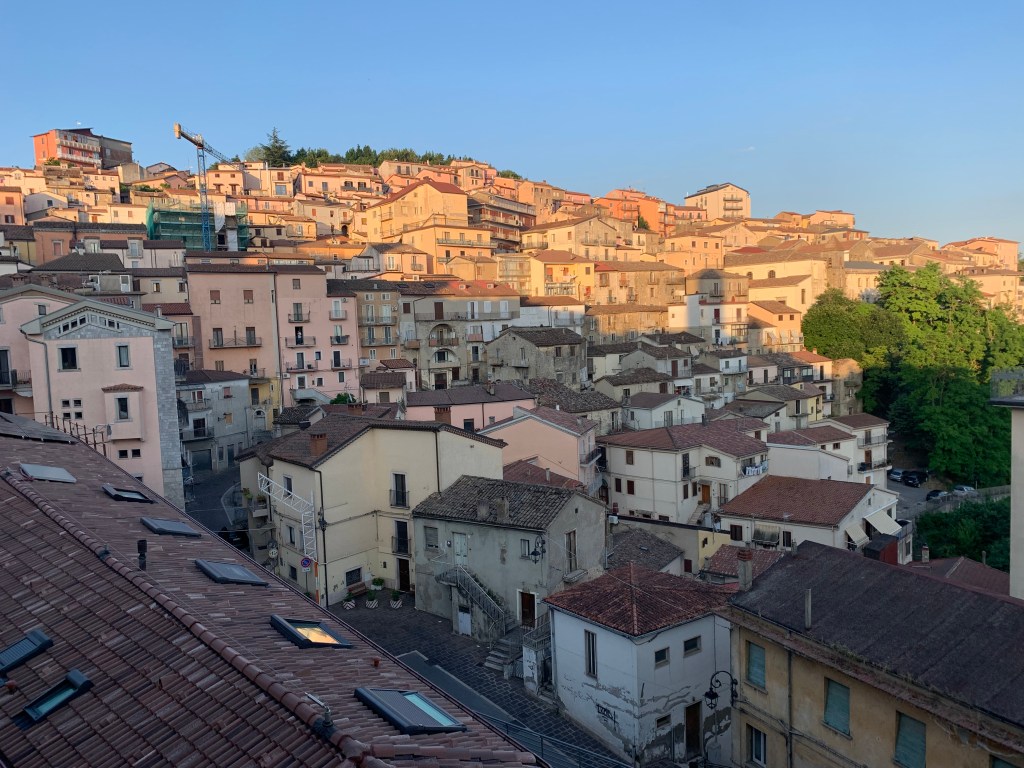
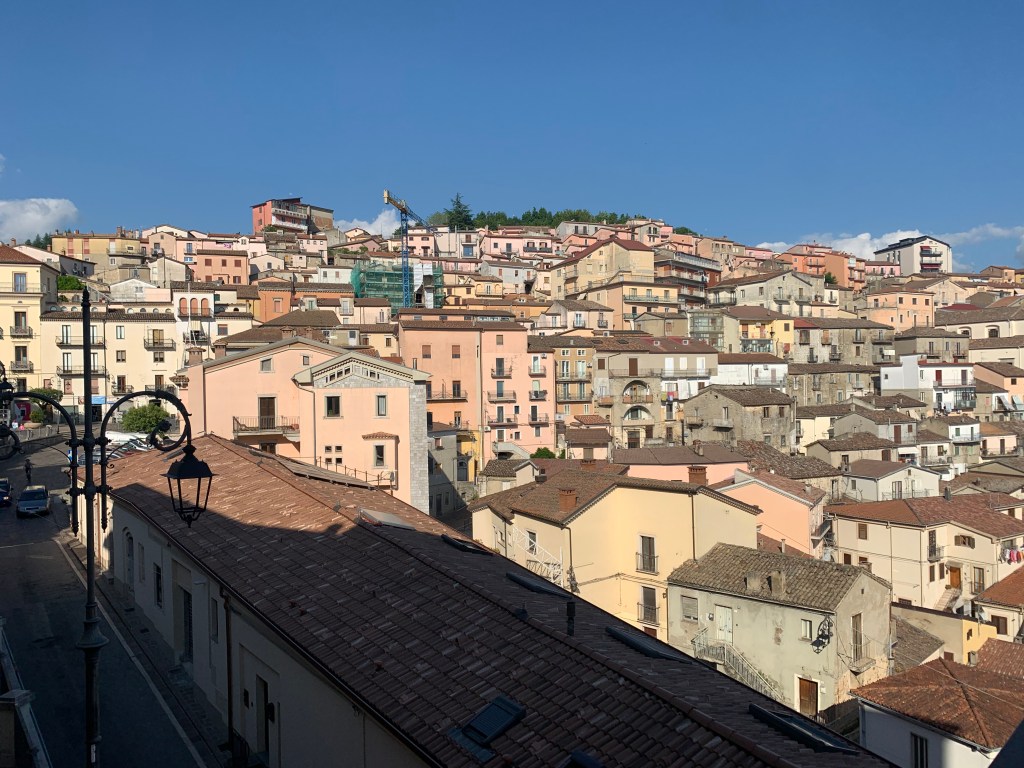
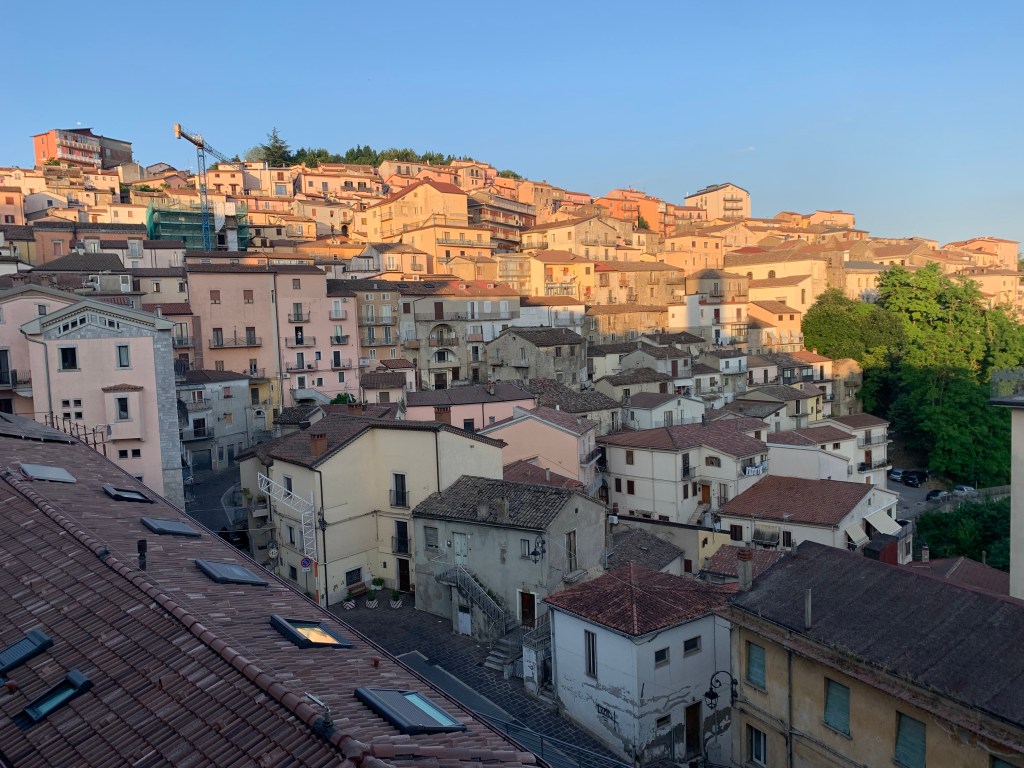
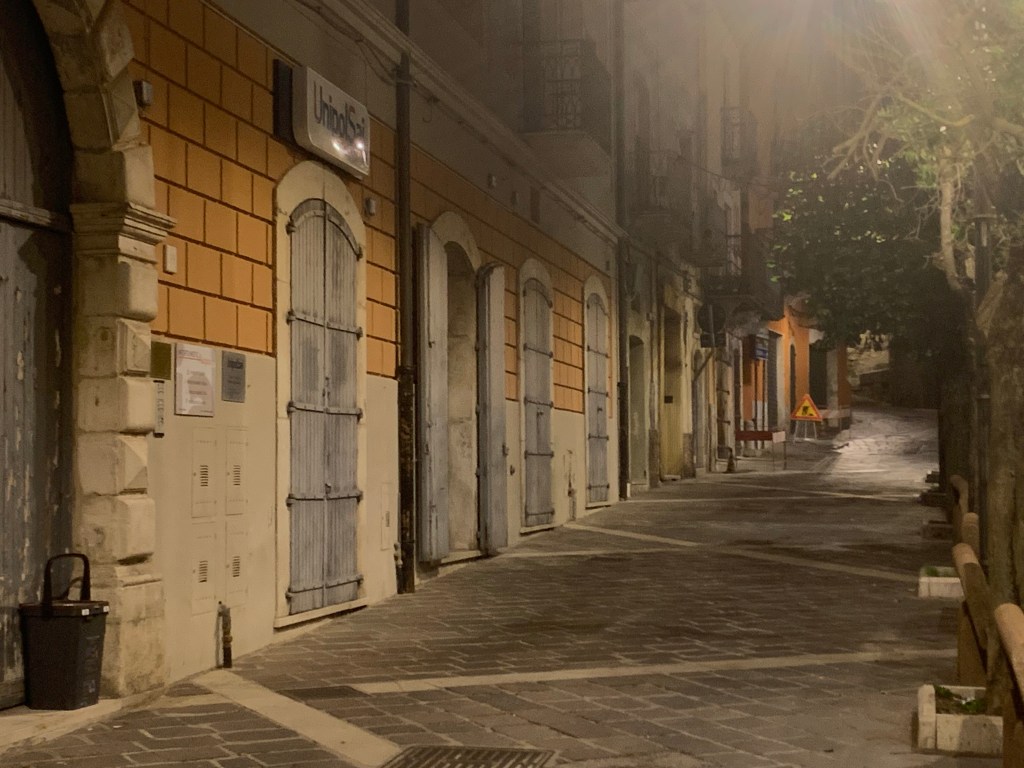
Once in the town, we took narrow, twisting roads with many hairpin turns as we scaled the mountain to near the top. At the town square—a cobblestone area with a statue of Emanuele Gianturco, tables and chairs, benches, one store, and one coffee shop—the GPS told us to turn left. Where it told us to turn looked like a sidewalk, cobbled-stoned just like the square, and I shouted at Santo, “Stop, that’s not a road.” “I think it is,” he answered. “See the benches are facing towards the square.” “OK,” I said, still hesitant, as he turned. Indeed there were cars parked ahead of us on this “road.” A man approached as we neared the end where an arched portal blocked our path. It was the owner of L’Arco Bed & Breakfast waiting for us. He pointed to a place where we should park—very small, and Santo had to get so close to the stone wall on his left to keep the car out of the roadway that he could barely get out. We had to set the cardboard clock dial on the inside of the windshield to the time of our arrival (17:00). We could leave the car til 9 am, then we could re-set the dial to 9 and stay one more hour (all parking in the town during the day is 60 minutes only).
Our host lead us through the stone portal, up a small incline to the B&B. Rosaria, his wife, was waiting for us inside and immediately got us both waters, which we needed desperately. We managed to communicate that I wanted sparking water and Santo still water. We sat in the small breakfast area trying to communicate with our hosts. We had decided to go to dinner right away since we were so hungry, then just crash after dinner for the night. We ask them to recommend a restaurant and they offered to call for us. “Si,” we said. “Grazie.” When they were on the phone, I knew they were asking us what time we wanted and we tried to say now. I remembered the word for soon: “presto.” But the first reservation was at 8 pm (20:00). OK. We’ll rest a bit first, then go. The restaurant is a short walk from the B&B.
Finally we were alone in our beautiful room—large, clean, “minimalist” room with large bed, sofa, desk, armoir, all in white, beige and brown. There was a lovely bathroom all in marble with walk in shower and bidet. And two balconies overlooking the hillside town on one side and a lush green mountain on the other.
We took a minute to take it all in, then we crashed. It felt SO GOOD to have my body lying down. It had been about 27 hours since we left Auburn. We set the alarm for 7:40 and both slept until it went off.
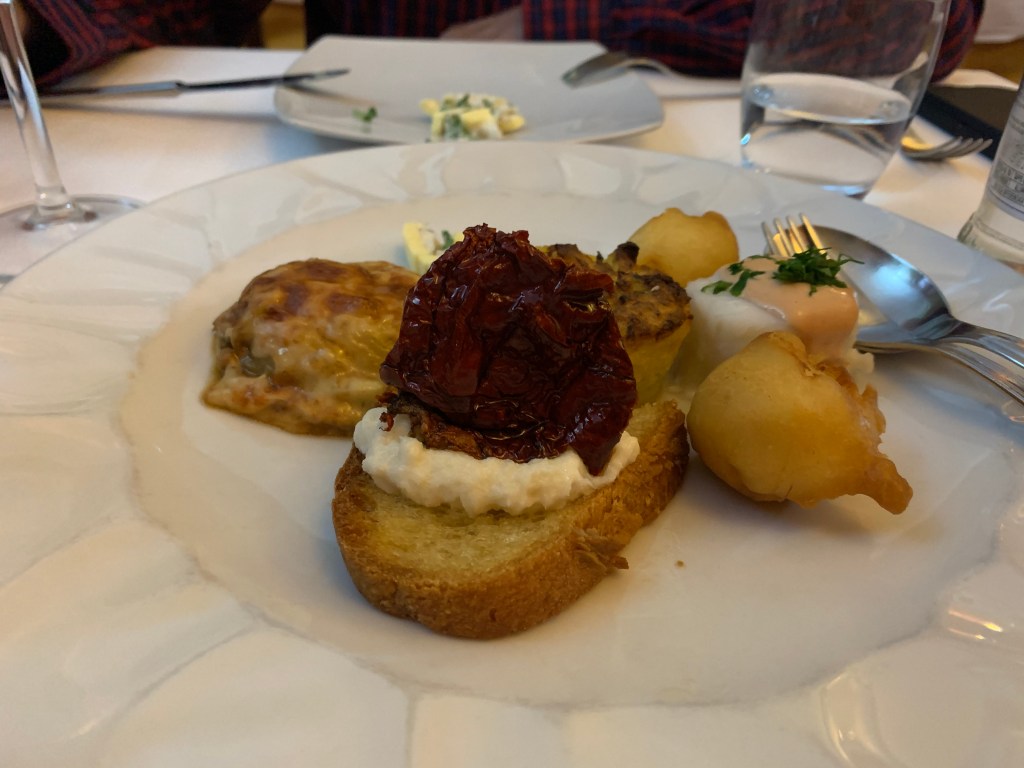
We walked to the restaurant—Osteria Gagliardi. We asked for a table inside, though there were several people sitting at the outside tables. When they realized we didn’t speak Italian, they get the waiter who spoke the best English and he was very helpful with the menu—and everything else. Pietro made recommendations for food and wine and explained everything as best he could. Apparently, baccala (cod fish) is the specialty of Avigliano (odd since it isn’t on the coast). There was baccala in everything: appetizers, pastas, entrees. I was surprised it didn’t show up in the desserts. The appetizer he recommended had five different items—all with baccala. Then we each had a pasta dish. Mine was homemade pasta with a mushroom sauce. The past was very heavy and the sauce rich. I think too rich for me, because my stomach started to hurt, even though I had taken a Lactaid. By the time our entrée came, I really didn’t feel like eating. I didn’t have any of my baccala dish (plain baccala with a dried pepper on top), but had some of Santo’s pork dish.
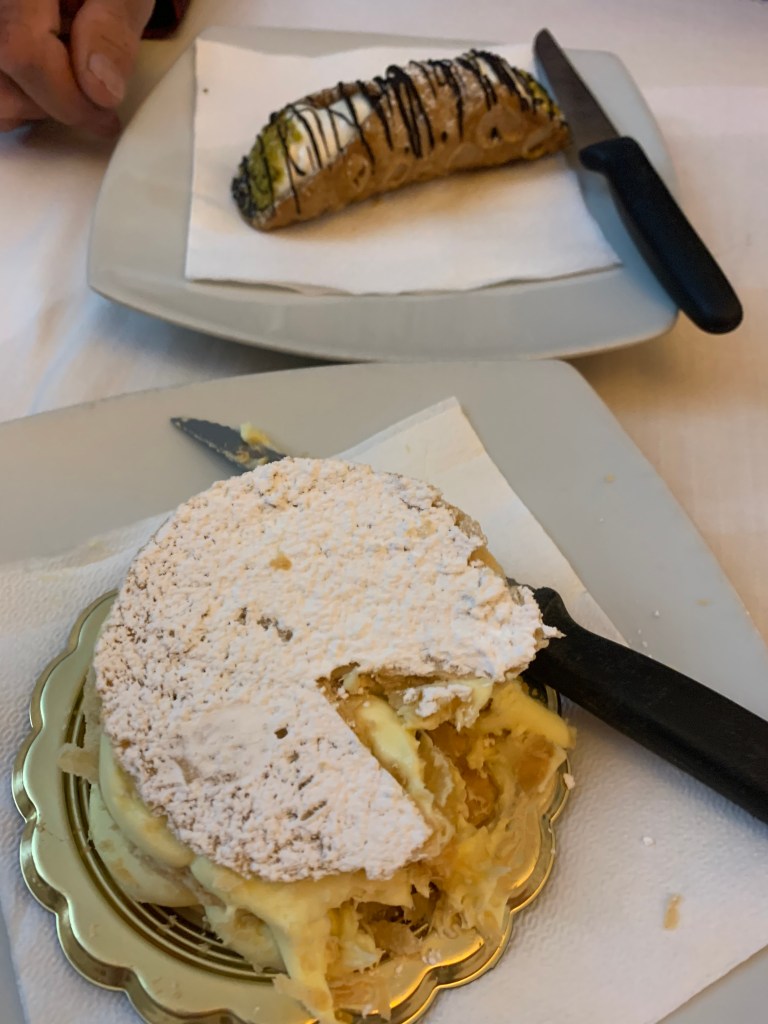
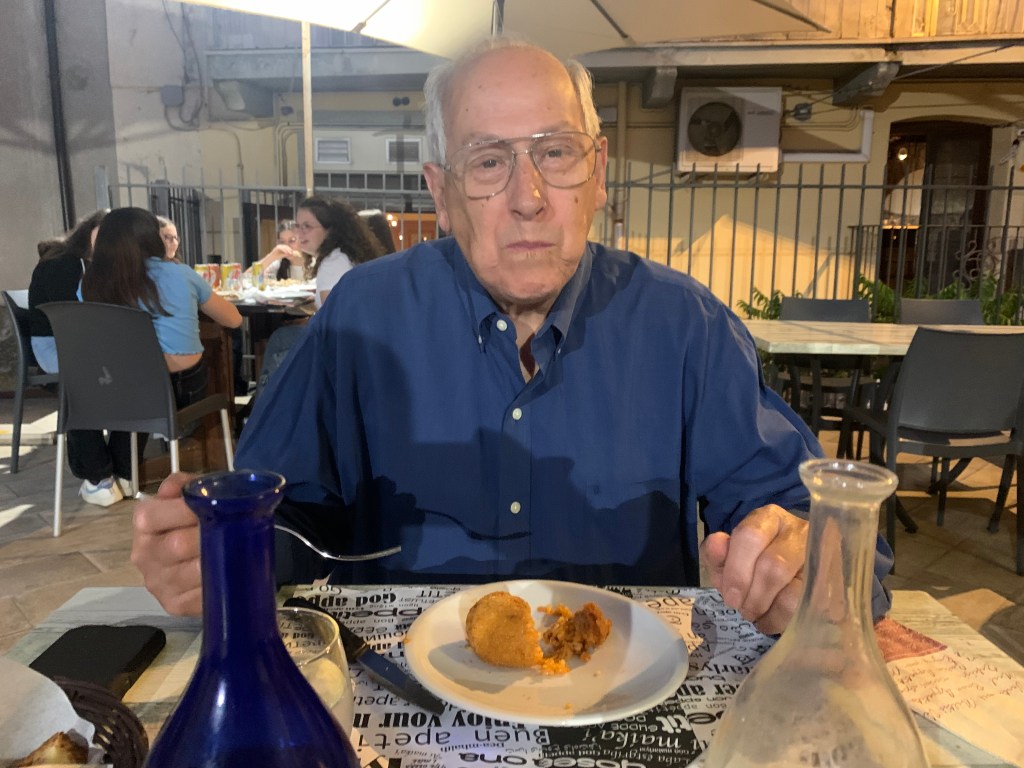
Unbelievably, Santo wanted to order dessert. Probably because they were only 2 Euros each! We ordered a cannoli and Mille-feuille (what we would call a Napolitan). I can’t believe I had some of each—they were just too good. But we did take half of both home, along with the other food we didn’t finish.
As we were leaving, we talked a bit with the owner, and Pietro, and said how great Pietro had been. We talked about my family being from here, that my name was Mecca, and we thought the mayor was named Mecca. It took a while (and Google translate) to communicate what “mayor” was. Pietro didn’t know if that was his name, but he went in the back to ask someone for us. We didn’t know that was what he was doing, so we left. He came out after us to share the information that, indeed, the mayor was named Mecca! He also told us he was not working the next day, but would be working Thursday. We felt he wanted us to come back. Our third friend.
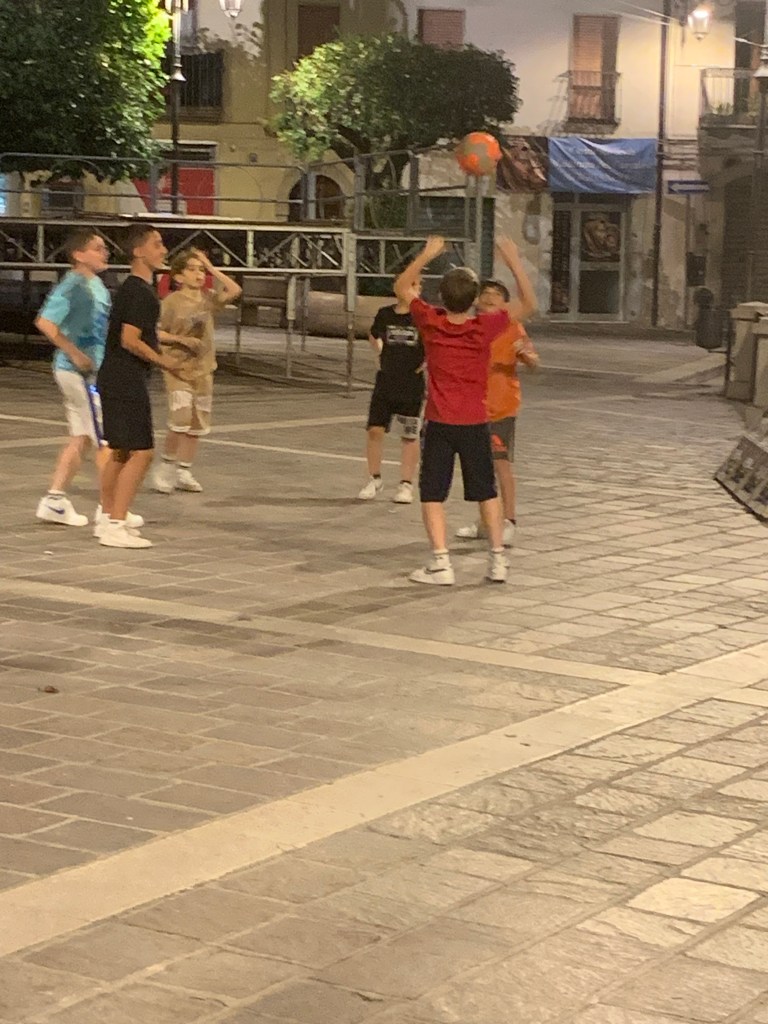
On the walk back to our hotel, we stopped to sit on a bench in the cobbled square. A group of boys were playing some made-up game with a soccer ball, a source of endless fascination for Santo. I thought it was cute how much he enjoyed it. I think it reminded him of his own childhood.
Back in the room, Santo went straight to bed. I wanted to figure out why I didn’t have any data, though Santo did. I called Spectrum and was on the phone with them for probably 45 minutes with no luck fixing the problem. Frustrated. Also, my computer would not connect to L’Arco’s wifi. Another frustration. I had no internet on my phone or computer. I was in withdrawal. And I wanted to check several things for the trip. Went to bed frustrated and feeling stupid. No maps, no Google translate, no internet for anything. I read for bit, as tired as I was, and finally was able to sleep.
Day 3 – Wednesday June 28, 2023
Didn’t walk up until after 9 am but felt pretty well rested. Got a shower—ahhhhh! and dressed in fresh clean clothes. Checked out the beautiful day from our balcony, then we headed to breakfast. The B&B had given us vouchers for breakfast at the little coffee place on the square where they sold espresso and pastries. We each got a croissant and coffee, mine with warmed milk that I poured in myself. The croissants were filled with a delicious lemon filling and were flaky and fresh. I continued trying to connect to the internet and continued to be frustrated. I knew I needed to move on, but it was hard. Santo had reset our car clock to 9, so we needed to leave by about 10 am.
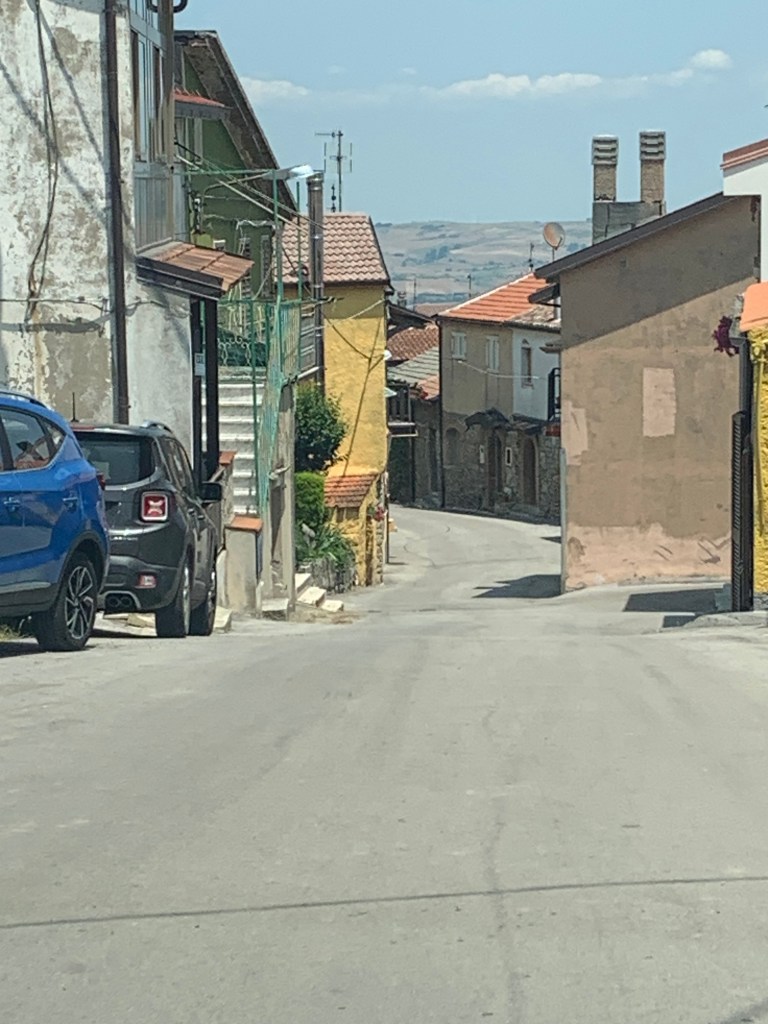
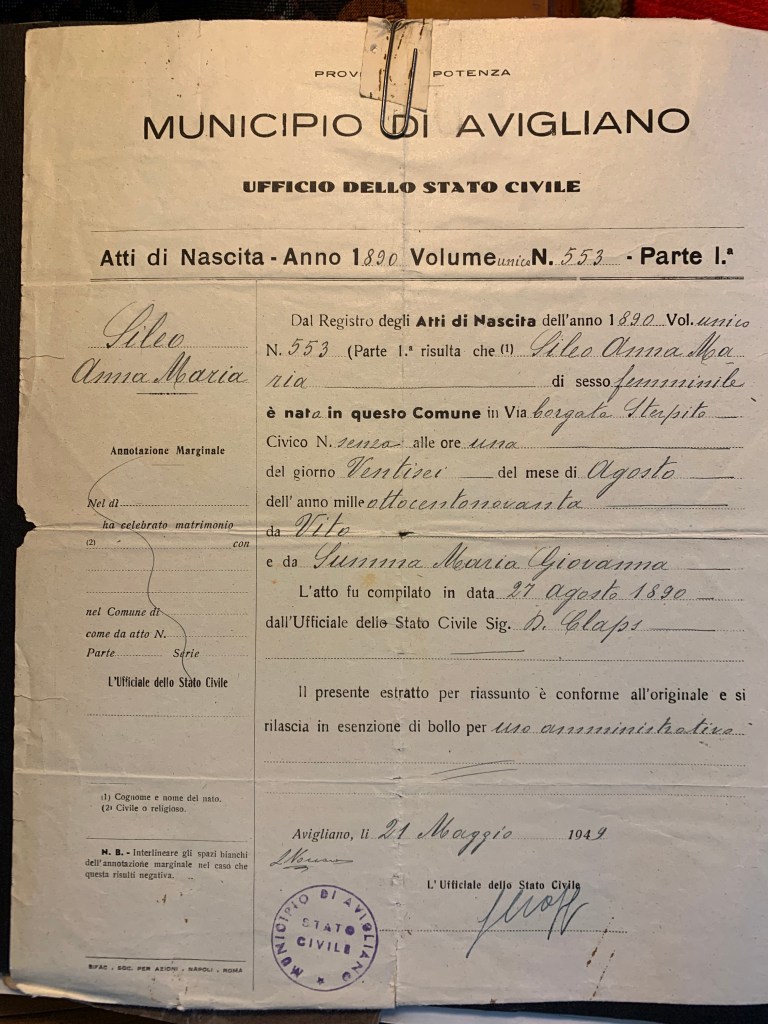
Our destination for the day was Sterpito, the “township” that appeared on Grandma’s birth certificate. It turns out there are two Sterpitos—Sterpito di Sotto and Sterpito di Sopra. We set the GPS first for Sterpito di Sotto. We wound up and down the mountains, beautiful views on all sides.
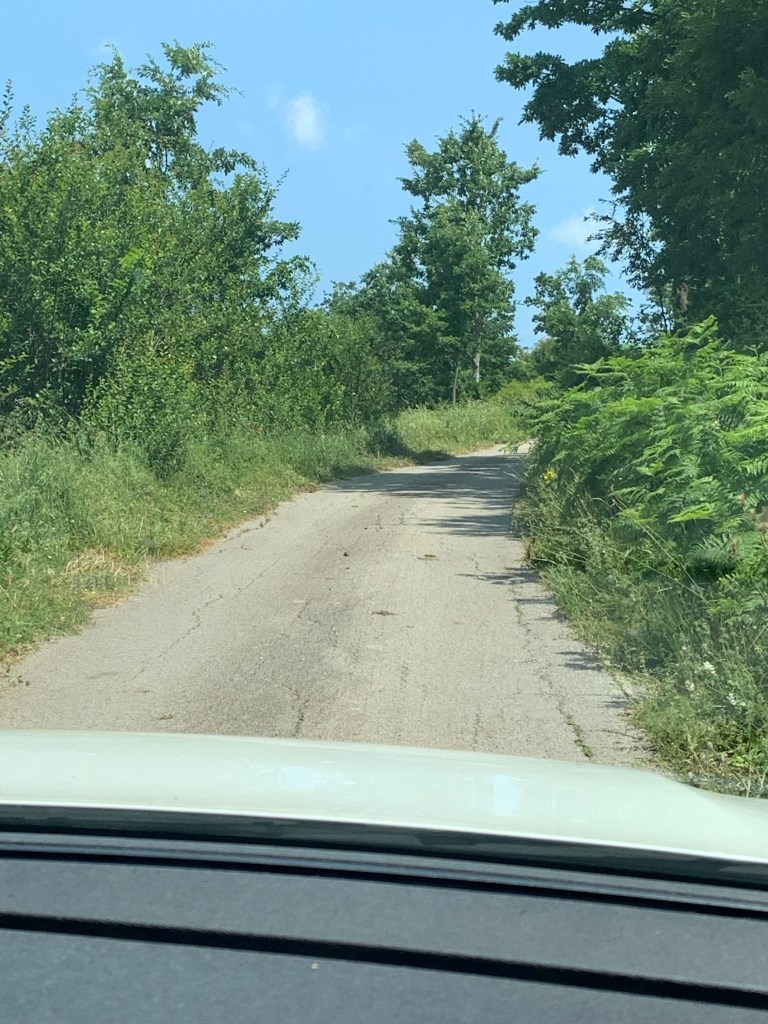
The roads got narrower and twistier as we drove, eventually turning to gravel and dirt. One road was dirt with grass growing in the line between the tires, deeply rutted. Suddenly the road seemed to just end. We thought maybe it was just taking a sharp downhill turn, but when I got out to look, the road was just gone—there were a few stones showing where it had collapsed, probably decades ago, and then just tall grasses and weeds. The road was so narrow there was no way to turn around without getting stuck in the mud on either side of the road. So Santo had to back all the way up to the turn. Not wanting to go back the way we came, we set our destination to Sterpito di Sopra instead.
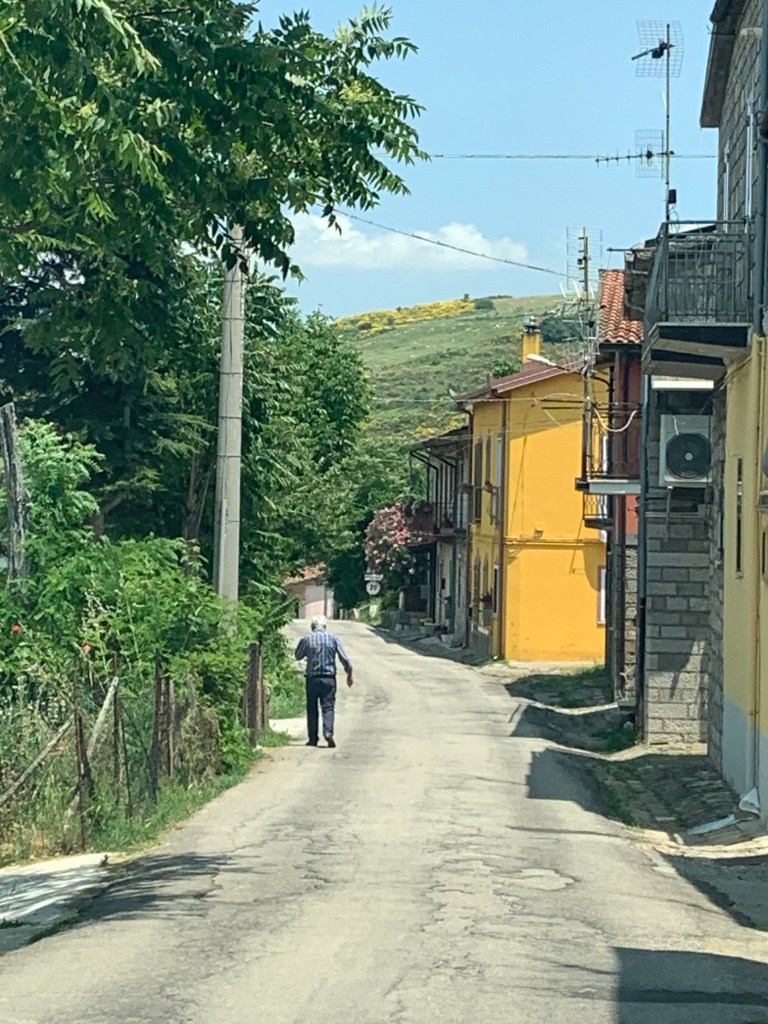
We were in rural country now. We saw two women with babushkas, one with a quad cane, walking up one of the steep roads alongside a field. They were carrying something, but I couldn’t see what. I was reminded of great grandma Sileo, who went up the mountain beyond Dunmore’s Hill Section to pick blueberries, then carried them in a large basket on her head into Dunmore to sell. No wonder! This is where she came from. She was used to climbing mountains.
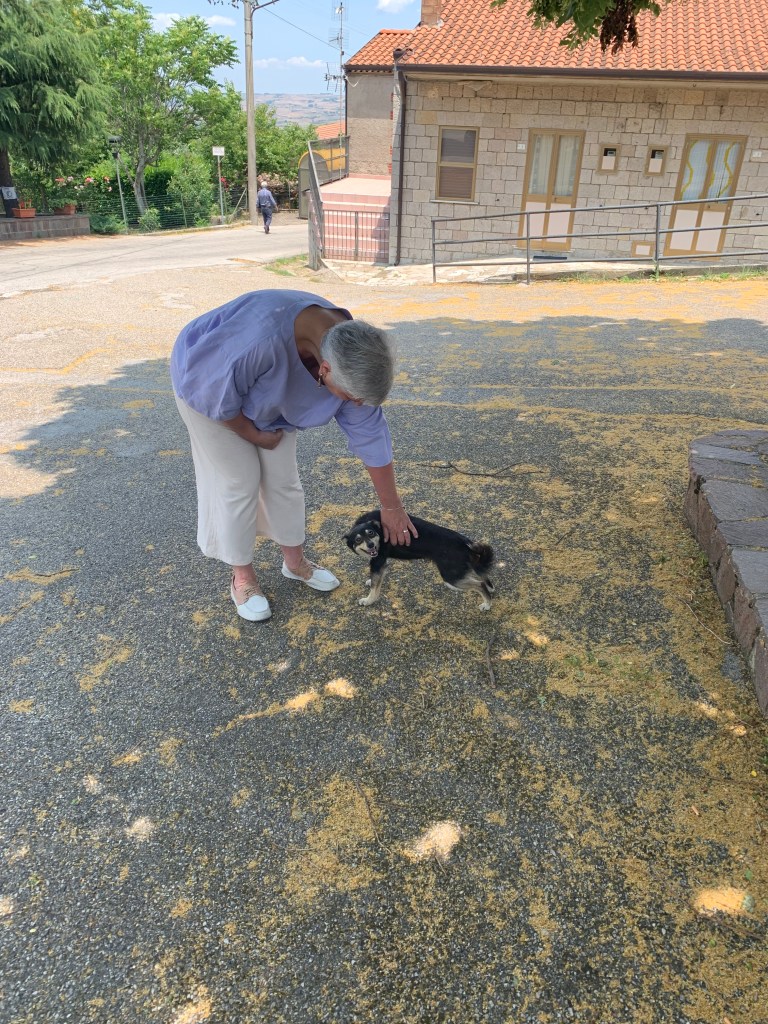
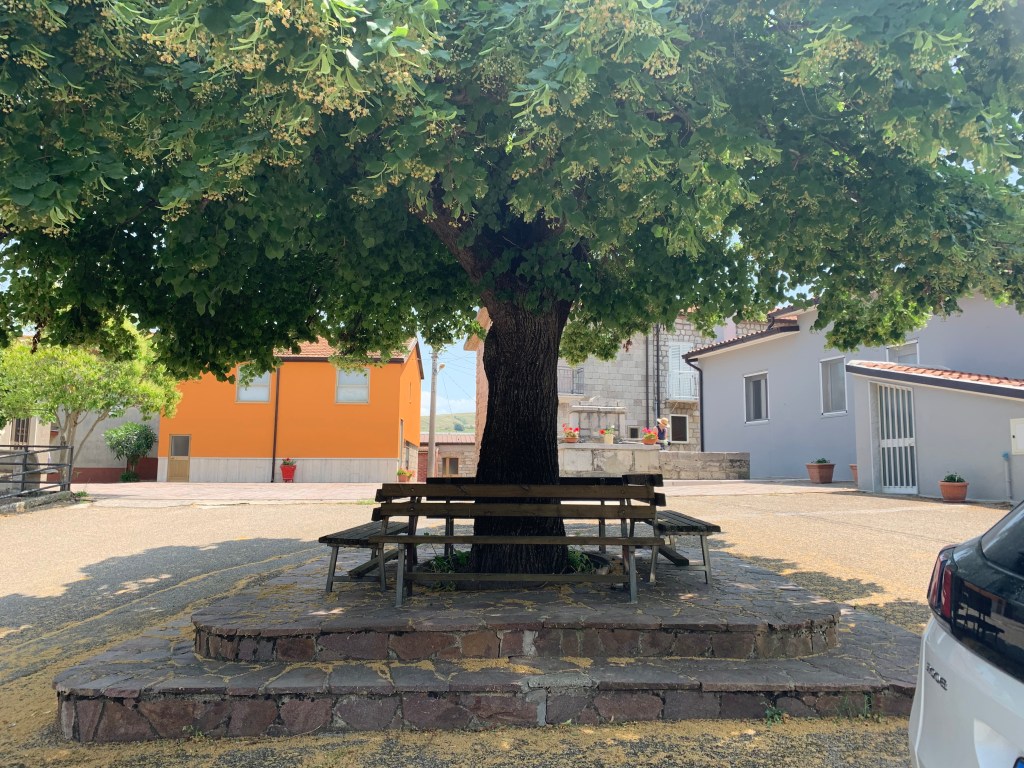
After a few kilometers of fields, with a few wooded areas interspersed, we came to the “location” in the GPS. It was a very small village square on the right. A very large broad tree shaded the gravel area. A few wooden benches circled the tree. A white-haired gentlemen was sitting on one of the benches and saw us park on the gravel near the road. I tried to work Google translate on Santo’s phone as we got out so I could talk to him and explain that my grandmother had been born here. A small black-and-brown (feral?) dog greeted us—so gentle and sweet. My fourth friend!
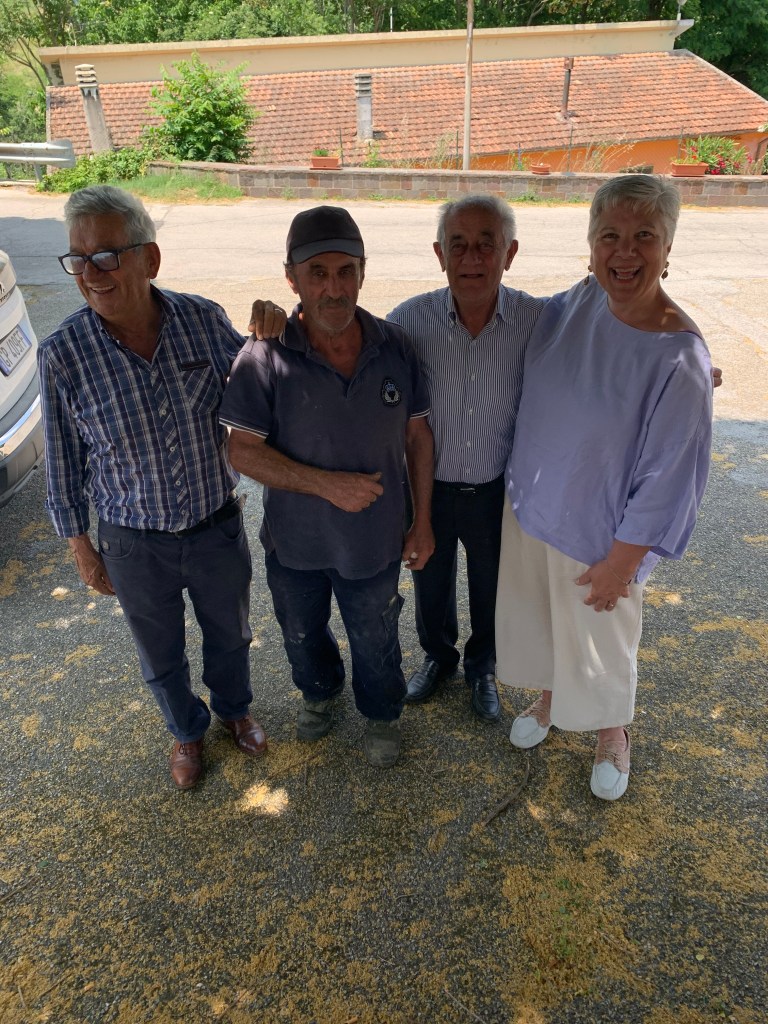
The man got up to greet us, coming to Santo first. Santo was trying to explain about my grandmother, then I tried. Finally I pulled up the picture of her birth certificate on my phone and tried to show him where it indicated Sterpito and Avigliano. Soon some other men came over—it seemed as if he had silently summoned him, or maybe they had just seen these strangers in the large Peugot talking to their friend. The first two men were in short-sleeved dress shirts. The third arrived dressed more in work clothes, looking like he had just come from the farm. We finally got Google translate to work in conversation mode and were able to have them them talk into it, then we would use it to talk back. I told them the family names—Sileo, Summa, Mecca. Sileos, they seemed to be indicating, came from Meccadinardo in Filiano, about 5 km away. But Mecca! Two of the men were Meccas! And the third, the farmer, said his mother was a Mecca. He left for a few minutes while we continued to talk to the other men. When he came back, he had in his hand a light brown egg. He handed it to me. A gift. It was warm. “Fresh,” he indicated in Italian. I think he had gone and plucked it from beneath a roosting chicken. Before we left, I asked if we could take a picture of all of us. We stood while Santo snapped the picture. “Familia,” I said. “We’re familia.” They smiled, some with toothless grins. “Grazie! Chiao! Grazie!” was all I could said as I took my egg and headed back to the car.
Friends five, six, and seven.
Driving down the road after setting the GPS to Meccadinardo, we drove past the first man walking on the left side of the road and yelled “Grazie” out the window one more time.
Before long, we saw the sign saying “Meccadinardo.” Just past the sign was a large open park with a playground, grassy areas, and lots of shade trees and benches. Our GPS still did not indicate that we had “arrived” so we continued. It was just trying to get us to the center spot of the town, a residential intersection. So we decided to go back to the park to figure out our next steps.
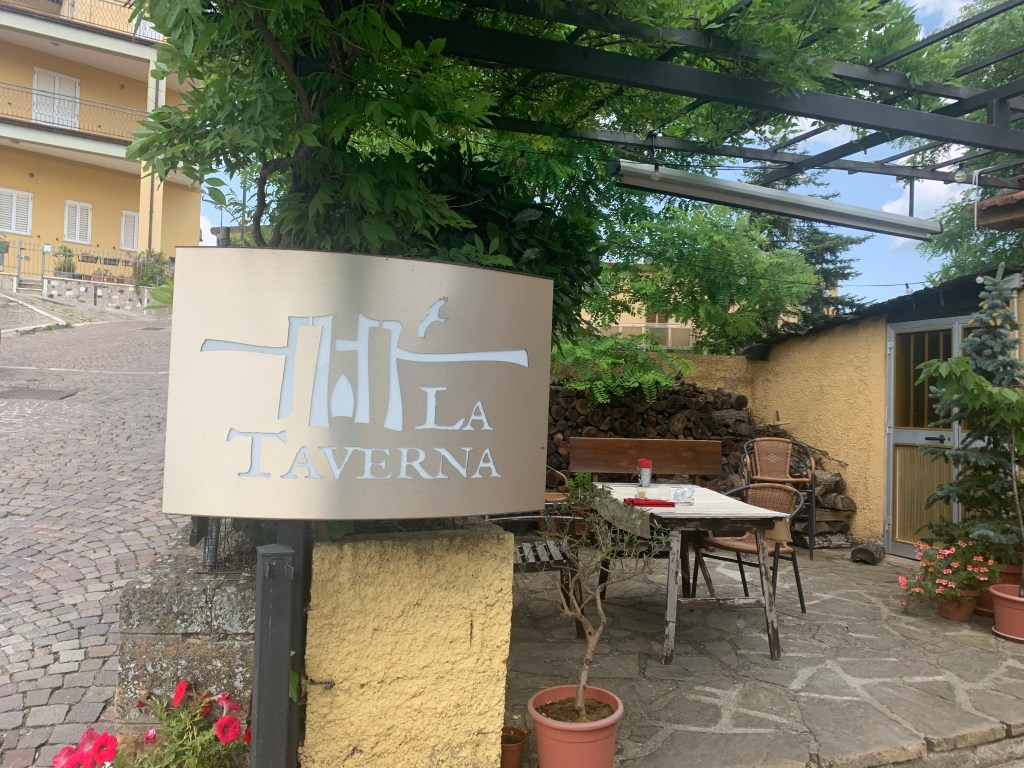
It was after 1 pm, we were hungry, having just had a croissant for breakfast, so decided to try to find a restaurant nearby for lunch. Santo located a place called La Taverna, which was in Lagopesole, on the way back to Avigliano. It was a short drive and we found the restaurant in a residential area and parked the car. La Taverna had some outdoor tables, all empty. A young woman with an infant was coming out the door on the left (what looked like a residence) and Santo pointed to the door on the right, asking if this was where we should go. “Prego,” she said, waving her arm to the entrance. She told us to pick a table. It was a little while before anyone came over, but in the meantime the couple at the next table struck up a conversation. The menu was via a QR code which Santo entered into his phone. The man did not know how to do this and came to ask for help. I tried to find the QR reader on his phone, or the App Store, but didn’t have any luck. Santo was going to show him the menu on our phone, but then the waiter came and helped them by describing the menu in Italian. We translated items using Google translate, then pointed to them on the menu. Learning from the night before not to order too much, we just each got a ”Secondi” and “Pane.” Santo got lamb chops, I got a pork dish with peppers and almonds. Both servings were large and delicious, and the bread was wonderful. We were going to get dessert, but realized we still had half our desserts from the night before in our room.
We continued to talk intermittently to the couple next to us, mostly on their initiation. The woman spoke a little English. I got up to go to their table so I could hear her better. They asked where we were from, told us where they were from (a town south of Salerno that was of archaeological significance and worth a visit). They seemed to just want to connect and I realized then that no one hated us because we were American and couldn’t speak Italian.
Friends eight and nine.
Leaving La Taverna, we headed back to Avigliano. I didn’t feel a need to visit the other Sterpito. I had already found Grandma here.
We went back by a different route with views of the mountainous area. We continued to be awed. It was almost 3:30 when we got back to Avigliano. We got near the hotel where we had parked before but there were no vacant spaces so we decided to drive around. Bad decision. After about an hour of driving around and around and around, up and up, then down one street that was so narrow, with cars parked on the sides, that we had to turn both mirrors in and I had to get in front of the car and direct Santo as he literally inched his way through. Harrowing. We were never so happy as to exit that street to an only slightly wider one. At one point when we were getting fairly close to the square again, the right turn we were supposed to make was closed! More driving around, with an increasing dread that we literally could not get there from here. Finally, we decided to drive away from Avigliano and try to enter the town from another direction. Miraculously, this worked and we made it back to the square. We decided we would just sit there and wait until a parking space opened. A truck was park near where we had parked the day before. Santo got out to talk to the workers around the truck to ask where we could park. It turned out they were leaving in 5 minutes and then we could take their large spot. They helped direct Santo into the tight spot. All the men hovering around the square were always helpful as we tried to maneuver our large vehicle. They always had buongiornos for us, and buonaseras in the evening.
Back in the room, Santo headed straight for bed. I was determined to figure out my internet issue with Spectrum, knowing only then would I truly relax. After 1 hour and 50 minutes on the phone with Spectrum trying one thing after another after another with no luck, I gave up. The girl, Tammy, had tried so hard and was so sympathetic. It was miserable and frustrating, but because of her it was not as awful as it could have been, even if she wasn’t ultimately able to help. My eleventh friend.
Once off the phone, I wanted to head to the square and sit outside with my computer. I had figured out that at least I could connect my computer to Santo’s hot spot so I could FINALLY do something on my computer. Santo wanted me to stay and lay down with him to be with me, and I felt bad, but I really needed to get out of the room and be on my own with my laptop for a bit. That, oddly, is how I relax. I spent the time enjoying the beautiful weather, the views of both town and hills, and the church bells. All while researching restaurants for dinner. I didn’t want to go back to the place we had been last night—just didn’t want more baccala, and something simpler. I found two pizza places. The one that looked better was a 17-minute walk but that could have been up and down hills. The other was only a 3 minute walk down the street where the Farmacia we could see from our hotel was. I convinced Santo to at least check it out before going back to the first restaurant, which is what he wanted to do.
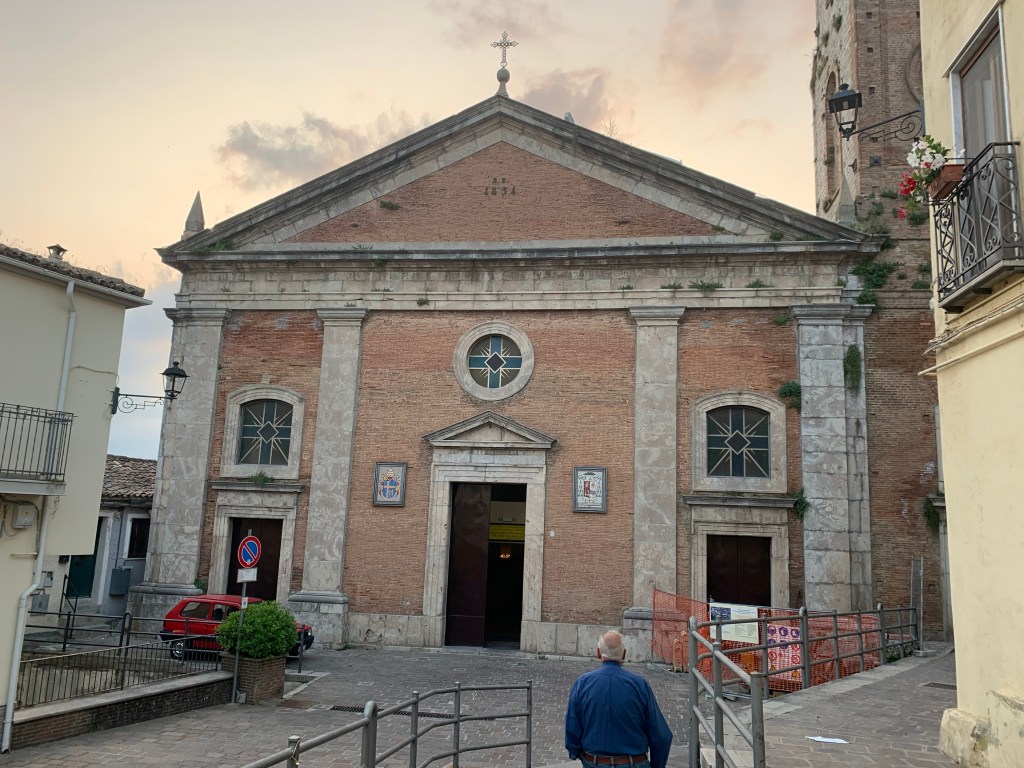
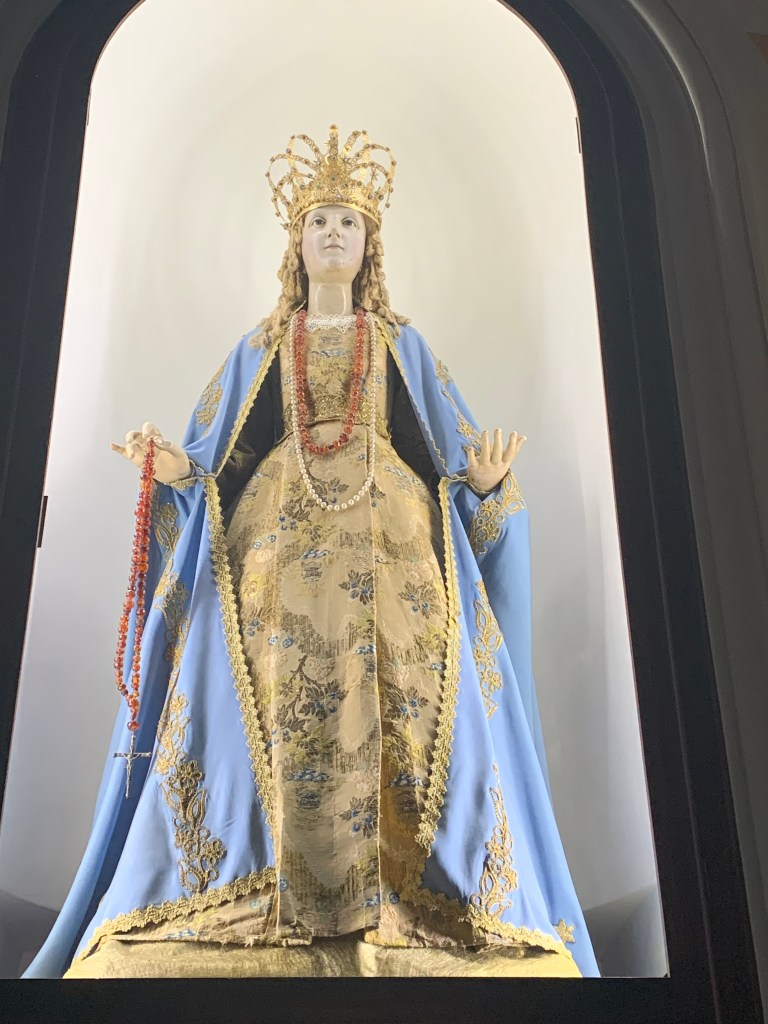
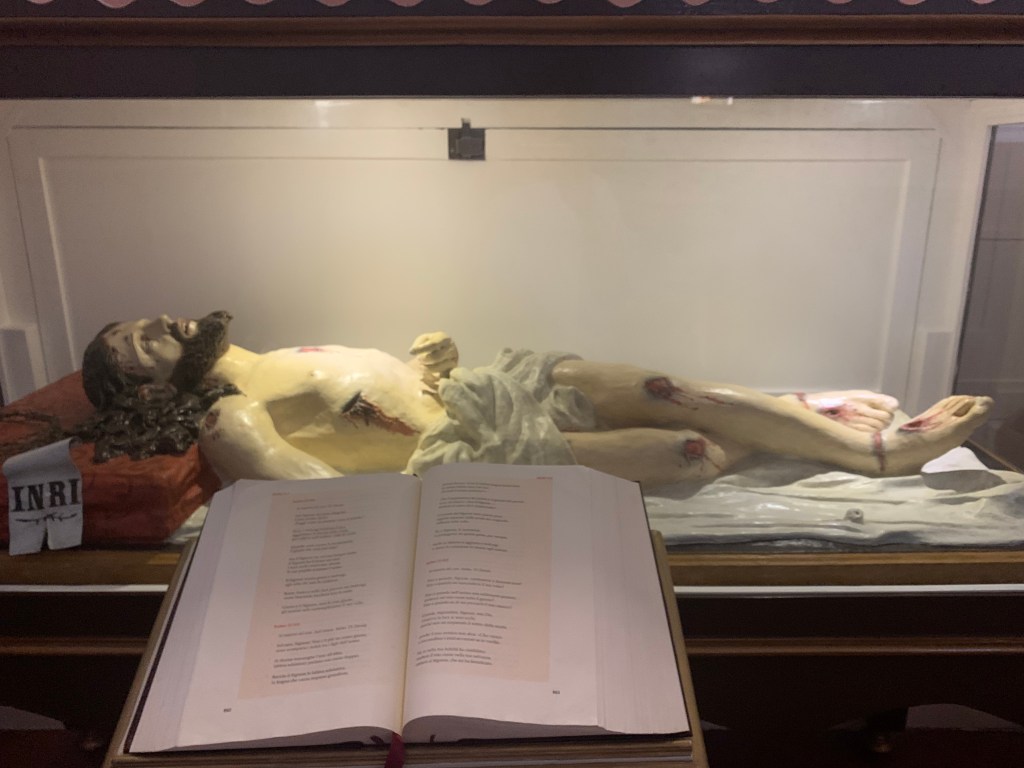
When we walked out of L’Arco, I wanted to turn left to go beyond the B&B where we had not been before. It was only a few steps to the corner, and as we approached Santo said, “There’s music. I hear music.” He followed the music around the corner and in front of us was the façade of a large church. That is where the music was coming from. The doors were open and we entered and sat in the back pew. The choir was rehearsing up front and the sound was just glorious. There were only twelve people, 9 women and 3 men, but the sound was that of a celestial choir. We moved closer and Santo was able to get a video of them singing. The church was ringed with gorgeous, ornate statues (why did the America churches remove all our statues?!). I knelt to say a prayer and started crying as I thanked my long-ago relatives from this place – for me! Then I walked around and took some pictures of the statues before we left.
It was close to 9 pm when we got to the restaurant. There was just a lighted sign on the sidewalk: La Strettola Pizzeria. We had to turn down the narrow walk on the left, then up some stairs to the restaurant. It had a large patio seating area that was very inviting. We decided to stay.
At the top of the stairs, I said to the waiter standing there, “Due. For dinner.”
“You are American?” he said in English.
“Yes,” we said. “You speak English!”
“Actually, English is easier for me. I’m from Argentina and know English better than Italian.”
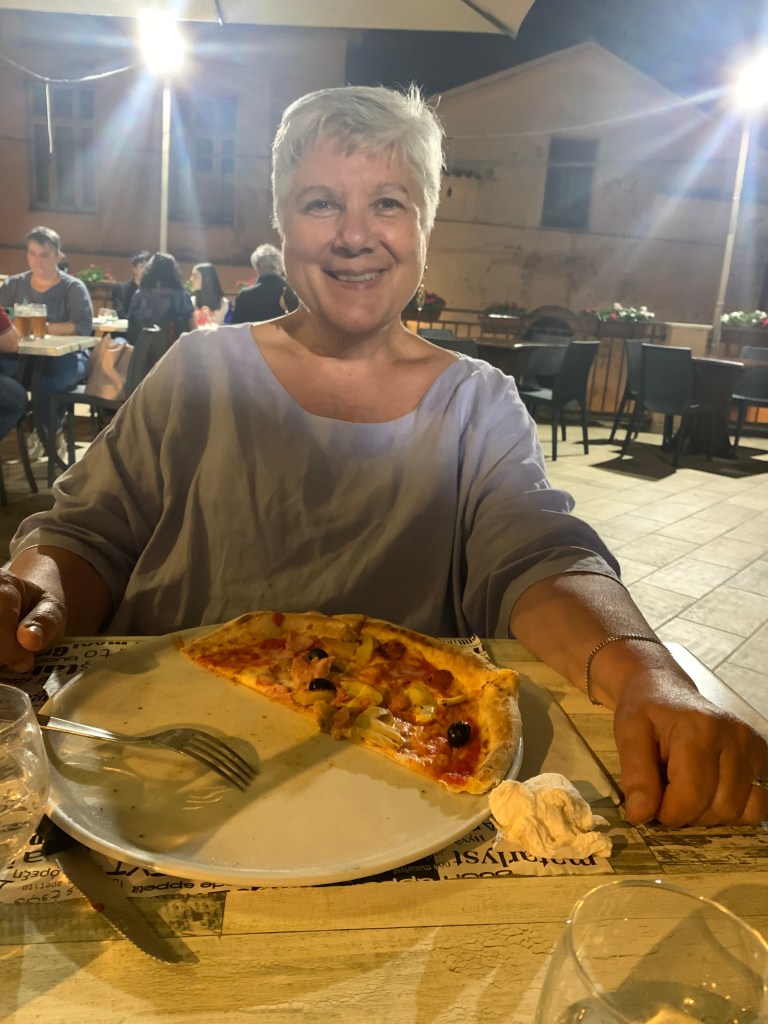
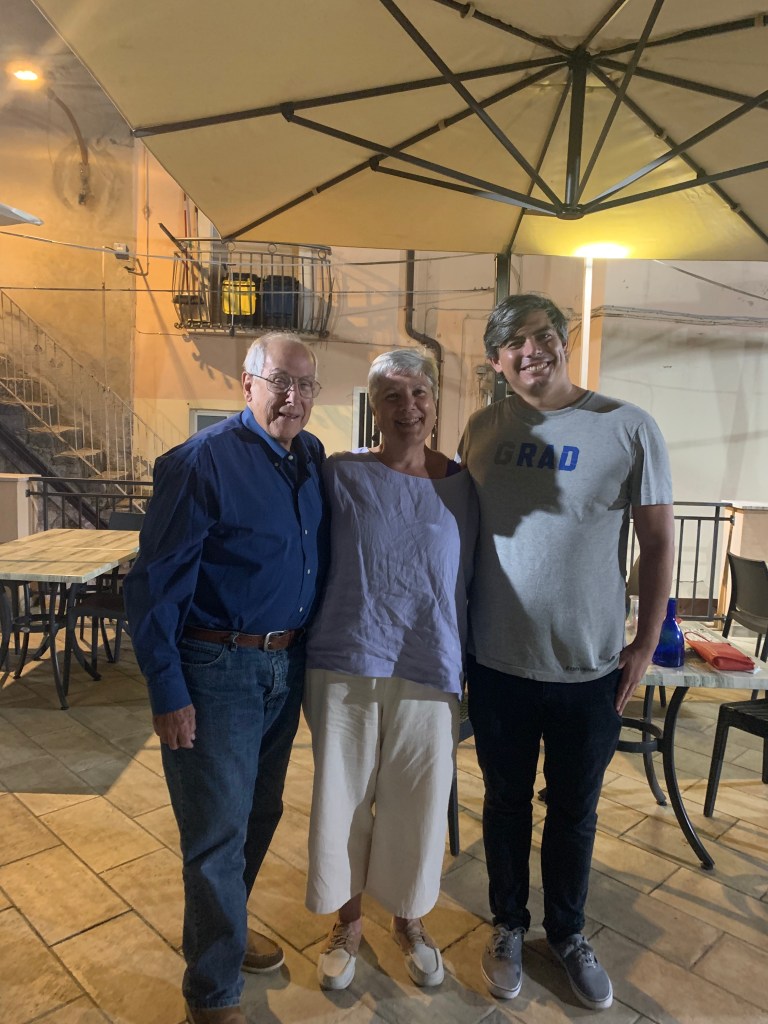
What luck! He was a young, handsome dark-haired man with a dashing streak of gray wearing a gray t-shirt that said “GRAD.” I think he enjoyed speaking to us in English as much as we enjoyed him. He helped us with the menu, at one point using his own Google translate to translate an Italian menu item into English! We both had salads (something green finally!) and a pizza with artichokes, olives, ham, and ricotta on a fabulous crust. We took 5 of the 12 pieces home. But we also ordered dessert. Santo got a pistachio souffle, I got a “gran limone” (big lemon) which was a real lemon filled with lemon sorbet. YUM! Gaston (like in Beauty and the Beast he told us), had relatives who had come from Italy and was trying to get his Italian citizenship so he could travel more easily in the EU. It expedited the process for him to live in Italy for a few months, which is what he was doing in Avigliano. His family was from a smaller village north of here, but there was no work there.
At the end of the evening, the owner came over. He also spoke English and we had a nice conversation with him. He was surprised we were driving. “In Italy?!” like we were crazy. Then he proceeded to tell us about a recent trip he had made to Bari and how crazy the drivers were. Before we left, we asked Gaston if he could ask the waitress to take a picture of the three of us. Then he sent me his phone number so could text him a copy of the picture. “If you’d like,” I had said. “Oh, yes, very much!” he had answered. Friend number twelve.
We made the short walk under a ¾ moon to L’Arco.
Three days. Twelve friends. Not bad.
Day 4 – Thursday, June 29
Another good night’s sleep. Breakfast in our little square. Felt strange to be there for the last time. In just 2 days, it had become “our” square. Had a double espresso with steamed milk and a sugared donut. Very light, like a Krispy Kreme but not as greasy. The day before, we had sent a message via Messenger to the mayor, noting that we had arrived and hoped to meet. I had communicated with him weeks before, and he said to just get in touch when we arrived. He answered later that afternoon asking where we were; we answered and asked when we could meet. Thursday morning, we still had not heard from him and kept checking Messenger as we sipped our espressos. I had sent a message at 9 am that we would be in Avigliano til 11 am if he wanted to meet us in the square. By 10:45, we were getting impatient to get on the road, so left for the 2-hour trip to Sassi di Matera, our next stopping point.
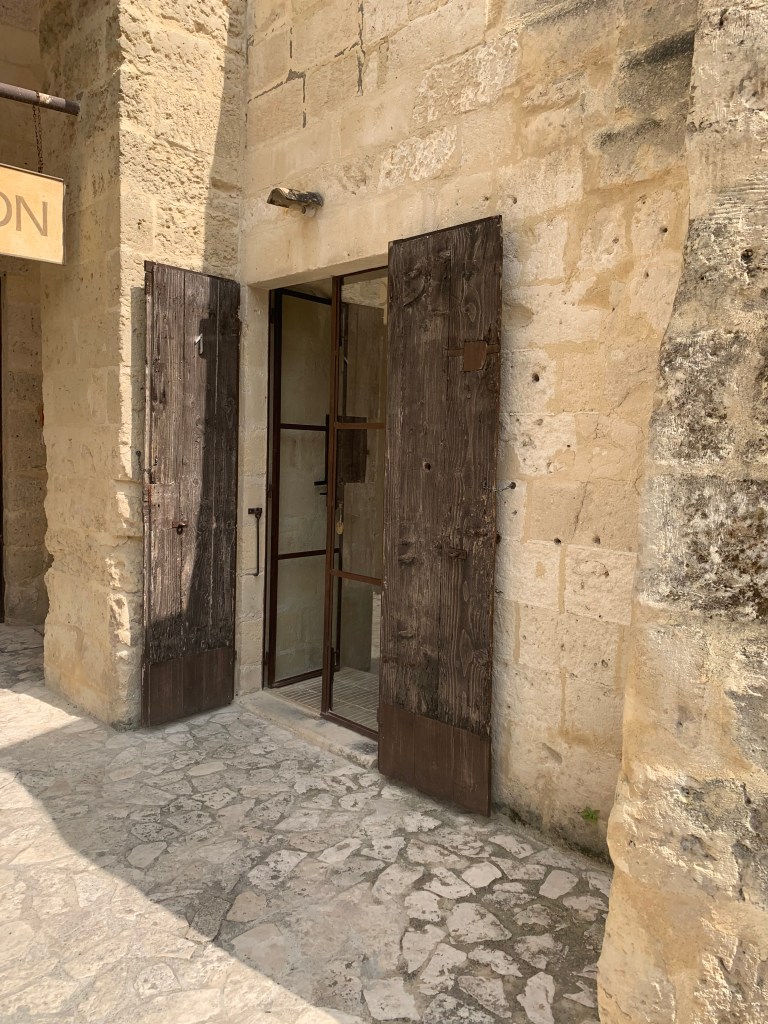
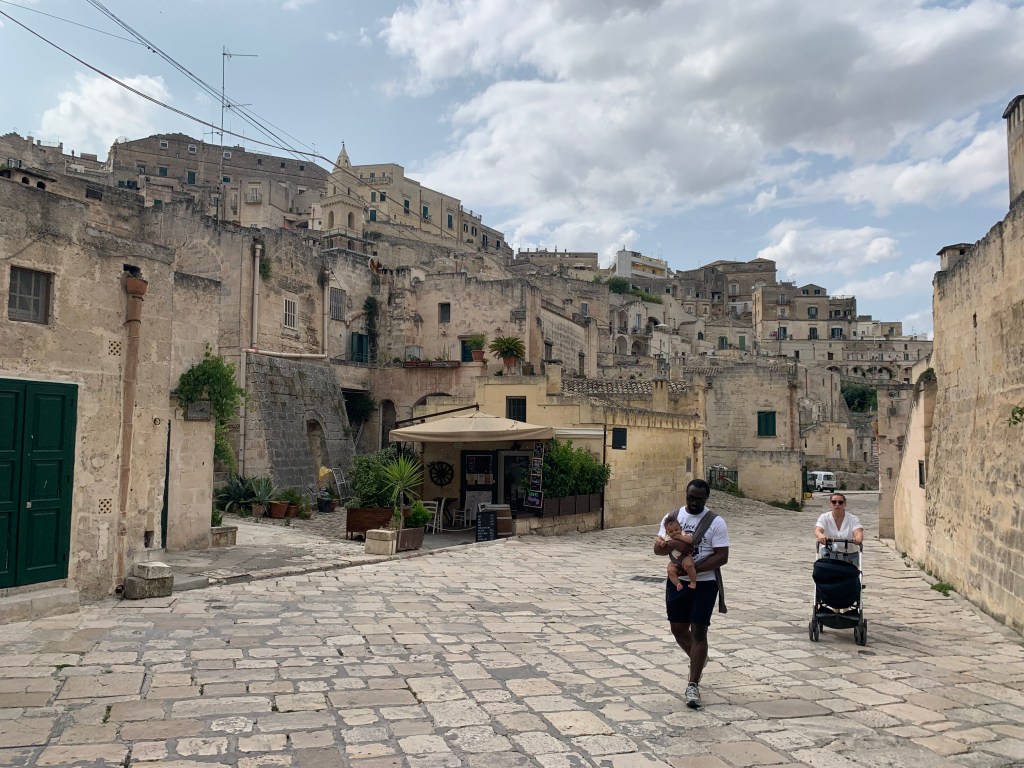
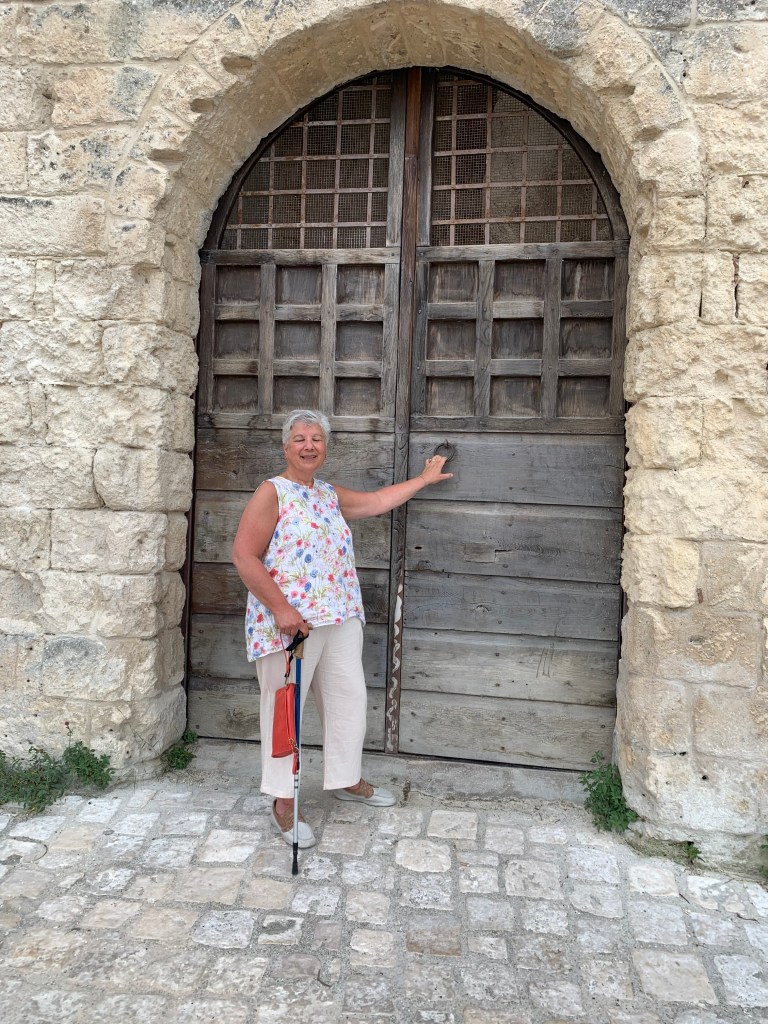
Pretty quickly we moved away from the steep hills of Avigliano and travelled roads lined with vineyards, orchards, and wheat fields, with gentle hills in the background. When we first entered the city of Matera, we found ourselves in a swanky area with designer stores and high-end restaurants—this must be the “new Matera” above the Sassi. We had not expected this. The parking garage we had reserved was down a narrow alley just outside the main square of the Sassi: Piazza Vittoria Veneta. We packed our overnight bags from the car, then headed to the square and the (supposedly) 10-minute walk to our hotel: Il Palozzotta Residence & Winery. We must have taken a wrong turn, because we were meandering through the crazy maze of paths and stairs that is the Sassi for nearly half an hour. It was hot. We were carrying our bags, and we felt lost. I didn’t want to make a wrong turn and add to the number of stairs we were climbing only to have to go down and up again. Luckily, I was using my cane or I wouldn’t have made it. Finally we arrived at a corner, and when we looked to our right, saw the name of the hotel in large letters on a cream-colored wall. Hallelejuh!
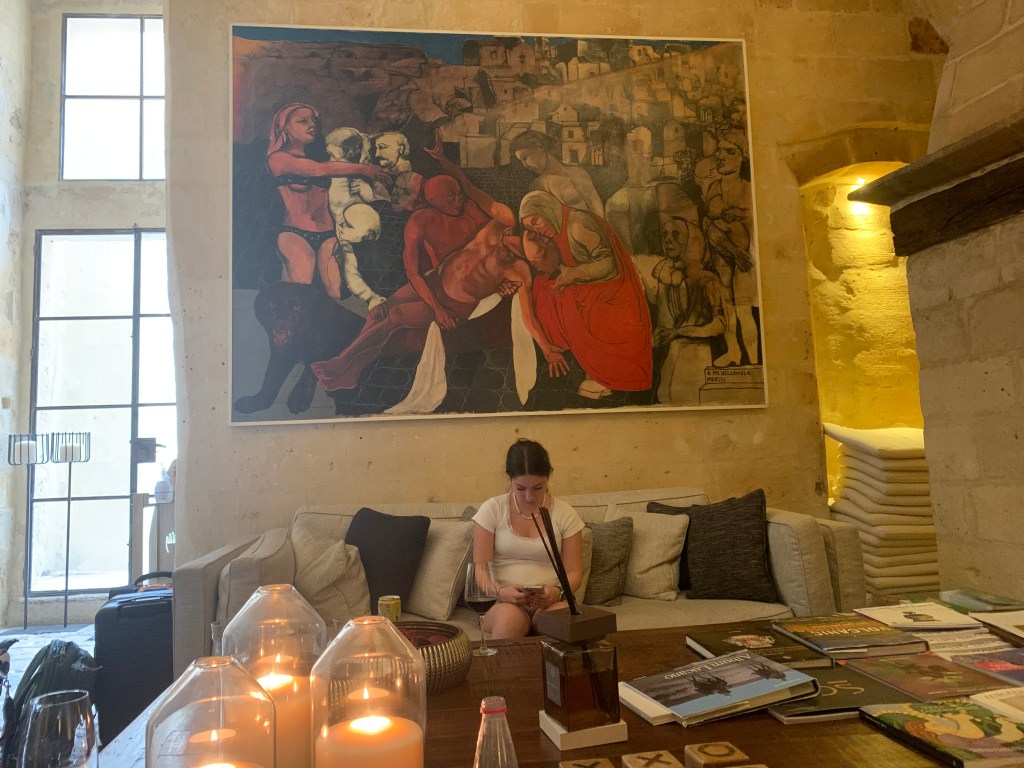
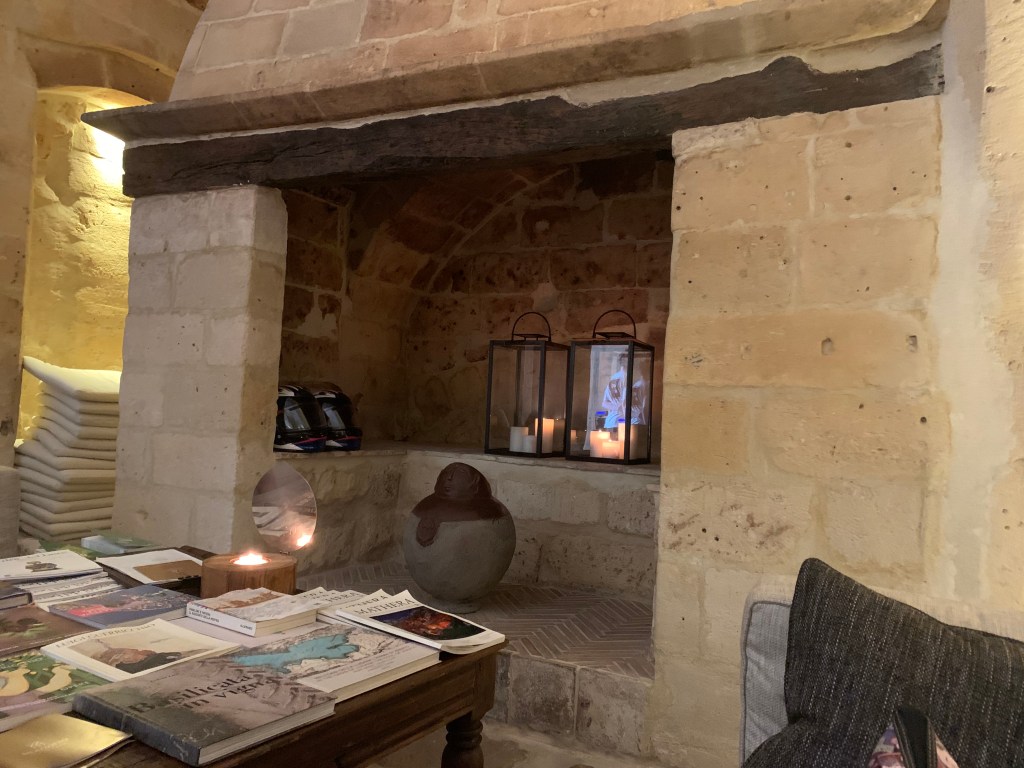
We entered the lobby and entered the cave world! The creamy rounded walls curved this way and that all around us. A large cozy seating area offered me a place to collapse. The hostess was helping another family and offered us drinks while we waited: a glass of wine for Santo and an ice-cold sparkling water for me. Ahhhh! The other family was originally from Italy but now lived in North Carolina and spoke perfect English. Being in a country where I didn’t speak the language was so difficult for me. So refreshing to be able to really communicate.
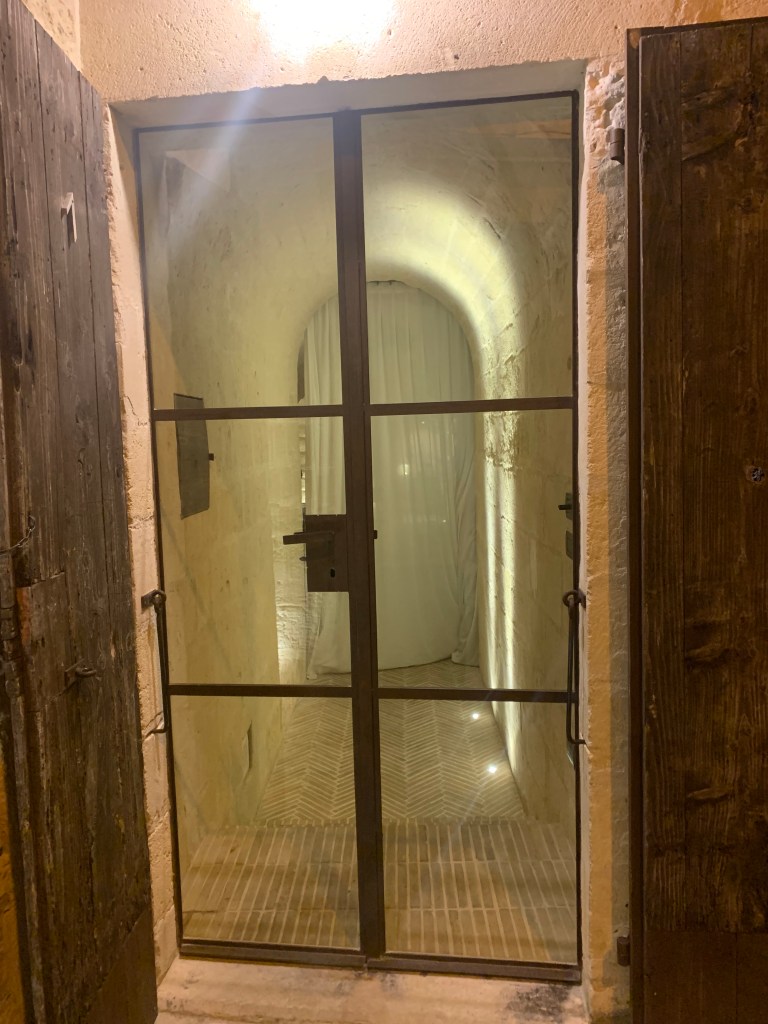
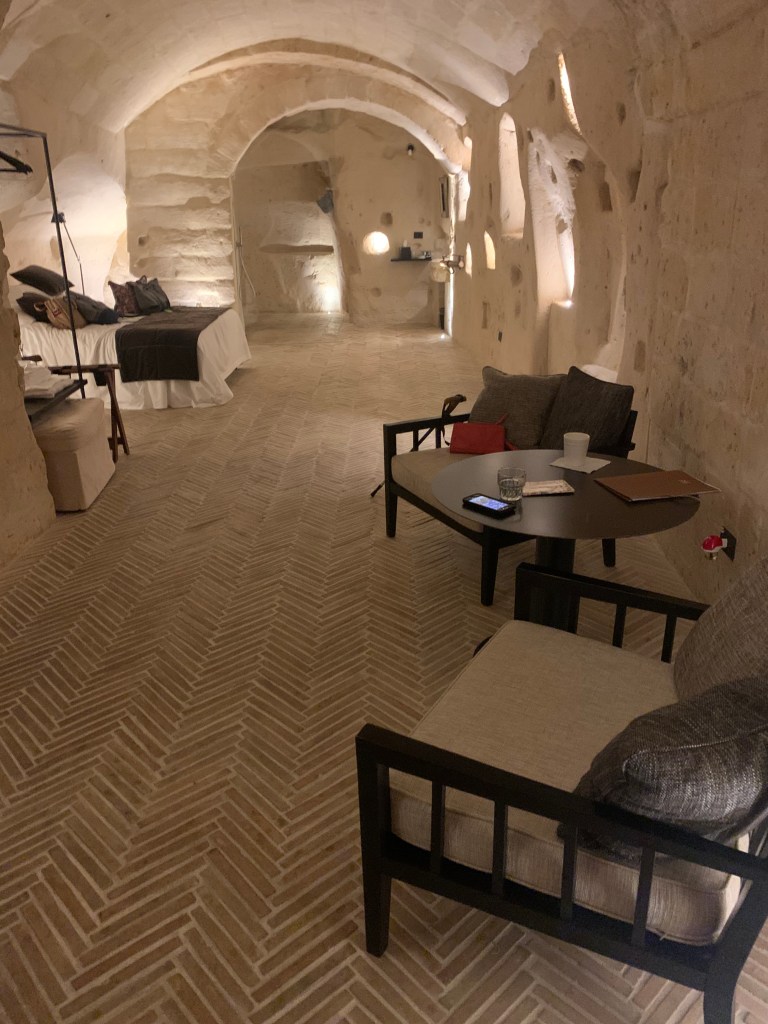
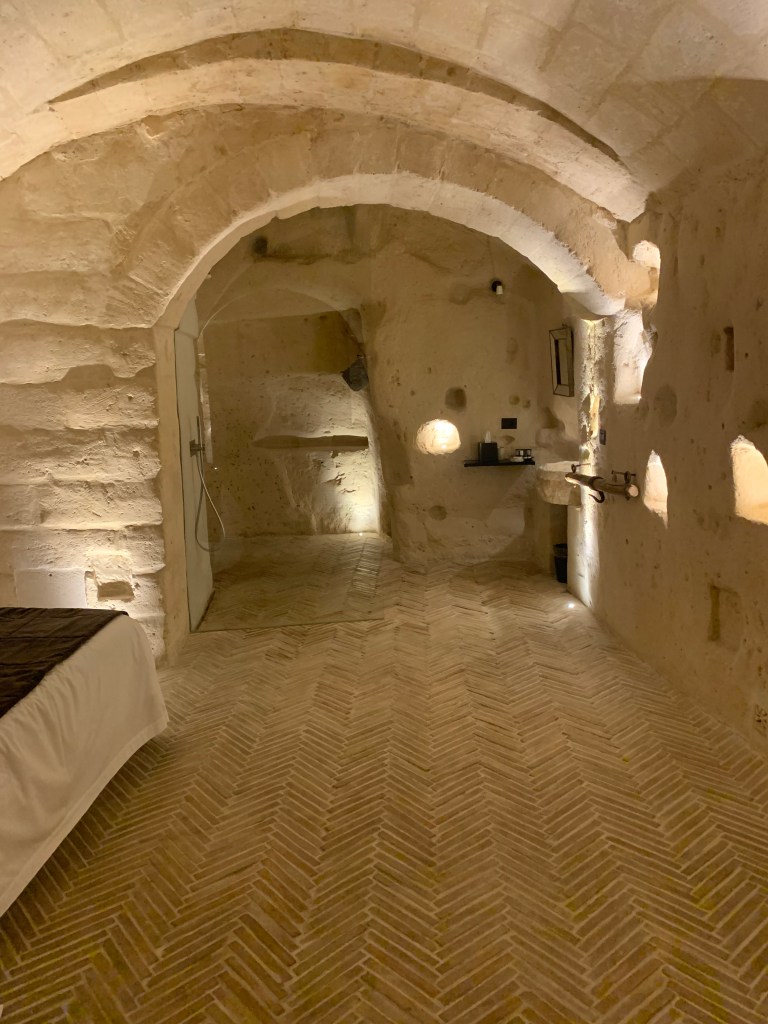
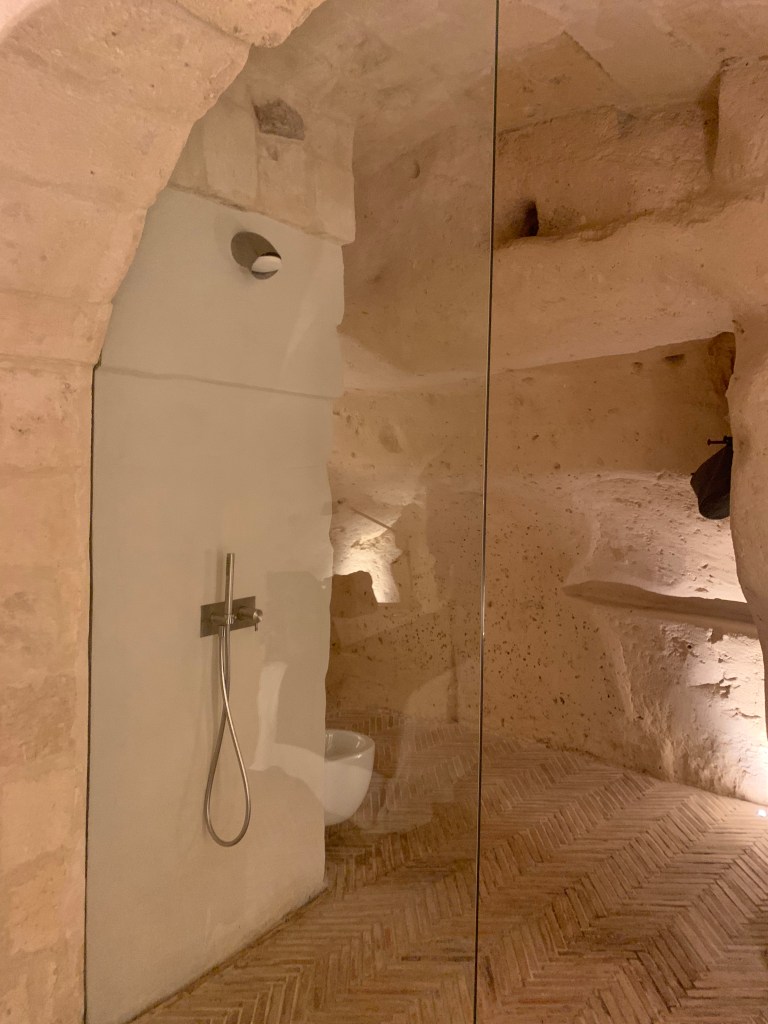
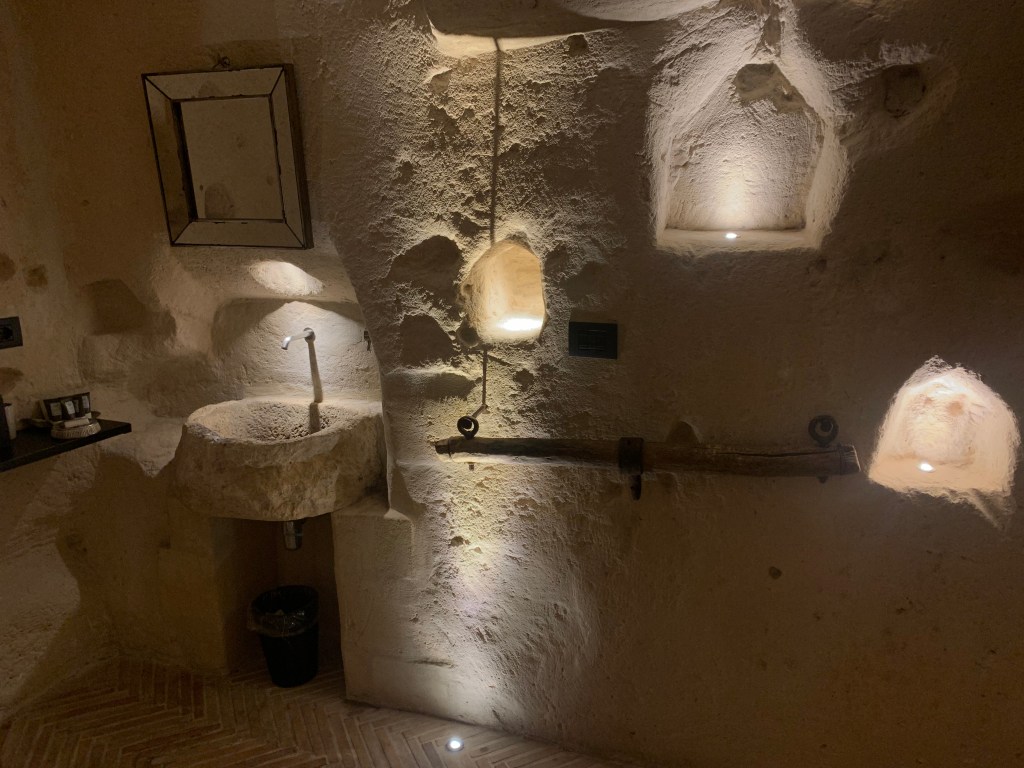
Our cave had a private entrance. Stepping inside, we were stunned by the size and beauty of the long cylindrical room. All creamy colors and golden lighting from small lights that dotted the nook, crannies, ceiling and floor of the cave. Our shower was in an open area against one wall with only a single large pane of glass separating it from the rest of the cave. The toilet and bidet were around the corner in a small nook—Santo hit his head the first time he tried to use it. The king-sized bed was nestled next to the curved wall. At the end of the cave near the entrance were two comfy chairs (COMFY CHAIRS!), a TV, fridge, and coffee maker. A heavy brown curtain hung from a pole and could be closed to give us privacy from the glass entrance door. This is what we had come to Matera for!
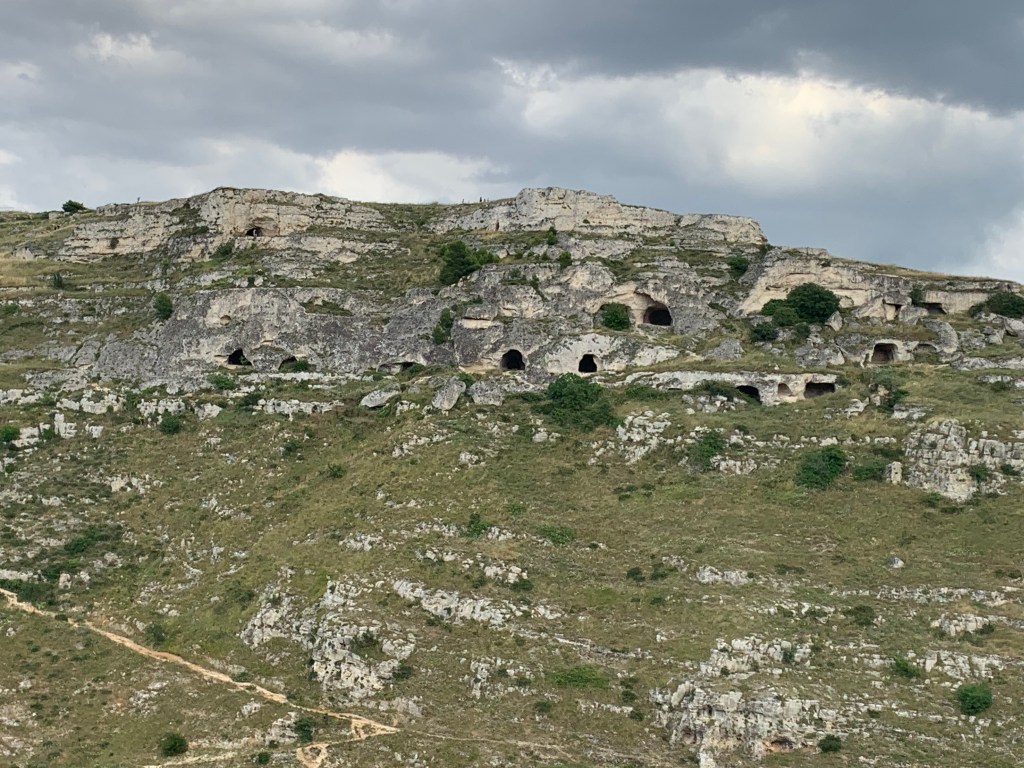
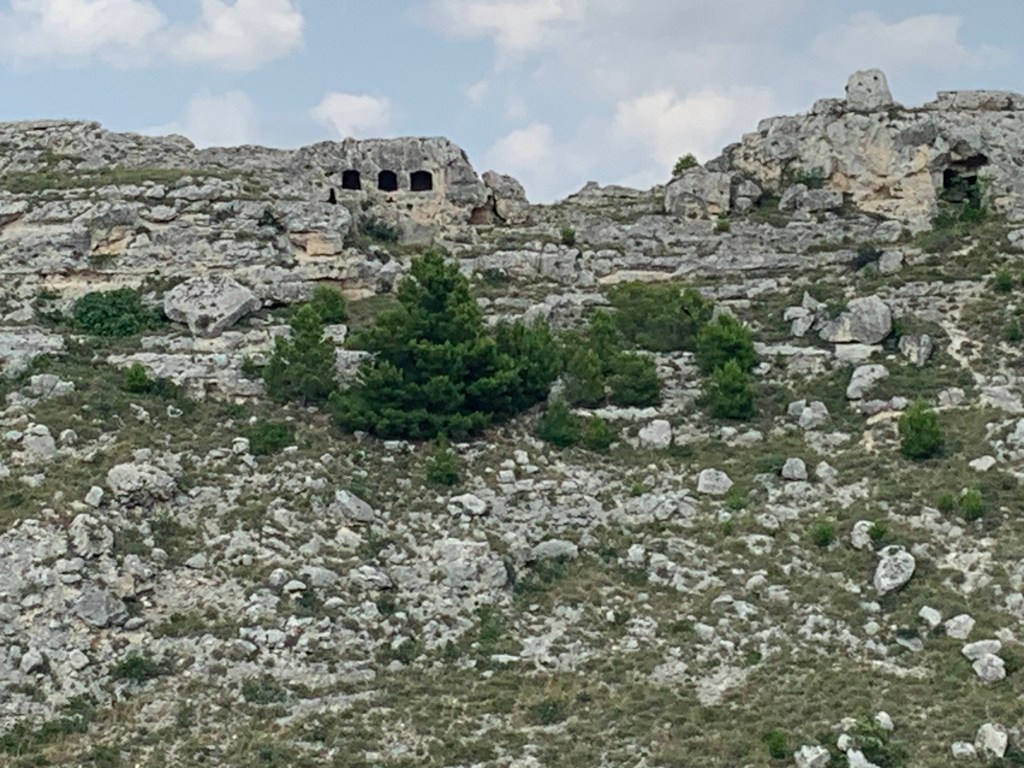
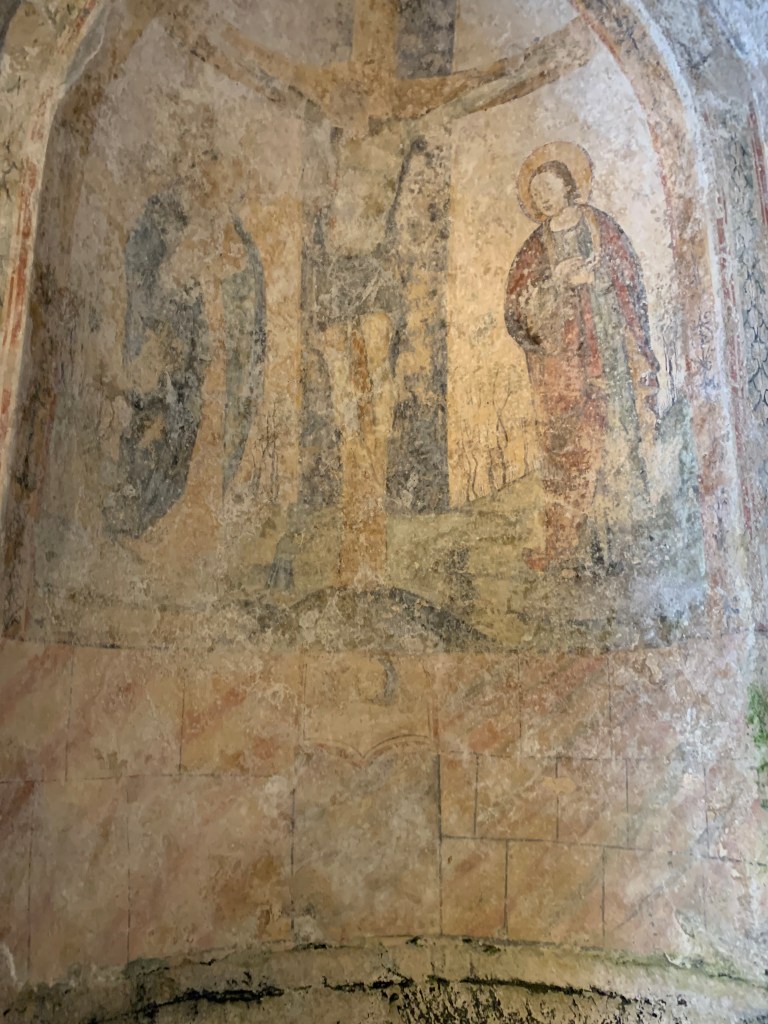
We were going to nap (hot and tired from the walk), but first I went to the lobby to ask for directions and recommendations. The hostess gave me a wonderful map and marked it up with the best routes, churches, etc. She made reservations for us at the restaurant and circled it on the map. Since the churches closed at 5 or 6 pm, we decided to do our walking tour first, then nap before our 9 pm dinner. We took the flat road that loops around the Sassi and runs along the deep canyon with prehistoric caves dotting the far side. We entered one of the many cave churches and enjoyed the muted frescoes from centuries past. The monotone cream color of the entire area was broken only by outcropping of flowers and small gnarled trees pushing through the stone.
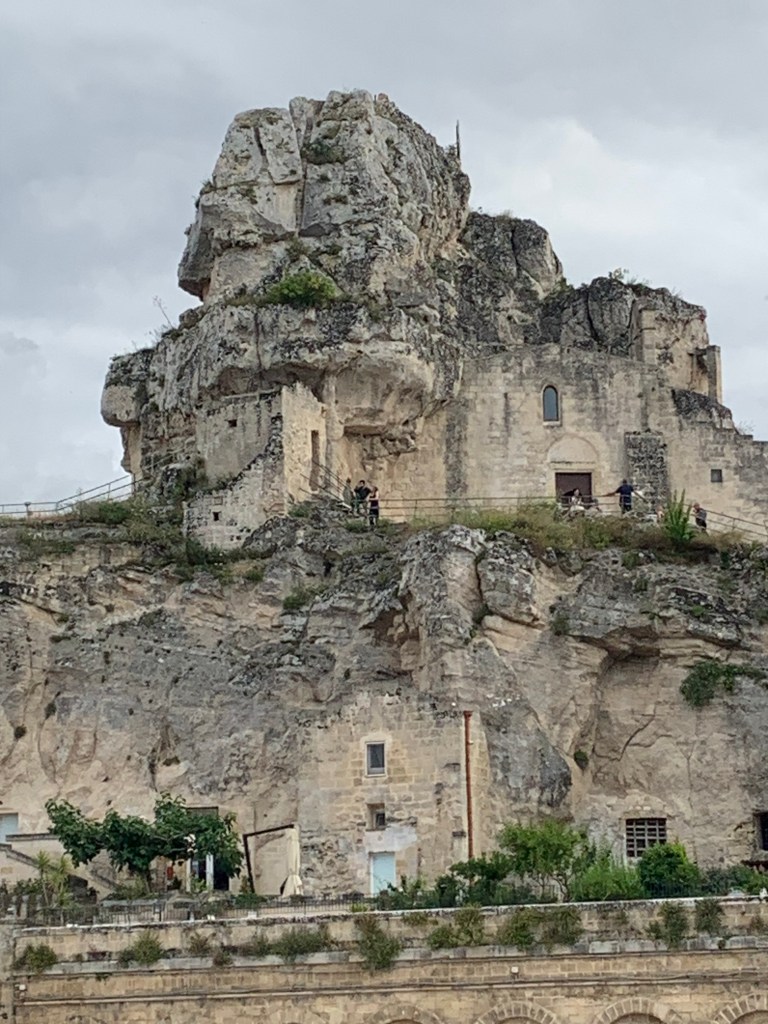
After about 30 minutes, we came to a large, slightly more modern church surrounded by an open piazza. High above the piazza was a more ancient church carved into the rock. I wanted to climb up to see it, even though I was very hot and tired. Santo decided to stay in the piazza area and wait for me.
I started climbing, cane in hand, winding stairway after winding stairway. Each intersection offered a choice and I had no idea which way to go. I kept looking up to the church, and making my best guess. I went up then down then up, up, up, then down again. At some point I went inside a church (4 Euros). At first I was disappointed at its small size, but the magnificent frescoes more than made up for it. The midnight blues looked almost like velvet, deep and rich. More meandering after I left the church. Soon I was hopelessly lost. I began to feel a bit scared. Even if I wanted to give up, I knew finding a way down would be no easier. At one point when I reached a dead end in the maze and let out a large sigh, two women nearby looked at me. “I am lost,” I said. They tried to help (in Italian), but didn’t know their way either. I said, “It’s OK, I’ll just keep trying. Grazie!” I climbed a new set of stairs and noticed that they were behind me talking to someone else. They were asking directions for me! They were able to point me to a path towards the church. At this point, I was worried about Santo worrying about me. I tried to text and call him, but DAMN SPECTRUM!, my phone did not work. I had no way to get in touch with him. Now I was really scared. I honestly didn’t know if I would ever make it out of there and back to the road down below. Eventually, I saw down and to my right, the open piazza. And Santo! I was probably several stories above him but I shouted, “SANTO!” He heard me and waved. I kept going and came to an intersection. To my right were steps to the piazza. In front of me was a shop with gelato and drinks. I had to stop. I got an acqua gasata and guzzled it before the man was even able to wait on me. There was a chair in the small shop and my body fell into it. I was glad it took him several minutes to wait on me, though I was also worried about Santo worrying. I ordered a gelato amarena (black cherry), soft and delicious in a paper cup, which I ate with a wooden stick like the old Dixie Cups we got from the ice cream truck in Dunmore.
Still eating my gelato, I made it to the piazza. Never so relieved in my life! We went right back to the hotel, about a fifteen-minute walk without stops. When we were almost to the hotel, I saw the entrance to a church: Sant’Antonio. St. Anthony’s, like the Italian church in Dunmore. It cost nothing to enter. It was the cutest little church, set up with colorful chairs. There was a fresco at one end, and on the walls were posters for musical events that took place in the space. It was a hidden gem.
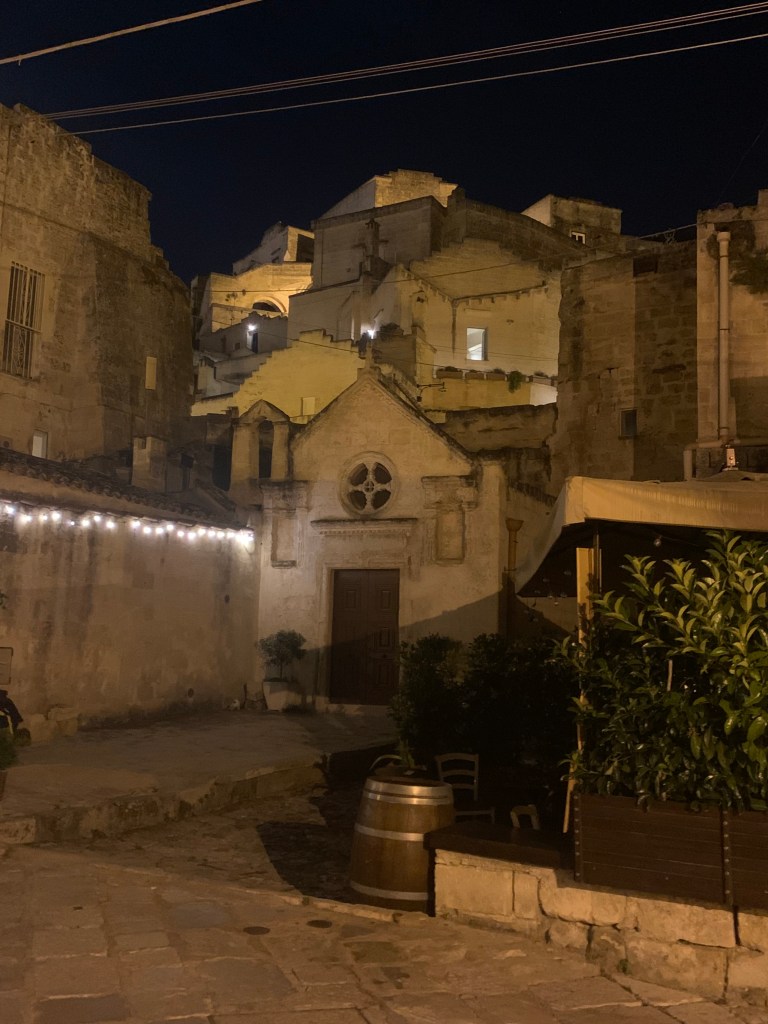
Back in our cool and comforting cave, we collapsed for a long nap, setting an alarm for 8:30. I woke up and knew I had to hop into the shower (or rather stroll behind the glass). Ahhhh! Refreshed, I dressed for dinner, and we took the short (3 minute) walk to Osteria al Casale. We had a table outside under golden lighting directly across from the canyon. Carpaccio, salad and pizza. Leaving the restaurant, we climbed to a church that offered a view of the entire Sassi.
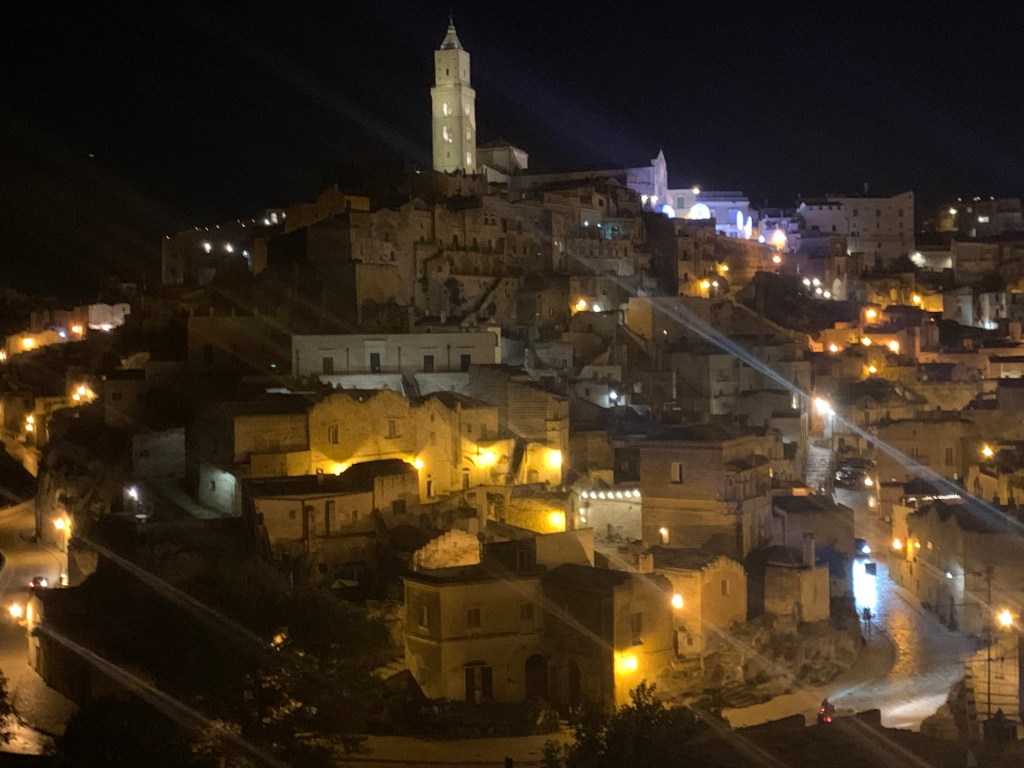
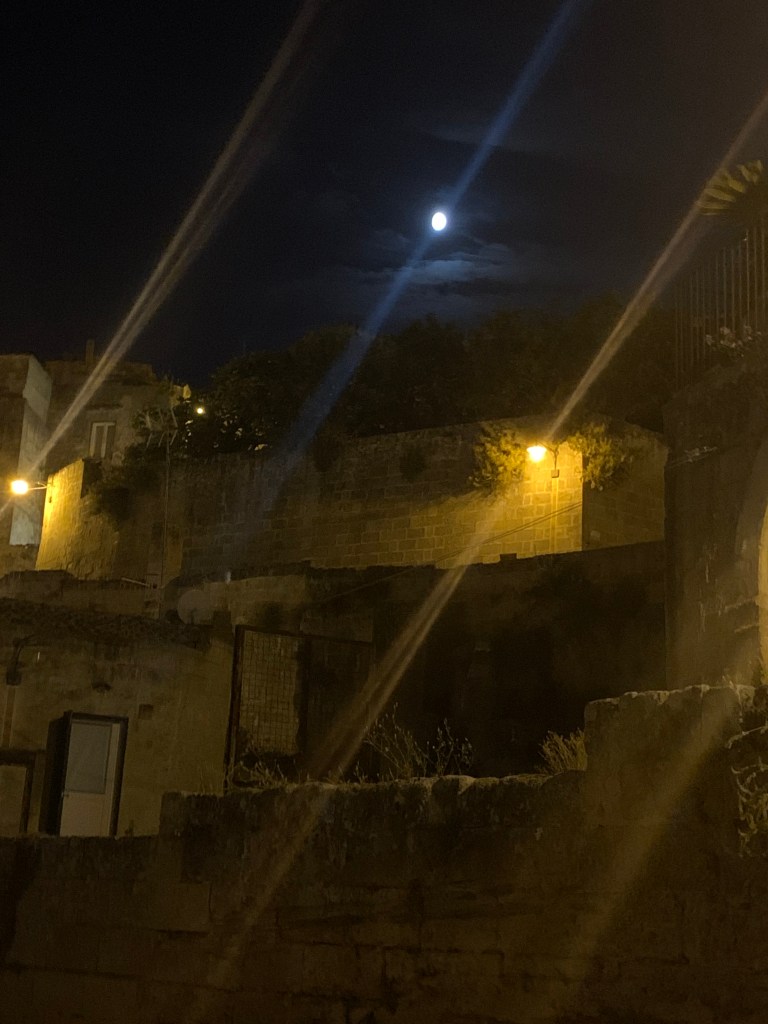
With a nearly full moon overhead and the Sassi looking like an illuminated sand castle city, Santo and I held each other, grateful for this moment, this trip, this life.
















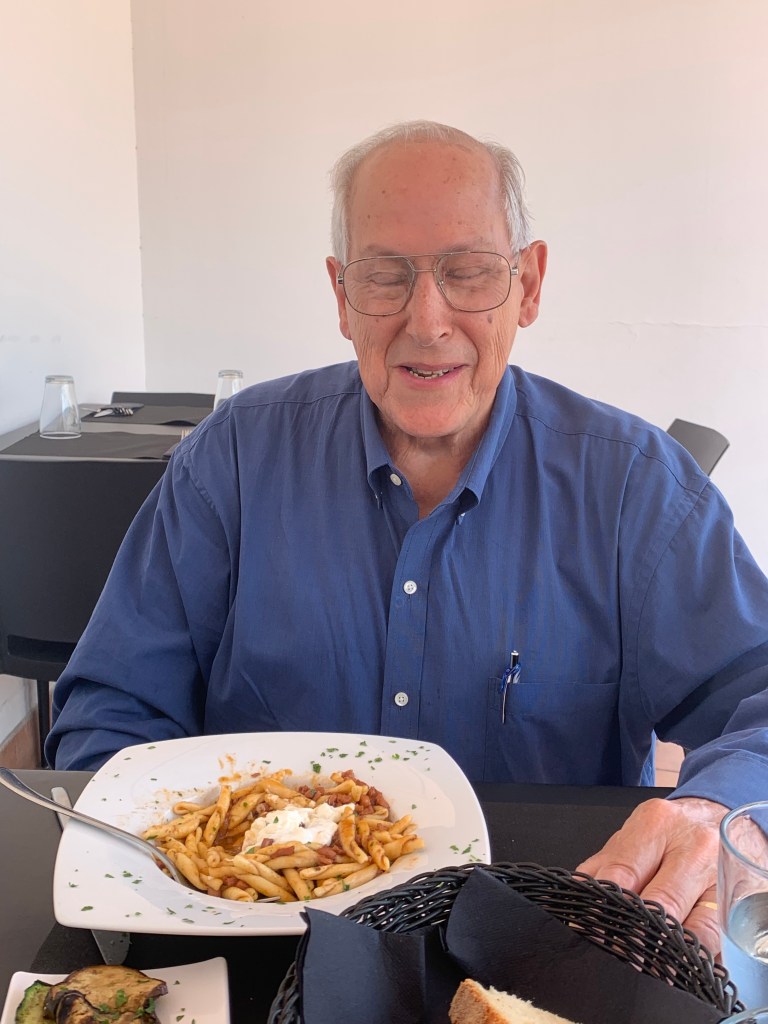
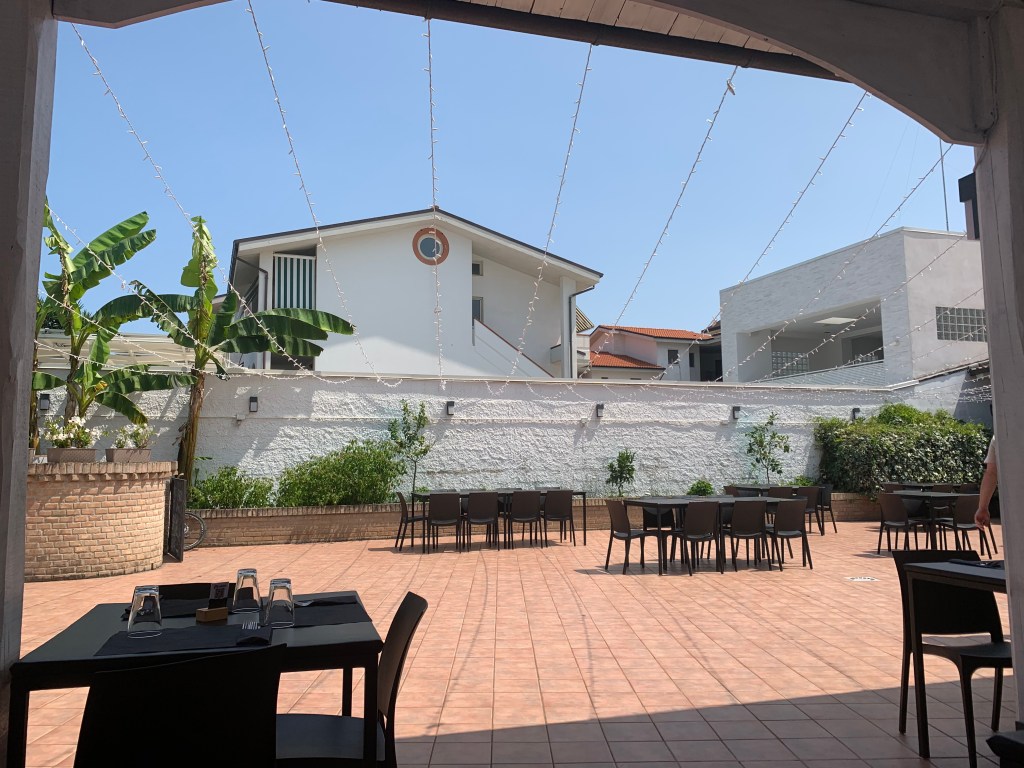
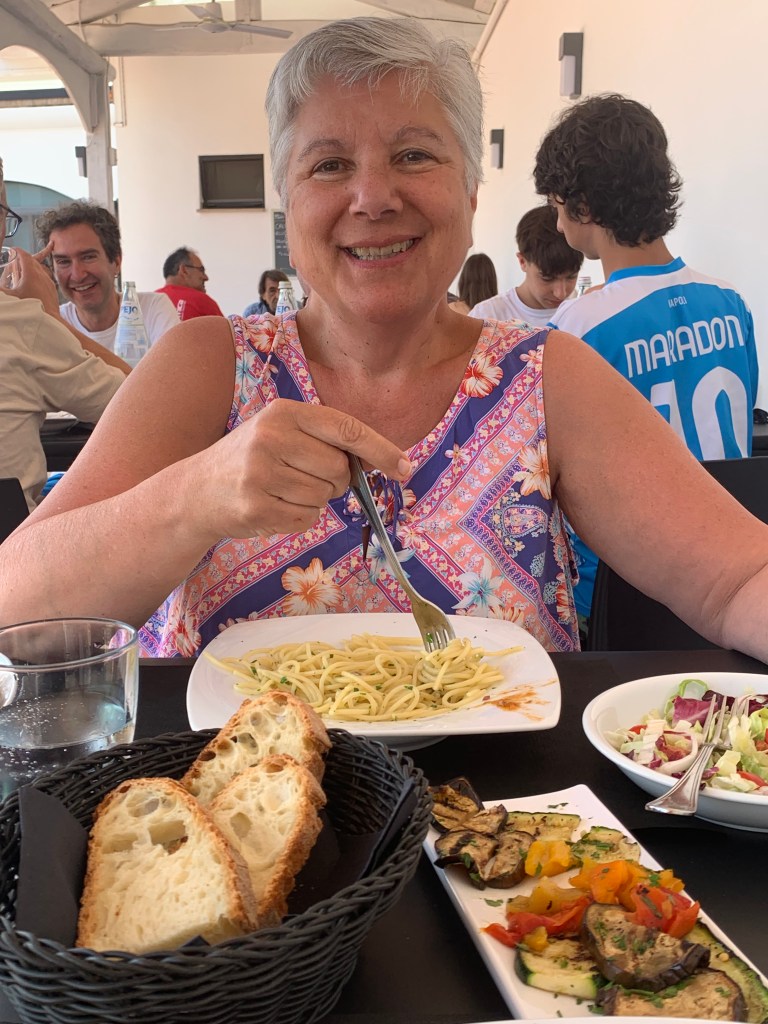

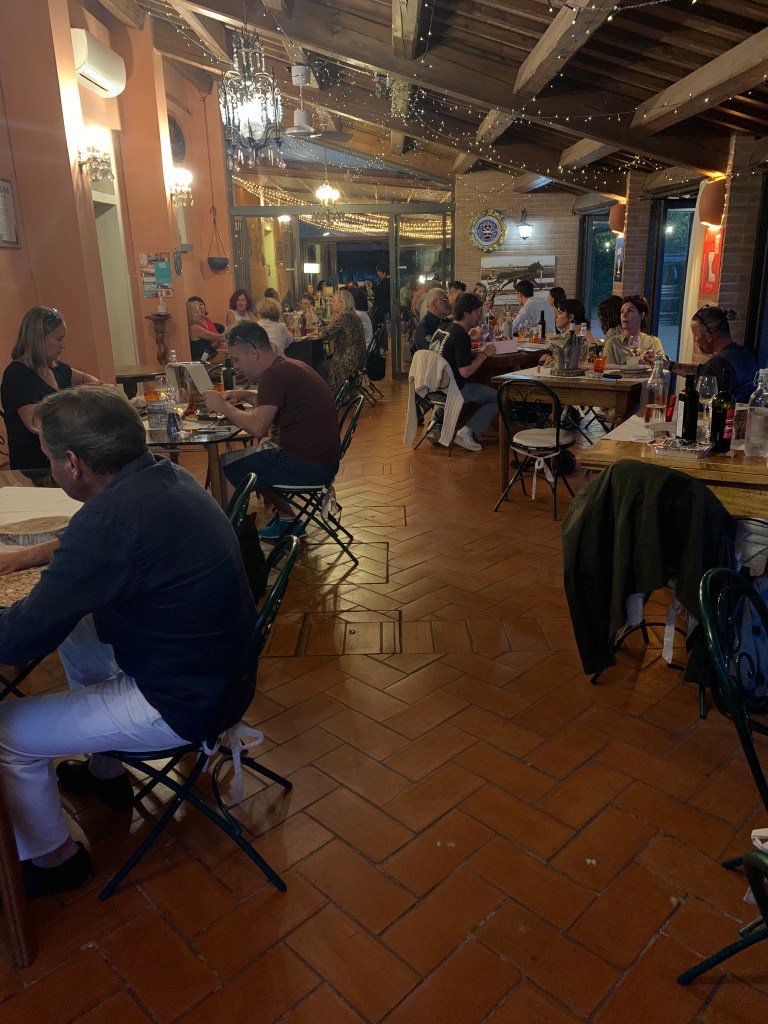

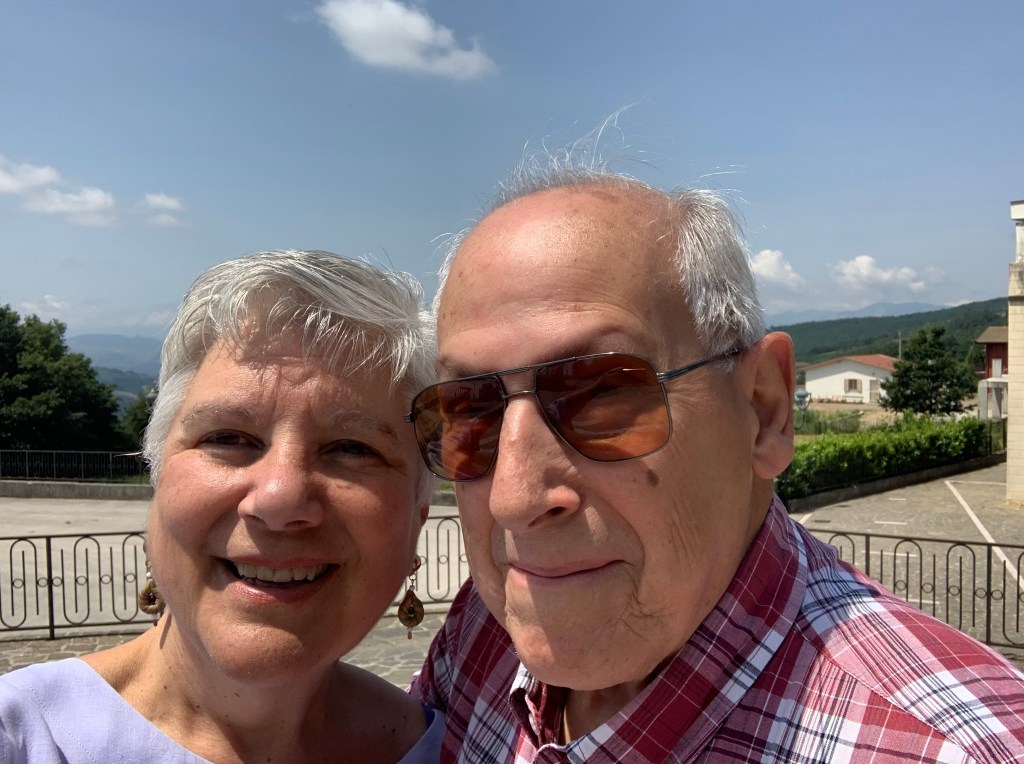





 Rambling Rose