The car I grew up in
Was a ’59 Pontiac Star Chief
Four -door sedan hardtop
In a color my Crayola 64 box called Flesh.
Even at a time when most cars
Came in a wide variety of vibrant colors,
This one stood out.
Not that it was flashy.
My Dad would never have a flashy car.
No, this color was like my Dad himself,
Solid, utilitarian, not trying to be anything
Other than what it was,
Prizing family over fashion.
Sprawled in the wide bench seat in the back,
My older brother and I would press our noses to the glass
Just to watch the world go by
In a horizontal blur.
Or stand on the hump in the middle
And fold our arms over the front seat
Between Mom and Dad
to watch the road come up to meet us,
the long white line whizzing under the chrome arrowhead
that ornamented the sleek hood.
During the day
We would sing along with Mom and Dad
To all the old standards,
Taking turns picking which song would be next:
“I’ve Been Workin’ on the Railroad,”
“Deep in the Heart of Texas,”
“Don’t Fence Me In,”
“On Top of Old Smokey,”
“From the Halls of Montezuma,”
And my favorite “Give My Regards to Broadway,”
Because it talked of that magical black-and-white place
I saw in the late-night movies
When my Mom would let me stay up to watch with her.
But on nighttime drives
When they thought we were asleep
My parents would sing “their” songs:
“I Love You Truly,”
“Blue Heaven,”
“Let Me Call You Sweetheart,”
“A Shanty in Old Shantytown.”
Mom’s beautiful soprano carried the tune
And Dad would come in softly to harmonize.
Often they would lean their heads closer
And find each other’s eyes
As they stretched out the final note.
Nat King Cole’s “Rambling Rose”
They sang both day and night.
I think it was the word rambling
That captured their imaginations,
And seemed a perfect accompaniment
to our rambles in the flesh-toned Star Chief.
Daily life for my parents in our small coal mining town
in the four-room apartment above my grandparents
was not easy.
Mom worked school hours in a medical lab,
then cooked, cleaned and cared for us
and anyone else in need of her loving touch.
Dad worked long hours in the lumberyard
where he had been employed since high school,
before and after the war.
After supper, he went out to do the books for several local businesses,
working alone in darkened stores and offices.
Dad was not someone anyone would call a dreamer.
Hard work, responsibility, frugality, caution.
These were the concrete values he lived by.
But every once in a while,
With a twinkle in his eye
He would let tell us about his two fantasies:
To go on a big game safari in Africa and,
Just for a time,
To ride the rails like a hobo.
Our excursions in the Star Chief,
particularly the long Sunday drives to the Poconos,
were Mom and Dad’s escape from the routine
and our entertainment.
Often our only destination
Was a roadside overlook
Where we’d enjoy a picnic lunch packed by my mother
Served on a starched cotton tablecloth
Laid carefully over the rough wood of a rest stop table.
These trips didn’t cost anything to speak of
(gas was cheap back then),
But for us they provided untold treasures.
I often wonder if,
Coming around a bend,
My father imagined a tawny lion
Slinking across a field
Or a gazelle in full gallop
Leaping across our path.
Did he look at the countryside rushing past
And imagine he was peering through the slats of a boxcar?
Perhaps.
I suppose each of us packed our own dreams
For the ride.
And no matter where we rambled,
That was enough.
The tears I cannot shed
Sit hot behind my eyes
Or throb in the heavy dark space between my temples
Sometimes they close my throat
And I am paralyzed, suspended in time,
Until with a gasp my breath comes again
With a surge of emotion.
The tears I cannot shed
Are ancient
Spanning the arc of a moral universe
That too often has bent away
From all that is right and good and just.
I pull hard
Adding my strength to the strength of all who have gone before
Straining every fiber
Bending my knees and lifting my feet off the ground
to add my dead weight to the effort
But it is no match for the opposing force.
The tears I cannot shed
Are for Maria,
Who dreams one day of becoming a kindergarten teacher
Passionate to help eager young minds
dream their own dreams of all that is possible.
In the chill of a desert night sixteen years ago
She was carried across the border
By a mother driven by her own dreams for her baby girl.
Now Maria lives every day in the terror
That the only country she has ever known
Will banish her
And her dreams with her
Alone and afraid.
To a place that is beyond tears.
The tears I cannot shed
Are for Tamika
Who kneels every day in the soft fresh grass
That covers her son’s grave.
Doubled over in grief, her legs stiffen under her
And she needs to reach out to the cold granite
To slowly pull herself upright as her tears darken the gray stone.
Why did she have to send him out for milk that night?
Why hadn’t she noticed the broken tail light?
Why hadn’t he kept his hands on the wheel
As she had taught him over and over again?
How could a grown man with a gun
Feel threatened by a sweet boy
With a gallon of milk?
Imprisoned by these unanswerable questions,
She wonders, “Must all our tears run dry
Before black lives matter?”
The tears I cannot shed
Are for Hasan and Daria,
A young couple who fled their Aleppo neighborhood on foot
after it was bombed to rubble
so that their unborn son might have a chance
at life.
Two years later, huddled in a plastic tent
In a squalid refugee camp,
They listen to the crackling sounds
Of a transistor radio just outside their tent.
Despite the papers granting them refugee status,
The American president
Has banned them from entering the U.S.
Daria’s scream awakens a sleeping Aziz
Whose cries pierce Hasan’s heart
As he wipes from his son’s face
The tears he cannot shed.
What a wonderful whirlwind jumble of experiences on this magnificent vessel. Truly like stepping back to a more genteel time. Elegance, quiet, calm, and the ever-present gentle gliding movement of the ship marked our days.
The first few days of confusion gave way to seeking out favorite nooks and gradually falling into a somewhat fluid routine. Each of the four of us had our own rhythm, but we intersected throughout the day and always came together for dinner and our varied evening experiences.
Santo and I chose the dining room for our first breakfast. We were supposed to go to a safety training session at 10 am and were at the dining room by 9:10. At 9:55, none of Santo’s food had come and I only had a bowl Muesli (instead of the hot oatmeal I had ordered). I think the waiter was new, as he seemed somewhat muddled taking our order. But we later found out the Alison and Maurice had a similar experience. A few minutes before 10 am, I left to go to the training; I would explain to them why Santo was delayed. Still very confused about the ship’s configuration and where everything was, I seemed to meander forever, asking directions at every turn, until I came to the spot where the training was to be. It was in one of the elite dining areas. I did not see any meeting. I asked a waiter where the meeting was. “The safety meeting?” he asked.
“Yes,” I answered.
“It’s at 10 o’clock.”
“I know,” I said. “Where is it?”
“It’s at 10 o’clock.” I wasn’t getting anywhere.
“So did I miss it? Is it over already?”
“No, it’s at 10 o’clock.” I felt I was stuck in a “Who’s on First?” loop. I must have had a very confused look on my face. Finally, he said, “It’s 9 o’clock. The meeting is at 10 o’clock.”
Ahhh! The light dawned. We were to have turned our clock back last night. Oops! It turns out, we turn the clock back almost every night so that by the time we get to New York we are on Eastern time. No jet lag here!
I went back to the dining room and Santo was still at the table. His food had finally come but my fruit never did show up. We decided to try other breakfast options the next day.
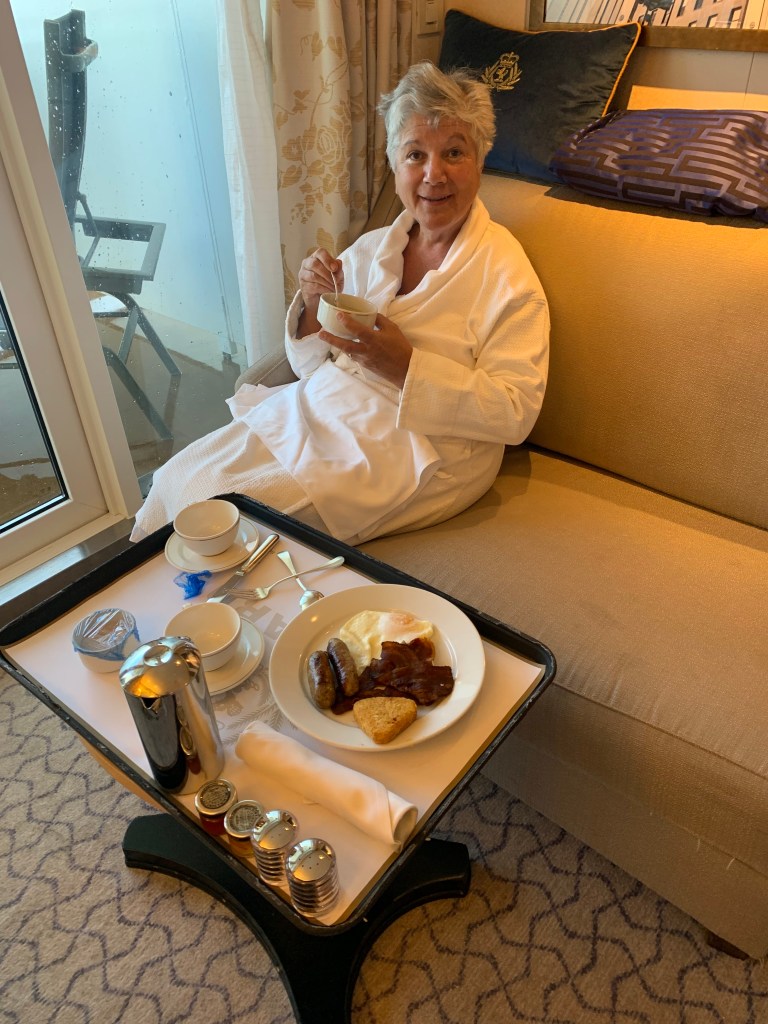
We discovered the King’s Court for breakfast the second morning. What an array of breakfast choices: muesli, oatmeal, cereals, cheeses, meats, eggs, hash browns, bacon, fruit, breads, muffins, yogurt, and more. And lots of lovely seating, including some glass-enclosed nooks where you were practically hanging out over the ocean as you ate. Coffee was brought to you and refilled often. Santo was in heaven. We returned every morning, except the one morning we opted for breakfast in our room. It arrived right on time, hot and tasty.
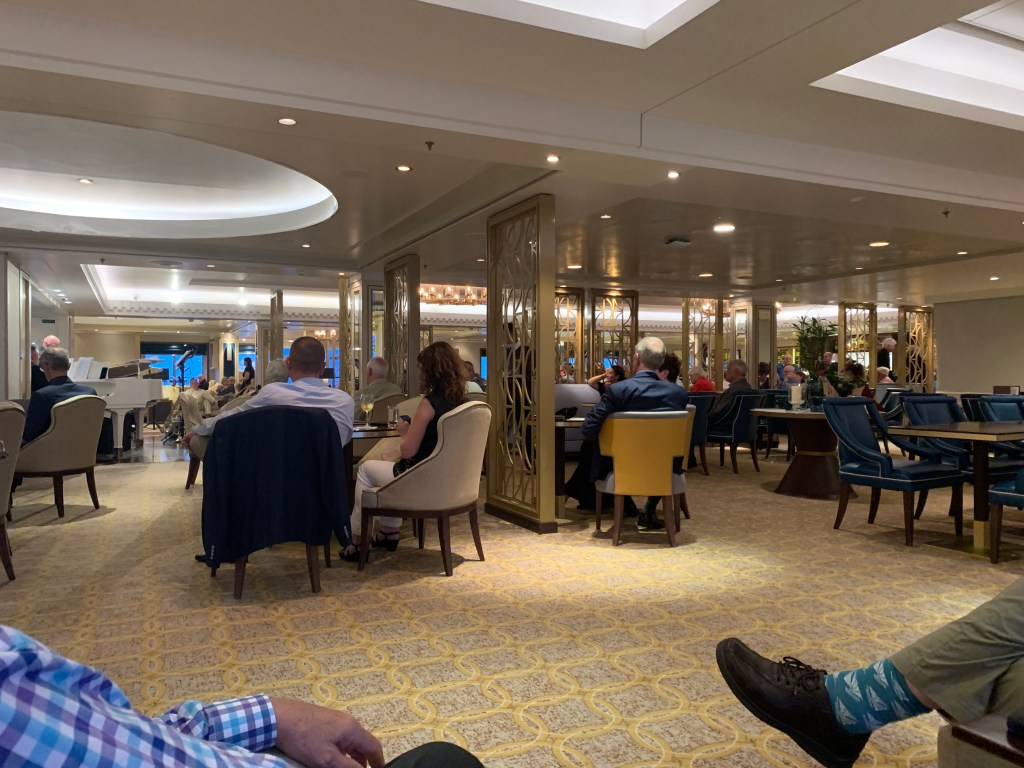
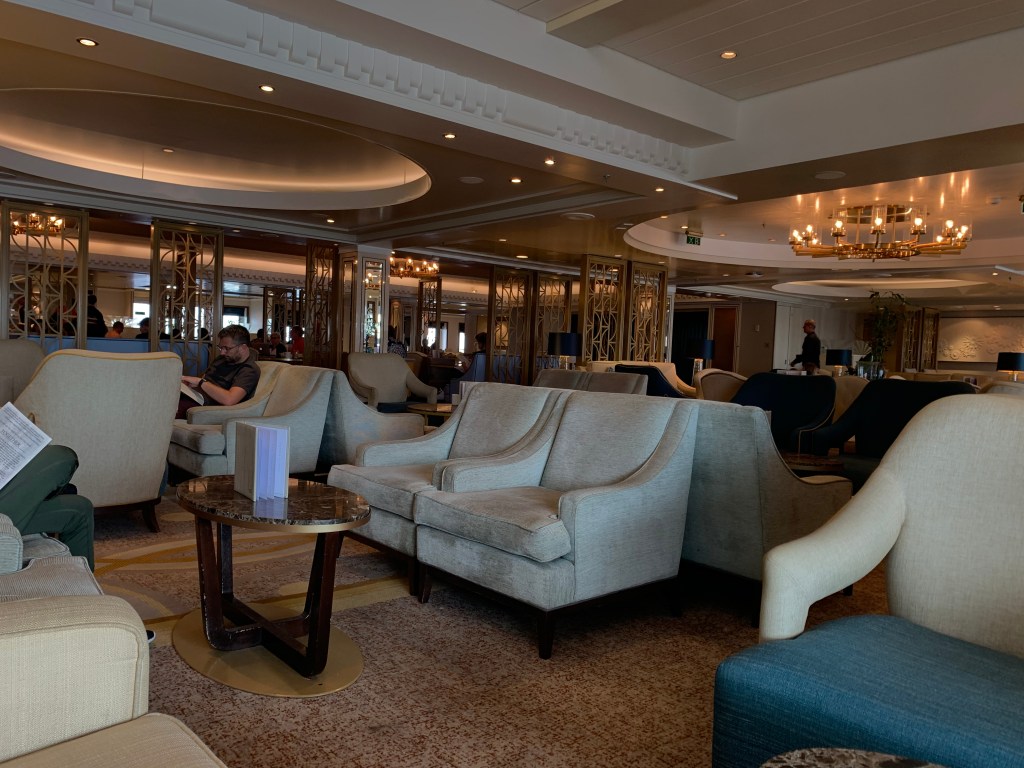
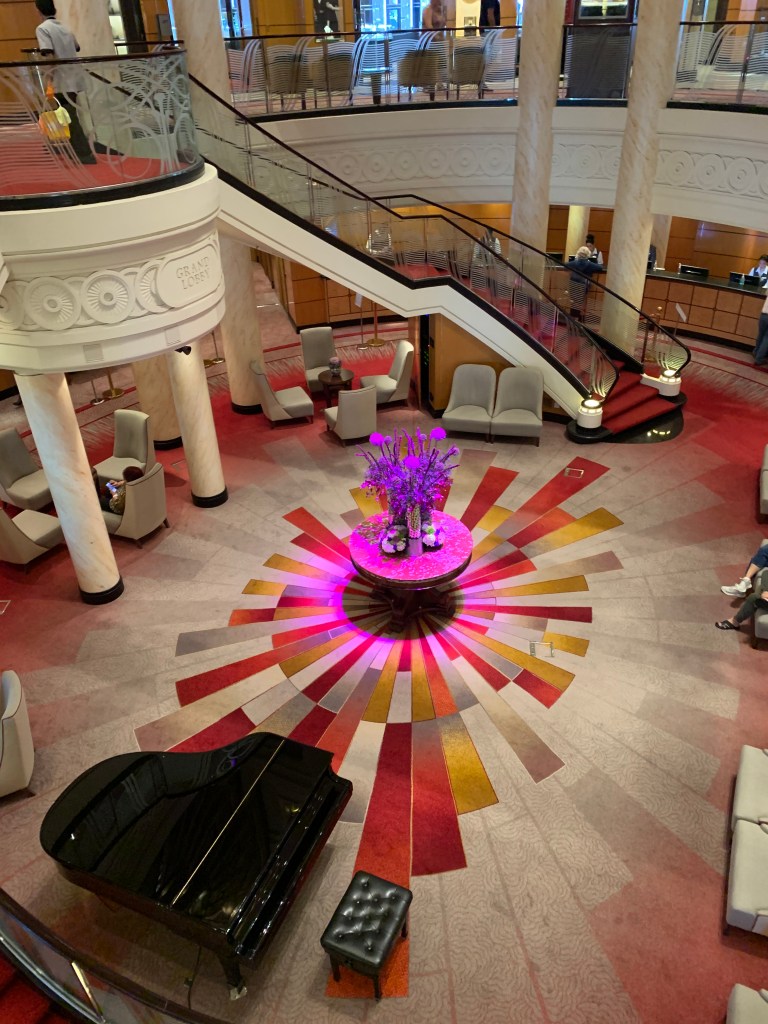
I think my favorite spot was the Corinthia room on the 7th Deck. It is all soft shades of cream, beige, gold, and muted blue. Light and airy but with a cozy feel.
And I could get Wi-Fi there! The Wi-Fi on the ship was spotty, and I could rarely get it in the cabin. The central common areas were the best chances of a consistent connection. I would check emails, read, write, gaze off at the ocean (or in most cases the fog), sometimes close my eyes and lose myself in the subtle drift of the vessel. It was heaven.
With only one Wi-Fi account, Santo and I could not both be connected at the same time, so sometimes we lost each other on the ship for hours at a time. We would both run into Alison and Maurice but rarely each other. Most lunches were on our own, often King’s Court. I tried the dining room once and was seated at a table with seven other people for a delightful conversation.
We attended a lecture with slide show about the great ocean liners and their history. We are part of a long and storied tradition. We visited the planetarium for a show about the origins of the universe. Alison and I spent several hours one afternoon at the indoor pool at the back of the ship on our deck (Deck 12). The loveliest indoor pool I’ve seen. It is enclosed all in glass and you feel you are actually outside. The air is not steamy and does not smell of chlorine. There are cushioned lounge chairs, a hot tub, and a bar for drinks. The four of us even squeezed in a game of cards (Three-Fourteen). Maurice nearly sunk us all in the last round, but I managed to hold on for the win.
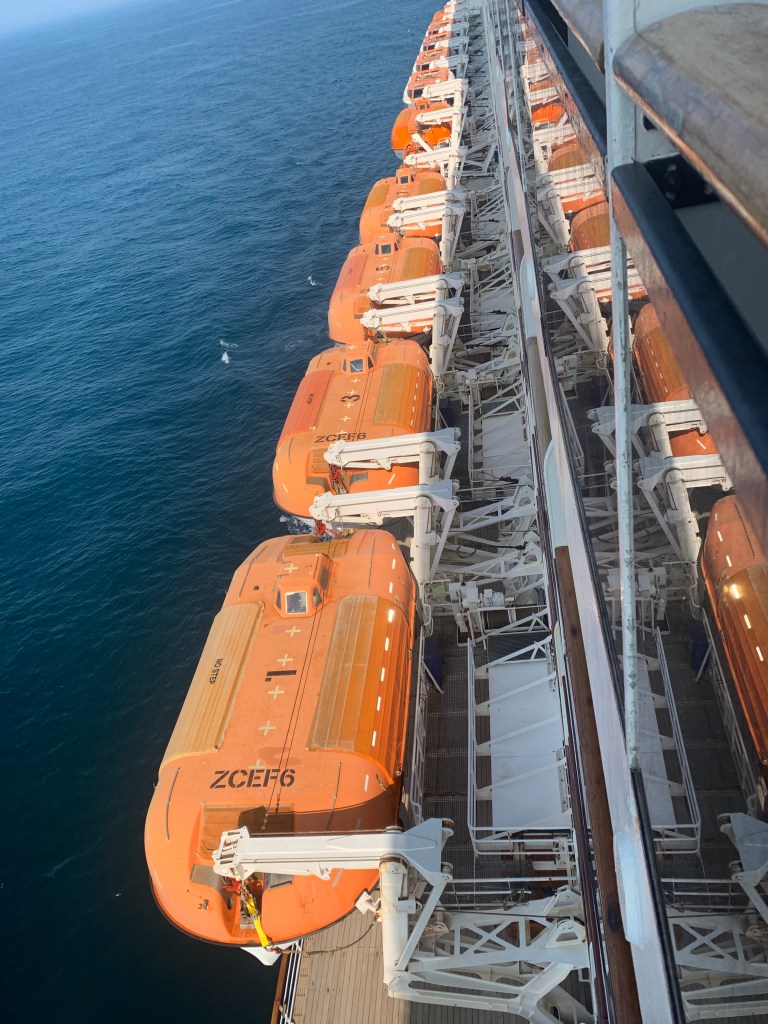
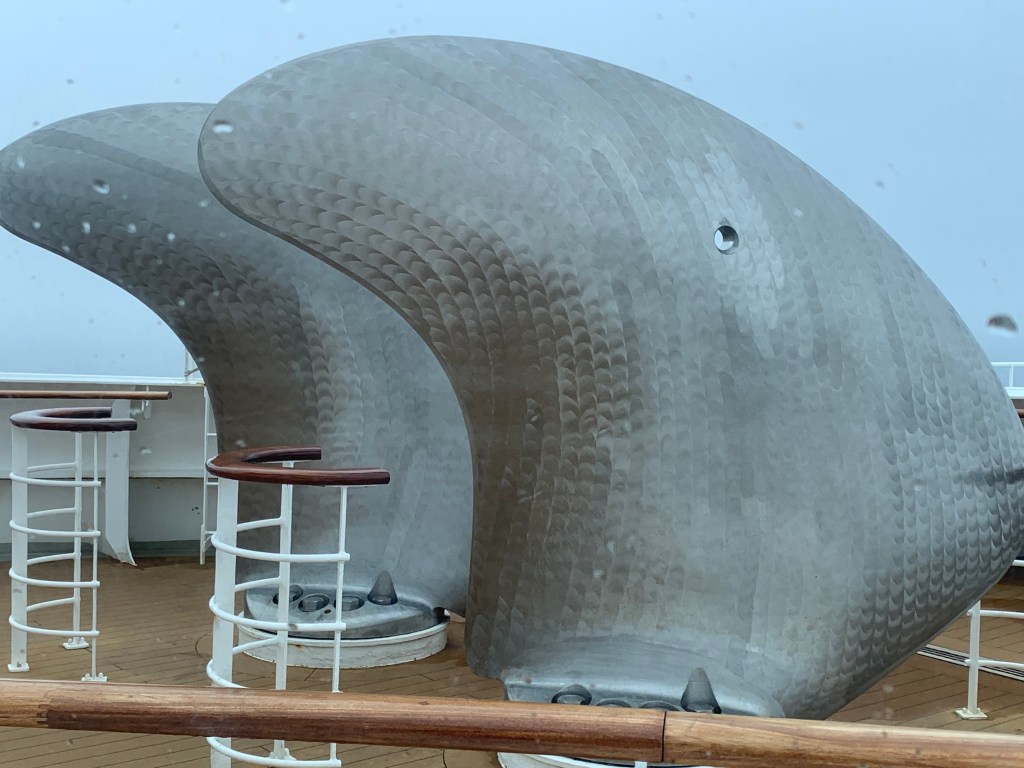
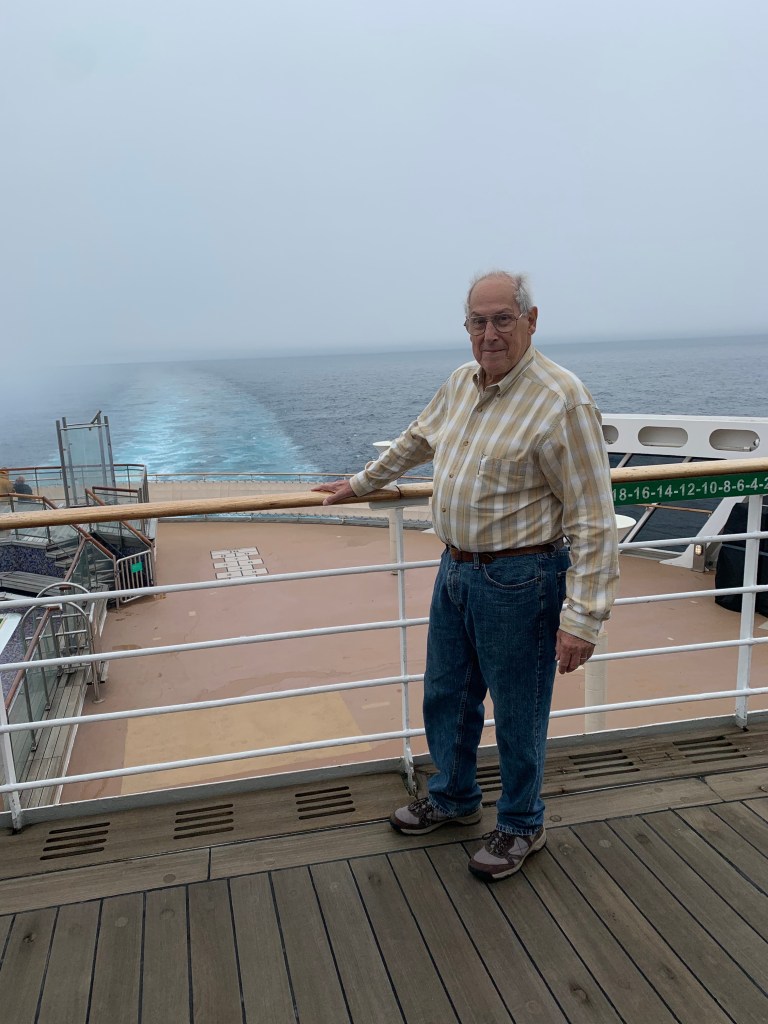
Most days included a stroll around the deck on Deck 7. One lap takes about 12 minutes. I don’t know why I found it surprising that the deck felt so solid. Looking out over the rail, which looks like the rail on every ocean liner that has ever sailed, I felt I was part of some great time continuum, my footsteps superimposed on those that had gone before. It is the same sea they gazed out at, the same fog that embraced them, the same feeling of being so small in a vast world.
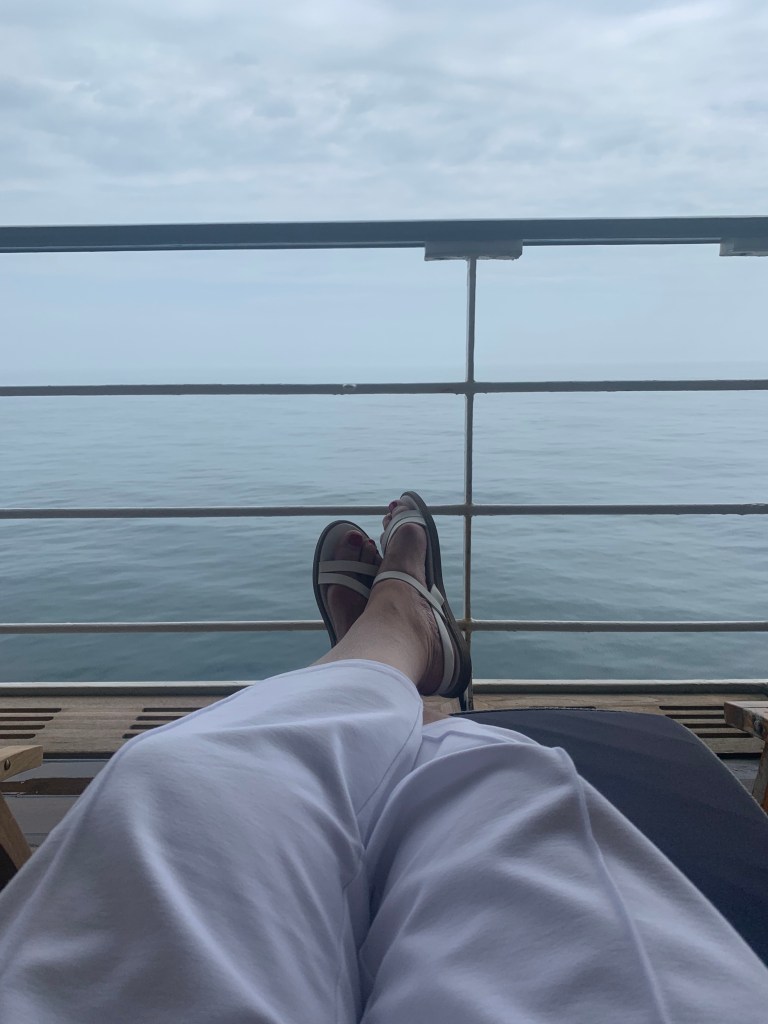
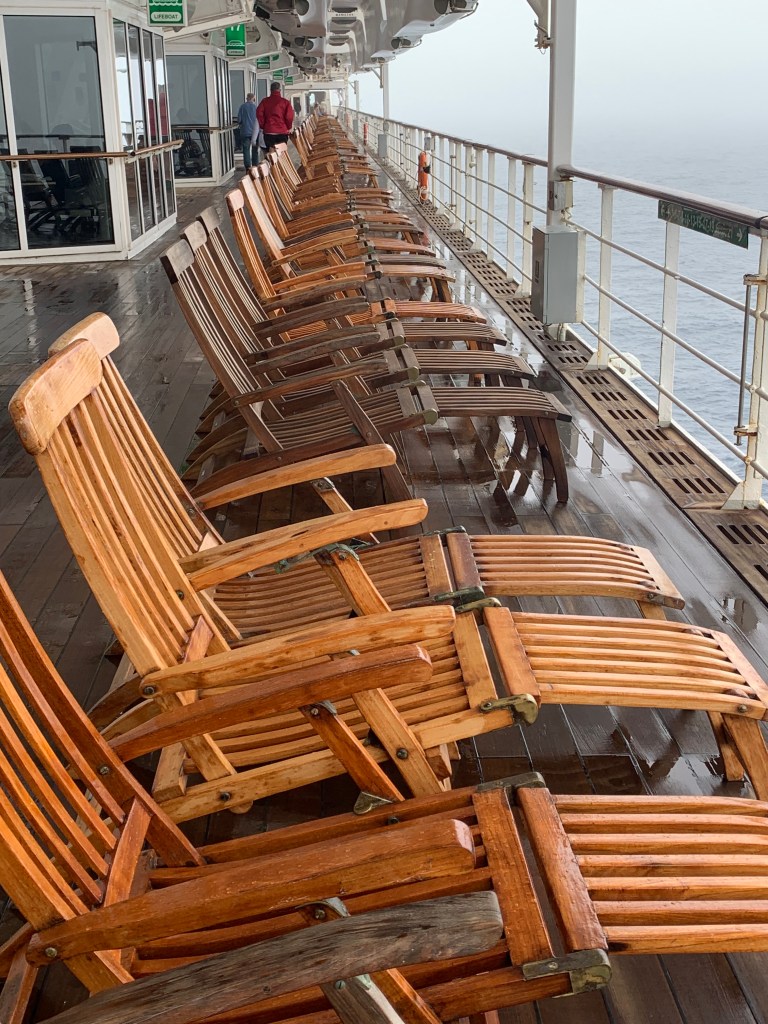
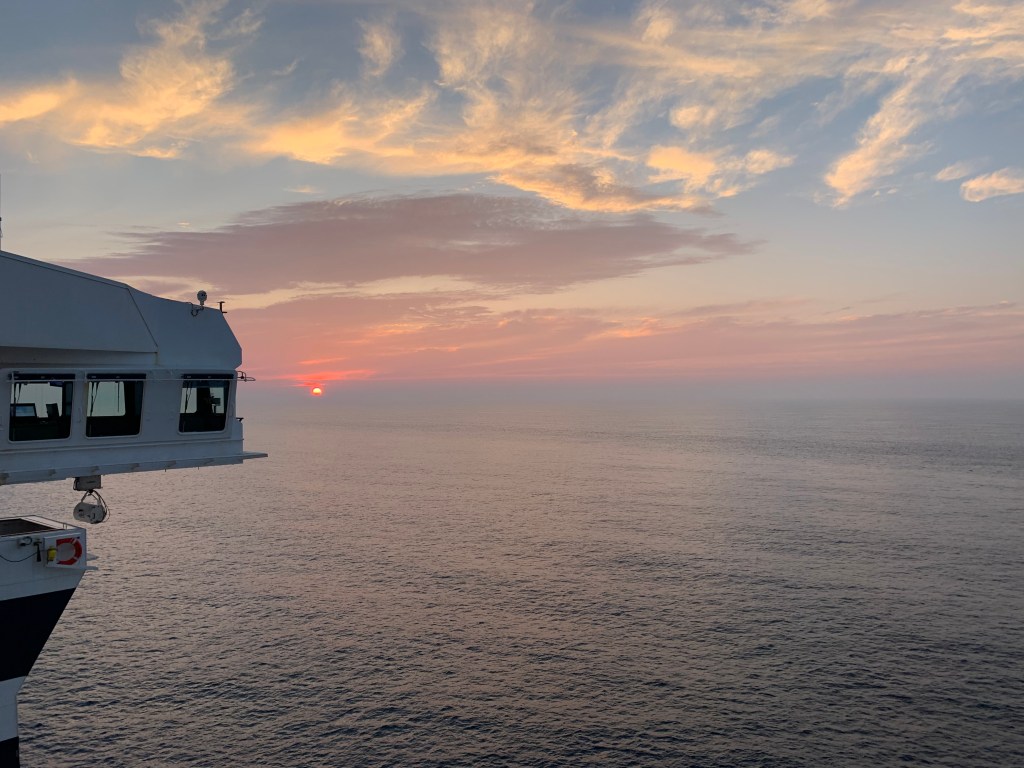
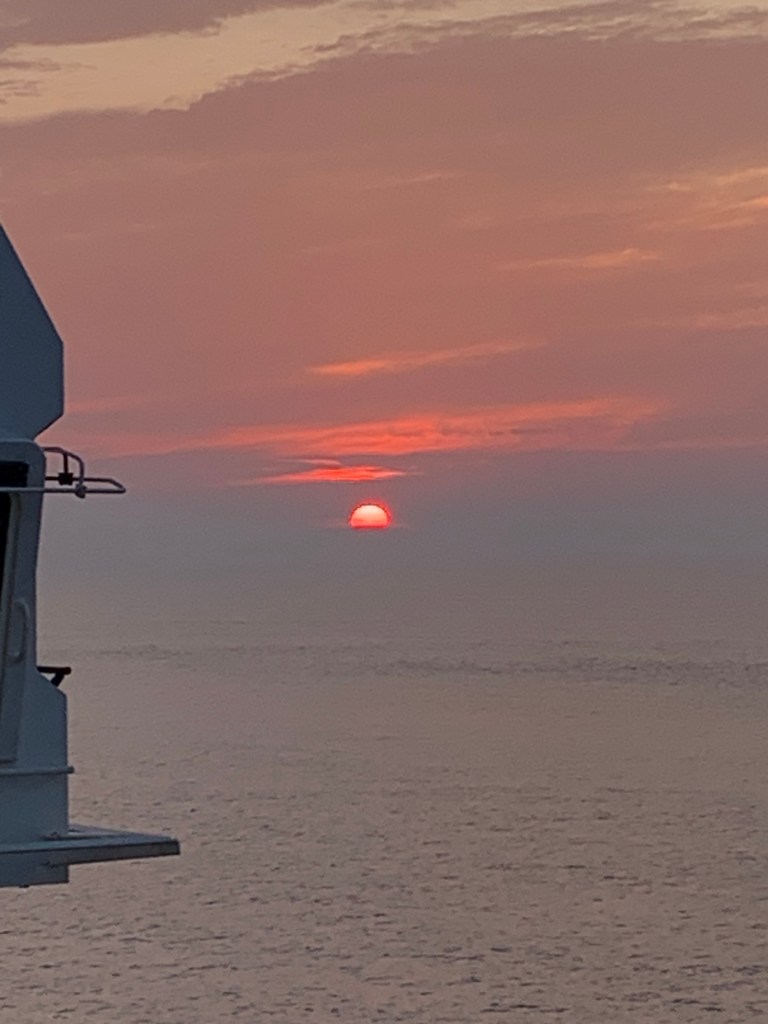
The deck chairs beckoned, but most days it was too cold to lounge. We had one of the foggiest crossings ever, according to other passengers who have done the crossing many times. It was only on our last full day that we saw the sun shining on blue ocean and I was able to sit out on deck. It was also the first and last sunset of the crossing.
But somehow, I hadn’t really minded the fog that accompanied us for most of the trip. Perhaps it enhanced the feeling of existing somewhere in the “mist of time.”
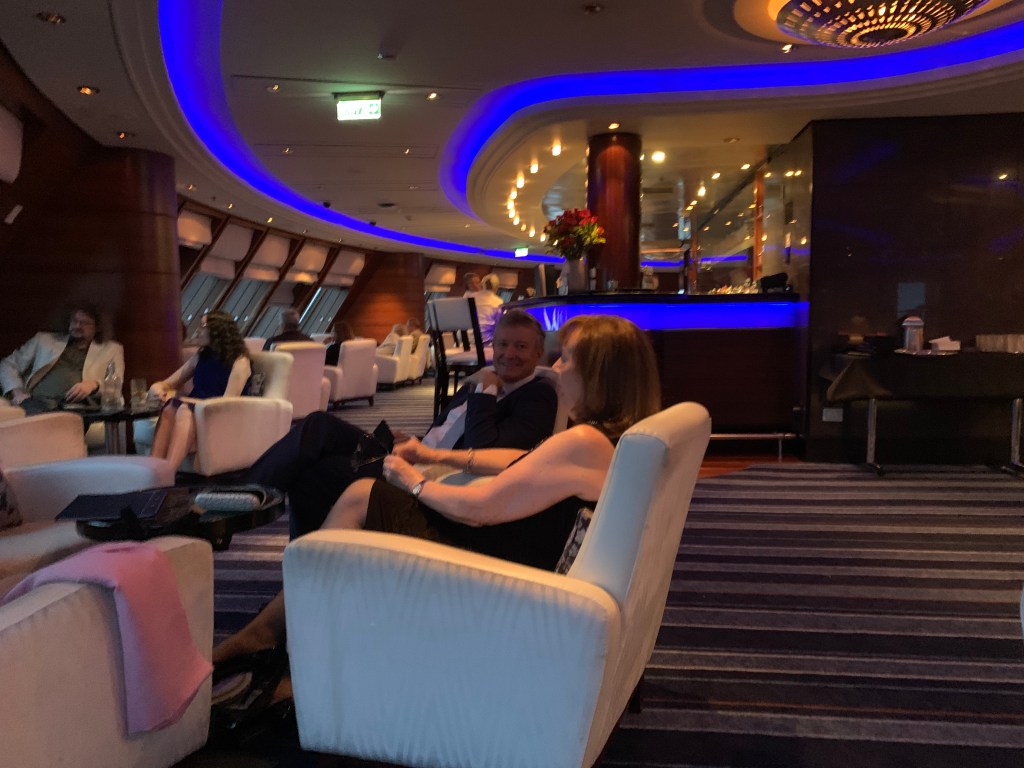
Santo found the Deck 8 library early on and took out several gardening books. I got there mid-week and chose a novel by Anne Tyler. It was also later in the week that I discovered the Commodore Club on Deck 9, at the very front of the ship. It follows the curve of the bow, windows all around, white leather chairs and simple adornments. The sea is this room’s décor. It seems to be a favorite spot for reading with all the light streaming in all those windows.
There are three lounges near the dining room on Decks 2 and 3. Each has its own character: the Chart Room has a nautical feel with maps, a combination of deep and muted blues, and lots of wood. Across the way is Sir Samuel, which serves specialty coffees. It is very simple, with a coffee house feel. The third lounge is the Golden Lion, a typical British pub with plaids in deep reds and greens, high back chairs, and TV’s to watch sporting events. The men’s final at Wimbledon took place during the cruise and the room was packed. Over the course of the week, the four of us would meet at one or the other of these lounges for a pre-dinner drink, or a late evening nightcap.
Everywhere we went, smartly dressed waiters, and a few waitresses, offered drinks and served us at our tables. Each lounge had a slightly different drink menu, and I got to sample some very interesting mocktails, as well as every flavor of Pellegrino: lemon, lemon & mint, orange, and my favorite, orange pomegranate.
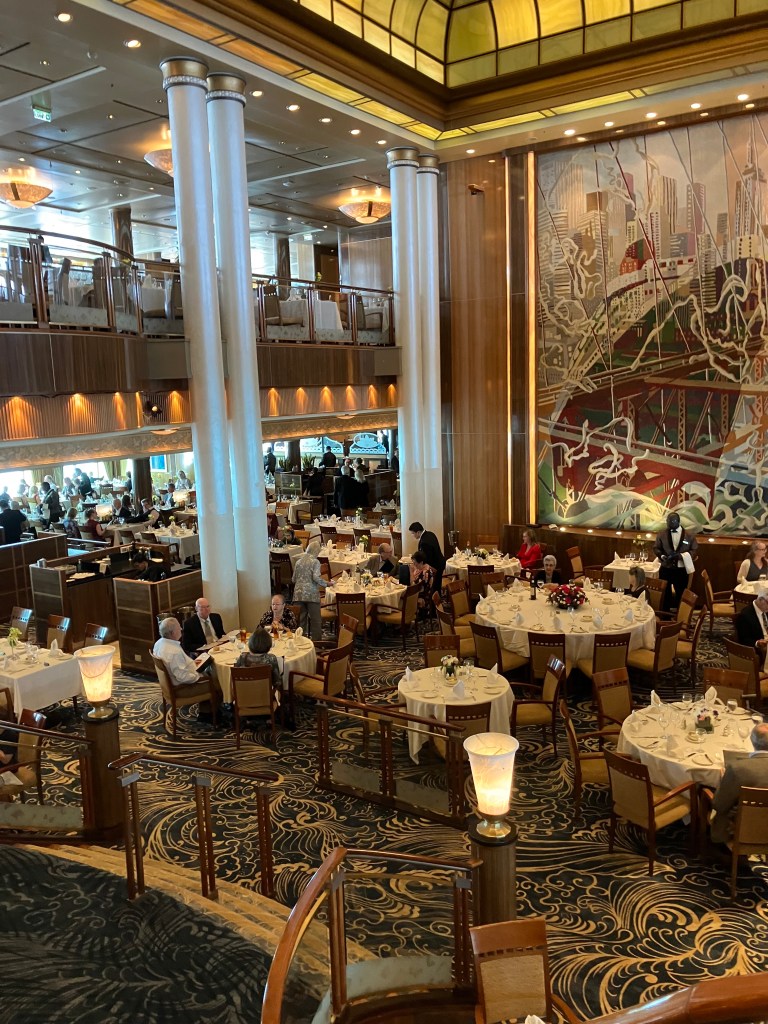
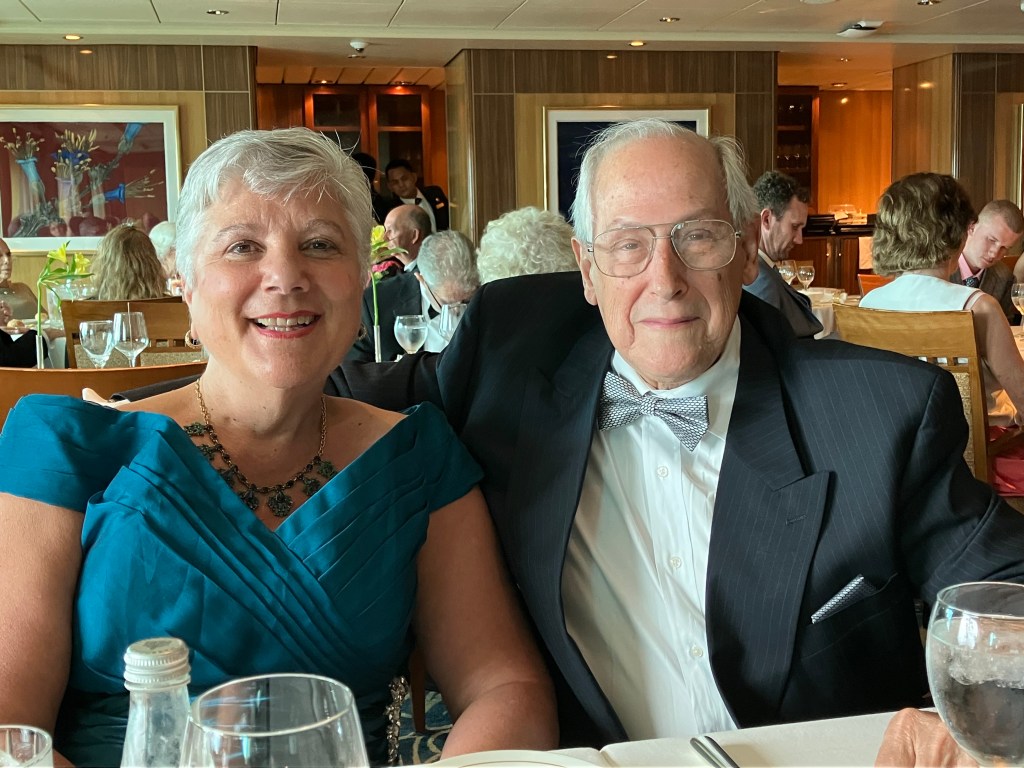
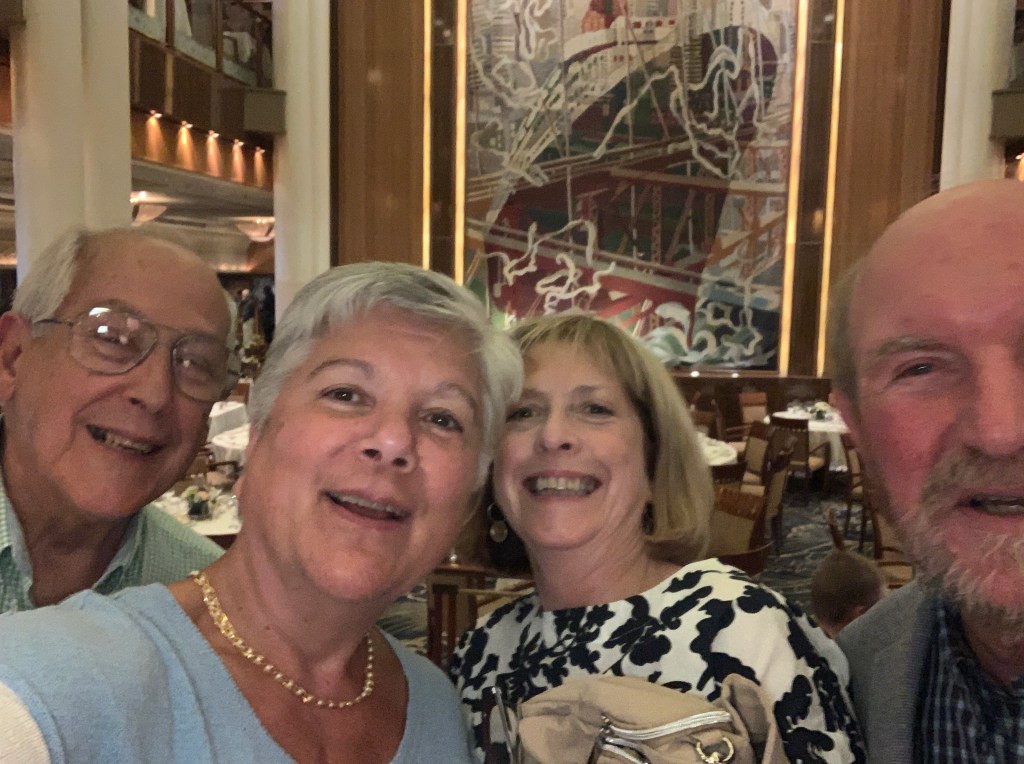
Dinner was in the main dining room, Britannia. We had the same waiter, Norman, and sommelier, Daniel, every night. The beauty of this room never got old. Dinners were four courses plus dessert, though we usually only ordered three, and once in a while a dessert to share. We would each talk about our days and the varied ways we had spent them. Then we’d discuss our plans for the evening: the show in the theater, music here there and everywhere, or the evening’s gala.
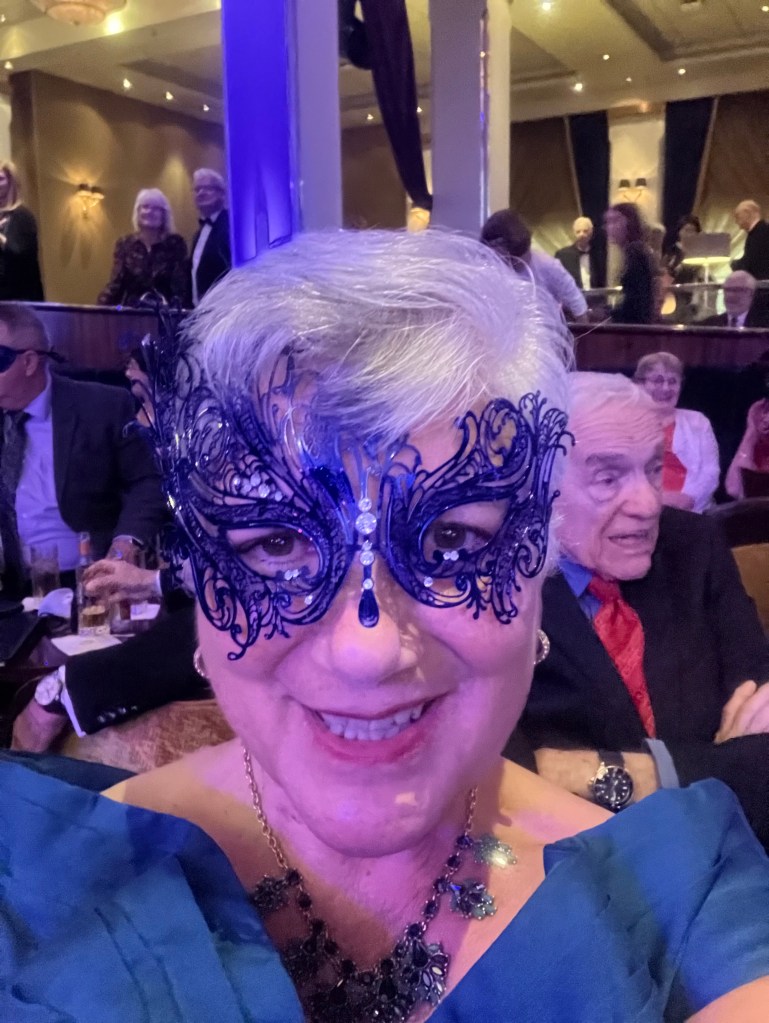
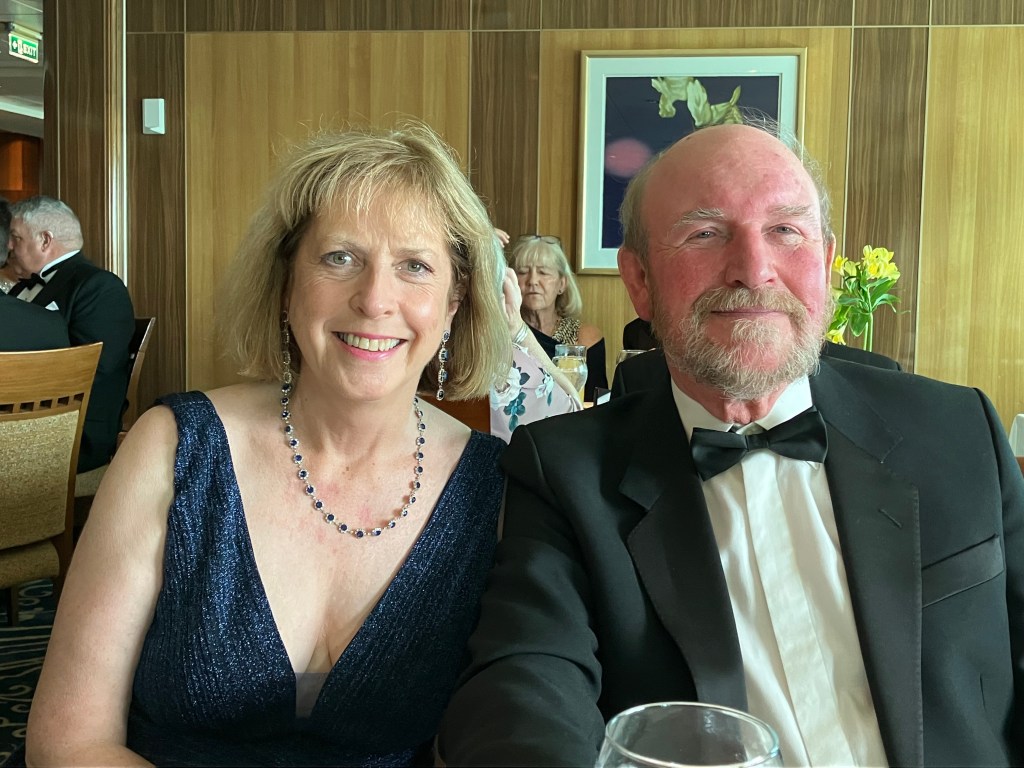
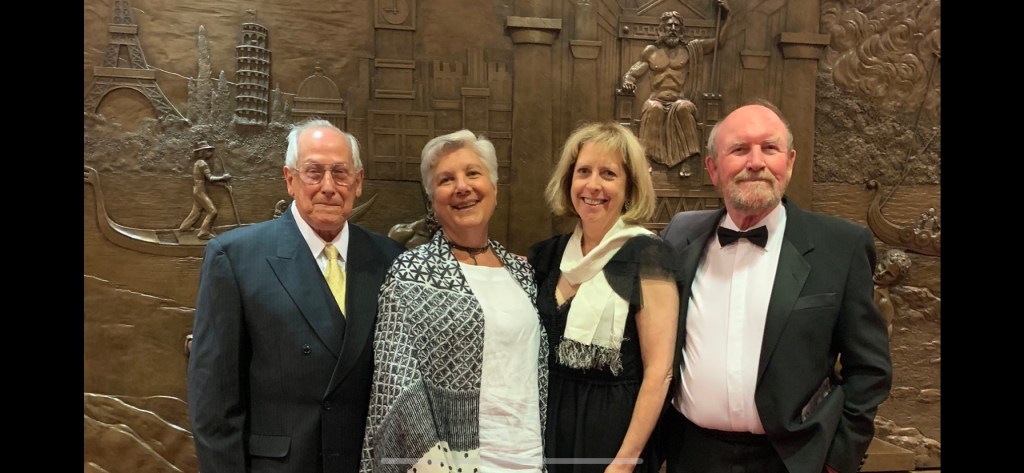
There were two galas on our crossing: the Black-and-White Gala and the Masquerade Gala. The Black-and-White was the second night, and we were not much in the mood for it. I was feeling my lingering bronchitis worsening and Alison had been seasick most of the day. I just not feel like getting dressed up, so chose my black dress pants, white linen top, and the new black-and-white shawl I had bought in Rothenburg rather than the evening wear I had packed.
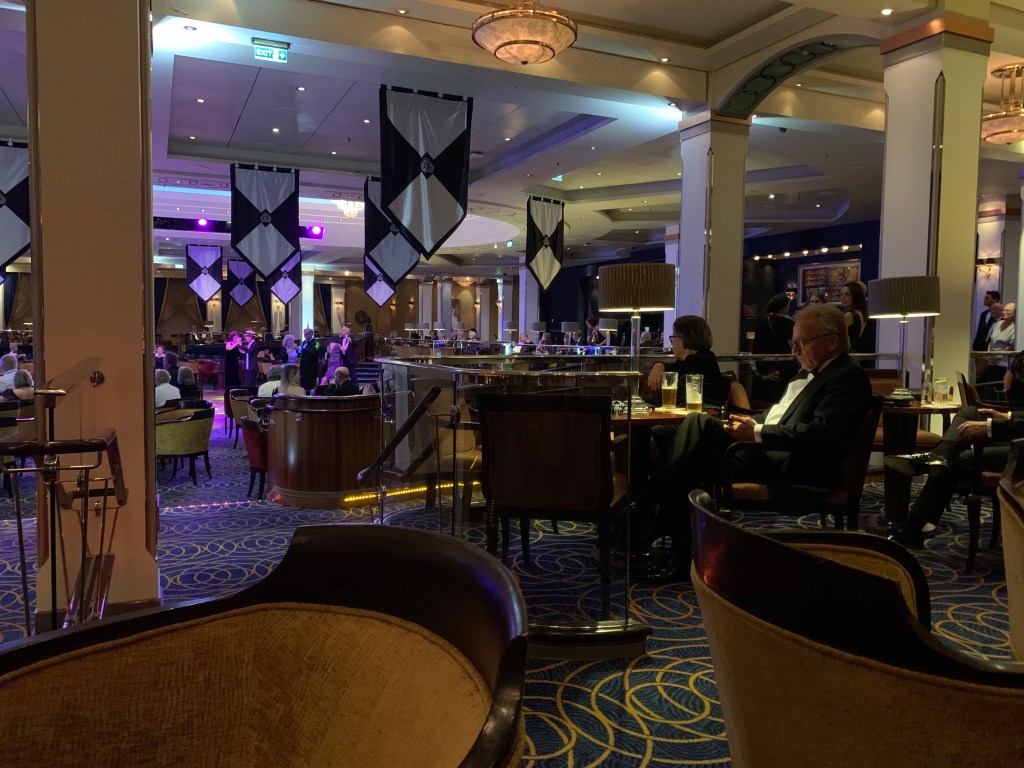
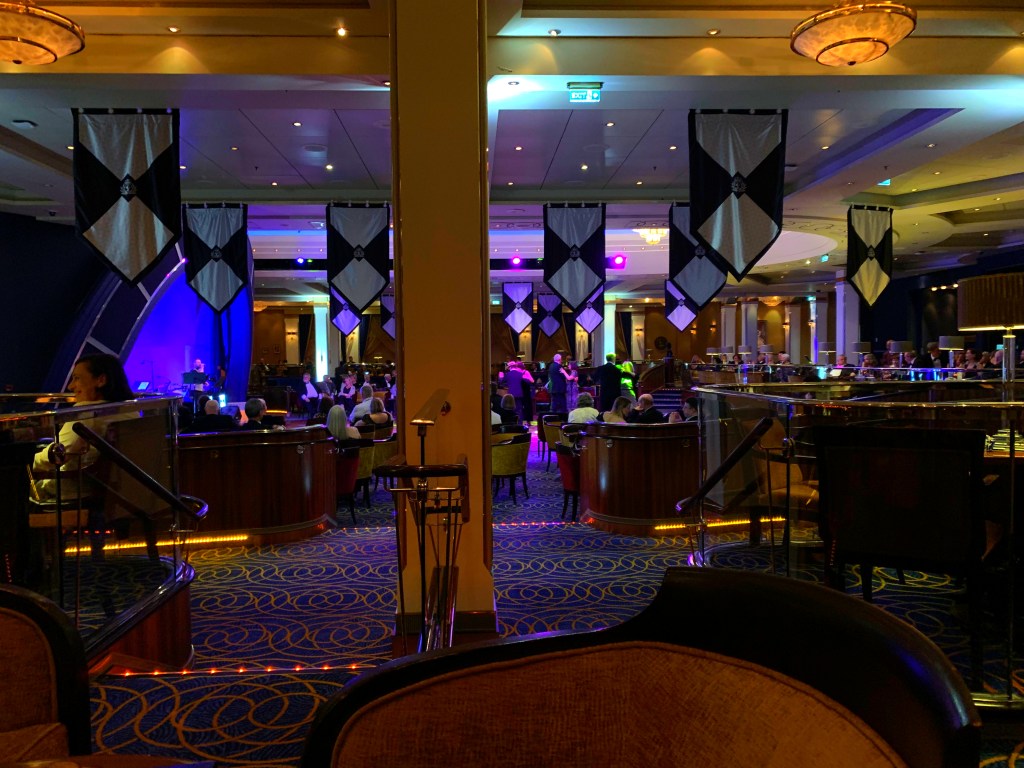
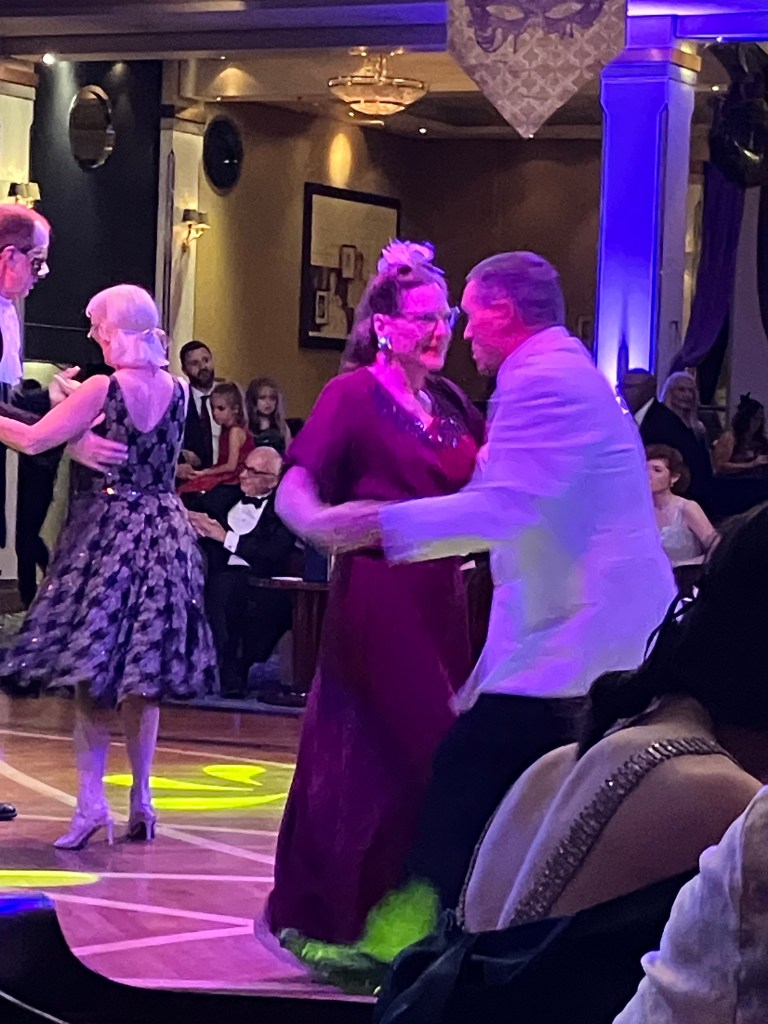
None of us thought it was much of a gala. The room was wonderful: a tiered cocktail lounged with a large dance floor and a stage for the orchestra. Shaded lamps glowed on every table, and the curved brass rails separating the tiers gave a wonderful curving sweep to the space. Many of the tables were taken, but we found one on an upper tier facing the side of the stage. We had expected people to be standing and mingling and generally a more festive atmosphere. It seemed very sedate, everyone just sat in their own small groups, and the music was contemporary music by a band rather than an orchestra. We didn’t stay very long, but were glad we had at least made it there.
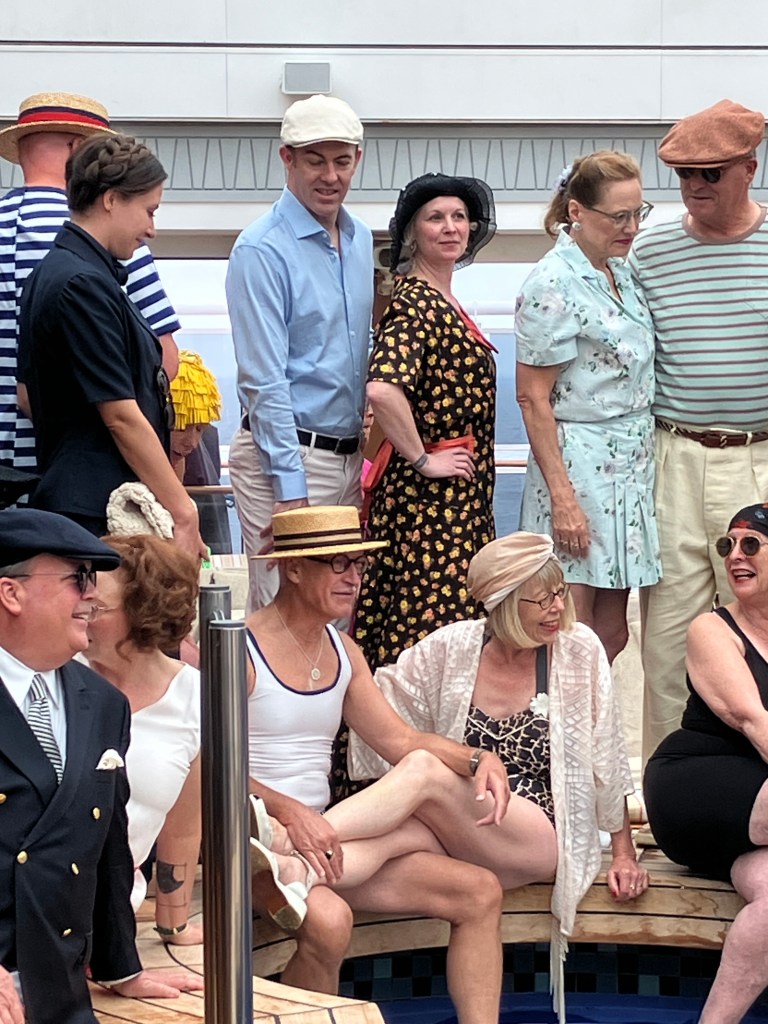
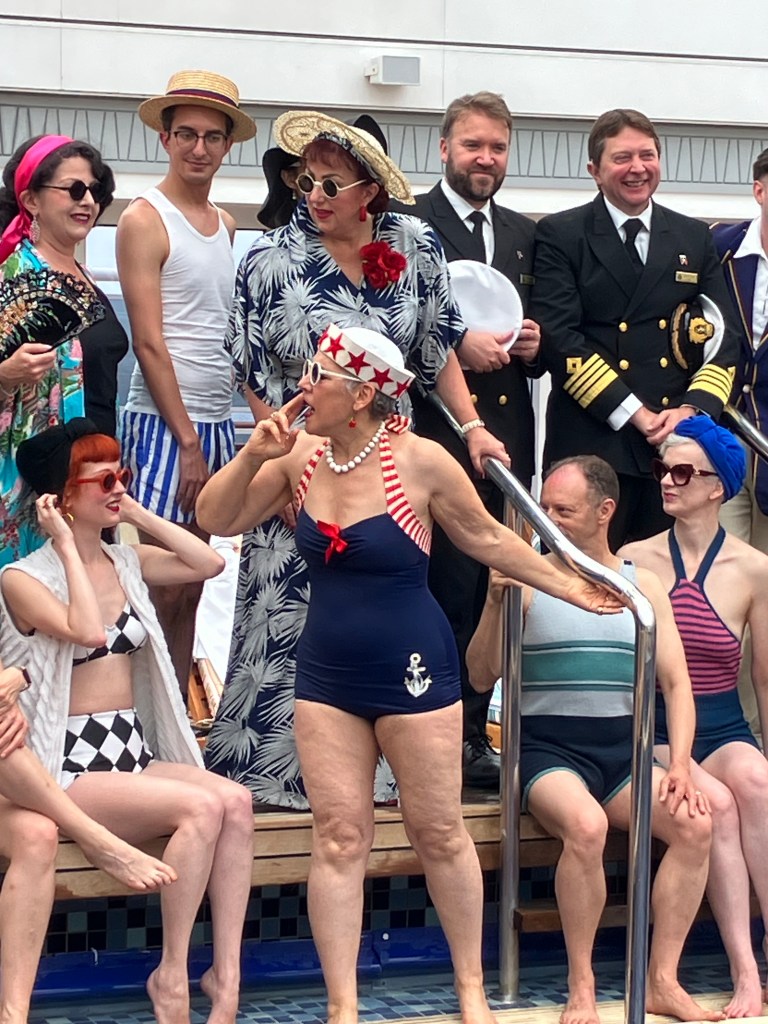
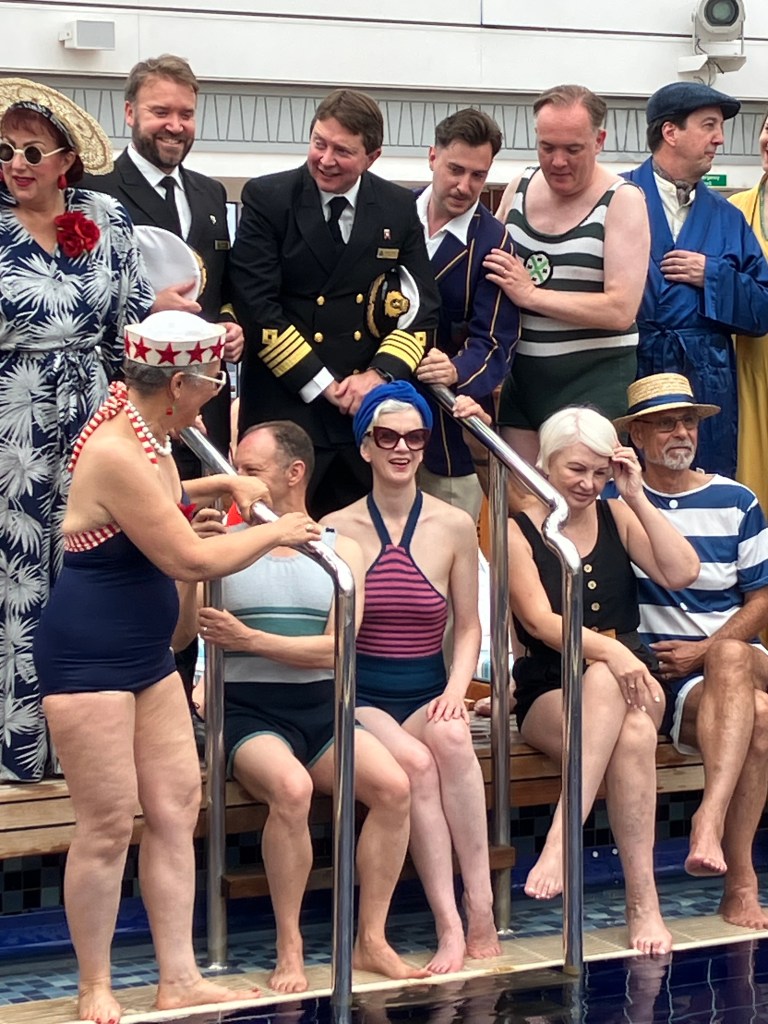
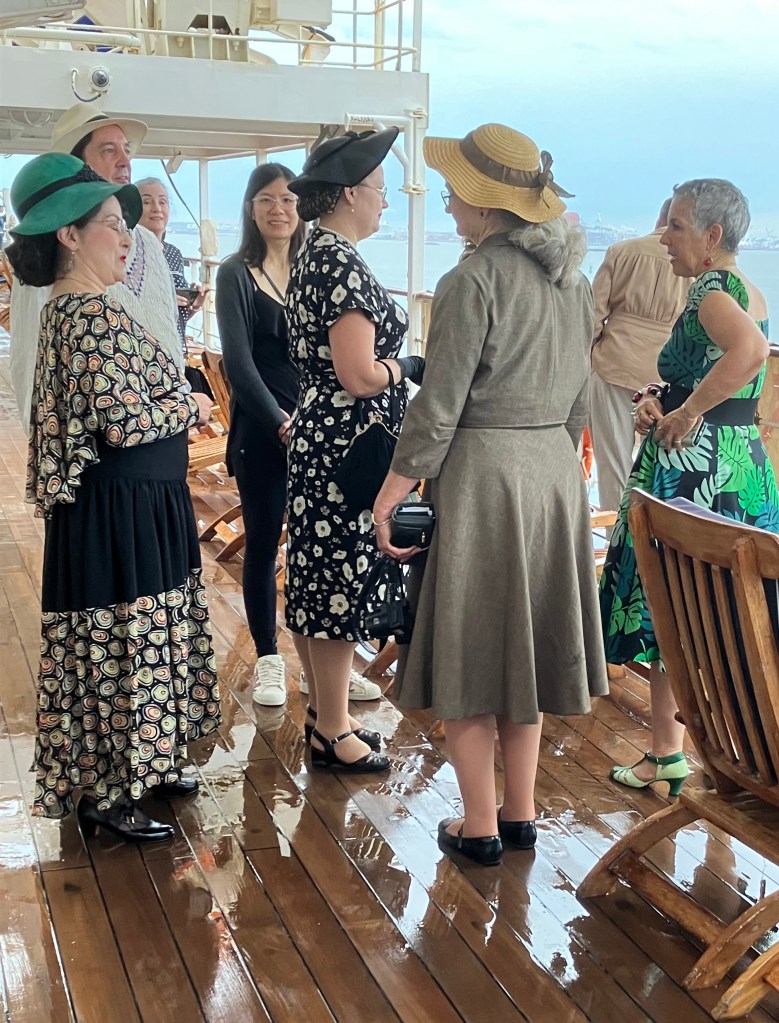
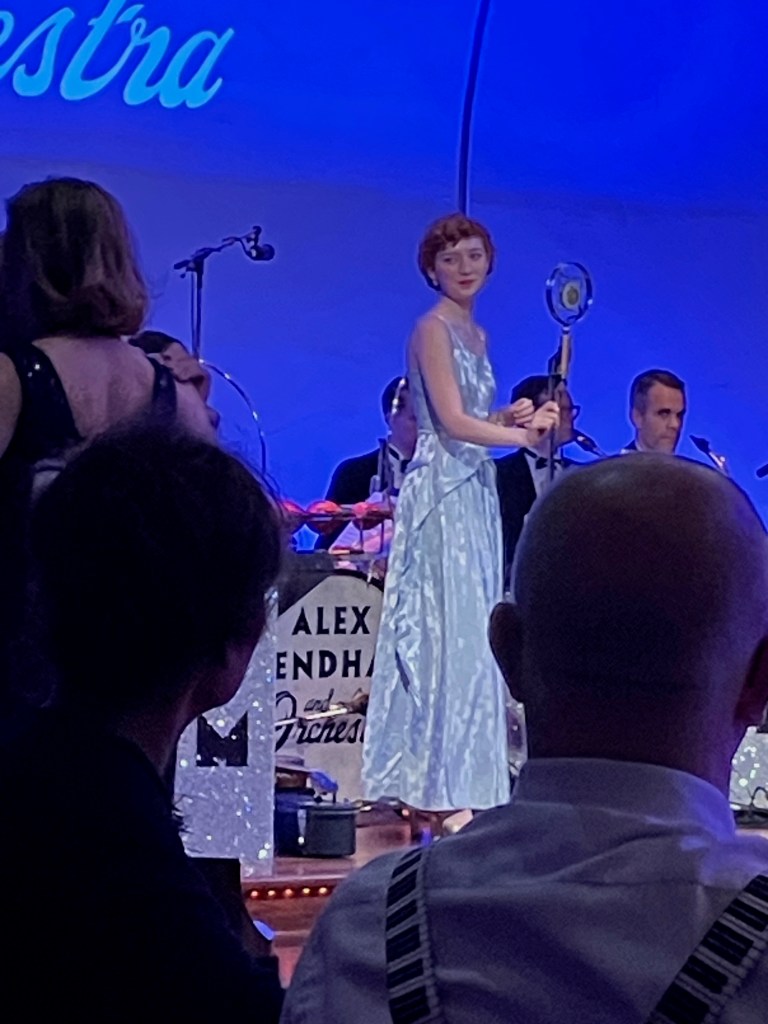
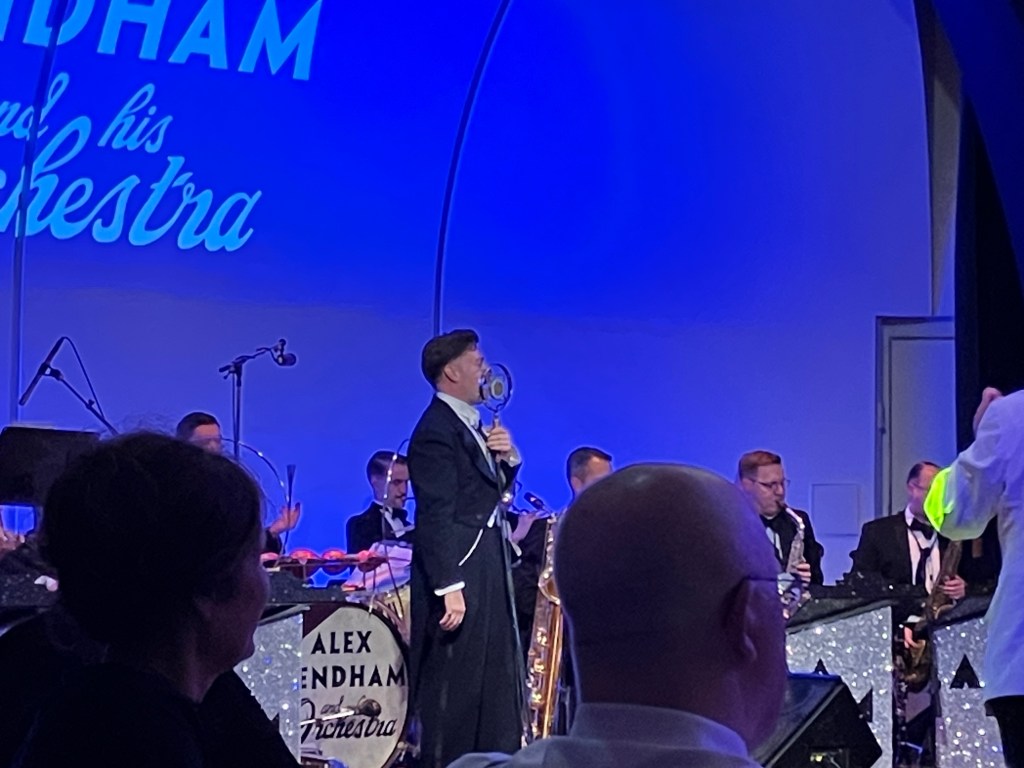
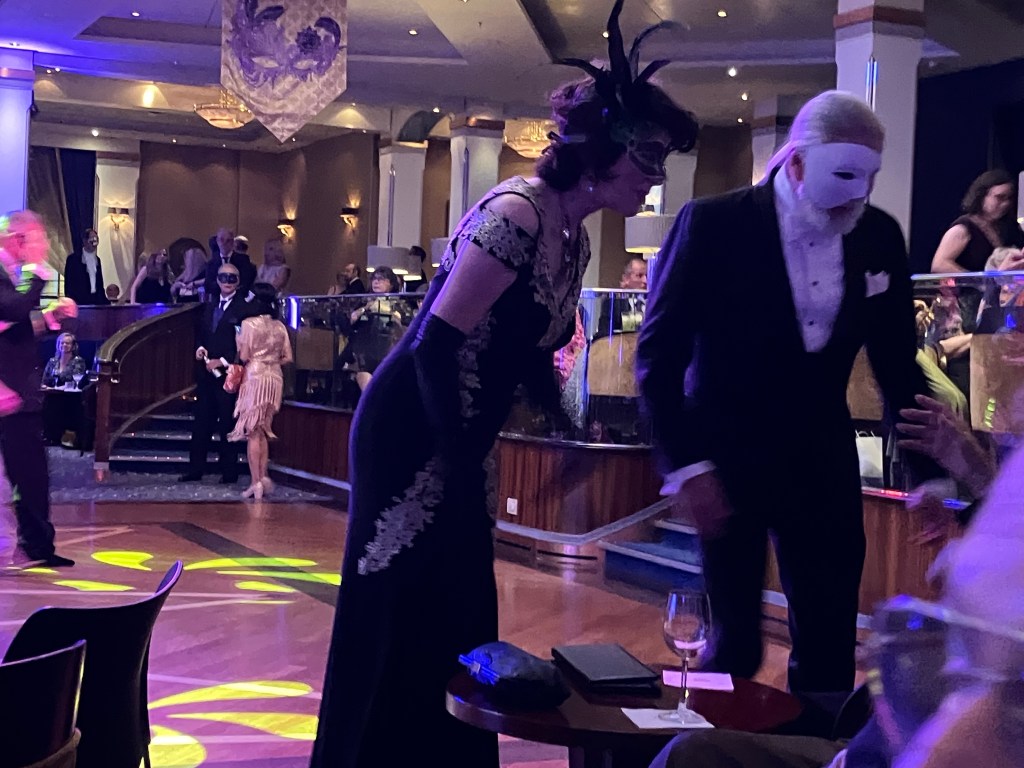
The true gala was the Masquerade Gala! There was a wonderful orchestra that played music of the 20s, 30s, and 50s. There was a troupe of dancers that apparently accompanied the orchestra. They were all dressed in wonderful period clothes and the dancing was spectacular. We had gotten there early and had seats up front so we could enjoy every moment. The troupe members had worn vintage clothing throughout the cruise. I had seen them here and there throughout the journey and was fascinated by the authenticity of their attire.
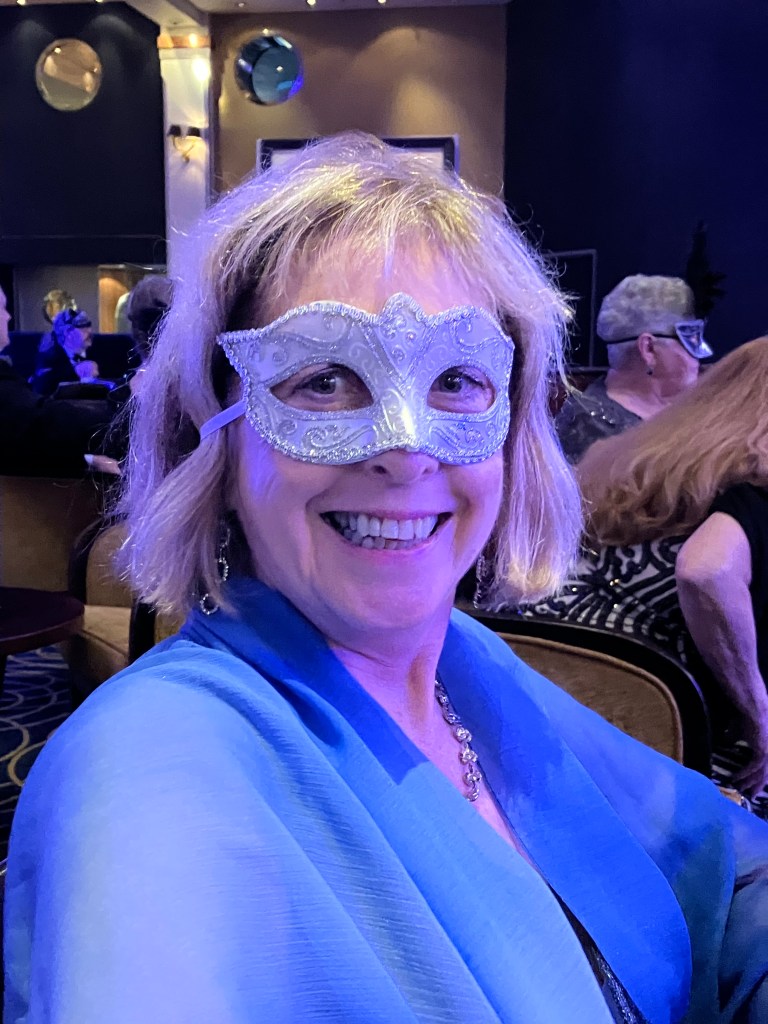
Now I finally knew who they were and why they were dressed that way! Even though their dancing was quite intimidating, we did get up for a few dances. Even Alison and Maurice got up to dance to “A Kiss is Just a Kiss.” Everyone was dressed to the nines, and most had masks. As I looked around the room, at the tuxedoed orchestra, and the dance floor swirling with elegant dancers from another era, I knew that I would never see something like this again. I breathed in the experience, one that would not soon leave me.
Throughout the crossing, there was a wonderful camaraderie among the passengers. If we were staying in a hotel with 2000 other people, I don’t think I would feel connected to the other guests. But here, everyone feels they we are all part of something special, that we are in this together. People chat easily on elevators, at tables near one another, in lounges and restaurants, wherever our paths cross. We have met so many people from so many places: many Brits, Germans, Americans, some Australians and French. Everyone has a story about where they come from, where they live, and how they are here now on this grand ship. During my many hours in the Corinthia Lounge, I loved listening to the cacophony of accents around me. It was a music I knew I would not hear anywhere else. There is an openness and a spirit of adventure and exploration among those who choose a transatlantic crossing in this modern age. We are not only connected to one another, but to the past. We are so blessed to be able to partake of this long tradition.
The four of us decided to enjoy our last light in the Commodore Club on Deck 9. It has a wonderfully elegant vibe at night, with sweeps of blue lighting along the ceiling reflecting in the white leather chairs. A pianist was at the grand piano, playing with ease and emotion, creating a perfect soundtrack to our last night.
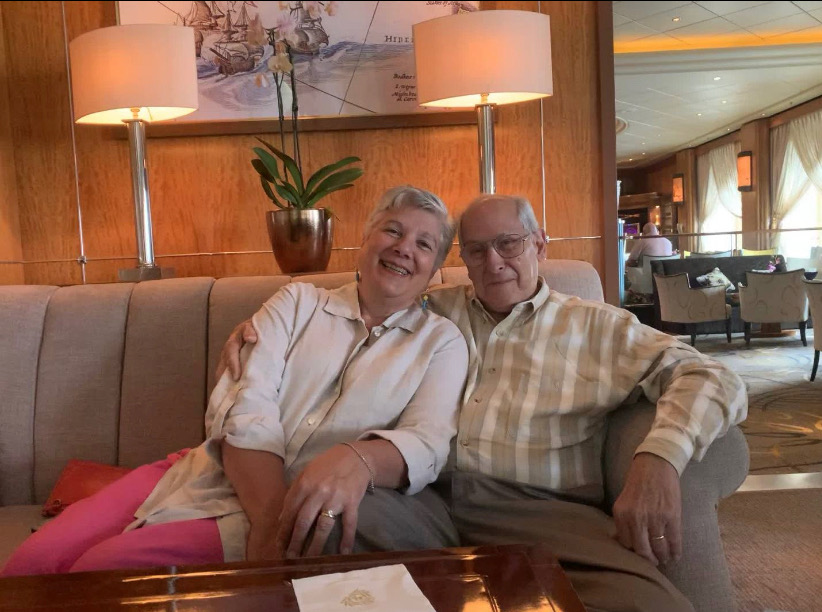
The highlight of the crossing? Being with Alison and Maurice. We melded so easily together, all four of us. They are so easy to be with, so like us in so many uncanny ways, such salt-of-the-earth people. It is hard to believe we have not seen each other every week for decades. That, in fact, over four-plus decades, Alison and I have only seen each other four times, and the four of us had only been together once before this. How is it that God plucks people from another continent, another culture, to fill a place in our hearts no others can?
We talk a lot about seeing each other again soon. Maybe they will make it to Auburn. Maybe we will have a holiday with them in Ireland. We said the same when I left Belfast after my visit six years ago. I pray it is not another six years until the next reunion. We are getting too old for such long intervals! And yet, when I am with Alison, we are the nineteen- and twenty-year-old students still figuring out who we are and who we want to be, still feeling drawn to one another, still laughing at the same things (except now it is how similar our husbands are), still dreaming dreams (though some of them now are for our children), still excited about what is yet to come. What a blessing the serendipity of this reunion vacation has been!
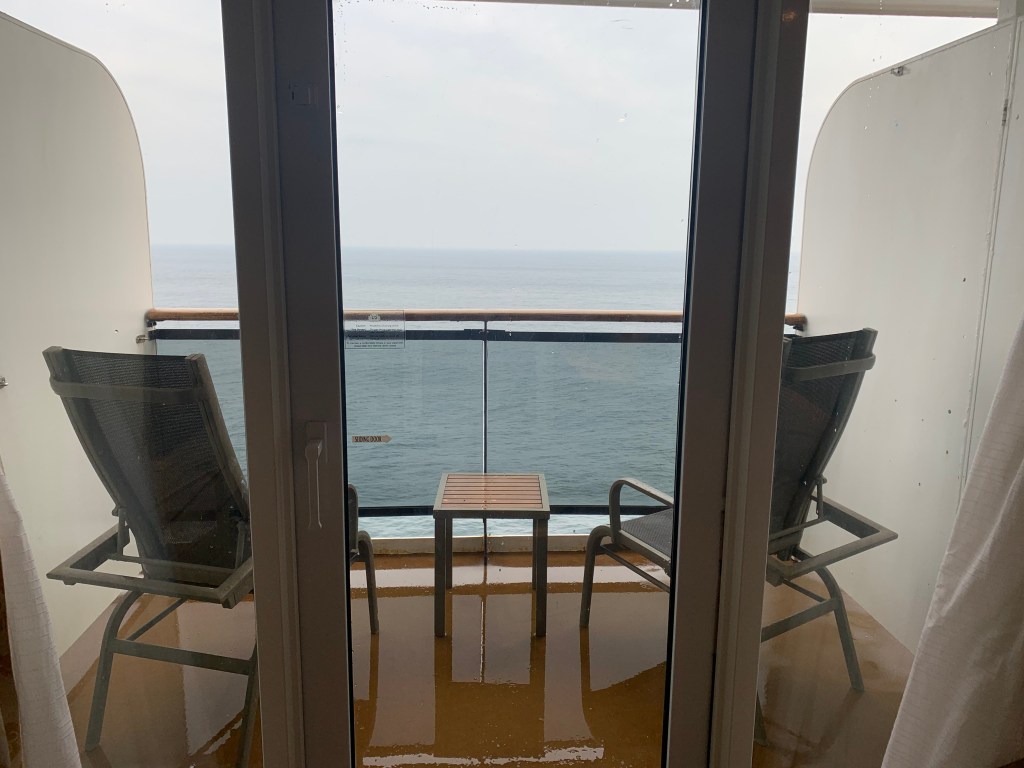
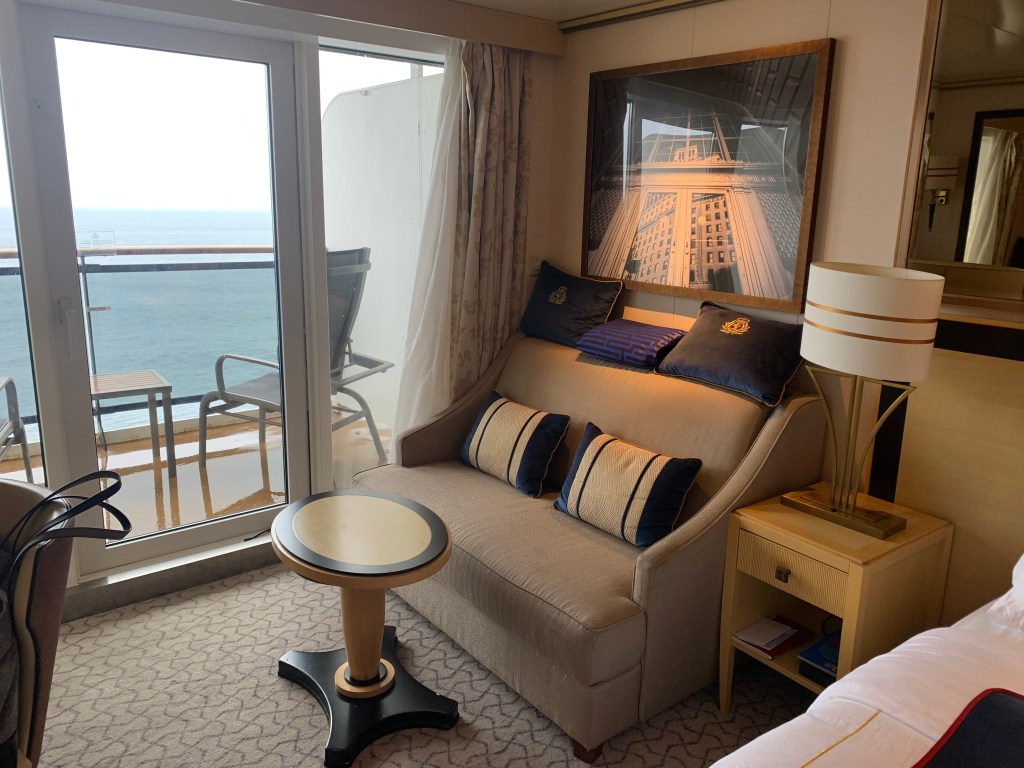
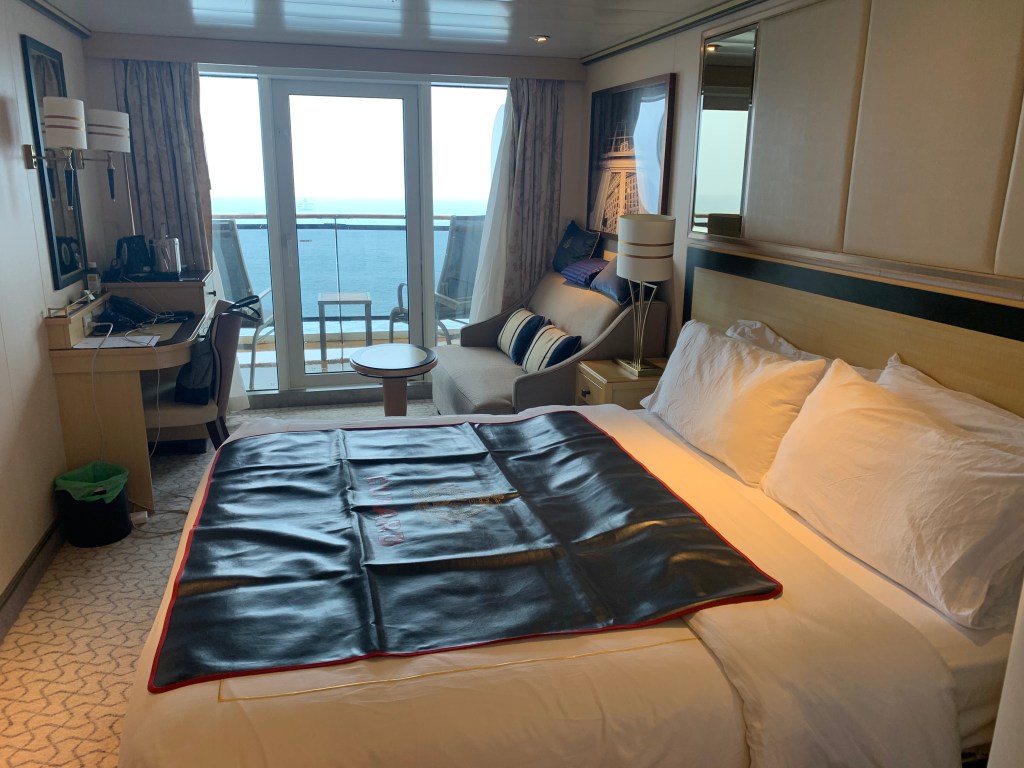
Santo and I have also enjoyed many happy hours in our stateroom. It is such a comfortable, relaxing place, with as good a view of the ocean (or the fog) as anywhere on the ship.
On our second day onboard, I was feeling worse and contacted the ship’s doctor. They sent someone to our cabin to do a COVID test before they would see me. I knew if I was positive, it would mean I would be confined to the cabin for the rest of the trip. While this would be difficult, I felt it wouldn’t really be that bad: I could eat the same food delivered to the room while every inch of the stateroom let me know I was on board the Queen Mary in the middle of the Atlantic. Luckily, my test was negative and the doctor was able to see me. She prescribed cough medicine with codeine and a medication for the “yicky” feeling in my mouth. She thought the dry air on the ship had exacerbated my lingering cough, but since I was not wheezing and my lungs were clear, she did not think there was still active infection, just the after-effects. I hoped she was right.
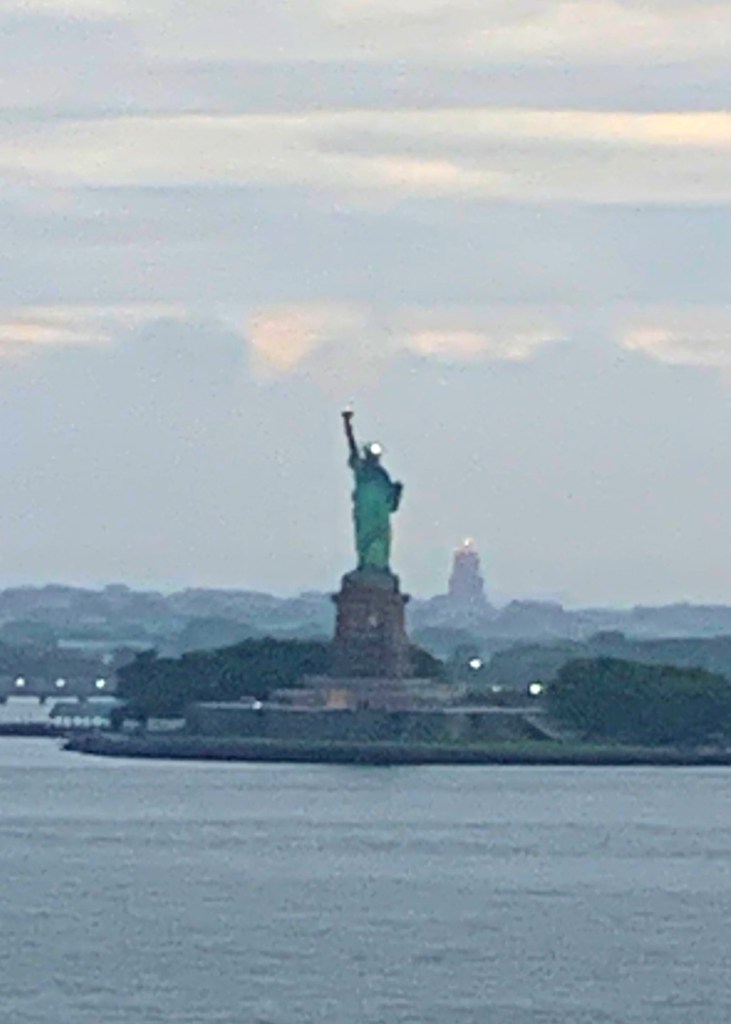
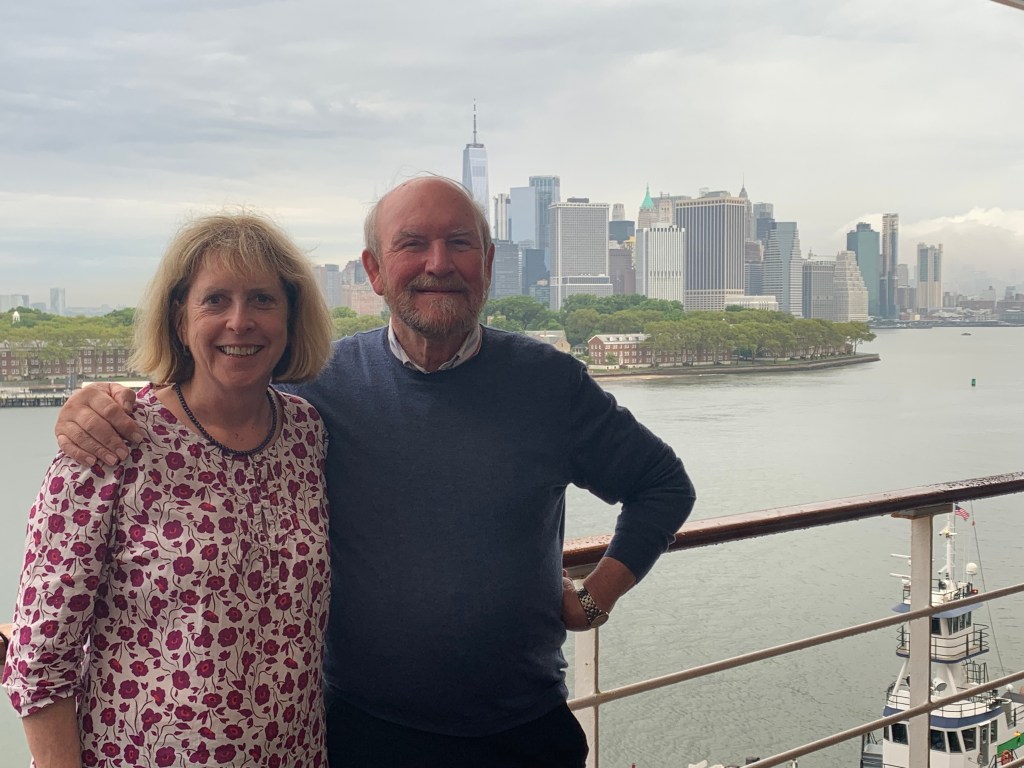
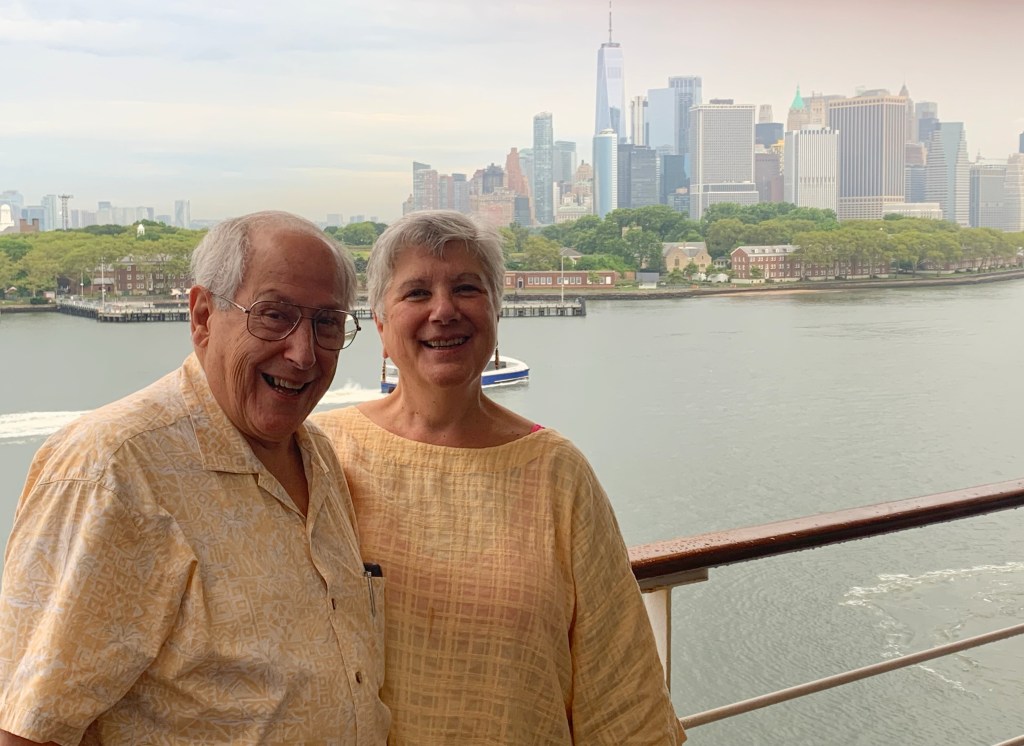
Early on our last morning—by early I mean 4:45 am—we got up to watch the ship come into New York Harbor, under the Verrazano Bridge and approach the Statue of Liberty. We went down one deck to the Observation Deck where people were already gathered. Dawn was brightening the eastern sky as we glided northward, the tallest funnel barely clearing the bridge.
Soon a bright light in the distance signaled Lady Liberty. The white light from her crown was the brightest, but the golden beam from her torch stood high above, atop her raised arm, beckoning.
I remember Oma, my grandmother, telling me about the moment she saw the Statue of Liberty when she sailed to America in 1925 with two children in tow. She had not wanted to make the journey, to leave everything she knew behind in Germany, but she had to follow her husband who had come two years earlier. When she saw Lady Liberty, she was filled with a new hope. Perhaps there would be something for her in this country. Perhaps this new life would be a good one. Almost 100 years later, I am taking in the same view, in a style she could never have imagined. Her dreams came true in me. Her hardships paved the way for the blessings of my life. I am grateful to Lady Liberty for giving that frightened young woman the courage to persevere in her new life in America. As we pass the grand Lady, I close my eyes and nod in silent prayer, thanking them both.
We had set our alarms for 6 am, got packed quickly, and enjoyed the breakfast the hotel “had sorted” for us. Not only cereal and milk, but yogurts, breads, and jams as well. We left with the sweet taste of The Devonshire’s hospitality in our mouths.
We knew no one would be at the hotel at this hour. At the bottom of the stairs, I pushed on the door to the pub and restaurant to get to the front door and – LOCKED. We tried the two keys on our room keys with no luck. We knocked on the glass pane of the door, hoping maybe someone was here. We saw a door marked “Private” and knocked on that. There was a door behind to a rear patio, but the space looked enclosed. We were stuck. Finally, Santo decided to explore the patio area while I stayed at the door. In a minute, I saw him waving me to come out. There was an emergency exit gate around the back corner of the patio. When we got through the gate, I couldn’t at first see a path to the street, just the stone walls of the surrounding buildings. But there was a narrow walkway between two buildings—free at last.
Once at the car, we did the final rearranging of our luggage in preparation for boarding the Queen Mary. Once we were onboard, we could unpack for an entire week. Heaven!
We were excited for the adventure ahead, and especially to see Alison and Maurice. Alison and I had met forty-five years ago, in September 1978, on the first day of my junior year abroad at Trinity University in Dublin. We lived on the same floor of a Trinity dorm located on the outskirts of Dublin. We became fast friends. During my year there, I spent many bank holiday weekends, when other students went home for the weekend, with Alison and her family in Belfast. Her parents, Eric and Sadie, were so like my own parents. I fell in love with them immediately.
In the intervening years, Alison visited me in the states twice and I visited her in Northern Ireland twice. Every time, it was as if we had never been apart and no time had passed. Friends can be soulmates as well, picked by God to accompany one another in life, whether they are on the same continent or not.
As I was planning our trip, I had consulted with Alison about our time in the U.K. She had suggestions for our itinerary. After several variations, I settled on our plans for our U.K. visit. I sent Alison a copy of the spreadsheet I had created for the trip, showing the U.K. portion to double-check it with her. As soon as she got it, she noticed at the very bottom “Southampton—Board the Queen Mary.” She immediately texted back, “Are you sailing home on the Queen Mary?!?!?! I’ve ALWAYS wanted to do the transatlantic crossing to America!”
“Yes,” I answered. “It would be wonderful if you could join us!” I didn’t really think it would be possible, particularly since our cruise was already booked and the dates set. But she said she would “work on” Maurice, her husband, who would be more reluctant about the trip. I didn’t even say anything to Santo. About two days later, I could a text from Alison, “Maurice agreed! Can you send me the details of your booking?” WOW! I was beyond excited. Then I realized I had never asked Santo what he thought of Alison and Maurice joining us. They had visited us when all of our children were young and I knew Santo enjoyed both of them very much. But still … I think perhaps I should have asked him. When I did, he was as excited as I was. Whew!!!! In another two days, Alison texted again, “We’re in the stateroom next to you!” It all seemed unbelievable and too good to be true.
Now we were within hours of reuniting with Alison and Maurice.
The drive from Grassington to Southampton was rainy the whole way, but we didn’t seem to care. Once we were on the main highways, Santo was very comfortable driving. We hit some traffic, and the weather slowed us a bit, but we made it to the Southampton airport, where we would return the car, in plenty of time to get to the cruise terminal for our 2:15 boarding time.
I had set the GPS to the Avis Car Rental at Southampton Airport. Just as we pulled up to the sign, I realized the mistake I had made: this car was rented from National NOT Avis. The sign said Avis, Hertz, EuropCar, and Enterprise, but not National. Apologizing to Santo, I tried to re-set the GPS to find the National car return. I set it to an address that seem correct, but when we got to “our destination” there was no National car rental in sight. The airport was a mass of one roundabout after another. We looped around for a bit, then pulled into a building where there were lots of cars and activity. Santo parked illegally while I ran in to see what I could find out. It turned out this was the train station. The uniformed man at the counter knew nothing about car rental places and told us to get to “the airport.” We thought we were AT the airport. Another gentlemen waiting for a train overheard us and tried to direct me how to get back to the main terminal, and said that the car rentals should be near there.
Back in the car, we looped around some more, then decided to reset the GPS to the Avis location and ask there where the National was. We got back to the Avis sign, and noticed that at the bottom it said, “All other car rental companies, go to Short Term Parking.” We found Short Term Parking in the GPS and headed out again. It turned out Short Term Parking was right next to where we were, except we had to loop all the way around to get there. We pulled in and took a ticket. We figured we would be returning the car so wouldn’t need to pay anything. We drove around Short Term Parking and still no sign of National. We asked a man we say if he knew where it was, and he told us National was Enterprise. Enterprise had been on the original sign with Avis, Hertz, and EuropCar. There was only a barrier of low cement posts that divided Short Term Parking from the car rental return, so we could see the Enterprise booth. We drove up, and I crossed over to ask how to return our car. The woman at Enterprise said we needed to go out of the parking lot, around to the other side of the building, and come back in at the exact spot we had first arrived at when we got to the airport! She told us to ask the guy at the gate nicely and we shouldn’t have to pay for the “parking.” He was not happy about it, but he did let us through. We pulled round to the other side and go the car returned. Finally!
We made the short walk to the terminal and were advised by some agents outside the building that we needed to go inside to order a cab. There was a desk just for this purpose, and within minutes our taxi was there and we were on our way to the cruise terminal. We would not make our 2:15 check-in time, but thankfully we had until 4:00 to board.
The agent on the sidewalk at the cruise terminal was very helpful in getting our bags checked onto the ship. Then we began the boarding process. It was very organized, with lots of agents directing you into serpentine lines that moved very quickly. As we were making our way to the first line, Santo heard shouts, “Debbie! Debbie!” He looked over, and saw a woman waving from the line going into security. Santo bumped my arm, “Look!” and pointed to the woman. I looked over. “Who is it?” I said, and then in an instant realized it was Alison and Maurice! It wouldn’t be long now.
We were a bit muddled finding our cabin, but got there without too much trouble. Our bags were already waiting outside our stateroom, including the one we had had shipped from Auburn. As we were opening the door and beginning to get the bags inside, Alison and Maurice came out the door to the adjacent stateroom. Lots of hugs and smiles and the kind of euphoric feeling that comes at life’s rarest and most special moments.
The stateroom was even more lovely than we expected, with a comfortable sitting area with loveseat and coffee table, balcony with two chairs and a table, king size bed with nightstands, desk and chair, comfortable bathroom, and plenty of room to store our clothes. There was even room under the bed to store the suitcases. We were really here!
I unpacked enough to get ready for dinner. Standing on the balcony for a minute, a beautiful rainbow came into view. A lucky sign? It popped in and out, even double at one point.
Santo was still getting his stuff organized so I popped over to Alison and Maurice’s cabin. We were all a bit confused about everything, especially where to go, but we knew we would figure it out. Santo joined us, and we had a quick chat. We would meet shortly for dinner. We had a table for four for the 6 pm seating.
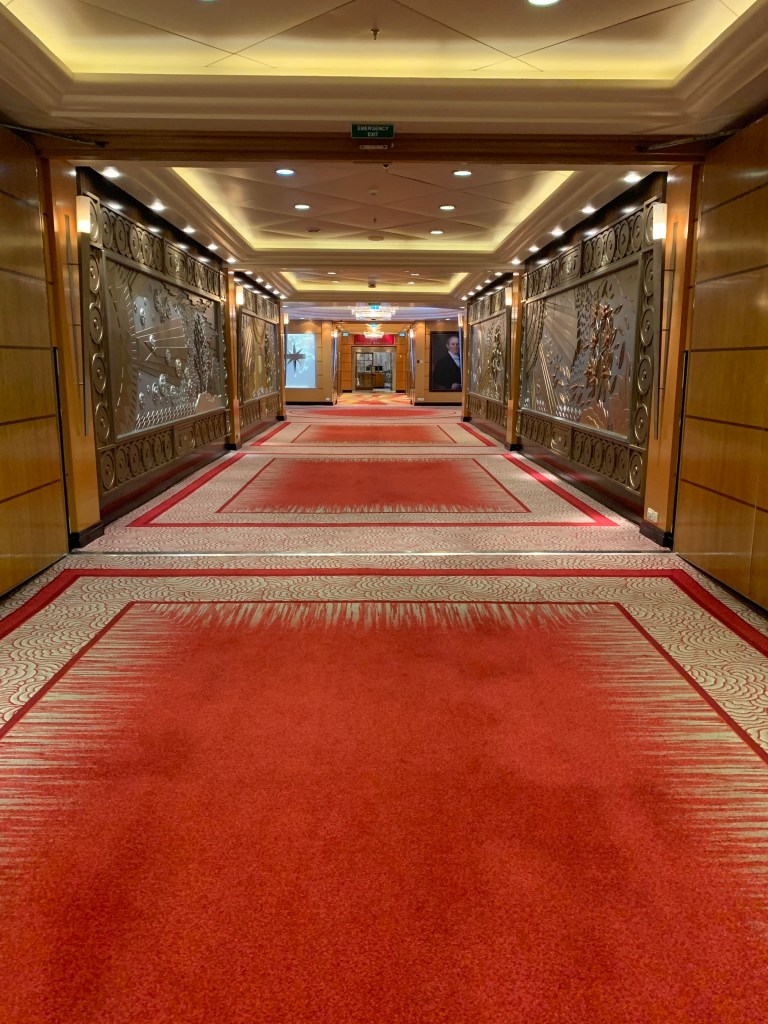
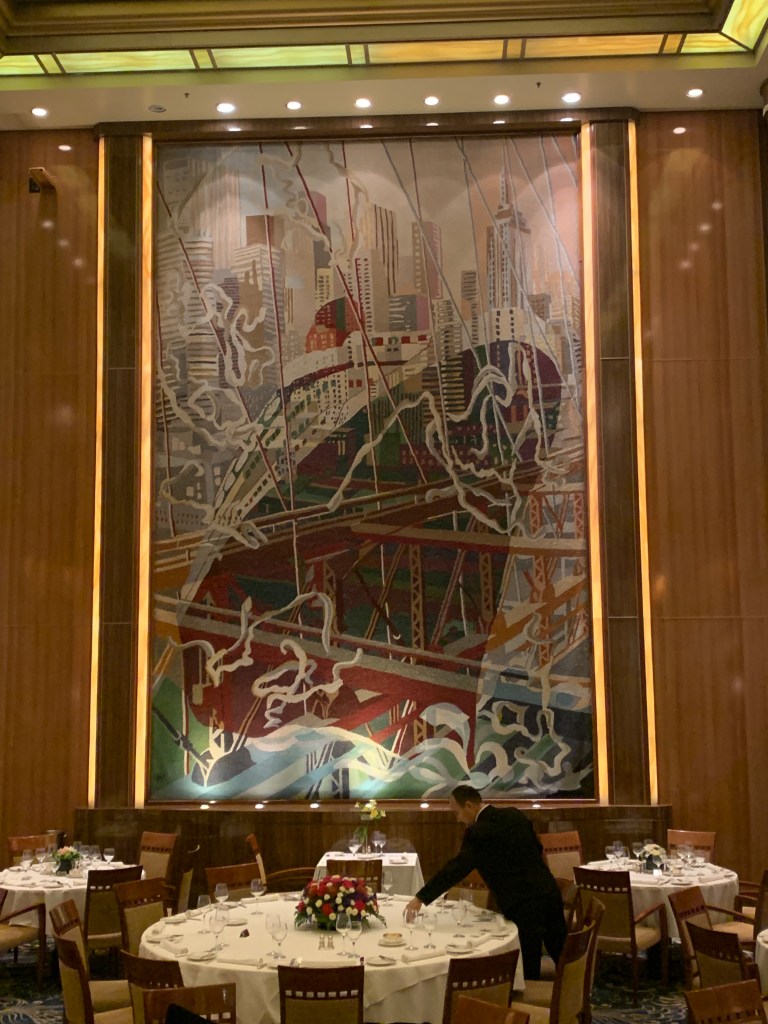
The Britannia dining room on Deck 2 was magnificent. Two levels, rich red carpeting, gleaming wood, polished brass, white tablecloths, and crisply uniformed waiters. A two-store bronze relief of the ship towered two floors at the center of the dining room. There was just one other table for four between us and the windows opening onto the ocean (for now, Southampton Harbor).
We enjoyed our first four-course meal of many to come. It was so easy to talk to Alison and Maurice, as if we were with them all the time. We laughed, told stories, marveled that we were here, talked about our kids, and began to think about what we would do during our time onboard.
While we were lingering over our coffee, the waiters started trying to get us to leave so they could get ready for the next seating. Finally, a supervisor came over to advise us we needed to leave. So we just moved next door to the Chart Room to continue talking. Sitting near a window, we waited for the ship to set sail. The originally scheduled 5 pm departure had been delayed to 10 pm due to weather. Eventually, we saw that we were pulling away from the dock and gliding forward. We were underway!
Tired from the day and still not recovered, we headed to our room. We still needed to unpack before we could get into our bed. Getting everything settled away in closets, cabinets, and drawers was such a freeing feeling. No more packing or unpacking for a solid week!
I feel into the last bed of our long journey and was cradled to sleep by the gentle rocking of the ship.
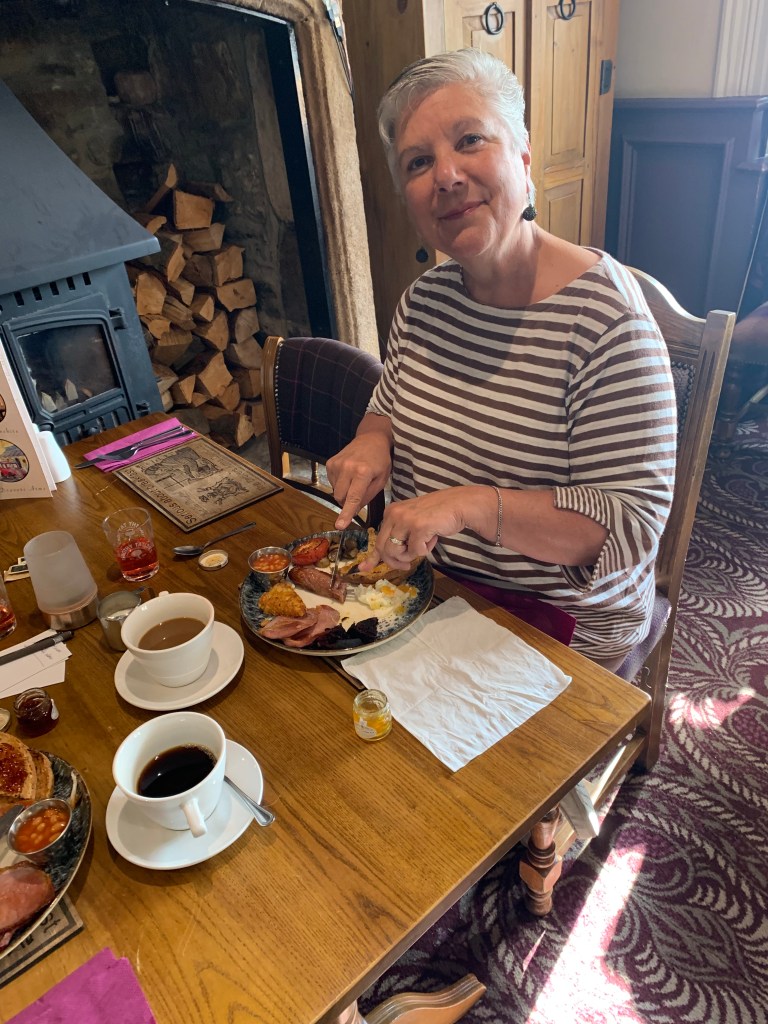
Even with all we had eaten for our late-night meal, we woke up ready for our British breakfast. Santo headed down first while I grabbed a shower. We ate in the same room where we had had dinner with another lovely waitress. Both of us ordered the “Mrs. Hall,” which included eggs, black pudding, sausage, ham, grilled tomatoes and mushrooms, baked beans, and hash browns. One plate would have been plenty for the two of us!
Since breakfast was served from 8 am to 10 am, and we would need to leave at 7 pm the next morning, I asked the waitress if perhaps they could just leave some cereal and milk out for us. “No one gets here until 7:30,” she said. “But, don’t worry, we’ll get it sorted.” By the end of our breakfast, she came back to let us know that they would bring a fridge into our room with milk and leave some cereals and other things for breakfast. We were loving how the Brits “got things sorted”!
After breakfast, we were ready for our day in the Yorkshire Dales. We wanted to drive down those stone lined lanes that James Herriot drove on his veterinary calls to Yorkshire farmers. Could they really exist? We started at the Visitor Center where our car was parked. We got a map of the Dales, and the guide drew a route for us that would offer the bests views in the time we had. We headed off, grateful that the predicted rain was holding off.
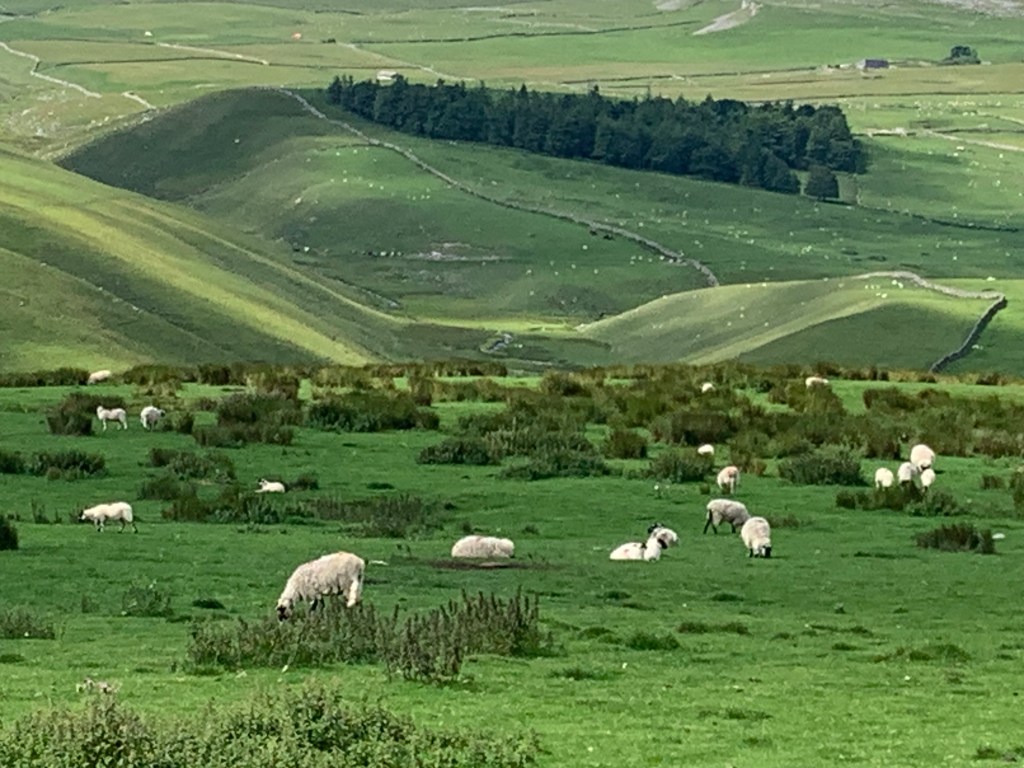
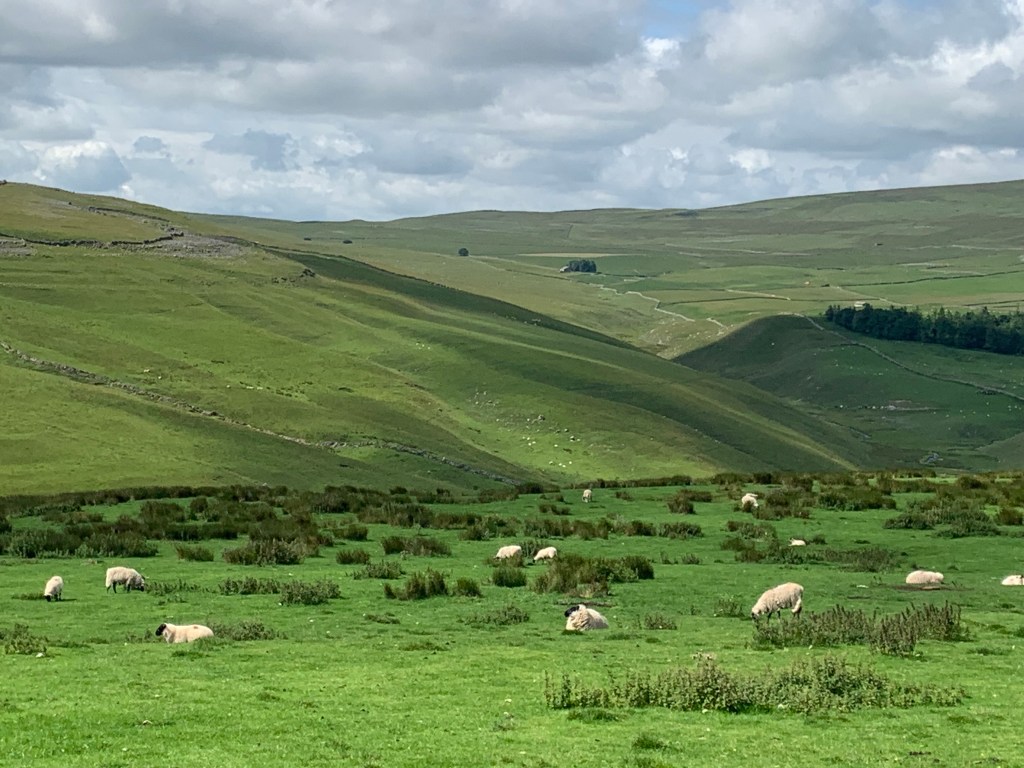
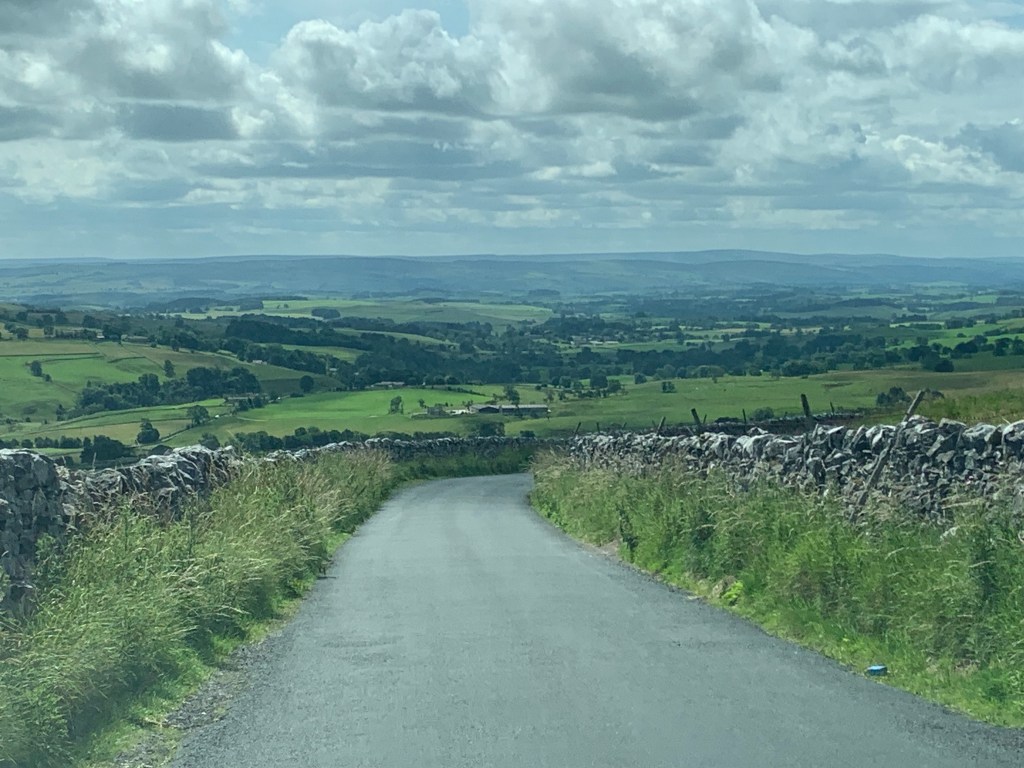
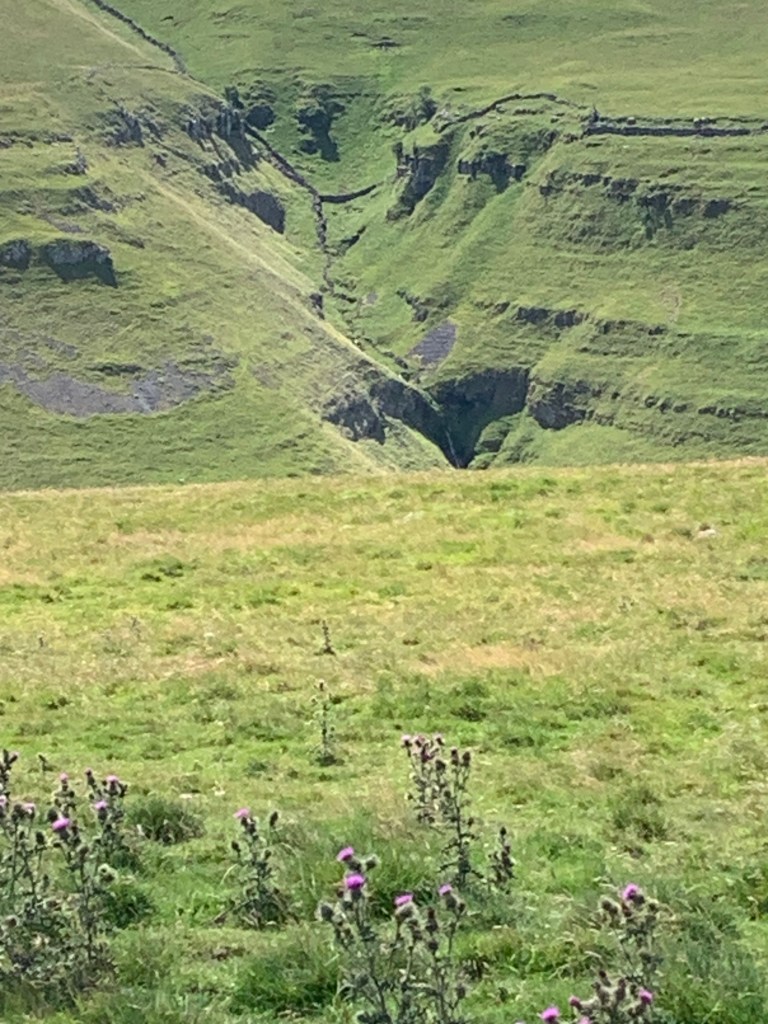
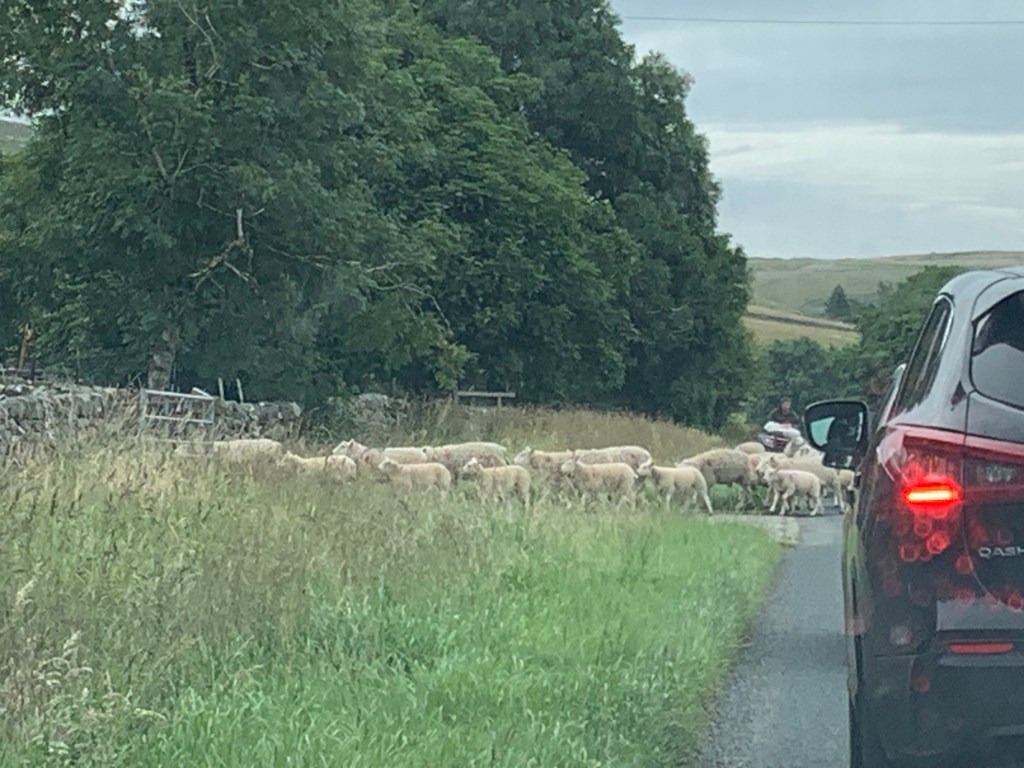
It was not long before we were on James Herriot’s roads. They do indeed exist. In spades. They are all two-way roads, but in many places barely wide enough for one vehicle. Sometimes there were stone walls on both sides, sometimes just one. And the land rolling off far and wide was crisscrossed with stone wall after stone wall. How many man hours would it have taken to build all those walls—and maintain them? Dotting almost every field were sheep, dozens and dozens, by the end hundreds and hundreds, of sheep. A few cows grazed here and there as well. And now and then, farmhouses and barns in the same stone as the walls. Everything looking unchanged for centuries.
At one point we came to a small village (by small I mean about 5 houses). A car in front of us was getting directions from a local woman minding her young grandson. We, too, were confused about what turn to take at this juncture, so we waited to ask her as well. She was just lovely, and seemed so delighted to share her own delight with the beauty of the Dales with us. She told us about a road to talk that our GPS would not show us but that was spectacular. “Now, the bridge here ahead is washed out on one side, and further along it’s quite steep and winding [what had we just been driving on, we thought]. You’ll go through some cattle grids, but just keep going. It will be worth it. I drive this road all the time, though I don’t tell my mother that I take it,” she said with a smile and a twinkle in her eye.
We saw few cars on this amazing road. Everyone we did encounter was courteous, pulling over if they could, waving when we pulled over for them. There was a kind of rhythm to the journey, a natural ebb and flow to each encounter.
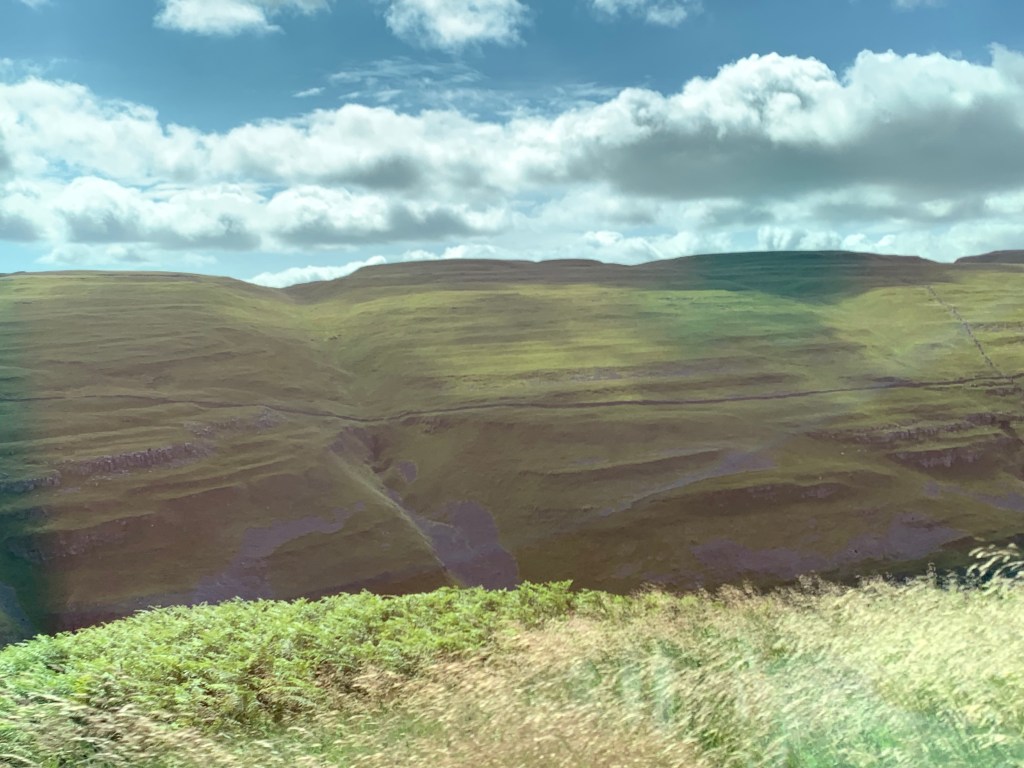
As we drove, when it seemed the scenery could not get any more spectacular, we rounded a bend and saw the hills suddenly grew steeper and taller, lined with sheer rock faces. The valleys plunged deeper, and the omnipresent sheep clung to the hillside with amazing grace and dexterity. The walls persisted. Shades of gray, brown, green, and white created a vista that rested the eyes and the soul. We were in love!
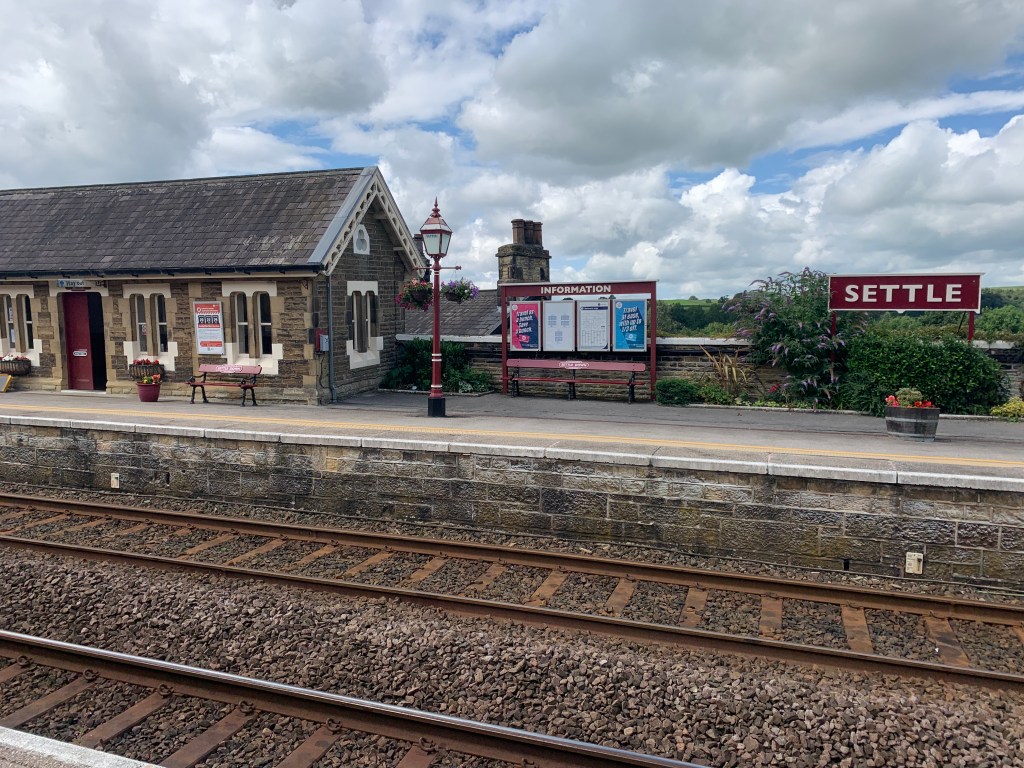
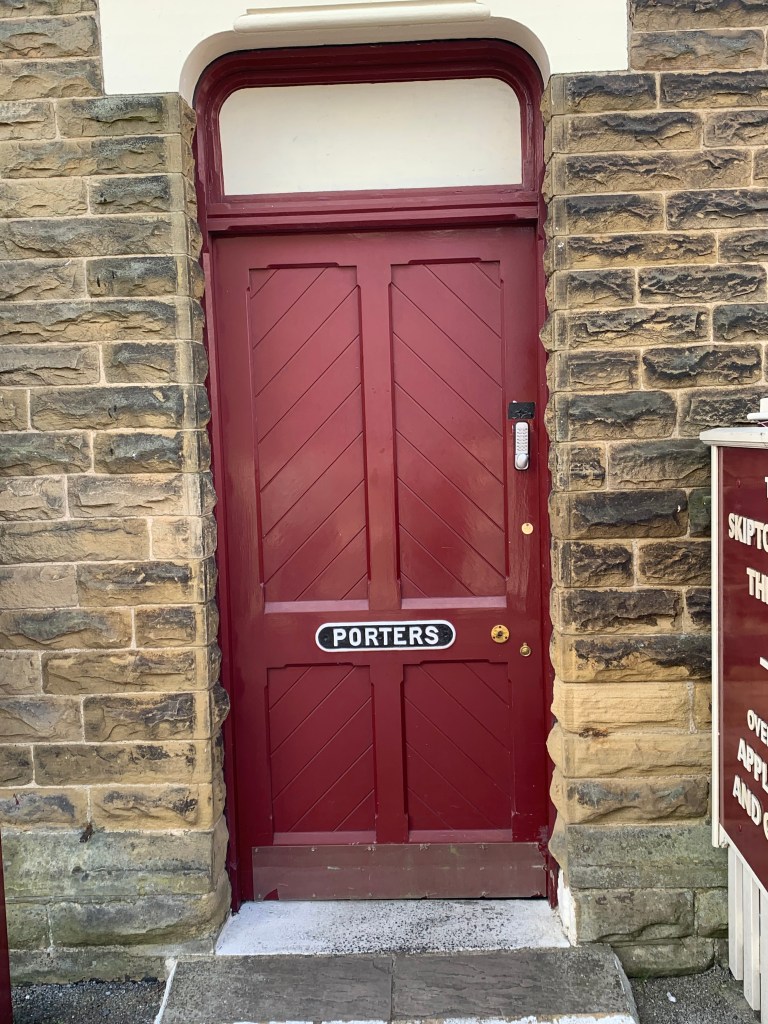
Just as the guide had told us, the town of Settle about halfway through our loop journey offered many places where we could stop for lunch. We founded parking at the small train station, a quaint stone building with red doors that looked like a scene in a movie.
We met an elderly gentleman in a tweed coat strolling with a cane. He smiled at us, and Santo asked him if he could recommend a good place to eat in town.
“Well, it depends on what you want to spend,” he said with little laugh.
“About 10 to 15 pounds or so,” Santo answered.
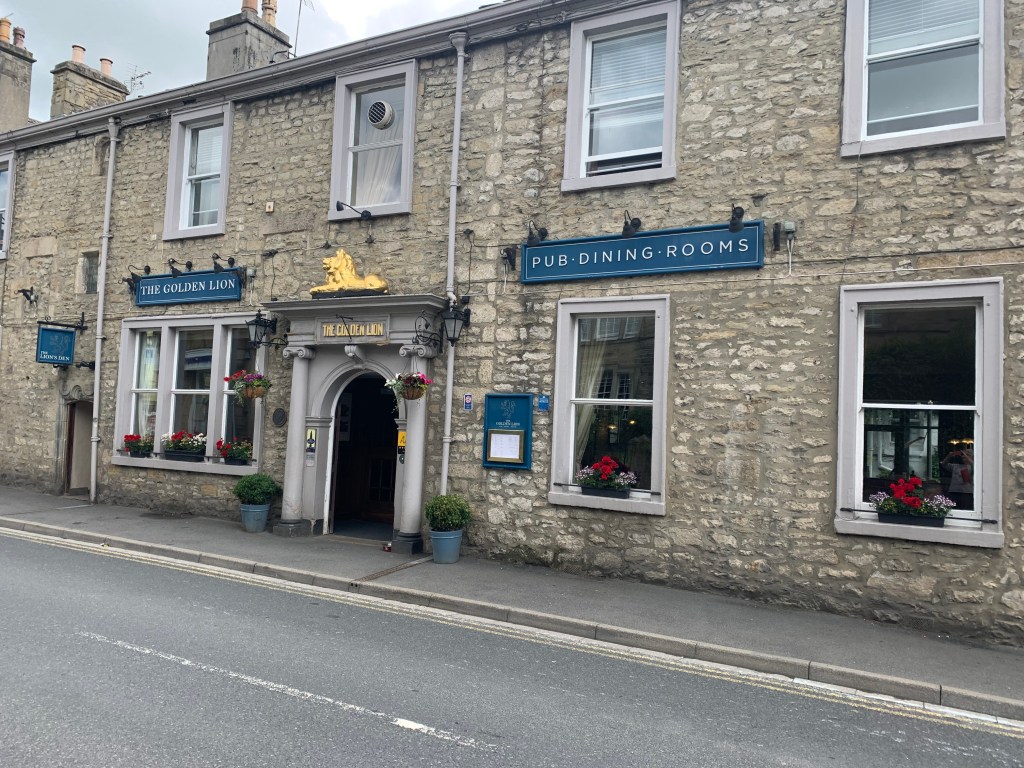
“Well, then, you should go to the Golden Lion. Best place in town.”
“How do we get there?” Santo asked.
“I’m heading that way meself if you want to come along.”
“Wonderful,” we answered, and began walking with him down the street towards the village. The sidewalks were narrow, so Santo walked beside him, chatting, while I tagged along behind. It was only a few minutes and we were at the restaurant and had to leave our newest friend.
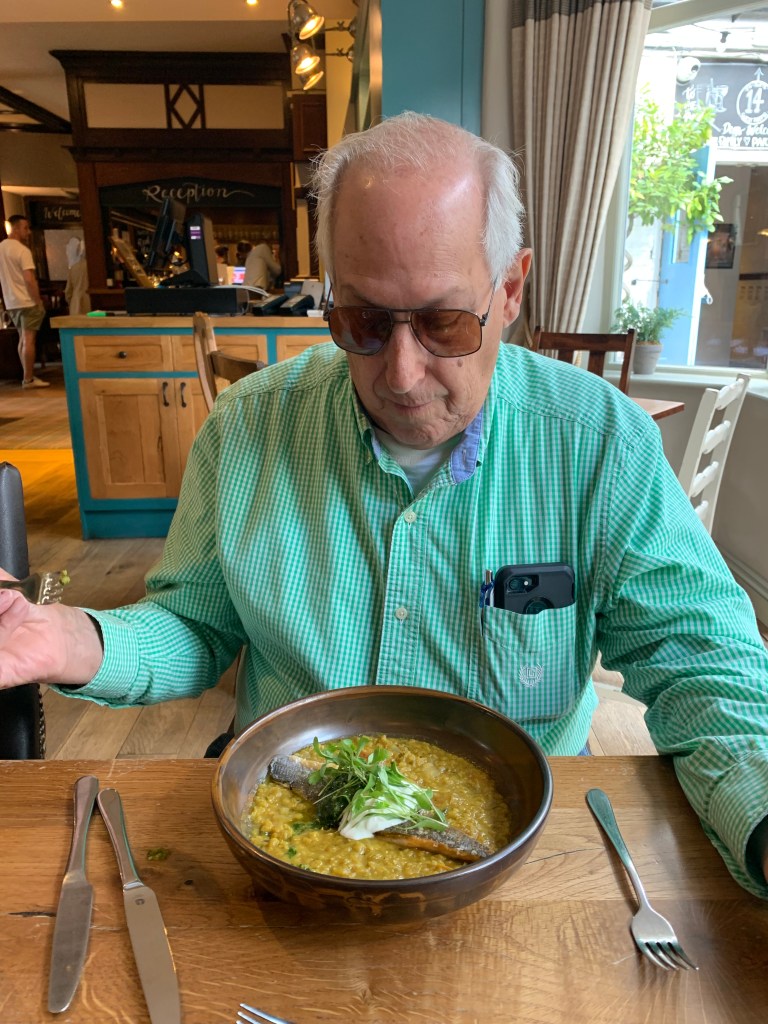
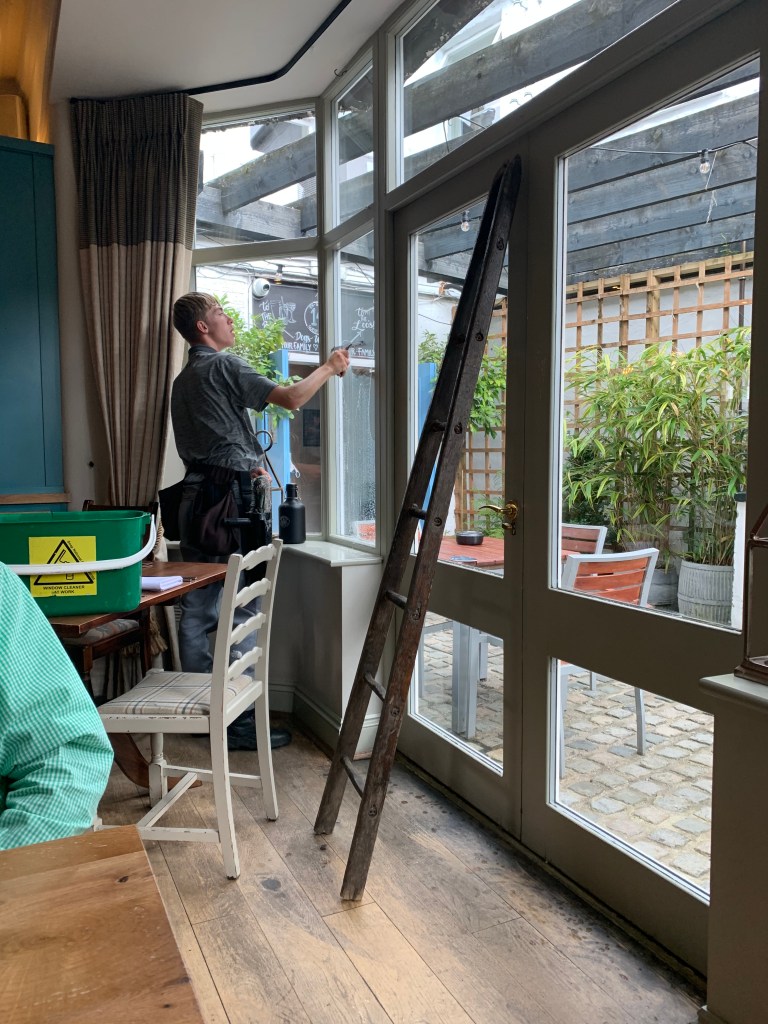
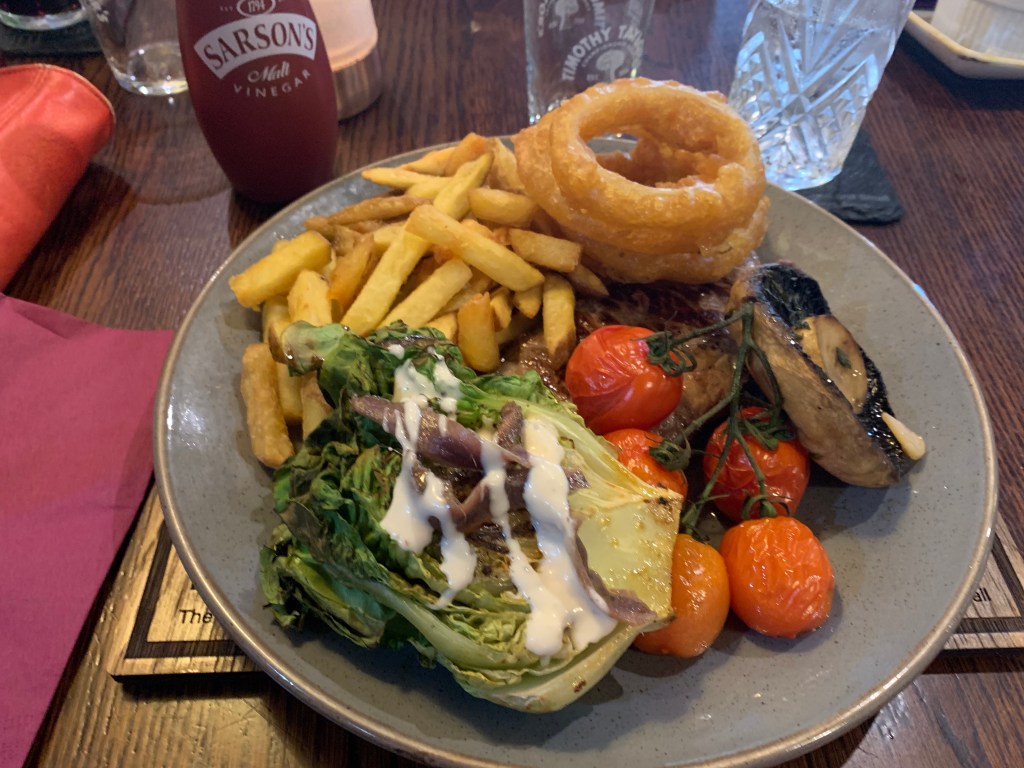
We were seated in a bright room on the right side opposite the darker pub to the left. Santo ordered the sea bass recommended by the waiter (he always loves to get our server’s recommendation!) while I got the daily special of a Fish Butty (fried haddock with tartar sauce on a bun with a side of chips). Both were delicious. While we ate, a young window cleaner worked with a ladder and squeegee, making his way around the room. When he got near us, he kindly asked our permission to do the window near us. So young and so sweet. The old ladder he used was perfectly suited to the job—and quite beautiful as well.
After lunch, we completed our circuit back to Grassington. In a short time, we felt we had gotten all we had come to the Dales for. We were anxious to get back home to watch “All Creatures” all over again.
We did a bit of shopping in the village, then back to the Skeldale Suite for a bit of a nap. My bronchitis was still hanging on, but I was ever hopeful for tomorrow. Blessedly, I was able to fall into a deep sleep (something that had been so difficult with my lingering cough). Even more blessedly, Santo postponed our 6 pm dinner reservations to 7 pm so he wouldn’t have to interrupt my blessed sleep. So many blessings!
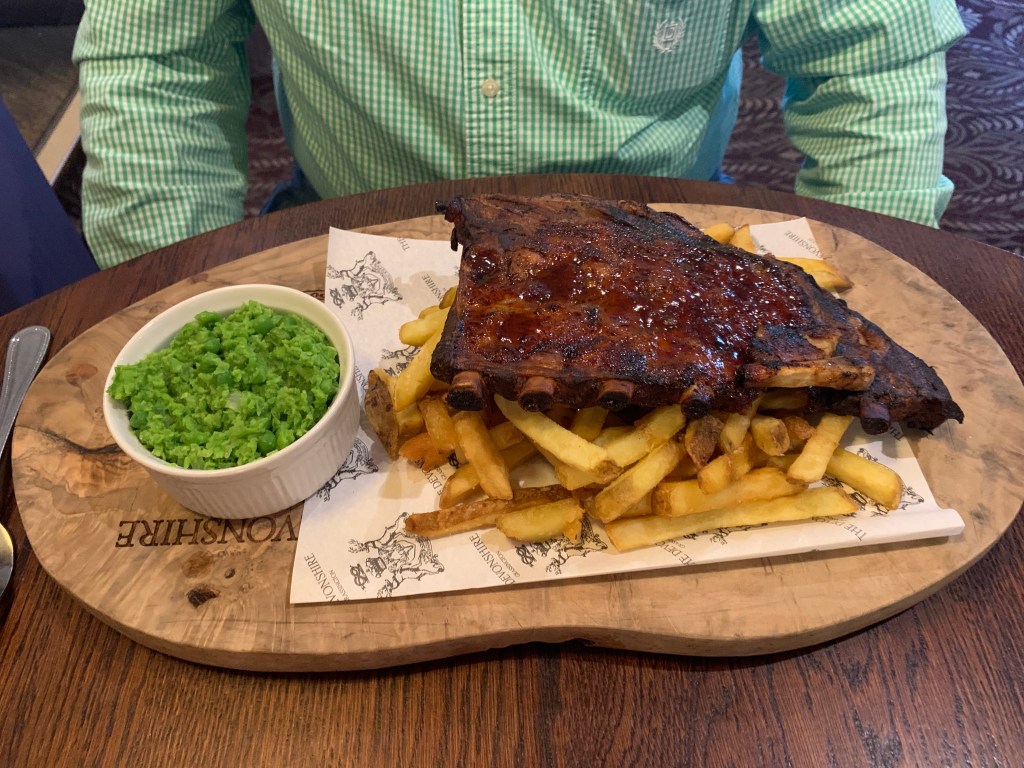
For our second diner at The Devonshire, I opted for a steak and Santo went for the baby back ribs, listed on the menu as being for the “stout hearted.” Somehow, he managed to finish them all and even helped with my steak!
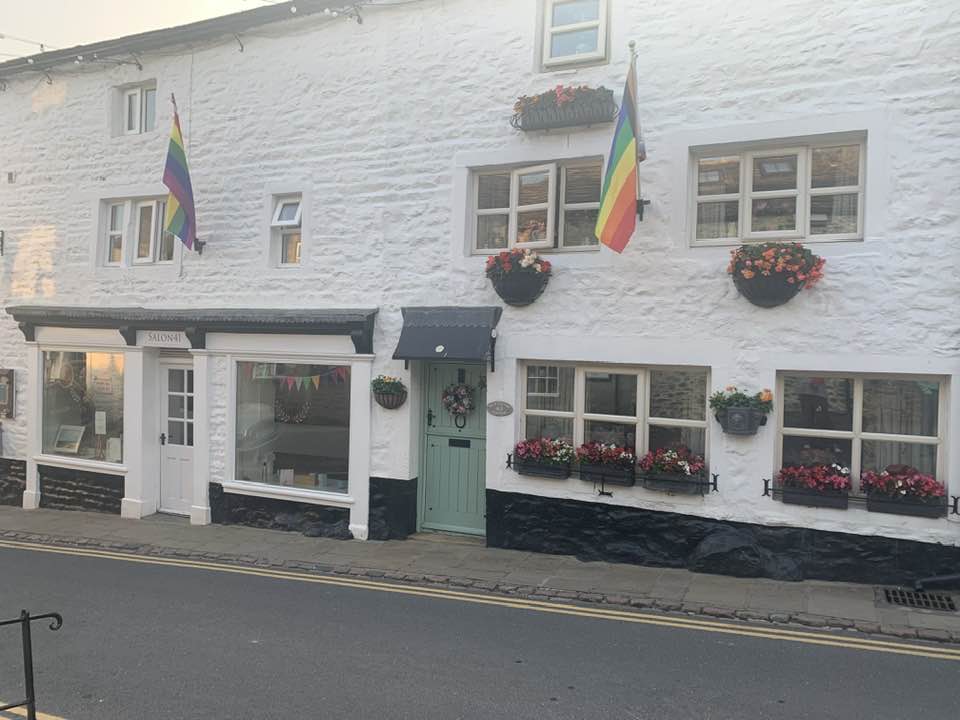
After diner, we took a stroll through the village. It was wonderful to see so many rainbow flags in the village, and signs for an upcoming “Pride in the Dales” event.
It was our last night on terra firma before boarding the Queen Mary 2. It hardly seemed possible. We had seen so much, experienced so much, met so many wonderful people. Our lives were richer for every encounter and we were feeling grateful and content, with just a hint of bittersweetness that this leg of our journey was almost over.
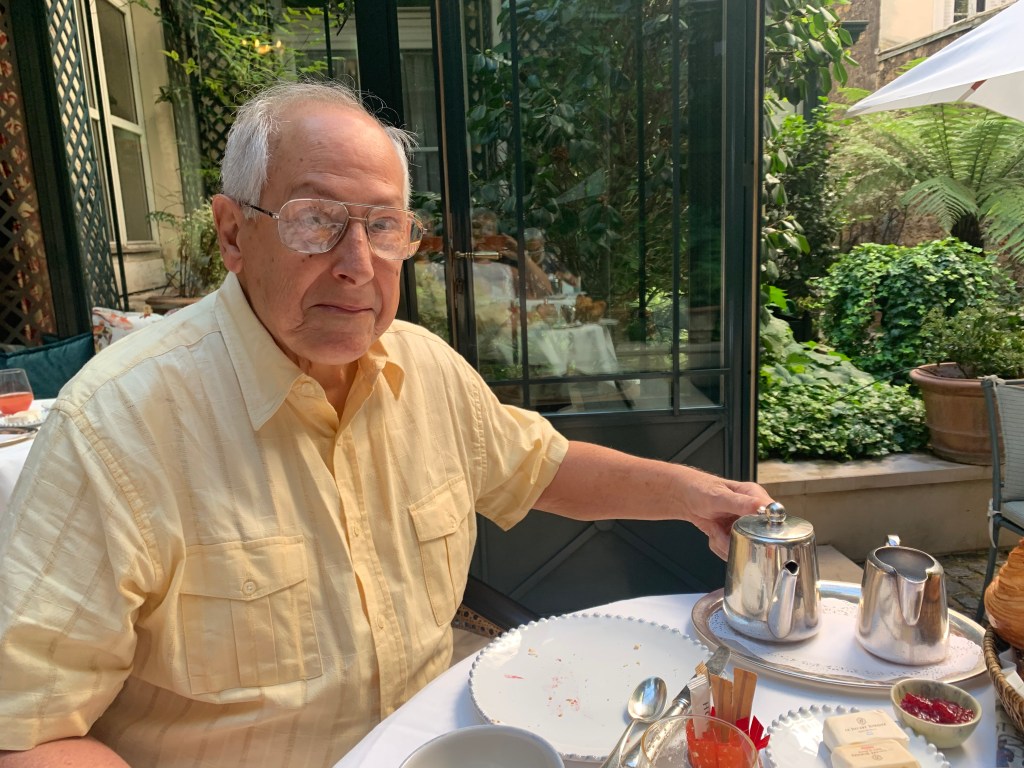
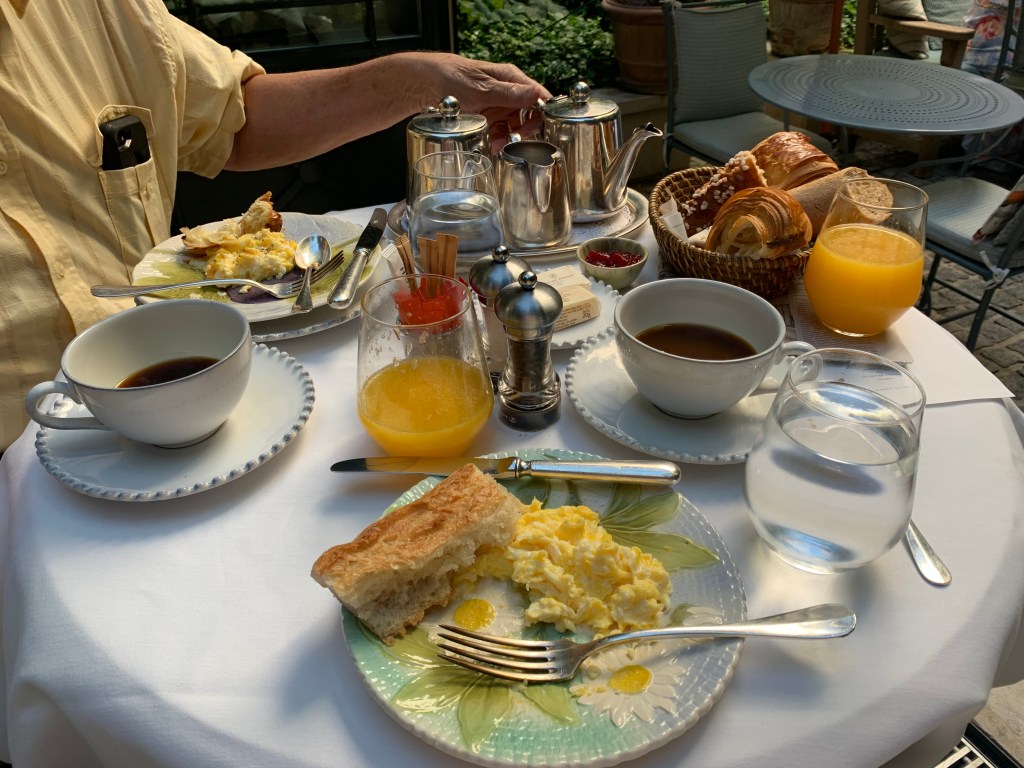
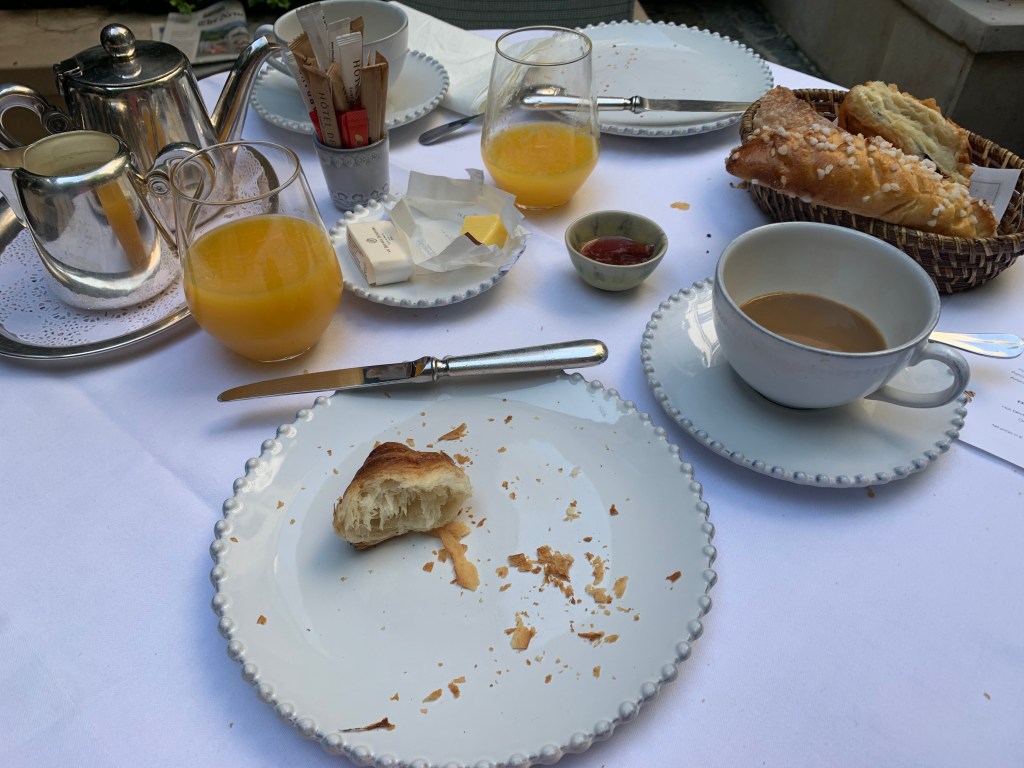
Our late afternoon flight to Manchester gifted us with a leisurely morning. We enjoyed a late breakfast of croissants and scrambled eggs in our oh-so-very-Parisienne courtyard. We didn’t need to go anywhere to feel we were completely immersed in Paris.
After breakfast, we reorganized our luggage in preparation for our flight to England. The goal was to get our largest suitcase below the 50-pound limit so we wouldn’t incur an extra charge. We also wanted to have our overnight bags ready for our two-day stay in Grassington in the Yorkshire Dales. We enjoyed a few restful moments outside in the street-side courtyard before packing everything in the cab and heading to Charles de Gaulle.
At baggage weigh-in, we found our bag was about 2 pounds overweight. Instead of paying an extra 75 Euros, we decided to re-allocate our stuff. The Air France staff directed us to a scale set up just for this purpose. We could put the bag right on the scale, open it, and take out stuff until it got below the limit. Voila!
De Gaulle airport was very organized and efficient, and the people were all very helpful, but it was somehow still exhausting. We ate some packaged sandwiches while waiting at the gate. A lovely woman across from us offered us a piece of homemade lemon cake. “I just can’t eat any more. You enjoy!” We did. People started lining up to board our flight before anything was happening. We weren’t sure why, but figured we should probably get in line, too. We waited and waited with nothing happening. Then finally they started boarding. We checked in with our boarding passes, then followed the line of people on the gangway. And waited and waited and waited some more. There had been no announcement of any delay. No one was saying anything. We all just stood there, baffled and frustrated. I was probably already in a grumpy mood, but this situation really pushed my buttons. Why weren’t they telling us anything? What was happening? Usual travel stuff, but I think I was at the end of my travel tether and really was not happy.
Finally we boarded, and blessedly it was a quick and easy flight to Manchester. We hopped on the shuttle to the Car Rental Village, which was about ten minutes from the airport, and picked up our Ford Focus hybrid. Much smaller than our Peugot SUV, we weren’t sure we could get all our luggage in, but by folding down the back seats, we managed.
We had decided that I would drive first in the U.K. I was nervous yet somehow excited to drive on the other side of the road. We set the GPS to our hotel in Grassington and were off. I told Santo to keep reminding me to get to the left, but I did pretty well with this. The roundabouts were a bit tricky (clockwise rather than counterclockwise) and it was not always clear when we were actually IN the roundabout so we could start counting the exits. The GPS instruction were always to “Enter the roundabout and take the Xth exit.” Amazingly, I only messed it up once.
Judging the width of the car and where I was in the lane was probably the hardest for me. Santo kept yelling, “You’re too close, you’re too close!” but I had cars coming at me on the right and figured it was better to graze up against some grasses and bushes rather than hit another car head-on.
Even expecting narrow roads, we had never imagined them this narrow—and with cars parked on the sides, it was quite dicey at times. I was also tired from the day of travel, and still recovering, so was counting down the minutes until we arrived.
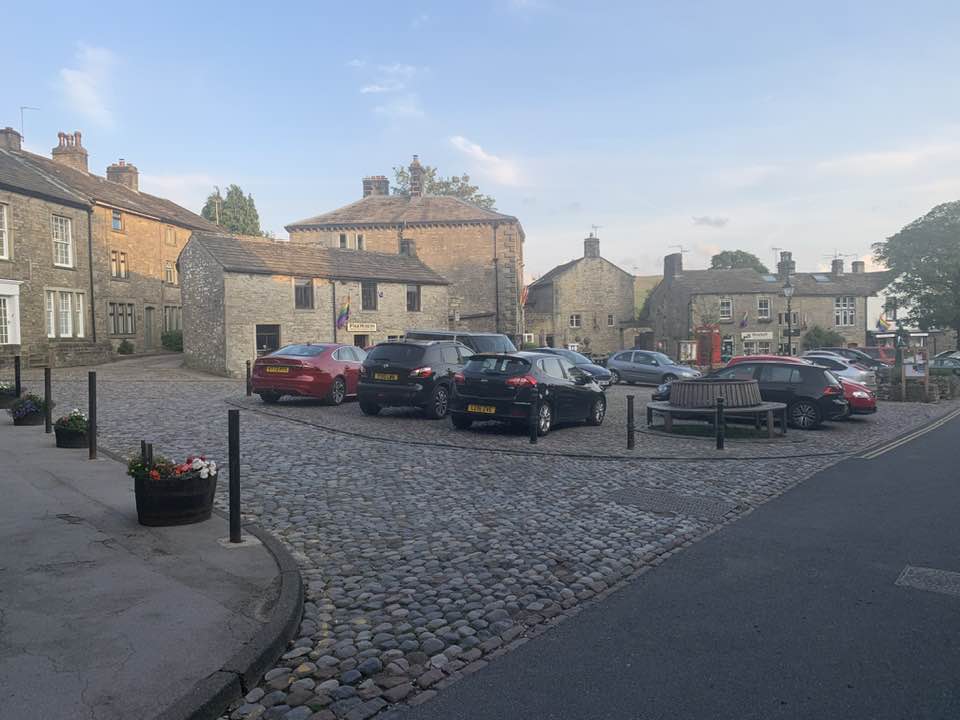
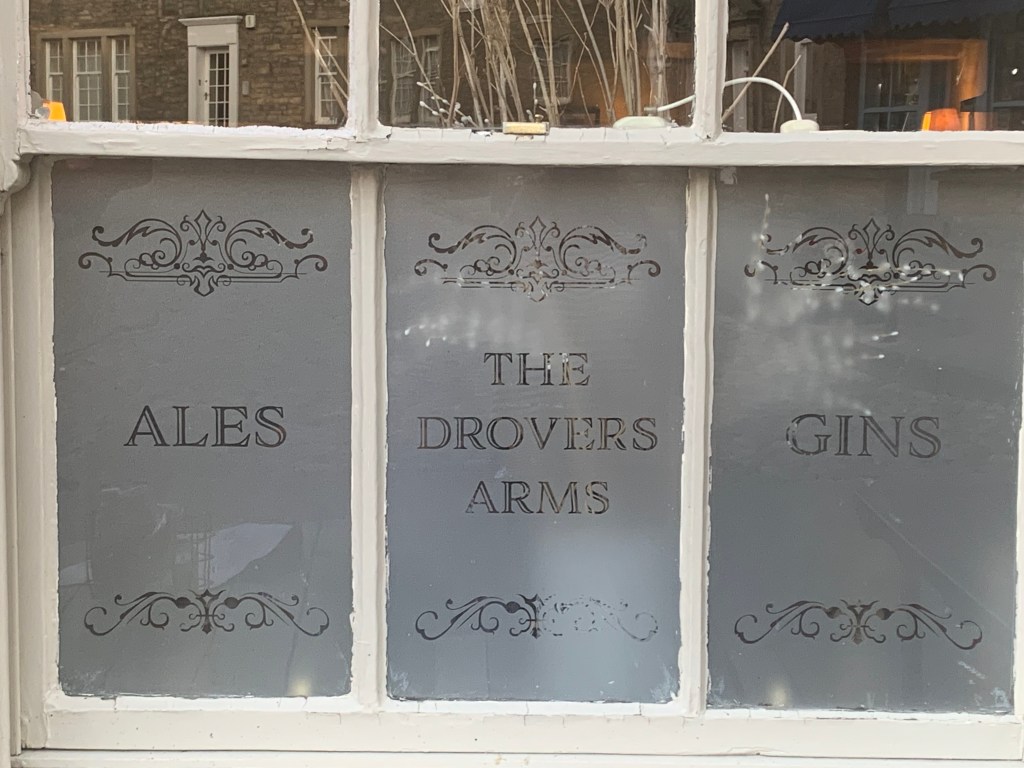
I had set the GPS to the actual hotel, even though we knew we would have to park in the parking lot behind the Yorkshire Dales National Park Information Center. We hoped maybe we could just drop the bags off first. The Devonshire was right on the triangular cobbled square. This is the village that serves as Darrowby in “All Creatures Great and Small.” And The Devonshire is the pub, The Drovers Arms, in the series. There was nowhere to park, even for a moment, near the hotel or in the square, so we drove the quarter mile down the road to the car park. It had started to rain and it was so much cooler (Hallelujah). Luckily the rain had slowed down to a light drizzle by the time we left the car and walked to the hotel.
On the way, Santo stopped in a small market in the square to pick up a bottle of water for me (I needed to be constantly drinking water or my mouth turned to cotton). He asked the woman in the shop about where to eat, and she said The Devonshire, “but you better hurry, the kitchen closes at 9 pm.” It was 8:45 pm.
We entered the pub. It was like coming home to a cozy house on a dreary day. The dining room was on the left, the pub on the right, all in warm hues of brown, the old wood lit with the glow of lamplight. The clatter of dishes and friendly voices made it feel welcoming and comfortable.
We asked the bustling waitress where to check in for the hotel, and she said, “With the bartender.” OK, well that’s different, I thought. Santo asked if we were too late to have dinner. She hesitated at first, but we could tell she really wanted to accommodate us. “Yeah, sure, we’ll get it sorted,” she said. A few minutes later, we were at a table in the dining room with our luggage on the chairs next to us. No time to get to the room before dinner.
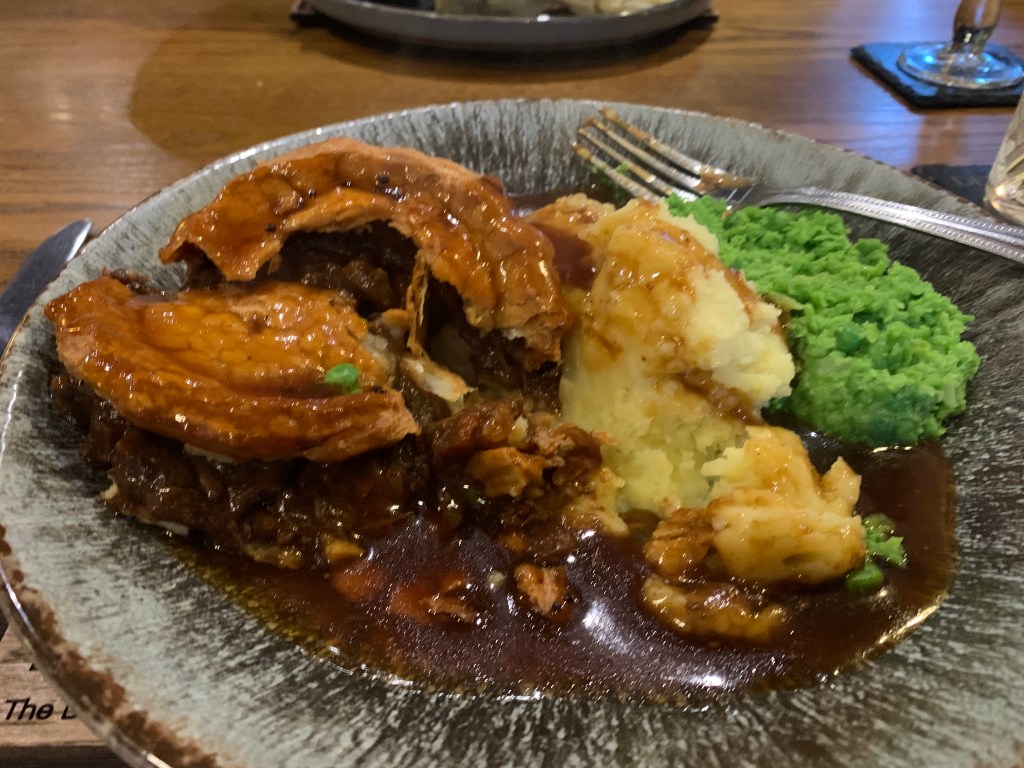
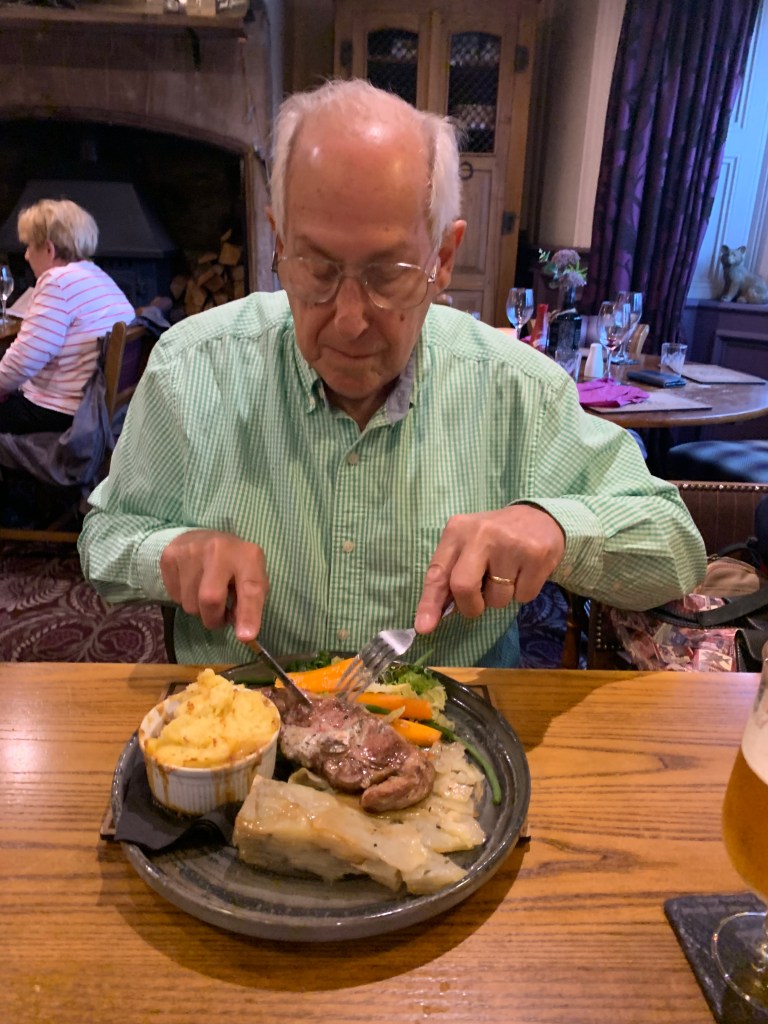
Santo ordered the “duo lamb” dish with lamb chops and a lamb shepherd’s pie. I had the pie of the day: steak and ale. The pie was the size of a large ramekin, crusted top, bottom, and all around with a beautifully browned, flaky crust. When I attacked it with my fork, the tender pieces of steak oozed out in a dark gravy. So delicious. Served with smashed peas: fresh green peas roughly mashed to the consistency of mashed potatoes.
After dinner, we double-checked with the waitress, “So we should see the bartender to check in?” He seemed awfully busy in the full and bustling pub. “Ach, I’ll take you up,” she answered and started grabbing our bags to carry them up for us. She double-checked the room number with the bartender, then led us up the stairs just behind a door at the back of the bar.
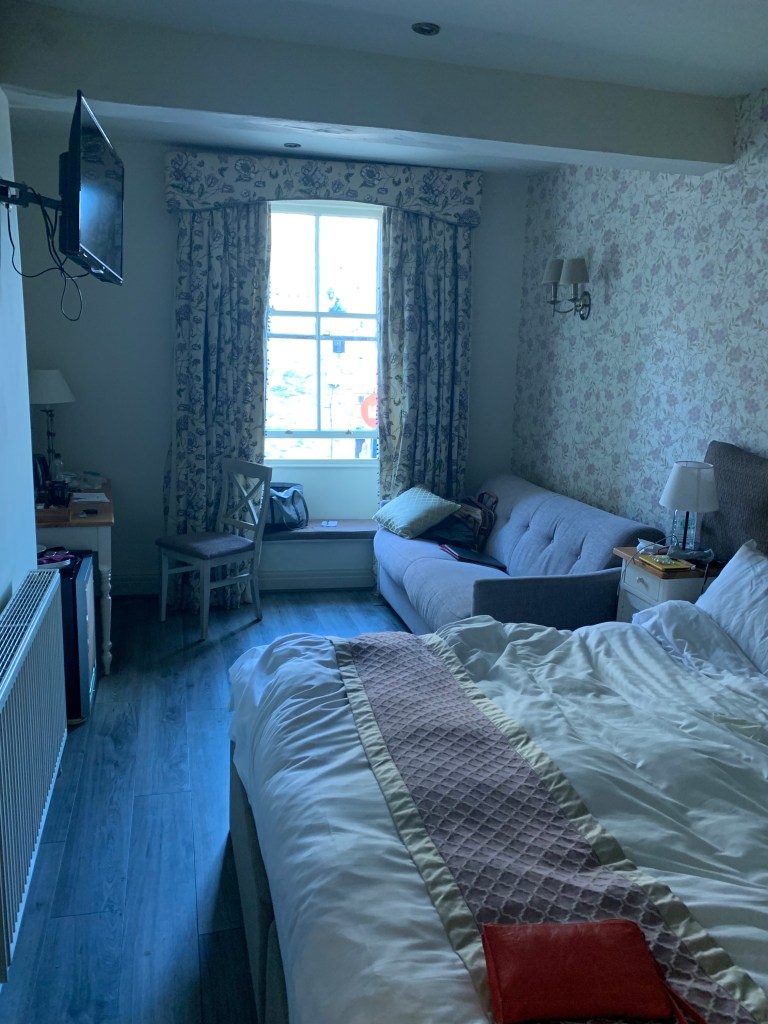
Upstairs, the hallway rambled left and right, up and down low steps. All of the rooms were named after characters in “All Creatures Great and Small”: Mrs. Hall, Helen Alderson, Siegried Farnon, the Herriot Suite, even Tricki Woo! Our room was the Skeldale Suite. It was a lovely large room overlooking the square. King bed, small sofa, desk, armoir, and a large bathroom two steps up from the room.
I wasted no time getting ready for bed and crawling in between he crisp white sheets. Santo sat at the desk for a while. For the first (and so far the last) time on our trip, I turned the television on. I found a show featuring female British comics and watched for a bit. Then I turned it off, preferring the stillness. Even with our window open to the square, the only sound we could hear was the low rumble of friendly voices from the pub below. It reminded me of lying in my bed as a child and hearing my parents in another room, their distant voices somehow comforting.
I woke up feeling the best I had in a long time. Symptoms were still there, but I was cool, at least somewhat rested, and I knew I would just keep getting better as the meds kicked in.
We enjoyed our courtyard croissant breakfast, then ventured out for a day in Paris.
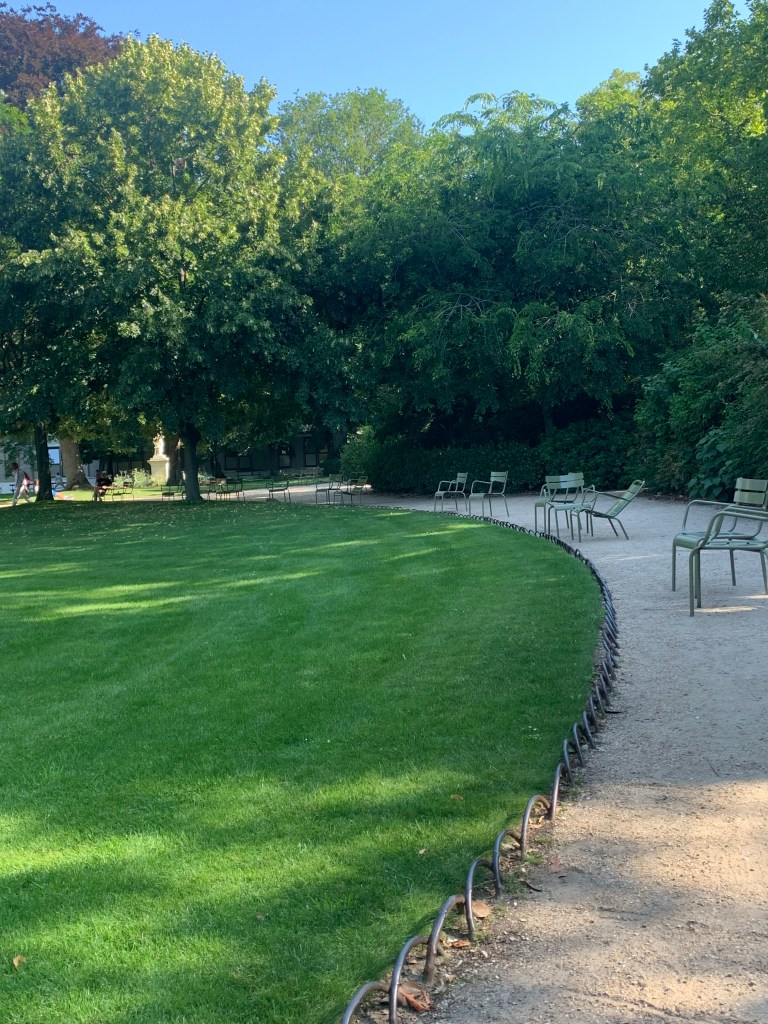
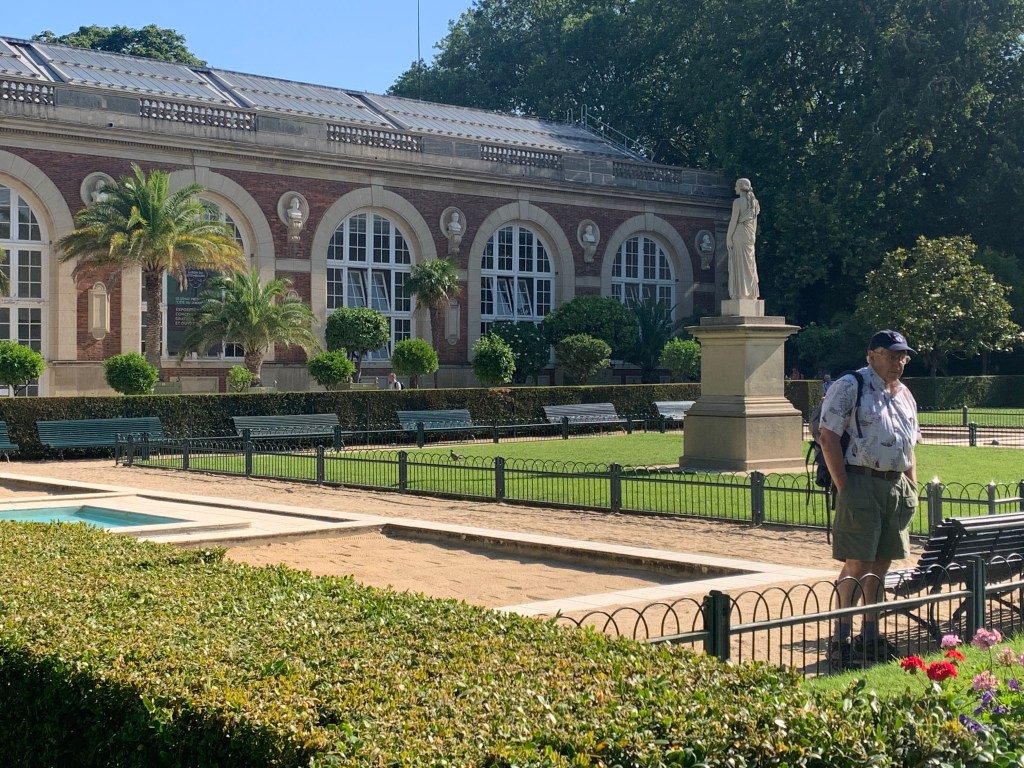
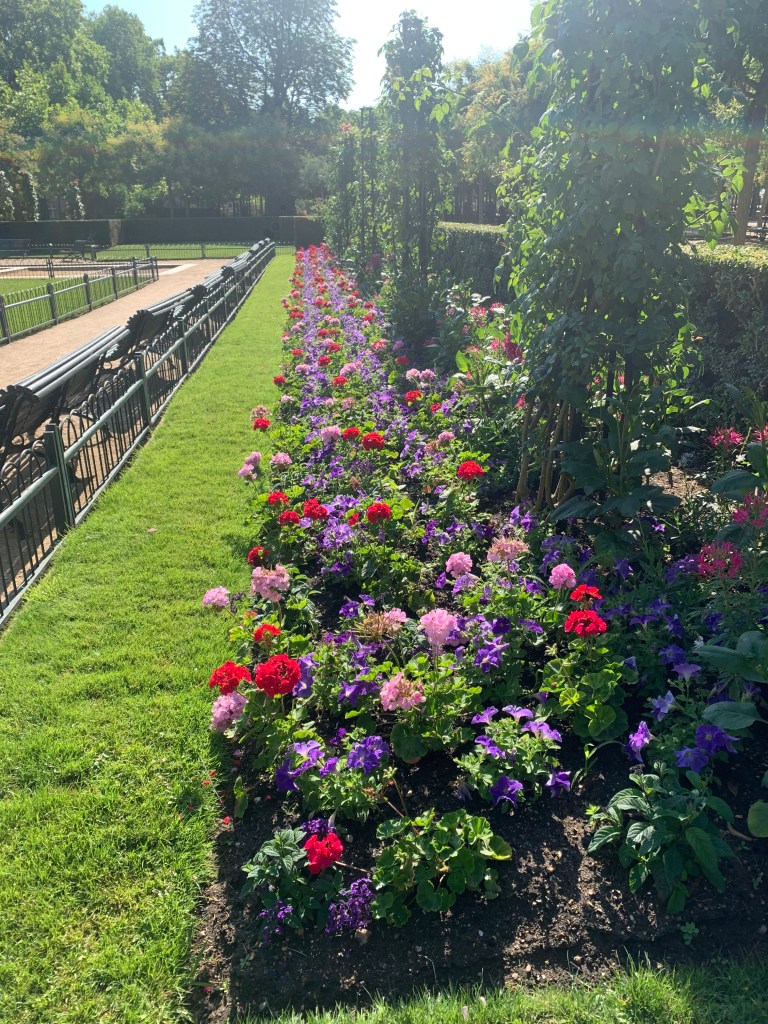
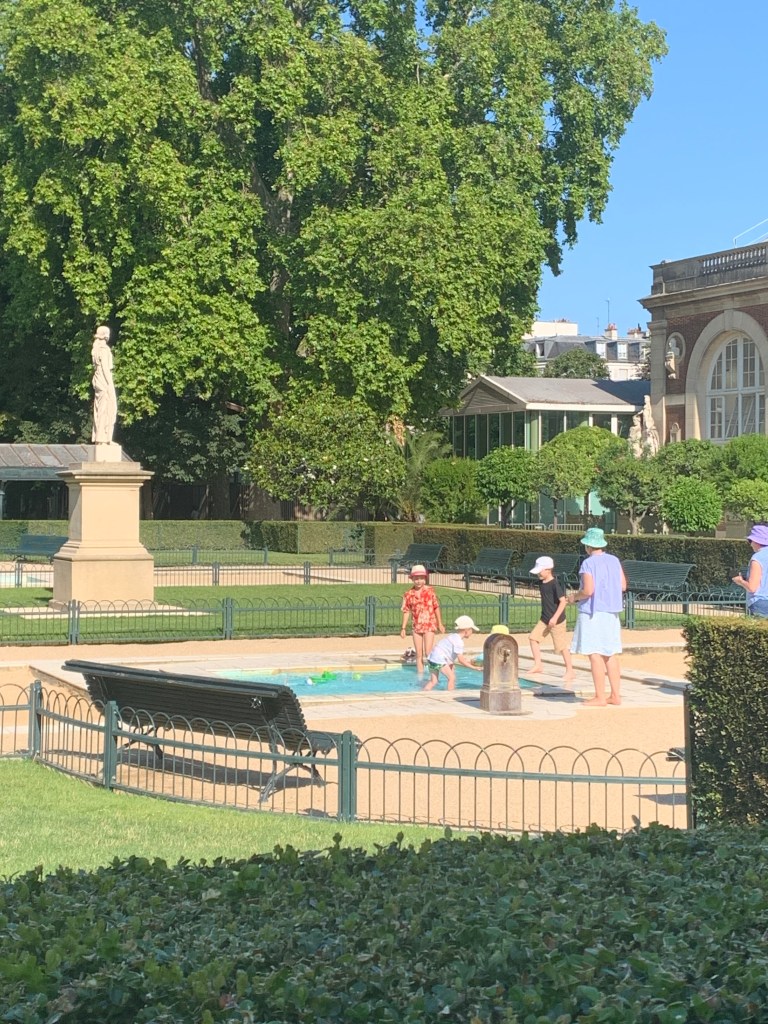
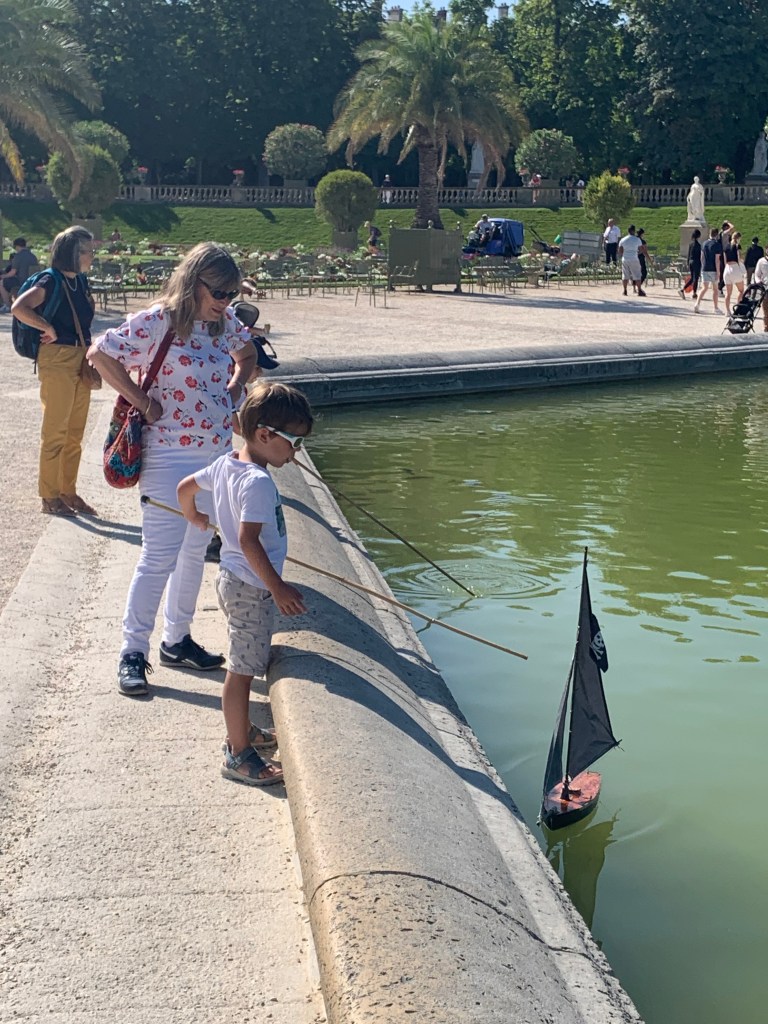
Our first stop would be the Luxembourg Gardens, just a ten-minute walk from the hotel. It was a lovely, clear, crisp morning with the Parisienne rooftops etching a graceful line against a deep blue sky. Tall iron gates at the corner of two streets gave us entrée into the gardens. They just seemed to go on and on. Wide sand-colored gravels pathways, shady wooded areas scattered with green metal chairs and benches, palaces, ponds, flower beds of every description, a wading pool and sandbox for the kiddies, and a round lake where two French boys about eight years old were sailing their homemade sailboats, prodding them long with sticks to set them in motion. We looked, we stopped, we sat, we meandered. One shady area was used by several different individuals and groups doing Tai Chi. Their exquisitely slow, graceful movements seemed to perfectly match the tranquility of the place.
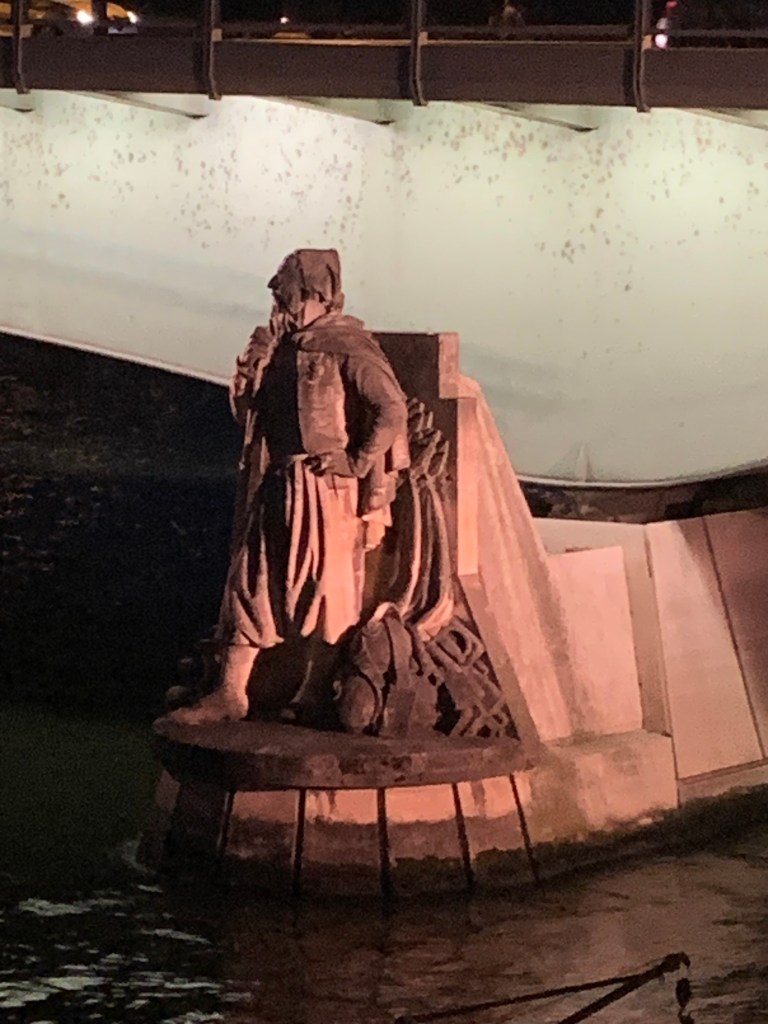
We made our way across the park and exited on the other side onto the Boulevard St. Michel. Luckily, Santo has an insane sense of direction and an excellent memory from when we were in Paris five years ago. He led us across the Seine to Île de la Cité, past the front of Notre Dame, then along its northern side. From the front, the two towers were intact, but massive enclosed scaffolding encased much of the building. From the side, the damage from the 2019 fire was evident. Much of the roof beyond the towers had burned or collapsed. Reconstruction of the buttresses and vaulted ceiling was underway, but the enormity of the task was evident.
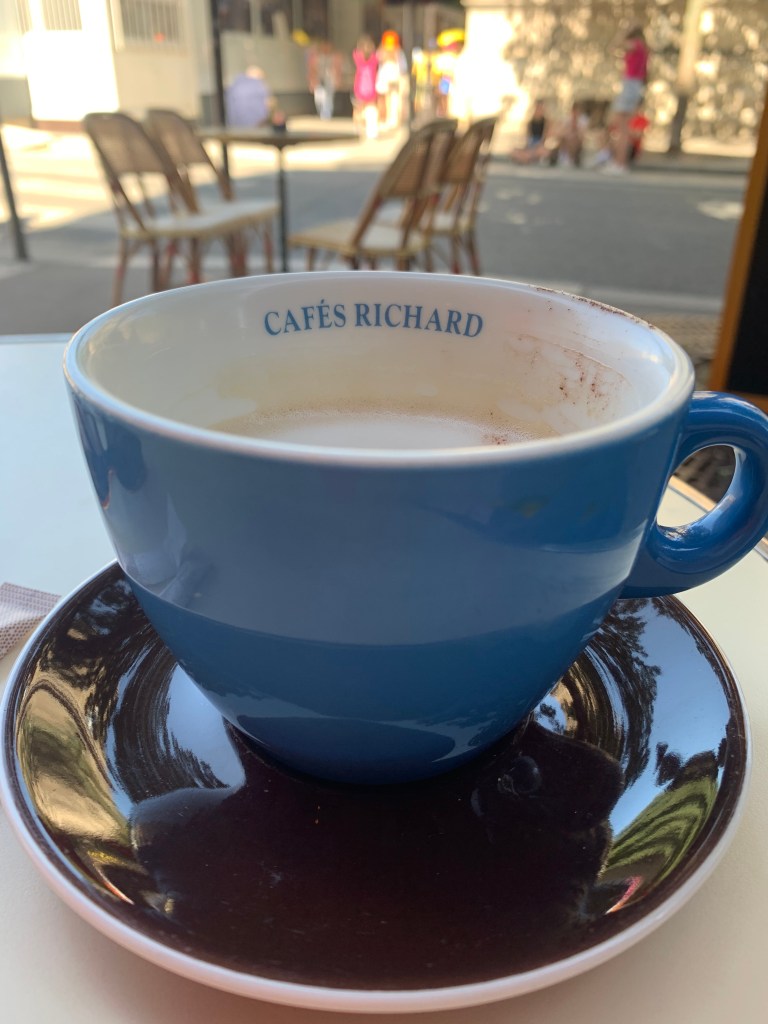
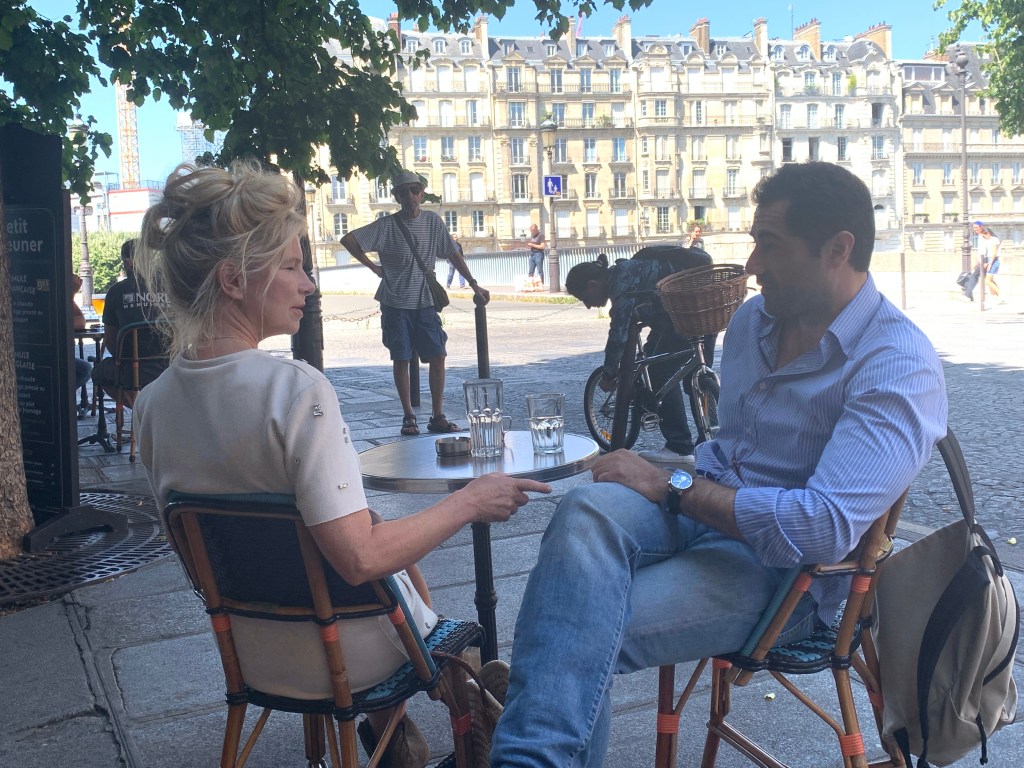
At the far corner of the cathedral was an inviting sidewalk café. The day had begun to warm up, so we decided to take a pause for some seats in the shade and welcome refreshment. I had a large cappuccino, Santo a lemonade, cold and refreshing in a tall glass. It’s what you do in Paris, right?
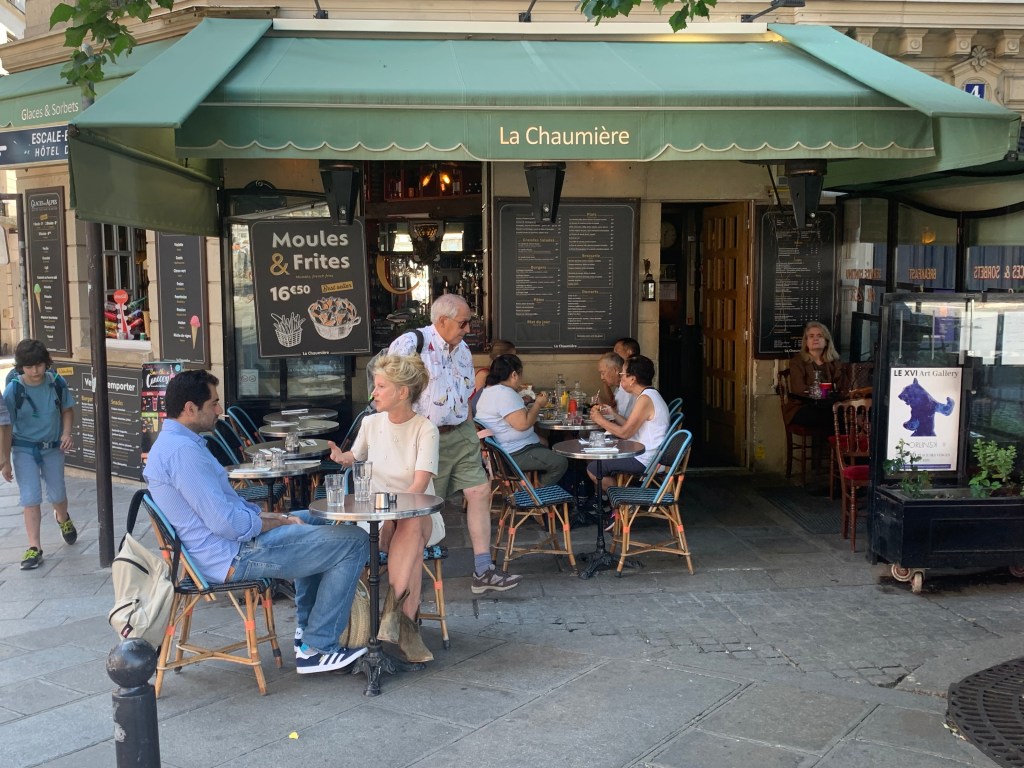
We continued from there in search of the café where Santo had enjoyed a most memorable meal of Moules Frites (mussels and French fries) the last time we were in Paris. It was on a day when I was sick and he had gone out on his own (what is it about me and Paris?). He had always wanted to bring me back there, so we planned to go for lunch. His nose led us directly there, just as he remembered, at a corner on the Ile Ste. Louis. We ordered the Moules Frites special and a side salad to share, as well as drinks. It’s amazing what they fit onto those tiny café tables! The Moules came in a large blue enamel pot, full to the brim, along with bread. My salad was large and delicious. It was more than enough for us both.
At the next table was a lovely family from England on a five week holiday through Europe. The oldest daughter had just graduated and was headed for uni in Manchester in the fall. The younger daughter was still in school. They had all planned the trip together and were crisscrossing Europe by rail to get to their desired destinations, including Verona, Berlin, Amsterdam, and more. The last time Santo had been here, he had met a couple from Australia. Travelling need never be lonely!
After lunch, we hoped to catch a cab back to the hotel so I wouldn’t overdo it on my first day out. We were not having any luck, so I said I thought I could walk it. But along the way, to my relief, we were able to hail a cab. The heat of the day and the exertions of walking several miles were taking a toll on my still recovering body.
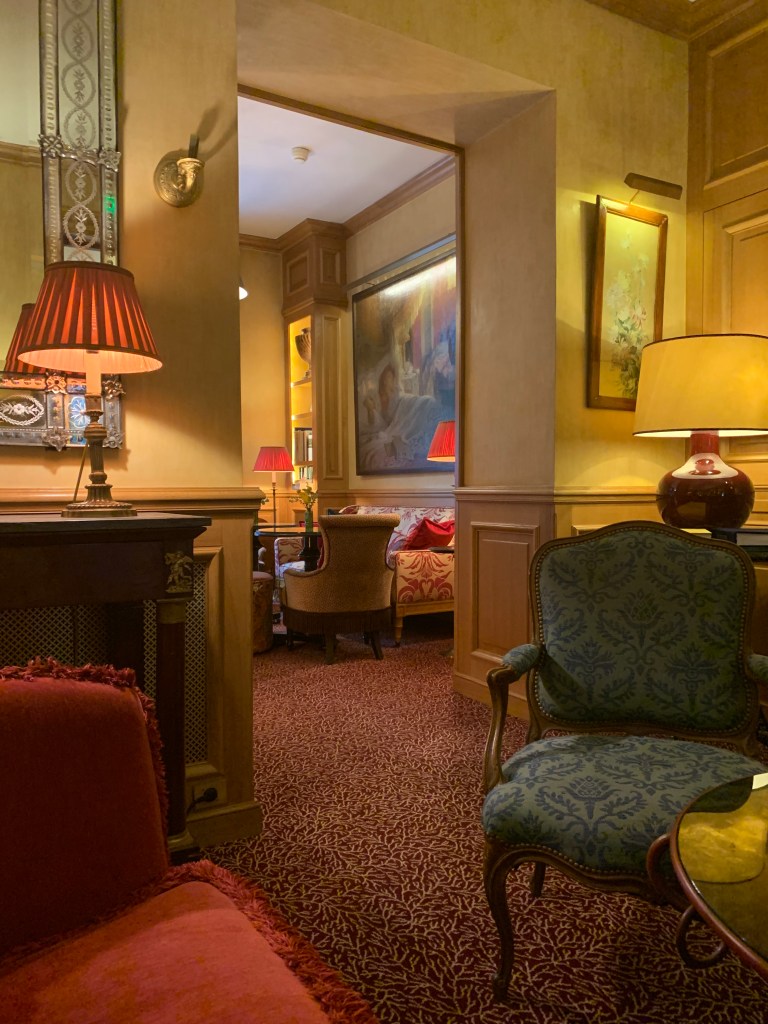
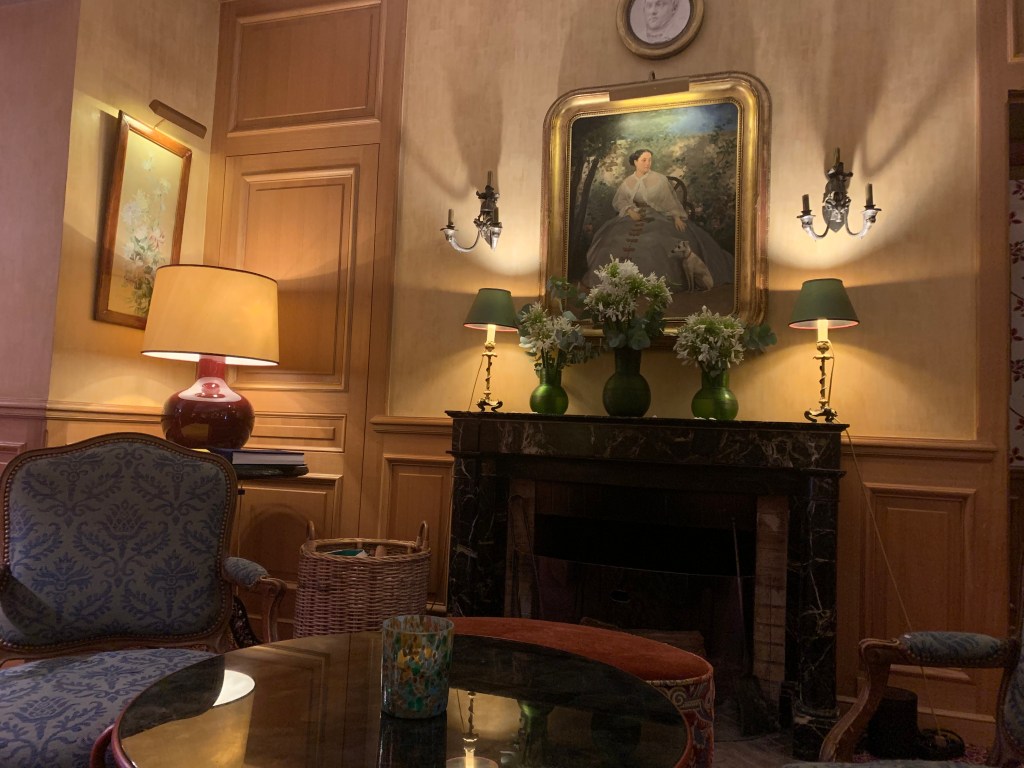
Back at the hotel, since our room had not been made up yet, I set myself up in one of the lobby living rooms, on a luxurious red sofa facing a black marble fireplace. A waiter brought me a glass of ice water, and I was able to get some writing done there. From my vantage point I could see, just beyond the archway to the next room, a wall-sized painting of a woman lying in bed, floating in sea of pale, soft bedclothes. Her hand lay atop her brow, her head on the pillow turned to the left where an older gentleman stood over her with a look of concern. It was not hard to project myself into that scene!
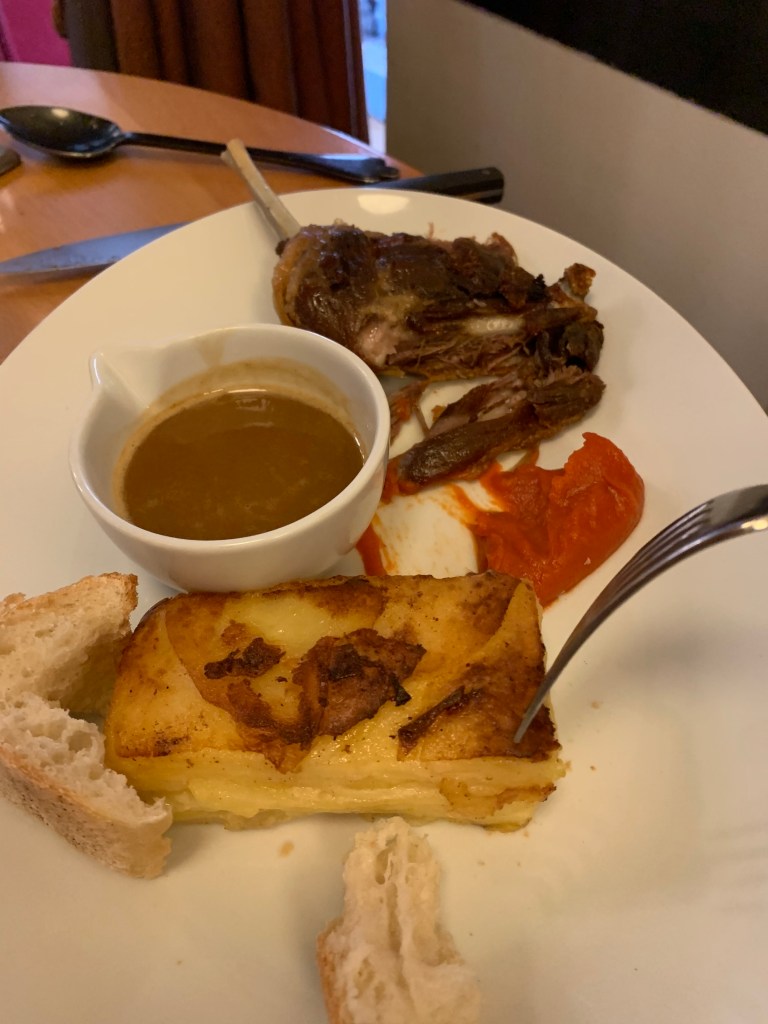
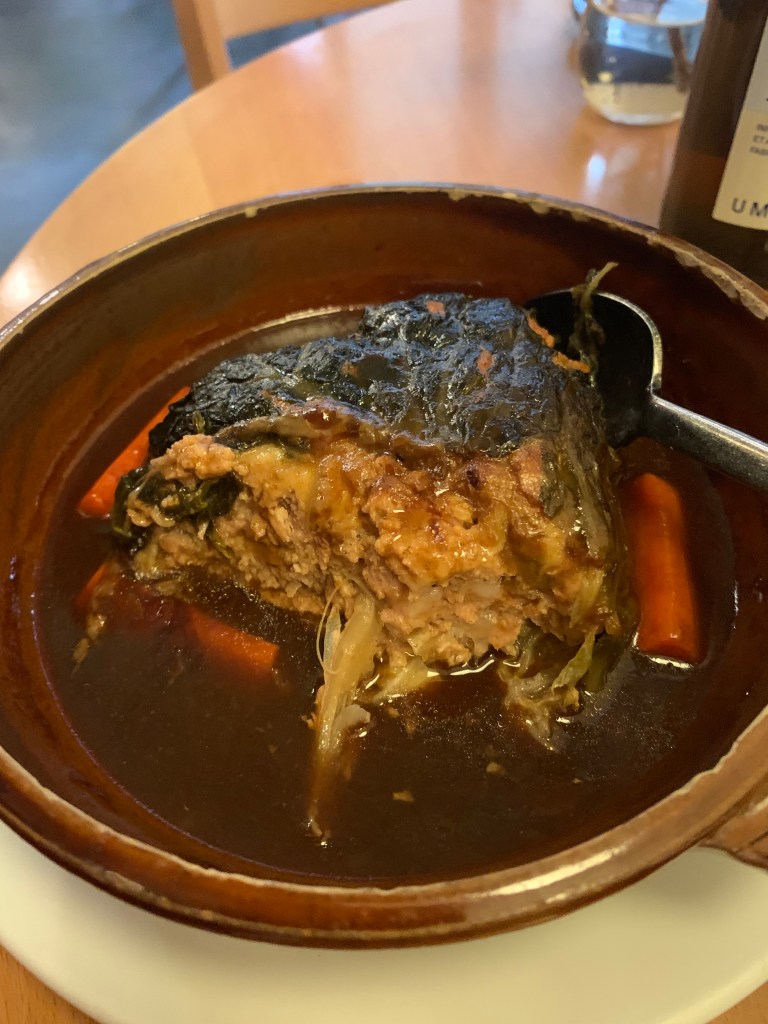
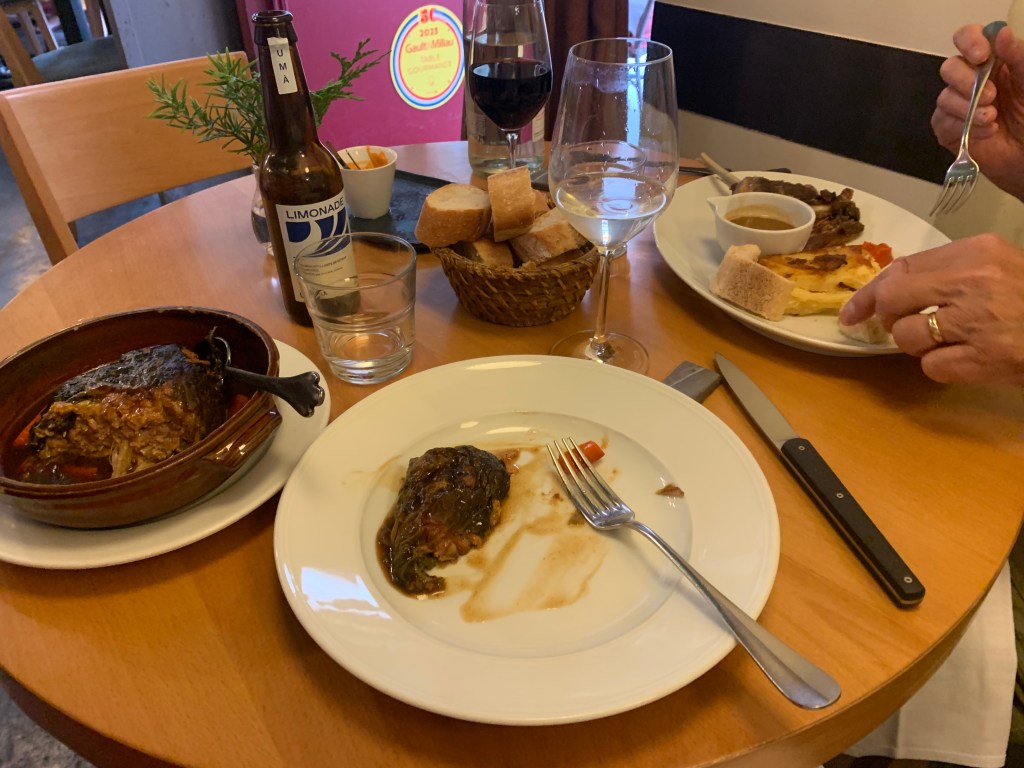
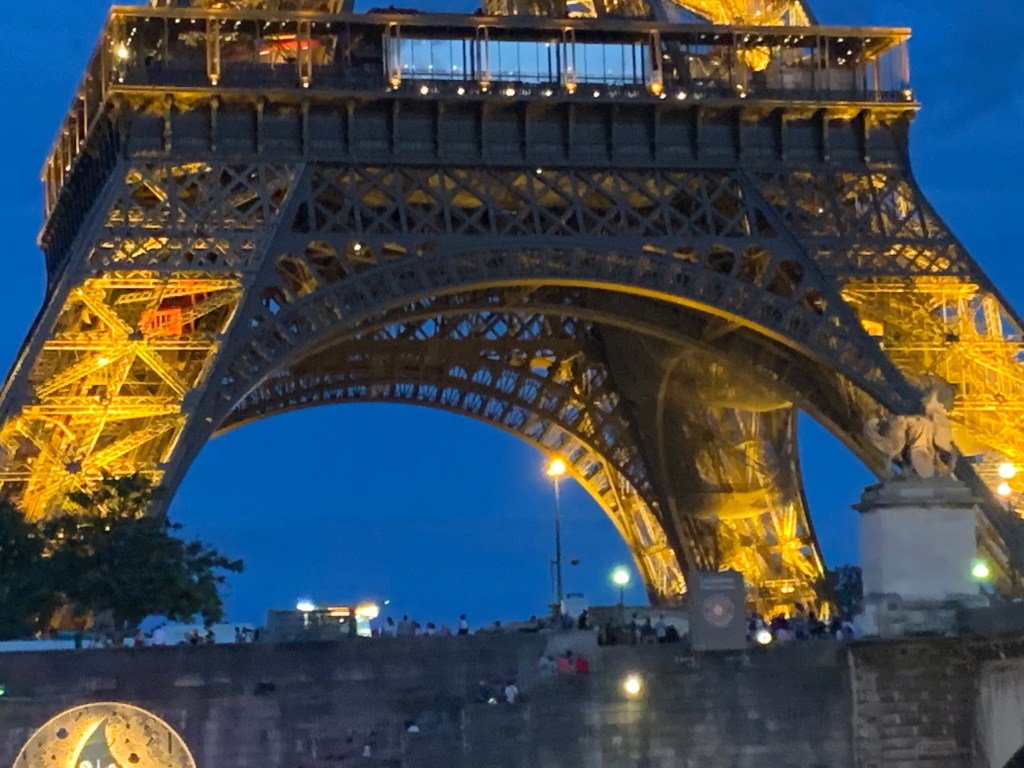
Once our room was ready, I went back for a nap so I would be refreshed for our evening: dinner at a restaurant not too far from the Eiffel Tower, than the much-awaited night cruise on the Seine. We took a cab to the restaurant, which I had found online, and it was excellent. It seemed like a place where locals went. The owner apologized that he did not have a table outside (there were only a few tables inside and out), but seated us at a lovely round table just inside the door where we were able to catch the evening breeze. I ordered the stuffed cabbage, listed on the menu as being from the chef’s grandmother’s recipe. Santo had the classic French duck confit.
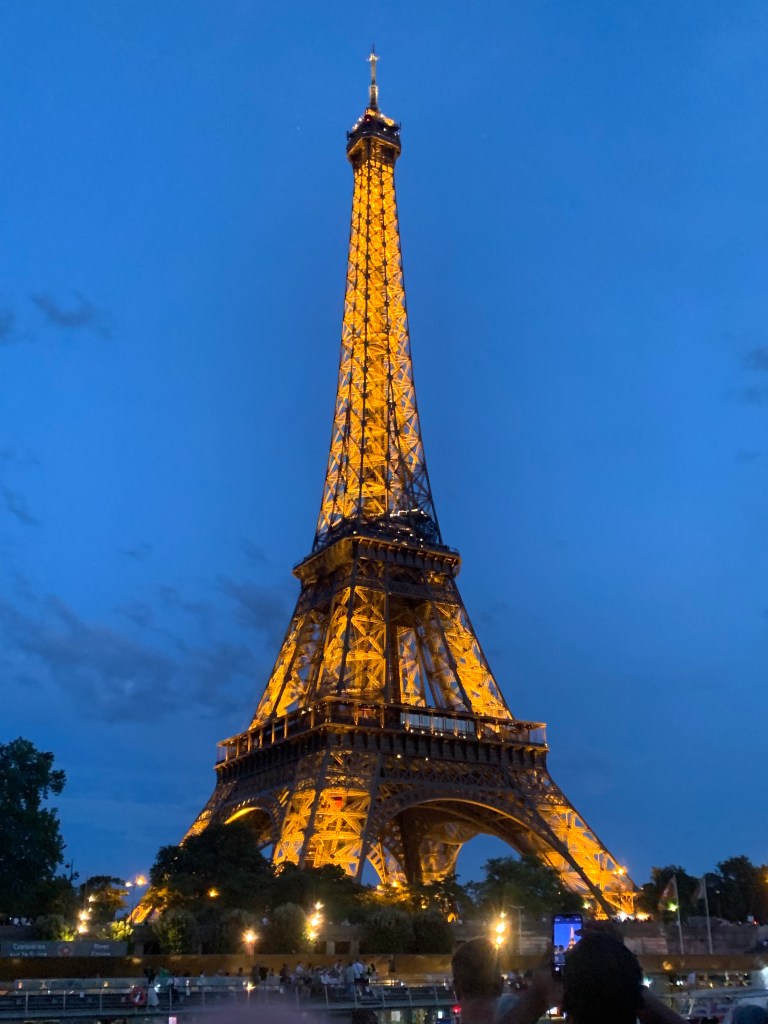
After dinner, we walked along the Champ du Mars, a greenway extending about one kilometer from the Ecole Militaire to the Eiffel Tower. The quay where we would get our cruise boat was another kilometer or more away on the other side of the river. The air was still warm, but there was a lovely breeze. We made it to the ship for a 9:30 departure, a perfect time with sunset coming at 9:54. We sat on the top deck, taking in all that we loved about this city as we made our way back down towards Notre Dame, around the island, and back up the Seine towards the Eiffel Tower just as the lights were coming on. It never ceases to be magical.
After some initial frustration, we were able to get a cab back to the hotel. We had gotten, together, at least one day in Paris. It was lovely. And it was enough. I went to bed grateful, but still wishing I felt a bit better. Maybe tomorrow.
When dawn came (I can’t say “when I woke up,” because I didn’t sleep), I couldn’t wait to get out and find someone in Paris who could help me.
Our breakfast in the courtyard was lovely: croissants and fresh rolls, coffee with warmed milk, orange juice, yogurt, fruit, and granola. I enjoyed it as best I could.
We stopped at the desk to ask about a pharmacy or urgent care center. They suggested trying the pharmacy first (pharmacists in France can diagnose and even prescribe for some things). If the pharmacist couldn’t help, they could refer us to a medical facility.
It was short walk through our lovely St. Germain neighborhood on a crystal clear blue sky morning to the pharmacy. The lovely, young Asian pharmacist asked me many questions, trying to get a clear picture of what was wrong. First she suggested some medication, but when she found out I had been sick for eight days, she thought I should see a doctor. We got directions to a place that had urgent care and set out. It was a hot day, I was tired, feverish, and coughing, but I felt I was finally going to get some relief. Unfortunately, we turned the wrong way out the door of the pharmacy and had gone about 20 minutes before we realized we had to go back to where we had started, then 10 minutes in the other direction. Hope propelled me along.
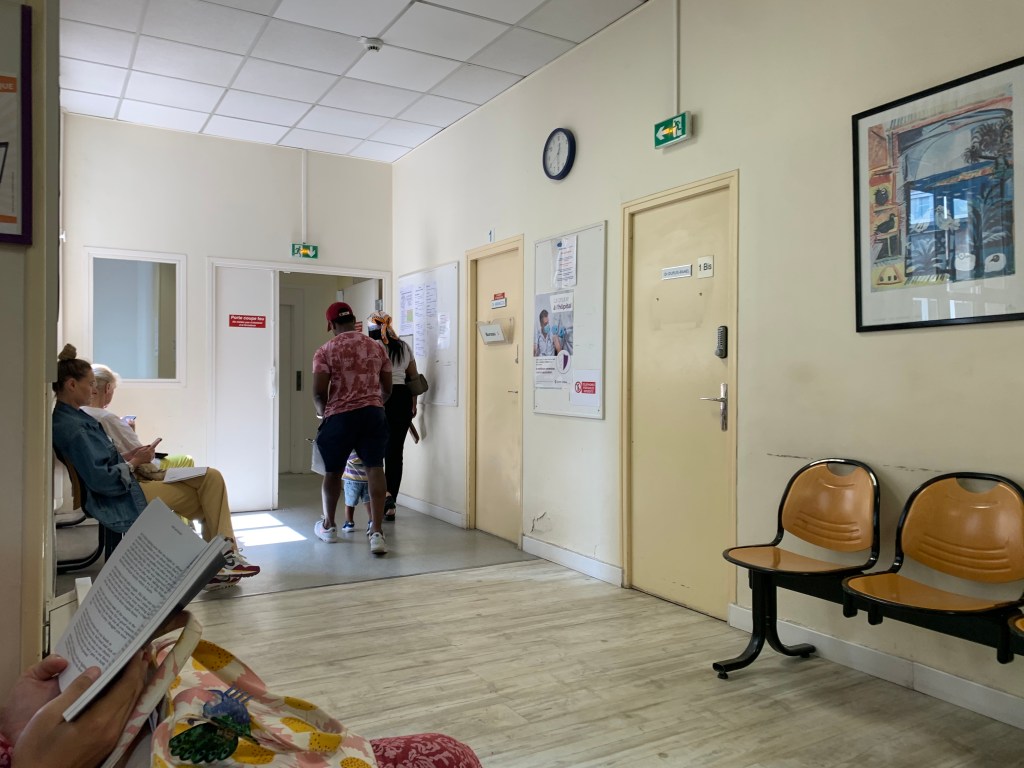
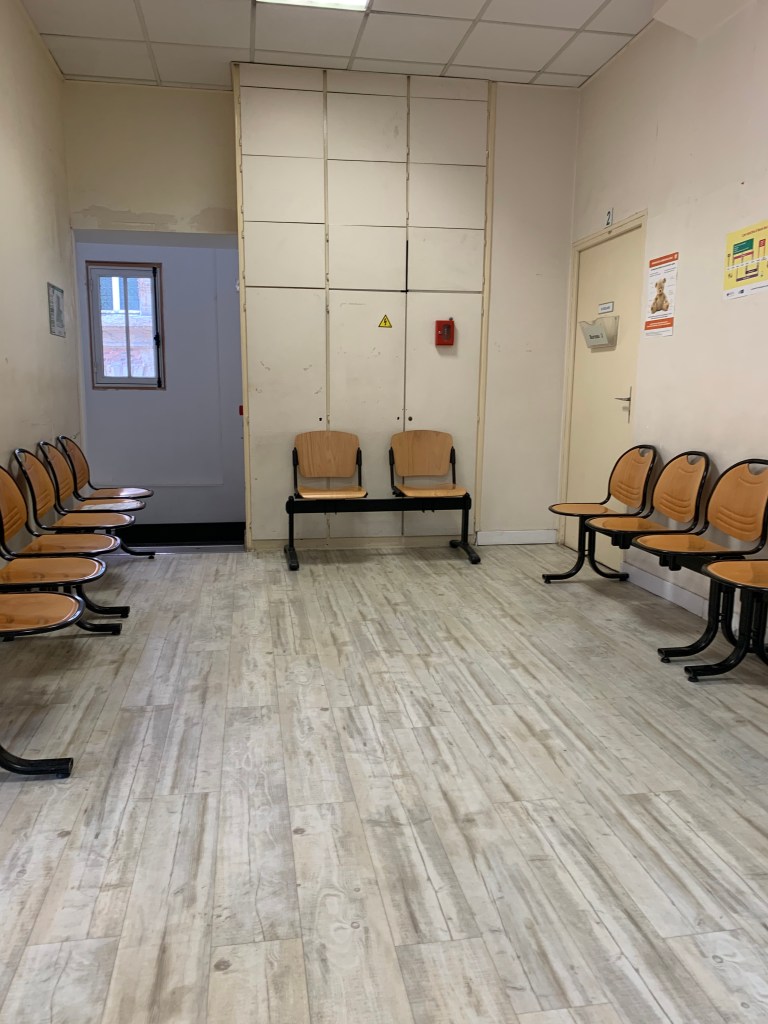
The clinic was located in an old building that took up an entire block. The main entrance led into a courtyard, and we followed signs to the clinic entrance on the ground floor. I explained my situation to the woman at the desk and she directed us to the elevator. “My colleague on the 1st floor can help you.” When we got out of the elevator, the stark and somewhat grungy room was lined with worn plastic chairs. An L-shaped counter had four numbered windows. There was a machine, like the ones at the DMV, where you select what you are there for, then take a ticket and wait to be called to a window. Since I didn’t know which ticket to take, I didn’t know where to go. Santo said to just ask one of the women.
I waited for one of the windows to be free, then asked the woman there if she spoke English. “A little,” she said. “Do you have an appointment?” I explained my situation again.
“So you would like to see a doctor?”
“Oui,” I said. “Is that possible?”
“We only have two general doctors. You will have to wait.”
“How long is the wait?”
“At least two hours.”
That’s when I broke down. I know now that two hours really is not at all an unreasonable amount of time to get emergency medical care, but hearing this released the tears that had been held back by the last shred of hope I had been clinging to. If the waiting area had been air-conditioned and comfortable, I knew I could do it. But sitting in this steamy room for two hours, at that moment, seemed unimaginable. I sat in a chair against the wall, Santo next to me, defeated.
The woman I had spoken with got up after a few minutes and went to one of the doctor’s offices. When she came back, she called me up and asked me for my passport. After taking my information, and a 25 Euro payment, she said that the doctor behind door number one (was this Let’s Make a Deal?) would be able to see me and I should wait for her to call me. I didn’t know if she had pleaded my case and I would be seen sooner, or if I would be waiting for hours, but waiting seemed the only thing to do in any case.
Less than twenty minutes later, a lovely middle-aged doctor in a white coat called me into her office (behind Door Number 1!), which was also the examining room.
“You need English, yes?” she asked.
“I do,” I answered. “I’m so sorry I don’t speak French. I am so grateful.”
Her English was halting, but competent. She listened to my lungs, but did no further examination, just questions about my symptoms, how long, etc. “We will take care of this,” she assured me. “I will give you everything you need.” She had smiling eyes, and was very sympathetic and patient. My angel of the day!
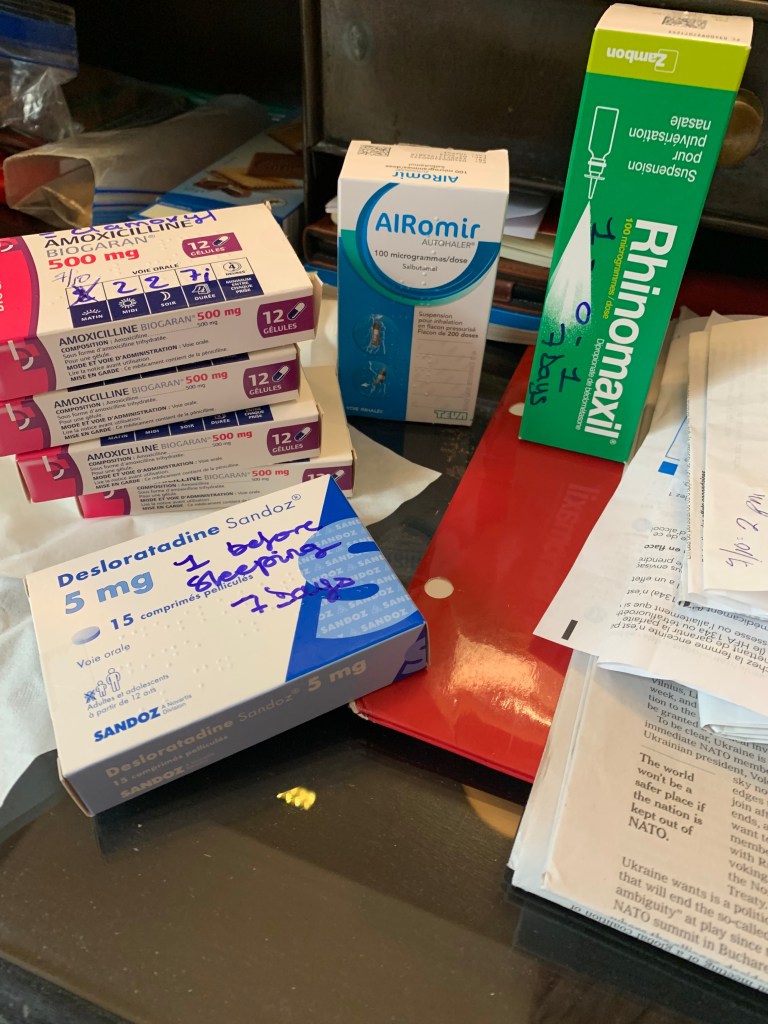
She prescribed an antibiotic (laughing out loud when I told her how we pronounce the word), an inhaler, nasal spray, and decongestant. “In two days,” she said, holding up two fingers, “you will begin to feel better.” I thanked her profusely, prescriptions in hand. We made the short walk to the pharmacy where the pharmacist filled the prescriptions on the spot, making sure I understood the dosing instructions.
Back in the hotel room, I took my medicine, changed into my nightgown, and crawled into the cool sheets, hopeful that I might actually be able to sleep. I felt bad for Santo though. He loves Paris and was so looking forward to our time here. “I think I just need to rest for a while,” I said. “Later we can go out to dinner and do the night cruise on the Seine.”
“If we do, we do,” he said, “If we don’t, that’s OK, too. The important thing is for you to get better.”
“But I feel bad,” I said, breaking into tears again.
“There is no need to feel bad. I feel bad that you’re sick.”
“You go and enjoy the day,” I told him. “Get yourself some lunch, visit a museum, whatever you want.”
Even with the medicine, I still could not sleep in bed, so decided to sit up and do some writing. About an hour later, Santo texted me that he was having lunch at a sidewalk café and sent pictures of his choices. I was so glad he was enjoying a good meal and being out and about in Paris. In another hour, I was getting really weary and decided to try to sleep again. Just as I was getting into bed, Santo came back. He would rest in our solarium while I tried to sleep and heal. He had purchased tickets for the night cruise from the hotel that could be used any time. He had also brought back bread and cheese, so we could stay in for dinner, then enjoy the cruise.
I finally was able to get some sleep. When I woke up, Santo was writing at the small table in the solarium. He smiled, “You finally got some sleep!”
“Yes, thank God,” I said. “I’ll freshen up in a few minutes.”
“You’re not going anywhere tonight. You need to keep resting. We can do the cruise tomorrow night if you’re up for it. The most important thing is for you to get better.”
As much as I hated to spoil the evening for Santo, I was very relieved not to have to get up and out. We enjoyed our French picnic (we were getting very good at these European picnics), I took my medicines, Santo sipped wine from the bottle he had purchased, and we enjoyed Paris as best we could.
Our final breakfast on the terrace at Schloss Berge with our favorite waitress. She was so excited for us that we were going to Paris, almost swooning when I told that was where we were headed. I put my hand on my heart and said, “Wir bringen Sie mit.” (We’re bringing you with us.) She clasped her hands under her chin, smiling and making a tiny bow. There were promises about “nächstes Mal” (next time) and seeing one another again. It didn’t matter that we knew that were not true; it was the heart’s desire that mattered.
The cab we had ordered the night before arrived early and we were on our way to the Oberhausen train station before 8 am. The day promised to be even warmer than the one before. This cab, finally, was air-conditioned, so I had hopes for a more comfortable day.
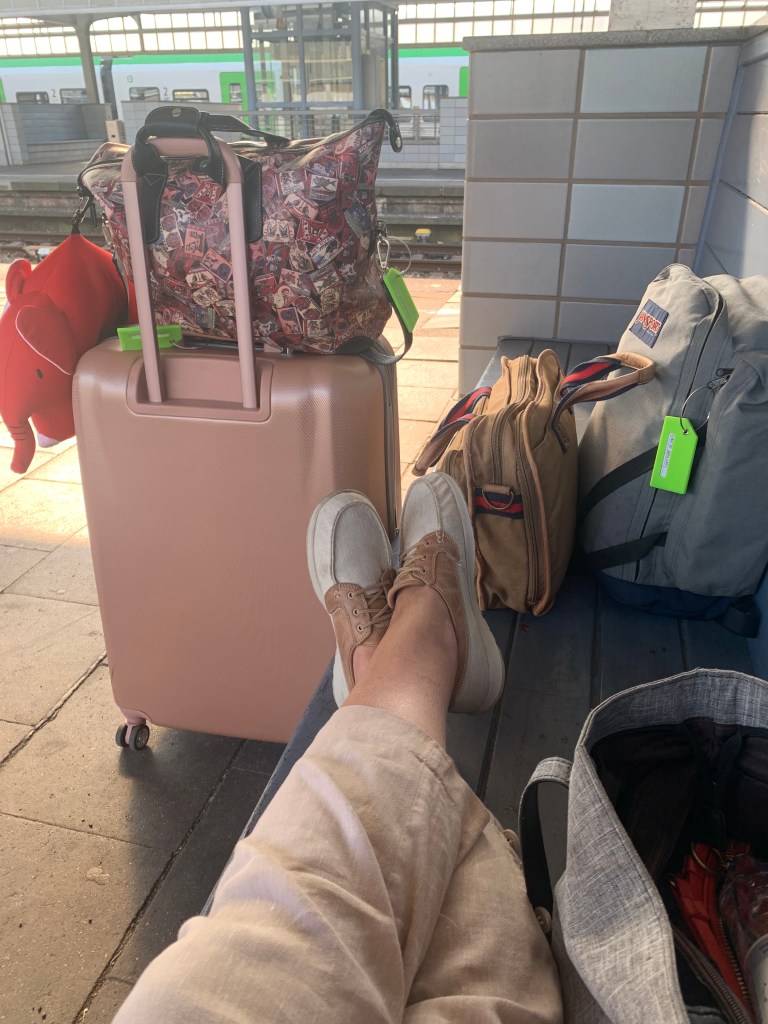
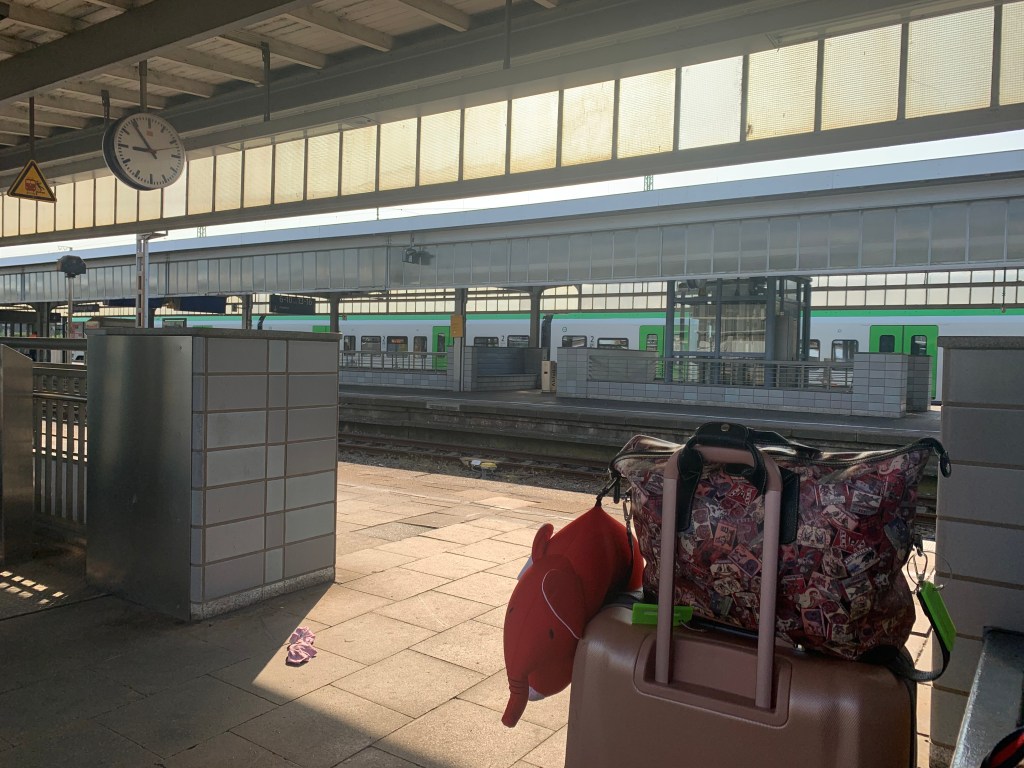
About 15 minutes and 80 Euros later (cabs in Germany charge extra for trips on the Autobahn), we were at the station and on our platform 1 hour and 45 minutes before our train. The desk clerk at Schloss Berge had suggested leaving at 8 am, so we had agreed, even though I thought it was awfully early. We found a long bench in the shade, settled our bags around us, and waited. We strategized about the best way to get all six bags onto the train: Santo would board first with his two small bags, I would move the larger bags to him and help him left them up and into the train, then I would board with my two small bags.
When I checked the electronic sign on our platform, I noticed Wagen (car) numbers for our train and letters which corresponded to large letter signs along the platform: A, B, C, D, E. We checked our tickets and realized for the first time that we had assigned seats. We were in Wagen 37, Seats 93 and 95, and should stand at letter E. This was at the far end of the platform, so a few minutes before the train was scheduled to arrive, we made our way there. When the train got there, we did not see any Wagen numbers, but I did notice on the car that pulled up in front of us the Seat Numbers 59 to 99. “This must be us,” I said to Santo. Luckily, I knew to press the button to open the doors. We knew the train would not stop long, so in the rush our well-laid plans went awry and we scurried to get everything up the steps and into the car. Somehow we did it!
Our seats were in the first compartment on the right. There were 5 seats, and 3 young men seated there. One was sleeping, but the other two were quick to help us with the heavy luggage. He managed to lift Santo’s garment bag, along with our hand luggage, up to the overhead rack. The largest suitcase we were able to place against the wall just outside the door and out of the way of the aisle. The young men moved so we could have our assigned seats: one by the window and the one next to that. They spoke perfect English and after thanking them profusely, we chatted for a bit. They asked if we had children, and I told them a son who was 30 and a daughter who was 26. “Those are exactly our ages!” one of them said.
The car was not as cool as I would have liked, but manageable. I was very tired, but was not able to sleep. This leg of the trip was only 2 hours anyway.
Changing trains in Frankfurt, we again strategized about the luggage. Several people were in the vestibule waiting with us and everyone offered to help. People are so nice. When the doors opened, before I knew it a tall black man lifted my suitcase and handed it down to Santo. Just like that we were on the platform. Our next train was two tracks away. We just needed to go to the end of our platform and over two tracks—all on the level.
The Frankfurt train station is large and open, so the warm air that clung to us from Gelsenkirchen continued to smother us. We found seats at a tall table, mostly for a place to drop our luggage while we waited. Santo went in search of food. I was too hot to eat. The train was at the platform early, so we made our way down to our assigned car number. We were lucky that just inside the doors was an area for large luggage and we were able to store both of our large bags as well as our carry-on luggage. We had two forward facing seats with plenty of legroom. Everyone else on the train, including Santo, seemed comfortable but I was still dripping with sweat. I felt like I had been waiting to get SOMEWHERE cool forever. Would it ever happen? My hopes were on Paris.
Our high-speed train traveled at over 300 kmh (that’s 186 mph) and got us to Paris in four hours. Since Paris was the last stop, we waited to get up and retrieve our luggage. Again, people around us were helpful and we were on the platform and on our way in no time. Cabs were waiting just outside the station. Next stop: Hotel de l’Abbye in St. Germain, our splurge accommodation.
Driving through Paris on our way to the hotel we were again overcome with the sheer beauty of this city. It is without equal. Street after street of light-colored buildings with wrought-iron French balconies, and enormous double doors painted in rich gem tones (deep greens, reds, and blues) that gave entrée to the inner courtyards. Sidewalk cafes dotted every block: beige-and-brown patterned chairs with bentwood backs and small round tables that seem to expand to accommodate whatever was ordered. All under the shade of striped awnings.
The hotel was on a narrow street. Gates opened to a courtyard with iron two tables and a red carpet leading to the double glass doors. At last!
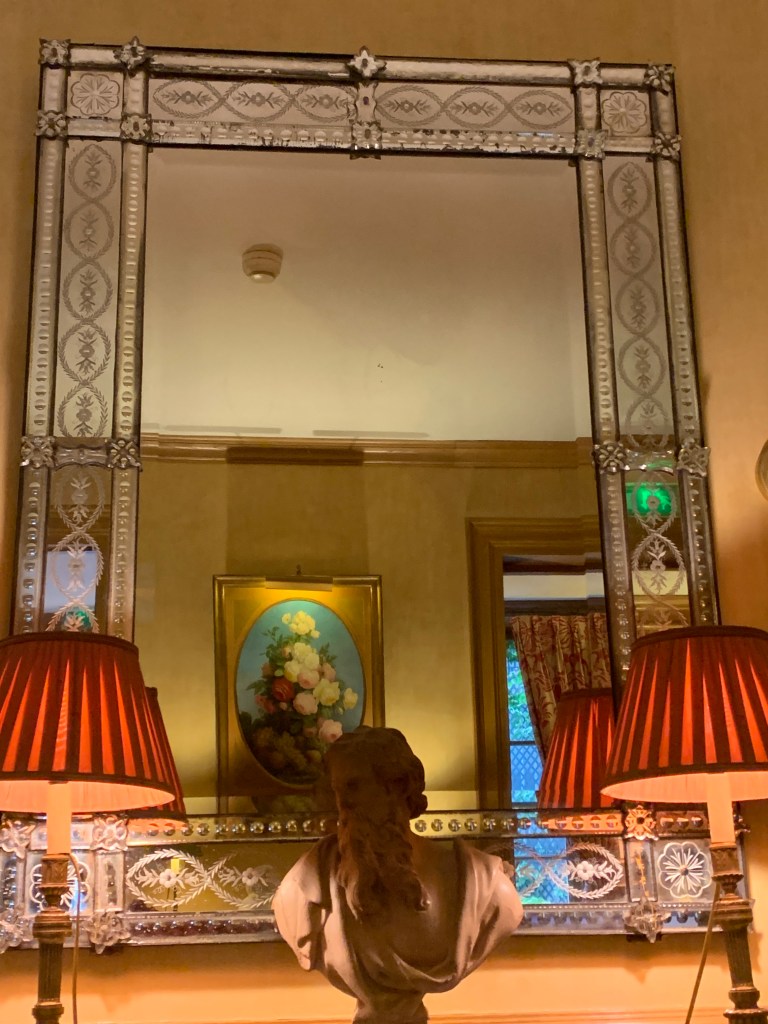
Inside, everything was warm, welcoming, and elegant, including the staff. Several small “living rooms” made up the lobby, each with an intimate seating area of sofas and chairs, wall sconces, small lamps with striped shades on marble-topped tables, and café or coffee tables. The walls were of pale cherry wood, outlined with simple and elegant moldings. Original paintings with lighted frames lined the walls. Deep burgundy and gold carpeting tied all the rooms together and added to the overall feeling of ease and comfort.
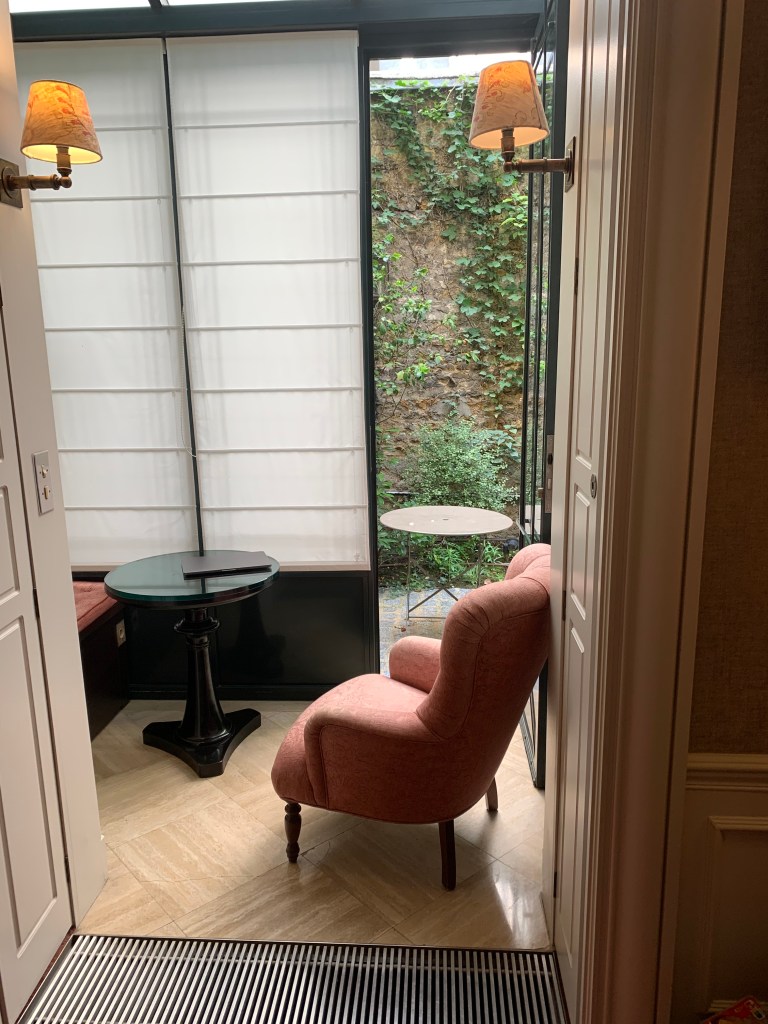
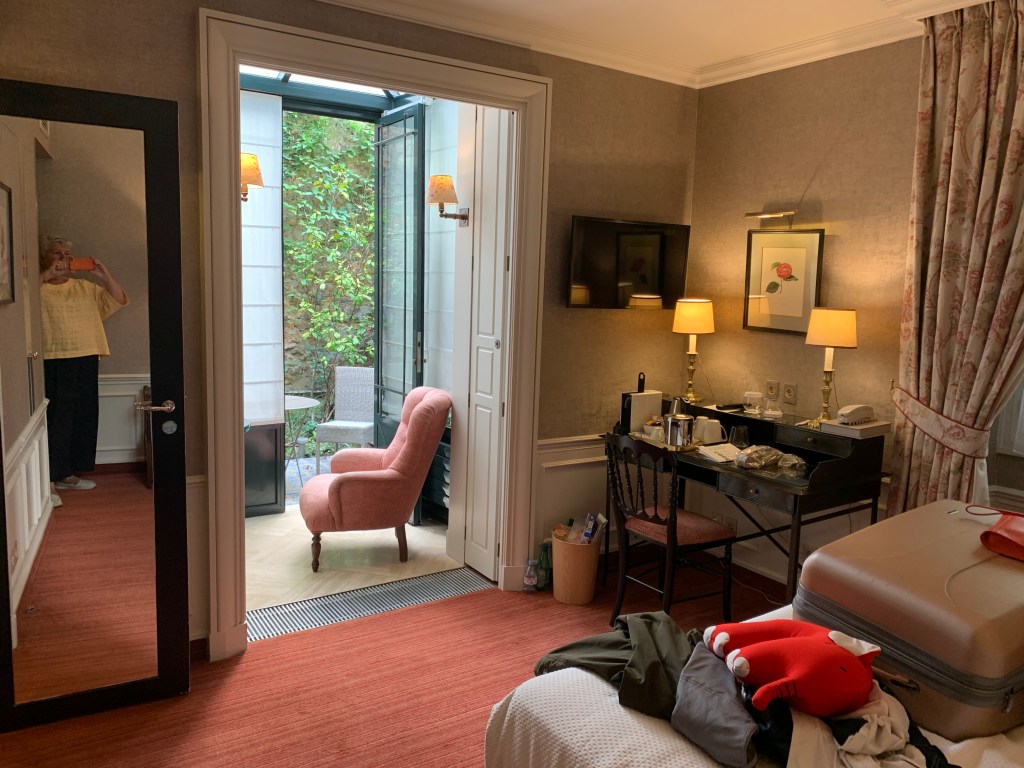
The desk clerk and another man helped us get our bags to the room, a first floor chambre that opened onto the interior courtyard. The room had the same genteel tone as the lobby areas. It was not as large as we had expected, but it had a solarium that opened directly onto the courtyard furnished with a cushioned wall seat, a small table, and a comfy chair. And, blessedly, the room was air-conditioned! “Not as cool as you have in America,” the clerk said, and then showed us how to turn it to the coolest setting. As soon as he left, I collapsed onto the bed’s cool pillows. I had been waiting so long for this moment!
We decided to eat at the courtyard café of the hotel; I could not think of leaving this comfort until at least the morning. The café served light fare, which suited us perfectly. Santo wanted to eat right away, but I needed a shower and change before I would be ready to face the world. The walk-in marble shower was marvelous. Even though I had trouble understanding the complicated instructions for operating the rain head, hand held, and side jets, I managed to get the cool water I needed to come out of the hand held and doused myself, washing away the sweat, exhaustion, and frustration of the last few days. Unfortunately, I was not able to wash away the bronchitis that had been plaguing me, but I did feel better.
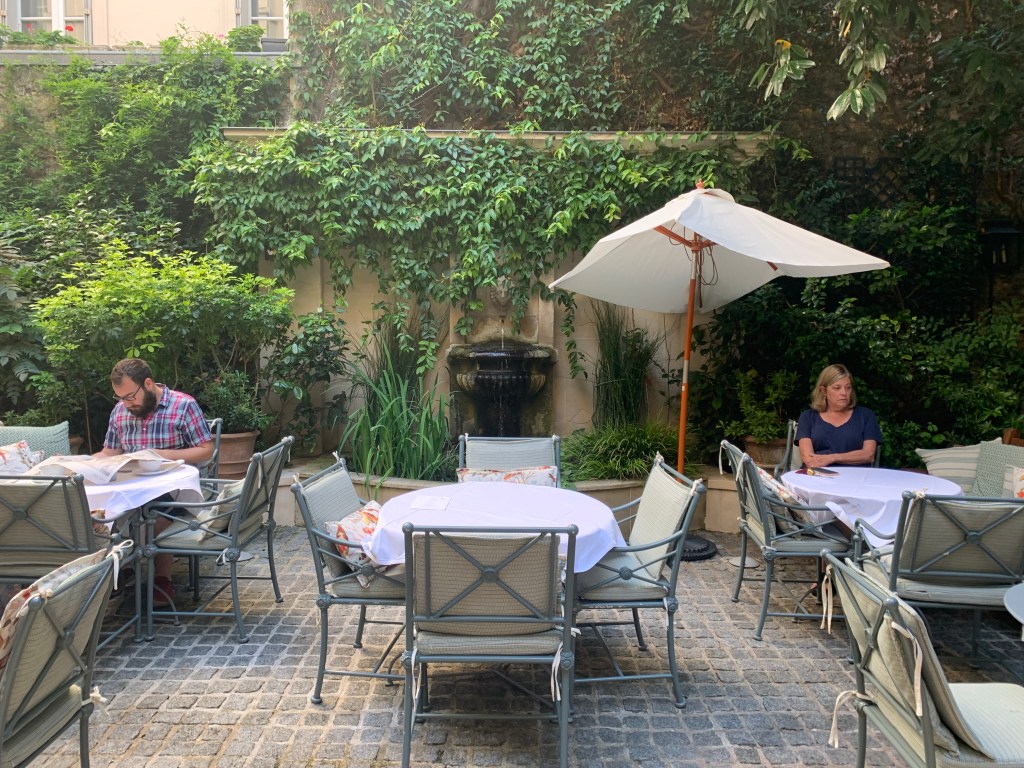
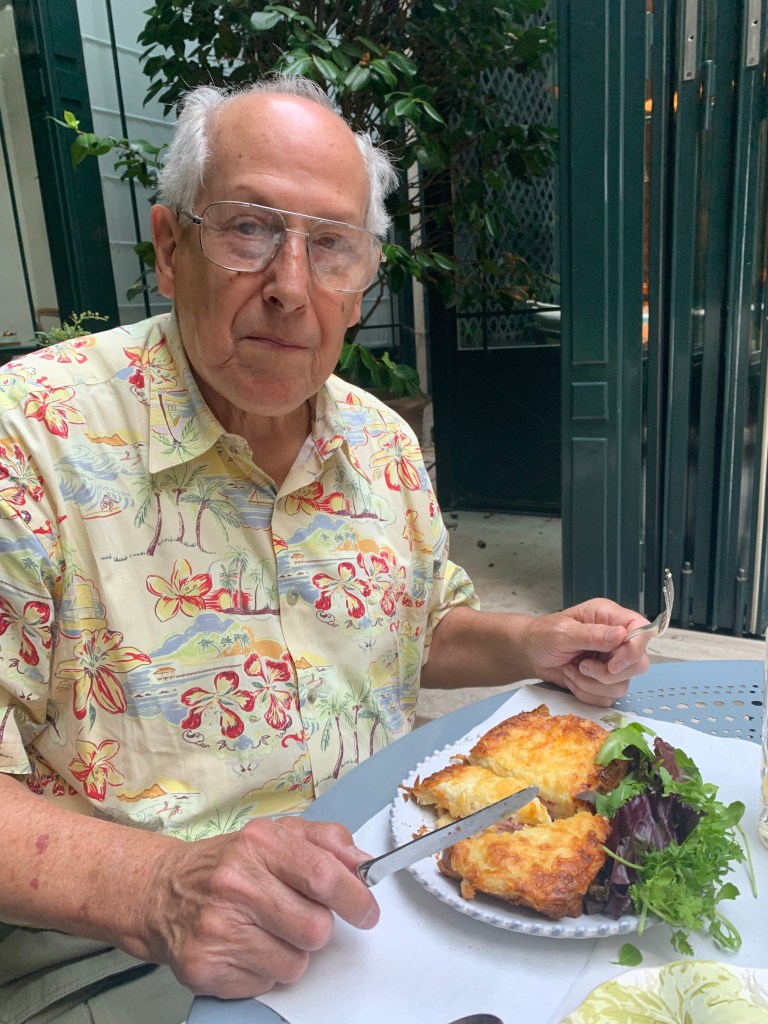
The courtyard was lovely, enclosed by the creamy walls of the building and overflowing with lush greenery. Water flowed gently from a tarnished bronze fountain mounted against the back wall. Seven or eight tables filled the space, some for two, some for four, each with cushioned chairs in shades of cream and blue. Santo ordered the Croque Monsieur, I had the gazpacho and avocado toast. The large white bowl of gazpacho looked like more than I could handle, but the saltiness of the tomato and vegetable puree was just the thing for my throat and I was more than happy to finish it.
Getting back to the crisp white sheets of our air-conditioned room, still fresh from my shower, I could hardly wait to fall into bed. The sensation of the first few minutes was pure delight. But I could not lay down for more than a few minutes before my hacking cough returned. The force of my exertions caused so much pressure in my skull that I thought my head would explode. Luckily, I still had the Ricola lozenges we had gotten in Rotheburg, but I had to have one in my mouth every minute, and even then the cough would break through. I barely slept. If I propped myself up on pillows, I could keep the cough at bay, but I could not sleep. If I lay down, the cough kept me awake. I was still very grateful to finally be cool, but I knew I had to do something about this sickness. It had just been too long and I was not getting better. And now my coughing was keeping Santo up, too.
Day 13. This is the day the trip went south. And I’m not talking geography here.
Started off OK but not great. It was hot in our un-air-conditioned third floor apartment, my sore throat and cough were not getting any better, and an even hotter day was in store.
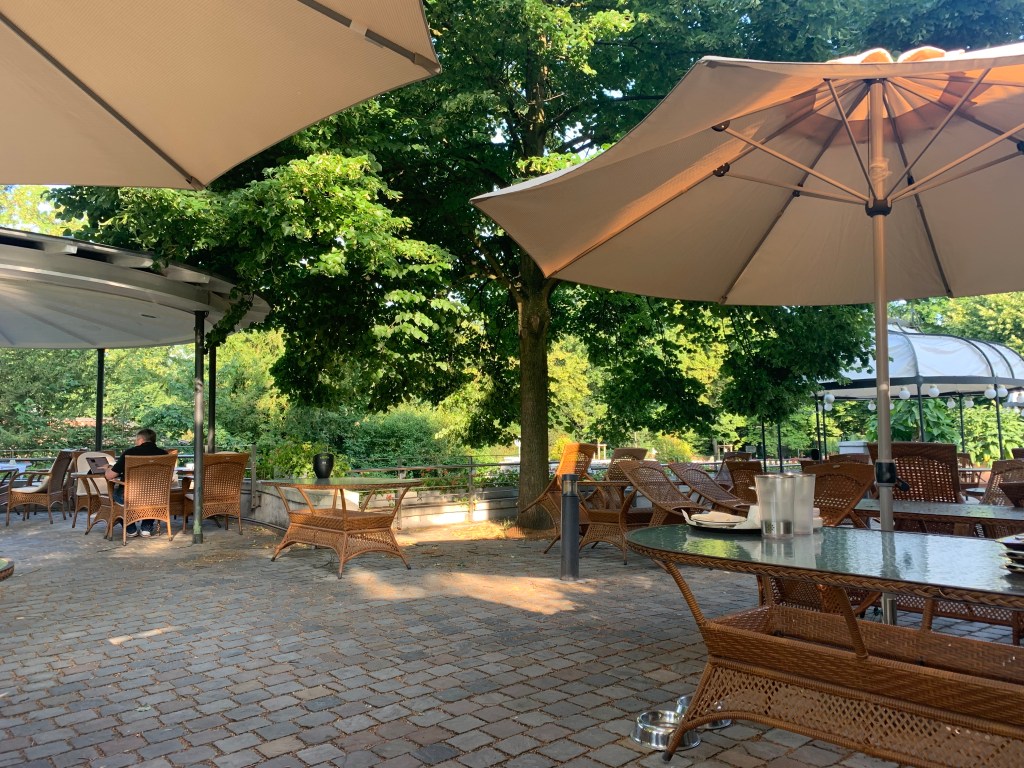
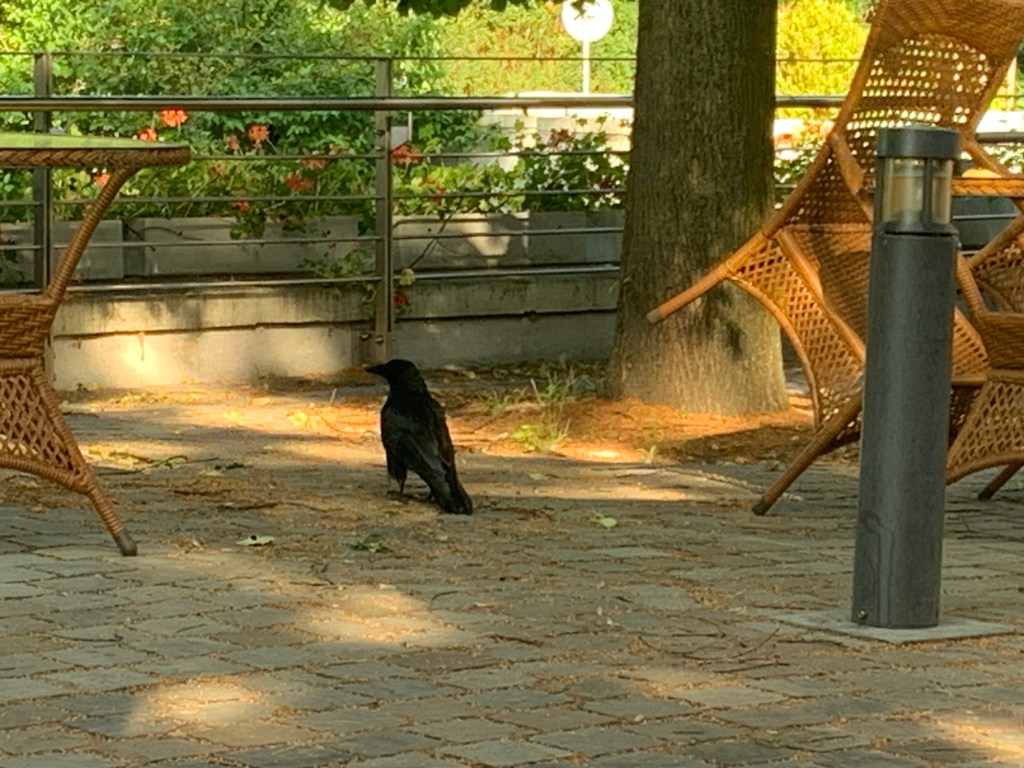
Breakfast was the usual delight, this morning served outside on the terrace, again with a delightful waitress. She truly could have served us anything and it would have been wonderful—her gracious hospitality was that enchanting. We even had another bird keeping a watchful eye on us–and our food!
After breakfast, we lingered in the shade for a bit, then made the short walk to the car to bring in all of our bags so we could re-pack everything in the room in preparation for the next leg of the trip. Thus far, our two large suitcases had never been out of the car. Our goal now was to make all the hand carry items as heavy as possible so the biggest suitcase would be easier to handle getting on and off of trains the next day.
After that chore, and a bit of writing and relaxing in the room, including another now-familiar picnic lunch, we headed to the car, heavy suitcases in tow, for the last day of visiting family sights. Our destination was Oberhausen, a larger city about a half hour away. It is the city where Oma and Opa were married. The address I had there was for the last place Oma had lived before coming to America.
Our first stop would be the Avis location where we were to drop off the car in the morning. We wanted to confirm how long it would take and make sure we knew the way. When we got to the location the GPS told us was the place, we didn’t see any Avis sign. There was a car dealership and a small repair shop in a large, asphalt parking area. We pulled in. A man was coming out of the repair shop. He looked like he was locking up. I stopped him to ask about Avis. He didn’t seem to know anything about it. I explained more, and nope, there was no Avis, no car rental place here. “Perhaps my colleague knows more,” he said, leading me towards the car dealership and calling out to someone. Another gentleman came out and I explained again. He, too, had never heard of an Avis location here. He asked if I had the address, so I got my phone and looked it up. 13-15 Wehrstrasse. “That is not here,” he said. “That is about 5 km away. Do you have GPS?” “Yes,” I answered. He wanted to wait for me to enter the address in our GPS to be sure we would be able to get there. They were both so sweet, so concerned for us, and so determined to help.
“Where are you from?” they asked. “America. New York. But not the city,” I said. “I am from Lebanon,” one man said, “and he is from Turkey.” “Wir sind alle Ausländer!” (We are all foreigners!) I said, and they both smiled.
The day was exceedingly hot and even being out of the car for that short time had me drenched in sweat. Was it a fever or just the heat?
We made our way to the new address and YES, there was an Avis there! We cheered at the red and white sign. Then we drove up. It was closed. We looked at the door. It closed at noon on Saturday (today) and was not open at all on Sunday. From the beginning, the plan had always been to drop off the car in Oberhausen on Sunday morning. No one from Avis ever told us the location would not be open. We had bought our tickets for the train to Paris from Oberhausen Hauptbahnhof (main train station) specifically because Oberhausen was the Avis drop-off location. We didn’t see any drop-box for keys or any sign saying what to do when the location was closed.
What to do now?
I hadn’t brought any of my paperwork with me, so we were anxious to get back to the hotel where I would have all of that plus Wifi. But since we were already in Oberhausen, it made sense to stop by Oma’s address first.
My mind was swimming with possible solutions: maybe we could change our train, drive the car to closer to Paris and take a train from there. Or find an Avis location that was open on Sunday and was close to a train station. Maybe an airport location would be our only choice. But how would that work with the train situation?
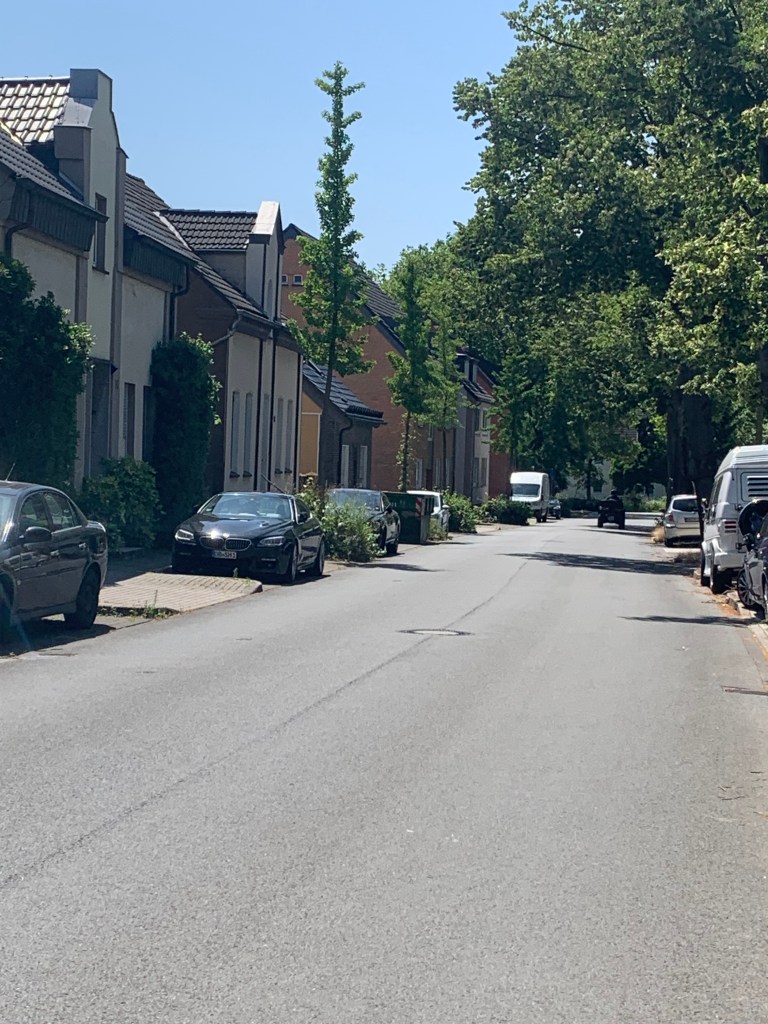
When we got to Michelstrasse 14, it was hard for me to focus on where we were. The building at number 14 was very new—a plain brick house that had a very stark appearance. It was a free-standing house, like most of the houses on this street, unlike the attached apartment buildings we had seen in Gelsenkirchen. Who knows what this street looked like in 1923 when Oma left? Even the trees which lined both sides of the street looked too young to have been here then. I had the strange feeling that Oma was never meant to have been here, at least not to have stayed here. Another life was already awaiting her.
Back at Schloss Berge, our room was even hotter than we remembered, our frustration not helping to cool us off any. I checked the train tickets (not refundable or changeable). Santo found the Avis location at the Düsseldorf Airport that was open today and would be open at 7 am tomorrow. But Düsseldorf was 40 minutes away from Gelsenkirchen and 20 minutes from Obehausen. We could drop the car in the moring and get a taxi to Oberhausen to make our 10 am train. But Santo really wanted to get the car returned today and be done with it. He did not want any hassles in the morning that would mess up our getting to Paris.
We tried to call Avis and spent nearly an hour on the line with someone who told us that the Rental Agreement Number we had was wrong, even though it was on the contract printed out at the Avis in Naples. Then he asked for the number on our car keys, and said that was wrong too. How could that be? We had the keys in our hands, and we had been driving this car for ten days. The agent was trying to find out if it would cost us more to return the car to Düsseldorf since this was not our original drop-off location, but was unable to get the information because of the “wrong” numbers. In the end, he gave us a number to call Customer Service. “I thought this WAS Customer Service,” I said. “No,” this is the reservation line.” “So we have to start all over with Customer Service?” “Yes.”
This time I let Santo make the call. All the phone options were the same as for the last call. When we got to a person, we asked if it was Customer Service and they said, no, it was the reservation line. “You need to call Customer Service.” THAT’S WHAT WE JUST DID!!!!! Santo explained our situation as briefly as possible and said: “Can you PLEASE connect me to someone in Customer Service who can help with this?” Finally we got a person on the phone who seemed to understand what we were saying. She had no problem finding up our Rental Agreement Number. She put us on hold to look into it … THEN THE CALL DROPPED!!!! “Let’s just take the car to Düsseldorf now and be done with it. Then we can relax in the morning,” Santo said. Seemed like a good idea, even though I was so hot and sick I could hardly imagine making our way back from Düsseldorf by train and then taxi.
First we had to schlep our heavy bags that we had just schlepped TO the car BACK up to the room so we could return the car. By the time I did the circuit — to the car, to the hotel, back to the car – I thought I would melt.
The drive to Düsseldorf was not too bad, and after one mistake finding the car rental return area, we got the car to the right place. We were told just to leave the keys in the car and go. So we did. If Avis ever tried to charge us more or gave us a problem, we would have it out with them later. Then we walked to the terminal to find out how to get a train back to Gelsenkirchen. The air seemed even heavier, even hotter, if that was possible. The Weather Channel told us it was 94 degrees Fahrenheit.
Luckily, a train was leaving in 10 minutes so we quickly bought tickets and made our way to the train station via the airport tram—NOT AIR CONDITIONED. Made our connection to the train. Santo thought it was air-conditioned but I didn’t feel it. I was dying. Coughing. Hot. Headache from coughing. Tired from not sleeping. And I knew I had another un-air-conditioned night ahead of me.
We got to the Gelsenkirchen train station and found a cab to take us to Schloss Berge. Should I have been surprised that it had no more air conditioning than on the train?
When we got back to our room, I went straight to the bathroom and starting filling up the tub with cold water. I didn’t think there was any other way I could get my body cooled down. We decided to have dinner at the hotel restaurant under the trees on the terrace and hope for the best. At least we would be served. The bath helped, at least enough for me to get dressed and down to dinner. Thank God, we had our wonderful waitress from the morning. She truly made the unbearable bearable. We found light meals to order: chicken in orange sauce with basmati rice for Santo and a wonderful grilled trout amandine for me with boiled potatoes that had just a hint of butter and parsley. We asked for ice and water—and to keep them coming—and made it through the meal feeling a bit more relaxed. At least our car worries were over.
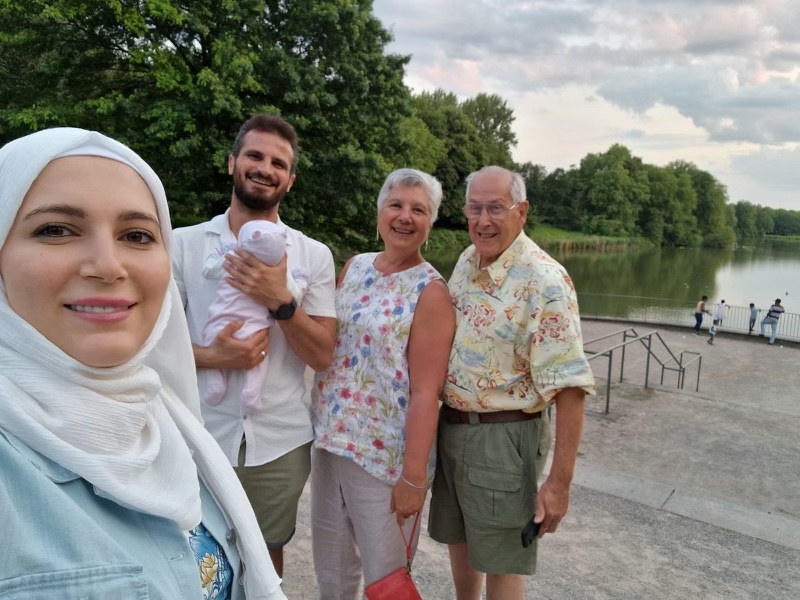
We even had enough energy after dinner for the short walk to Lake Berge. Dusk was beginning to settle on the lake, muting the heat of the day’s sun ever so slightly. A young couple were walking with a baby in a carriage as we neared the lake. I couldn’t resist looking in at the baby. Think dark hair framed her delicate sleeping face. “Jemand ist mude” (Someone is tired), I commented to the couple and they smile. We continued to the semicircular patio overlooking the lake and watched the large carp and ducks swimming leisurely below as pinks began to overtake the sky. It had been a tough day, but we were feeling blessed.
Heading back up to the hotel, the same couple stopped us, wanting to show us something. They had taken pictures of us looking out over the lake. They were just beautiful. “Could you send us a copy?” I asked in German. “I can give you my phone number to text them.” “Do you have WhatsApp?” the woman asked. It took us several minutes to figure out how to get Santo’s WhatsApp number to her so she could send the photos. Meanwhile, we talked. They were from Syria and lived in a town just a few minutes away. Their little girl was named Rita. “A German name,” the father said. We told them about our journey and my connection to Gelsenkirchen. Rita started to fuss while all this was going on, so the dad picked her up and held her. Santo and Rawun, the mother, finally figured out the technology. They wanted to take another close-up picture of us, and we wanted pictures of them. Rawun even managed to take a selfie of all of us.
We come from here. We travel to there. We change our lives and start new ones. Everywhere we go there are strangers–and friends.

























 Rambling Rose